Category Archives: Australia

My life in Australia

Loy Krathong in Parramatta

Sydney is so multicultural that every weekend there is some traditional celebration going on in different parks across the city. Two weeks ago we went to Parramasala and last weekend we were able to attend another amazing cultural event called Loy Krathong.

Loy Krathong takes place on the evening of the full moon of the 12th month in the traditional Thai lunar calendar. It is also called Thailand’s “festival of lights” and it is the time of year when the waters around the country come alive with candlelight and look not unlike a massive fairy ballrooms.

The history behind the festival is complex, and Thais celebrate for many reasons.  The main rice harvest season has ended and it’s time to thank the Water Goddess for a year’s worth of her abundant supply, as well as an apology for polluting the waters. Some believe that this is the time to symbolically ‘float away’ all the anger and grudges you have been holding onto, and including a fingernail or a lock of hair is seen as a way of letting go of the dark side of yourself, to start anew free of negative feelings. If your candle stays alight until your Krathong disappears out of sight, it means a year of good luck.

To celebrate this occasion, Sydney’s largest water festival, the Loy Krathong Festival, was held in Parramatta at the banks of the river by the same name. The festival attracted more than 12,000 people from Parramatta, Greater Western Sydney and Asian communities from all around Sydney.

The festival started at 5pm but we were there by 7 pm. By then, there were lots of people on both sides of the river.

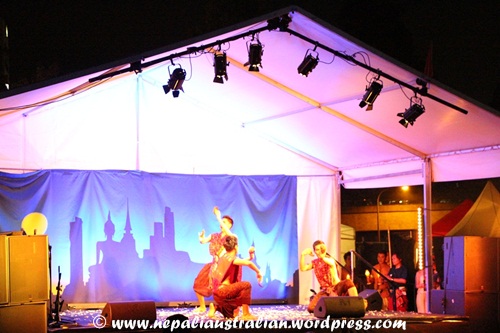
We started our journey from the main stage where there was some dancing going on. We watched a few shows and then started to look around to find out what else was going on.

I was really drawn to the crowd where there were tables and chairs set up to make your own Krathong that you could put in the river later in the night.

There is no equivalent word in English for ‘krathong’. You may hear people referring to it as a small boat, vessel, receptacle or container. In the run up to the festival, many shops and market stalls will display ready-made Krathongs, or in parts so you can assemble and decorate as you wish. In the past, krathongs were made from natural materials – usually a section from a banana tree trunk, crafted into a lotus shape by using folded banana leaves, and these can still be found for sale around the main festival sites. More recently, Thais have become more creative in their craft and design the krathongs from coconut shells, flowers, baked bread, potato slices, some breaking with the conventional lotus leaf shape in favour of turtles and other sea creatures.

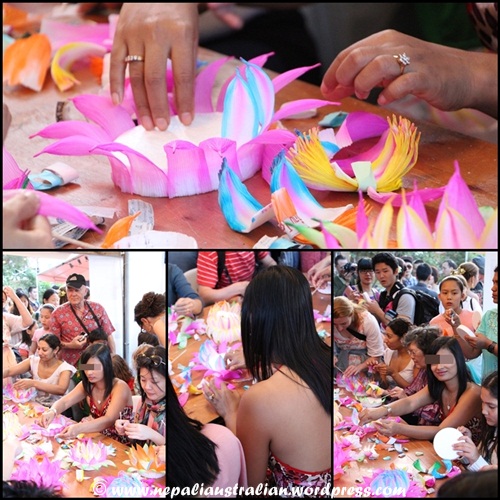
It was really fascinating to see kids and adults trying to make the Krathong. I joined the crowd and here are some of my photos AS took during the process. I really didn’t know what to do but I was happy to watch people and learn. It was fun and it took around 10 minutes to finish it.
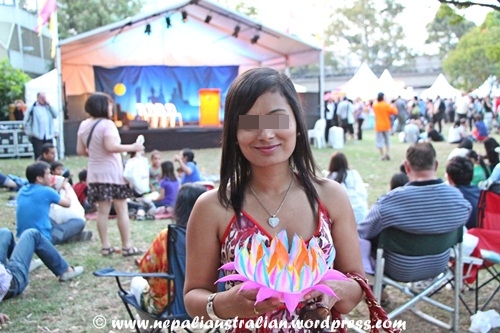
I guess at the end it turned out great. What do you think? 🙂

From there we looked at the stalls and check out lots of traditional jewellery making, umbrella making, the art of painting umbrellas and masks, weaving, making a lotus lantern, as well as other stuffs where there were beautiful ladies in traditional dresses explaining what they were doing.
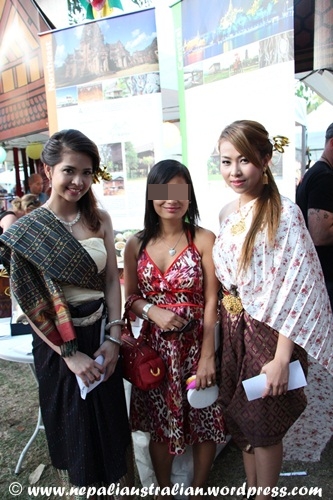
Then we moved on to the food stalls where there was a long queue. We did manage to get some curry puffs, spring rolls, taro spring rolls as well as duck salad and Thai green curry with rice.

With all this food we took a seat on the grass by the river and enjoyed the food and waited for the launching of Krathongs.
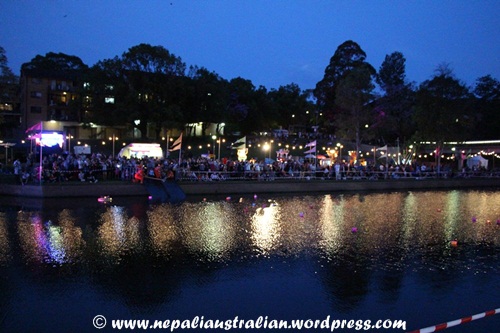
Once the official Krathongs were launched , I joined the queue and put mine into the water as well.

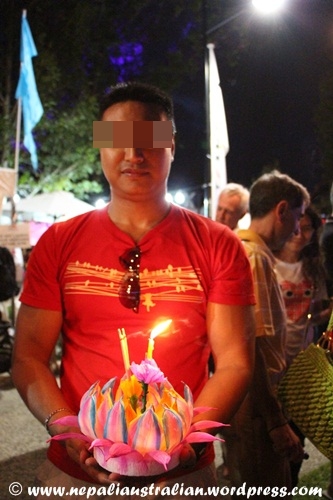
The river looked really beautiful with so many different designs and sizes of Krathongs floating on the water.

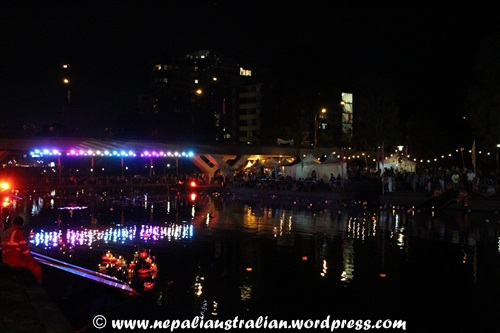
After that we went to the main stage where we watched Golden Lantern Dance, Candle Dance, Fighting Cock Dance as well as a Thai Puppet Show.  All of them were really interesting and fun.

After the show we went and crossed the bridge to go to the other side of the river where they had set up a Thai village as well as amusement rides for children.

At one corner there were fire dancers performing and there was also some free face painting going on. We also heard people singing Loy Karthongs songs in the competition.

Finally we finished the tour of all the stuffs and decided to sit at the top of a slotp on one side of the river and waited for the fireworks to start.

At 9.55, they started the fireworks and it went for more than 5 minutes. It was a really beautiful display. Finally we headed home after a good evening out.

Parramasala 2012

Last weekend we went to the festival in Parramatta called Parramasala.

Parramasala is an international contemporary arts festival that celebrates the global impact of South Asian arts and cultures. The city of Parramatta comes alive with vibrant art and entertainment including music, dance, theatre, comedy, film, markets and visual arts from around the world.

Parramasala is also designed as a destination in the state of New South Wales for tourism and business development. The festival is at the forefront of the promotion of Parramatta as a great city in which to live, work and play.

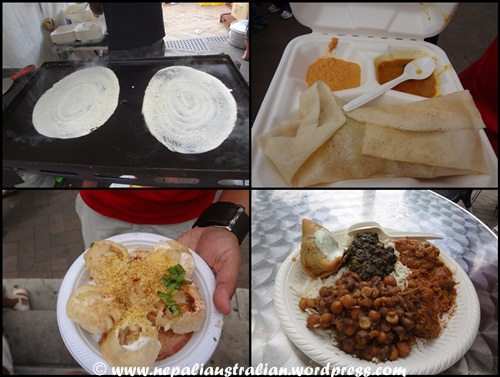
We went there around 2pm and waited for the program to start in main dance area. In the mean time we went and found lunch which included samosa, masala dosa and chicken biryani. I have to say that the food was not tasty as it supposed to be but I guess it is normal in fairs like this.

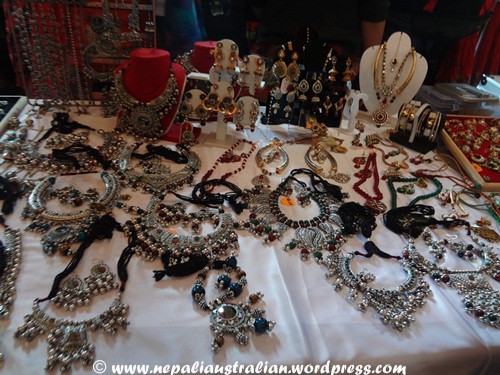
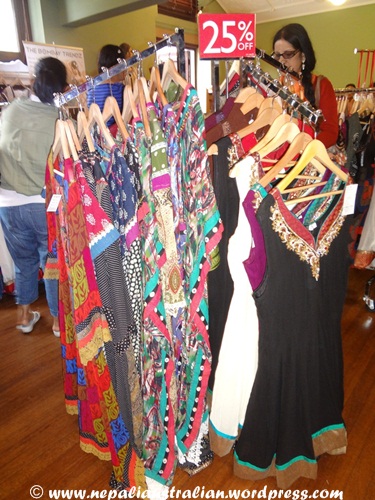
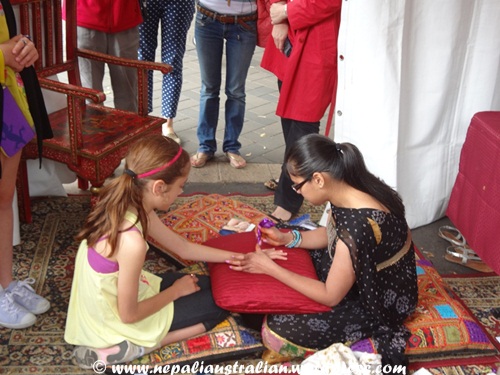
There were lots of stalls setup to sell items like Indian style jeweller, Manchester, Indian outfits, book stalls and henna painting area. I wanted to get a henna but then I was going to have a massage afterwards so didn’t seems like a good idea.

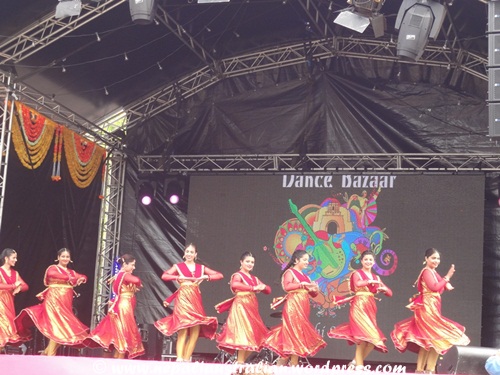
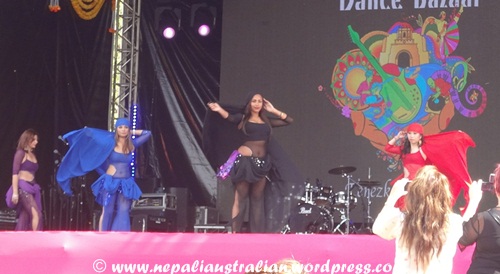
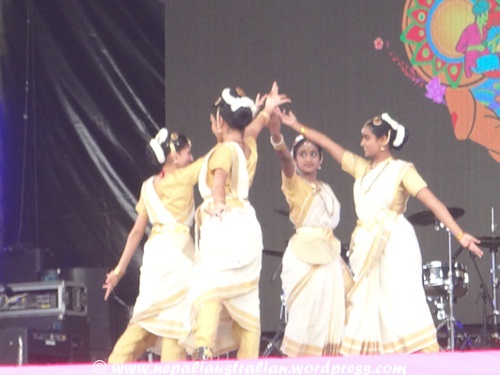
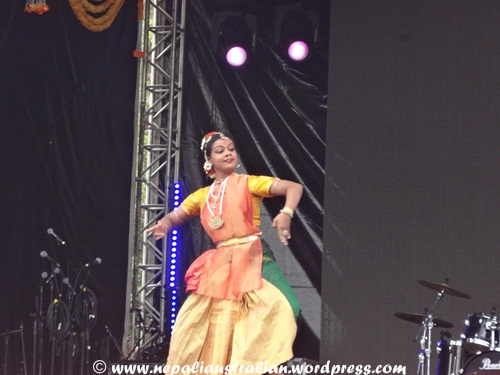
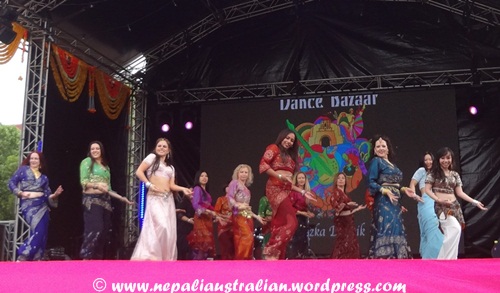
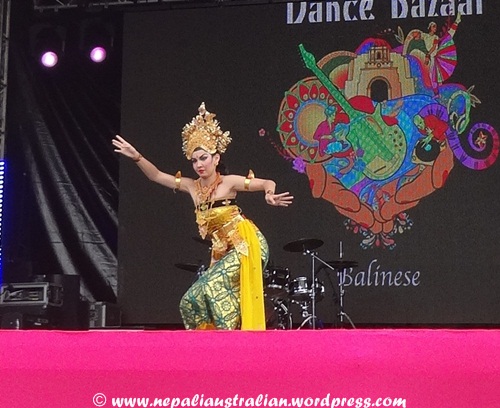
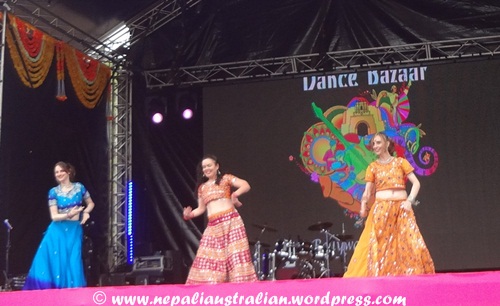
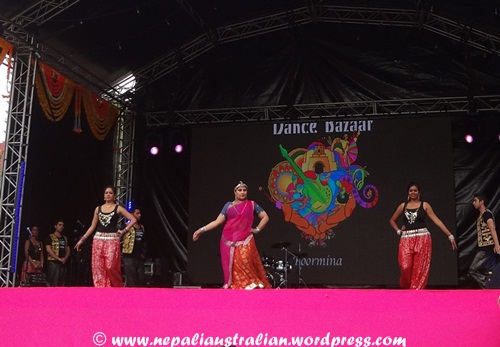
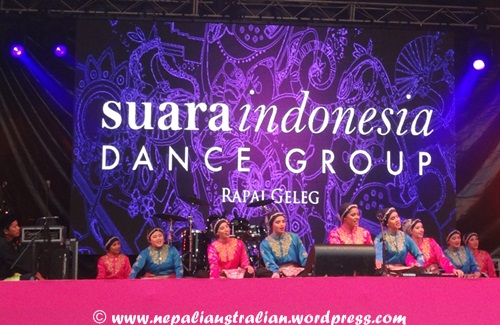
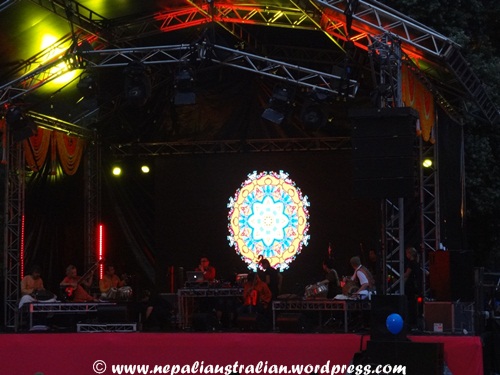
The dances were good with some Bollywood, Indonesia, Indian Classical dance as well as modern dances.  There was some Tablatronics program as well which was interesting.

We had fun.The audience for the festival is all embracing, and attracts a wide a varied audience.

But the day was really cold so we decided to leave at 7.30pm. The show was on till 11pm.

New rules for use of mobile phones while driving on Sydney roads

As I mentioned in my previous post here, I get really annoyed with drivers who are so careless on the road that they are putting themselves and others in danger. It is not fair that someone is careless and they take the life of some innocent road user or make them injured.

It is a common scene on the road to see a driver holding a mobile while driving. If I could issue fines to these people, I could have made lots of money for the government. Even though talking on a mobile phone while driving is not illegal in Australia, holding it is; but drivers hardly care about these rules until they see a cop car.

But things are changing now. They are making these rules very serious. From 1 November 2012, changes to NSW Road Rules have come into effect. These law changes primarily consist of minor amendments, clarifications and tightening of existing road rules.

Motorists will only be allowed to use a mobile phone while driving if the phone is fixed to a secure mounting or can be used without the driver having to touch any part of the phone. Here are the new rules that were effective from last week. Drivers cannot hold a phone in their hand, other than to pass it to a passenger, and can’t rest it on their legs or hold it between their shoulder and ear.

Provided the phone is mounted in a commercially designed and manufactured cradle, fully-licensed drivers can press buttons on the phone for the purpose to make a call, use GPS systems or listen to music.

Texting and emailing while driving, whether the phone is mounted or not, remains illegal.

I am so glad they are taking things seriously and hope this will help save lots of innocent lives on the road.

Rule states from Roads and Maritime Services’s Centre as below

Use of mobile phones

While a vehicle is moving or stationary (but not parked), a driver may only use a mobile phone to make or receive a call or use the audio playing function:

1.         If the mobile phone is secured in a fixed mounting; or

2.         If not in a mounting, use of the mobile phone must not require a driver to touch or manipulate the phone in any way.

All other functions including texting, video messaging, online chatting, reading preview messages and emailing are prohibited.

The new laws make it clear that a driver in a moving or stationary vehicle (unless parked) MUST NOT HOLD a phone in his or her hand other than to pass the phone to a passenger.

Penalty: 3 demerit points (4 in a school zone) and $298 ($397 in a school zone)

NOTE: Learner and Provisional P1 drivers are not allowed to use ANY function of a phone (including hands-free) while driving.

Police and emergency services vehicles

Police and emergency service drivers may continue to use mobile data terminals in the course of their work to receive job allocations, licensing, registration and other important information.

Visual display units in motor vehicles

A visual display unit (including a mobile phone), which is being used as a driver’s aid function, such as a GPS, may only be used in a motor vehicle if it is secured in a fixed mounting. This mounting must be commercially designed and manufactured for this purpose. It must be positioned in the vehicle to not distract or obscure the driver’s view.

Penalty: 3 demerit points (4 in a school zone) and $298 ($397 in a school zone)

Melbourne cup 2012

Today is Melbourne cup here in Australia. Melbourne Cup Day is Australia’s best known horse racing event held on the first Tuesday of November every year. It is an annual public holiday in the state of Victoria but I live in NSW so we don’t have day off. This event is popularly dubbed as “the race that stops the nation”

The main racing event takes place at the Flemington Racecourse in Melbourne, Victoria. More than 100,000 people usually attend Flemington Racecourse. Local races are held throughout the country on this day and when the main race of the day occurs at the Flemington Racecourse it is televised on screens at race tracks across Australia. The race is televised live to an audience of about 650 million people worldwide. Many people stop what they are doing shortly before 3pm on Melbourne Cup Day to watch or listen to the main race either via television, Internet or the radio.

At the races, people dress up – many women wear their best or most colourful hats and dresses, with some participating in fashion parades on the field. Marquees are set up for VIP guests, including local, national and international celebrities who attend this festive event.

The guests this year include Prince Their Royal Highnesses, The Prince of Wales and The Duchess of Cornwall.

The other guest includes Mischa Barton, VRC International Style Ambassador Philip Treacey OBE, and the stunning Rose Byrne .

Champagne, wine and gourmet finger foods are usually served on this day.

Many offices across the Australia stop work closer to the time of the main race to celebrate the event. Activities include office parties that feature hat and dress competitions, staff lunches at restaurants and afternoon teas where a television is available so workers can watch the main race. Bets are made on this day – even those who usually do not bet try their luck with a small wager or entry into a sweep, which is a lottery in which each ticket holder is matched with a randomly drawn horse. There are some Australians who deem horse racing as a cruel sport and have been vocal in their protests over the years.

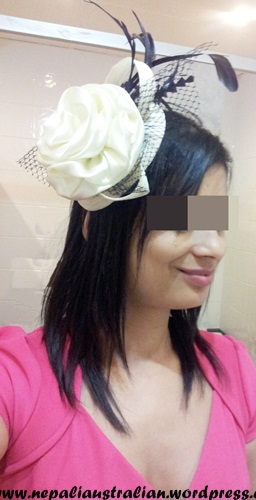
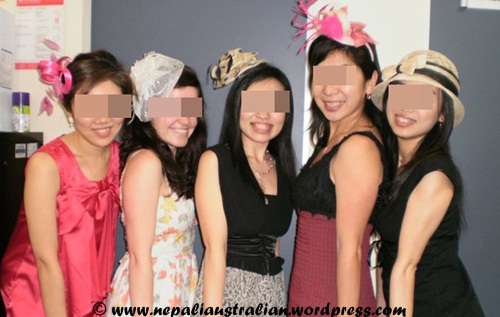
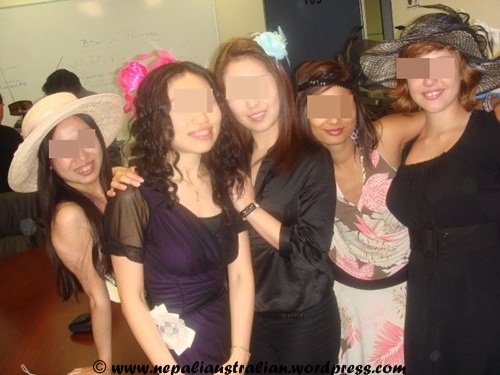
We follow suit like everyone at work and flocked up with hats and fascinators. Like every year, I put on the dress and a fascinator to go with that.

There will be nibbles with drinks during the race .We also did sweep and I have got 3 horses and hope one of my horse will win :).

The Victoria Racing Club expects the crowd at Flemington to reach 100,000 in time for the spectacular Emirates Melbourne Cup at 3pm.

Americain remains favourite for the Emirates Melbourne Cup at $6.20 with the TAB, followed closely by Red Cadeaux ($7.70), Dunaden ($7.90) and Mount Athos ($9.80). (None of them are my horse )

Latest photos from the race course.

Some facts about Melbourne Cup

  • The first Melbourne Cup was run in 1861 – the winner was the horse Archer. Archer also won the cup the following year.
  • The first cup races were originally run on a Thursday. The race was first run on a Tuesday in 1875, and has done so ever since.
  • The prize for the first Melbourne Cup was a gold watch and 170 pounds cash.
  • The winner of the first race in 1961 Archer is said to have been walked 800km to the course in Melbourne from Nowra, in New South Wales.
  • The youngest rider of a Melbourne Cup winner is believed to be Peter St Albans, who won on Briseis in 1876. Although his official age was not recorded, it is believed that he was 13 at the time.
  • Seventeen horses contested the first Melbourne Cup in 1861, watched by a crowd of 4000.
  • In 1877, the first Tuesday in November was declared a public holiday in Victoria (and is still).
  • The 1880 Cup was the first Melbourne Cup to attract 100,000 spectators.
  • The first woman owner to win the Melbourne Cup was Mrs Edith Widdis, who owned the winner Patrobas in 1915.
  • In 1916, the running of the Cup was postponed by 5 days due to rain.
  • Phar Lap’s win in 1930 was the only odds on winner in history (8-11), and was also the shortest-priced favourite in Cup history.
  • In 1954, ‘Rising Fast’ won the Caulfield Cup, Cox Plate and Melbourne Cup treble.
  • The 1958 Melborne Cup race was the first to start from starting stalls.
  • Arwon, the 1978 Cup winner, was from the town of Nowra, as was the first cup winner Archer (1861). In fact, Arwon is Nowra spelt backwards.
  • The race was originally held over two miles (approximately 3,218 meters), but changed to the current distance of 3200 meters following Australia’s adoption of the metric system in 1972.
  • The first camera photo finish was in 1948 when 80/1 shot Rimfire controversially beat Dark Marne (12/1). Although the rider of Dark Marne, Jack Thompson, was sure he had won, the camera said otherwise. However, it was later found out that the camera was out of alignment, and was corrected before the next race.
  • There have been no dead heats for first, but Topical and Gaine Carrington (1933) and Lahar and Zazabelle (1999) have tied for third.
  • The record time for the event is 3 minutes 16.3 seconds by Kingston Rule in 1990.
  • The first northern hemisphere trained horse to win was Vintage Crop, from Ireland, in 1993.
  • In 2002, Jockey Damien Oliver won on Media Puzzle, a week after his brother Jason was killed in a riding fall.
  • The first and only horse to be a three time winner of the Melbourne Cup was Makybe Diva (2003, 2004, 2005). At the same time, jockey Glen Boss becomes the first jockey to win three Cups in a row.
  • The 2006 Event carried 5.1 million dollars (Australian) in prize money.
  • Delta Blues becomes the first Japanese horse to win the Melbourne Cup, in 2006.
  • Bart Cummings has trained 12 Melbourne Cup winners (as of 2010) .
  • Americain became the first French horse to win Australia’s biggest race in 2010.

Sculpture by the sea

Each spring, artists from all over the world converge on Sydney’s Bondi Beach to Tamarama coastal walk to showcase their work at Sculpture by the Sea, the world’s largest annual free-to-the-public outdoor sculpture exhibition. The scenic walk is transformed into a 2km sculpture park with more than 100 works by artists from Australia and around the world.

Sculpture by the Sea began in 1997 with an exhibition held over one day at Bondi Beach and is now an annual event.

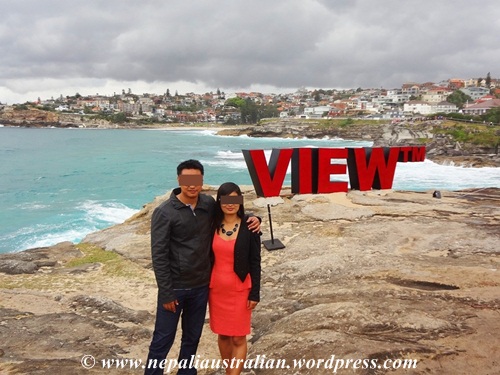
I have been going to this event for the last few years and it is a really nice thing to do on a day off as it provides great exercise, spectacular views, beautiful arts and many photo opportunities.

Like every year, this year also, I went to this exhibition with my husband and my friend SS. This year the exhibition consisted of a variety of works from 49 New South Wales sculptors, 28 interstate artists, and 36 international artists from China, Denmark, England, Germany, Iceland, India, Italy, Japan, The Netherlands, New Zealand, Norway, Puerto Rico, South Korea, Spain, and the U.S.

Every year there are some wonderful arts on exhibit along with some weird one.

I really wanted to go this year for the sunrise but these days the sun rises at 5am so to be there at that time, I needed to wake up at 4am. On weekend, that was not a good plan so we decided to go around 8am. Unfortunately, it was a gloomy day but it wasn’t raining yet.

We started from Bondi and were surprised to see so many people already there. I saw busloads of tourist everywhere. There were also lots of family with young children.

We started of walk from the first sculpture and followed the path along the Bondi beach to the top of the hill. There were many amazing arts there and some complicated ones.

On the top of the hill, there was a tent with mini sculptures so we entered and started looking at the amazing creations. In that time, it started raining heavily and we felt lucky to be inside the tent. The rain stopped within 15 minutes.

After the rain, we continued our walk toward Tamara beach. We saw two award winning arts. It was so nice to walk the coast and finally reach the last art. Overall we had a great day and quite good exercise.

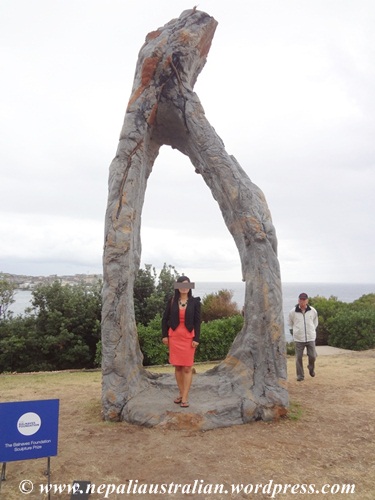
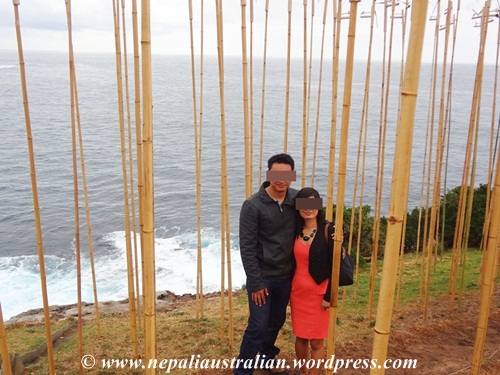
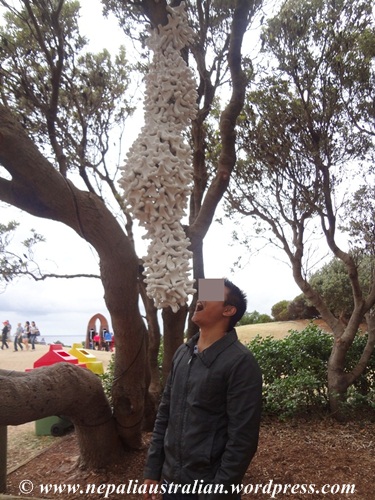
Sharing some photos from the day.