Tag Archives: dubo ko mala

Our Story : “Swayamvar” ceremony- Part 41

This is a continuation of my previous posts. Please read the previous posts here.

Swayamvar ceremony is the main event for the whole wedding and it literally means ‘Choosing the Groom by the Bride’. In the past, the bride had the right to choose one among many suitors. Nowadays, in the majority of marriages, Swayamvar is just a ceremony followed by Janti in Newari / Nepali wedding. For us the Swayamvar ceremony and Janti ceremony took place in two different days.

The Sahit sent during the Supari ceremony has an auspicious time written for the Swayamvar ceremony. For us the date and time was 24 June at 9.00pm. Therefore, it was going to be an evening ceremony.

Swayambar (2)

For this ceremony, I wore a red Dupata (silk with sliver work) sari, Dupata shawl around my arms and Ghumto (net red shawl similar to a veil) to cover my head. I went to the beauty parlour for hair and make-up.

Swayambar (3)

Before 9.00pm, all my family and I arrived at the venue. Due to the monsoon season, it was raining heavily. Everyone told me that the rain was a good sign for weddings. Anyway, all of us were waiting for the groom and his family to arrive for the ceremony. When they arrived, I was asked to go to the room upstairs so the groom and family could be welcomed and when everything was ready, I was to enter the room where the mandap was set.

Wedding Ceremony

In this mean time, my dad and uncles welcomed the groom and his family. They put Tika on the groom’s forehead, garland around his neck and escorted him to the mandap room. Once everything was settled, my cousin asked me to come down. I had my veil to cover my face and I was looking down as I walked towards the mandap.

Swayambar (4)

When I saw AS , I was so happy. He was wearing a Daura-Suruwal, Nepali national costume in light grey colour with dark blue coat and Nepali Dhaka topi. I was asked to sit next to him and the ceremony began.

Swayambar (5)

There were two priests, one from my family and one from his. They both told us to do lots of things, like doing Puja and saying mantras in Sanskrit and we were meant to repeat it after them. Vedic hymns and prayers invoked the blessings of all Hindu gods and the support of every element under the sun that will have a role in the conjugal life of the couple. The five basic elements of earth, air, fire, water and sky are highlighted time and again.

Swayambar (7)

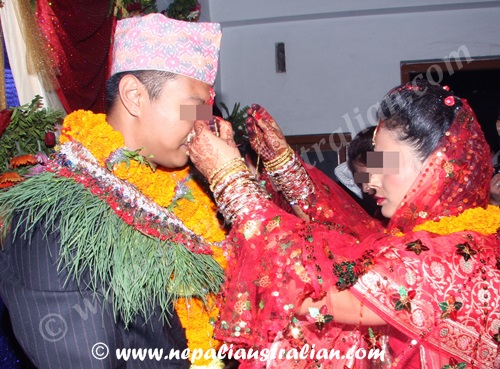
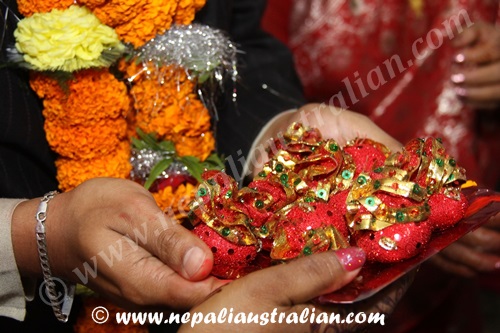
The Swayamvar ceremony continued with me circling AS thrice holding the Supari (from the Supari ceremony), Dubo ko mala (garland made out holy grass) and Ful ko mala (flower garland). Once I was done, I stood in front of him.

Wedding Ceremony

We exchanged Dubo ko mala and Ful ko mala.
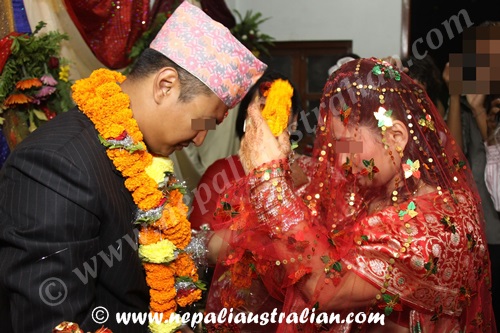
Wedding Ceremony Wedding Ceremony

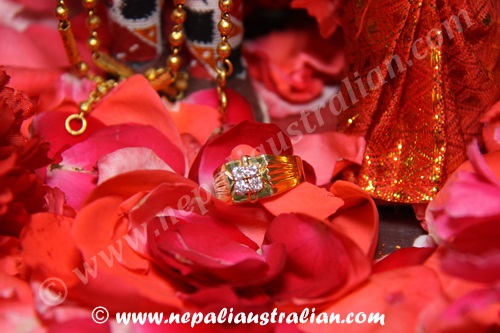
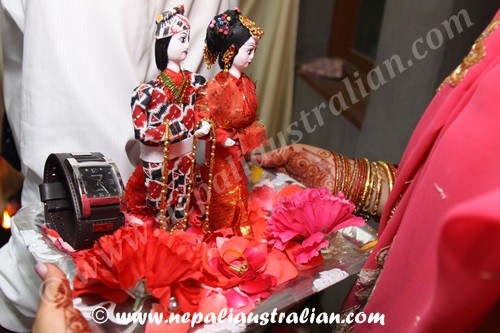
Then my aunt bought the tray with two traditionally dressed dolls (Bride and Groom) and all the jeweleries nicely displayed.
Wedding Ceremony Wedding Ceremony

Now AS put the diamond necklace and Tilahari around my neck and golden bangles on my hands. Then we exchanged rings. It was followed by me putting a gold chain around his neck and watch on his wrist.
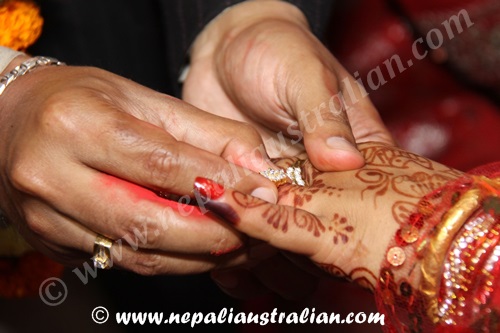
Wedding Ceremony Wedding Ceremony Swayambar (16) Swayambar (17) Swayambar (18)

Then priest asked me to sit down for the most important Sindoor ceremony. My aunt put golden and red clothe around my face covering my eyes, holding it from the back. Then the priest instructed AS to take a pinch of Sindoor in between his ring finger and thumb. He had to put that first to his forehead and then put on my forehead. Wedding CeremonyHe had to then move it into my hair partition still touching the forehead.

Swayambar (20)

This step was repeated two more times and now I was officially married to be his wife. Wedding CeremonyI touched AS’s feet for his blessing as his wife, and he handed me the Supari.

Wedding Ceremony Wedding Ceremony Wedding Ceremony Wedding Ceremony

Under the Hindu (Newar) tradition the sindoor and tilahari are the signs of a married woman. Finally, the priests pronounced that AS and I are husband and wife. He explained that as his wife, it is his duty to protect me and to make me happy.

Swayambar (24)

Now the priest asked us to share yogurt from the plate. AS ate a spoonful and then hand it to me. I had one spoon too. It was a bit hard to eat when everyone is watching. After this, we bowed to all elder relatives to get their blessing.

Family photos followed the ceremony and yes a Bhoj (party) as well. Once the ceremony was over, everyone was relaxed and started enjoying the food and company.

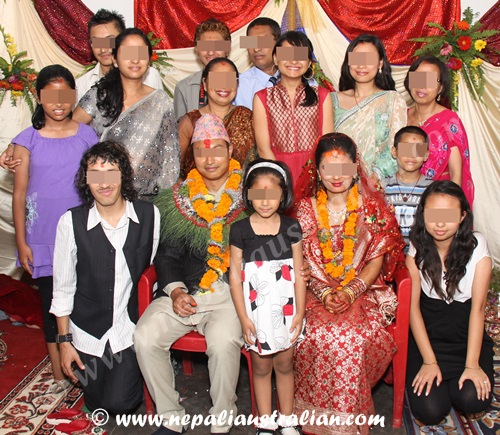
Swayambar (25) Wedding Ceremony

AS and his family left after the ceremony and we went home as well. I was so tired after such a long day but I was a married woman that day. It felt good.

Wedding Ceremony

More on the wedding in the next post.

Take care,

M from nepaliaustralian

XOXO

P.S: Do not forget to vote your favorite blog . NEPALIAUSTRALIAN’s Blog Award 2014

Go to Part 42

Nwaran for my nephew

Baby BJ was 11 days old last Friday so we had a ceremony held for him called Nwaran.

The ceremony is also known as Machabu Byakegu in Newari. It takes place on the  11th day from birth. This ceremony is performed to give a birth name to a child according to his/her lunar horoscope, this is usually not the name by which he/she will be known. This ceremony is normally small and celebrated amongst close family.

We are lucky to have a friend who is also a priest. He gave us a list of things that are required for the day and everything was ready when he arrived at my brother’s place at 8.30 am.

The main ceremony was conducted in the balcony of my brother’s apartment.  Before the priest arrived we had cleaned and mopped the place. So, when he arrived, he started making a Mandap on the balcony. Once it was ready he asked my brother to come and join him for the Puja.

He had all his books of mantras and it took more than an hour for the first phase of the Puja to finish. It involved lots of mantra reciting from the books and lots of different Pujas to God, with candles on the Mandap.

Then he asked my Sister in law and Baby BJ to join the Puja. He chanted more mantras from the book. Then he asked my SIL to perform Puja to the sun. Then he put tika on Baby BJ’s forehead and gave him a piece of paper which had details required to make his Jaata (lunar horoscope chart). It will be done by my parents in Nepal.

Then we took little BJ for Surya Darshan, i.e. to let the sunray fall on him as a blessing. He was also given a holy cloth with his birth name written on it.

Then he put Tika on my brother, SIL and then the rest of us. He also put Janai (holy string) around our wrists.

After that all of us put Tika on baby BJ as our blessings.  Little BJ got lots of gifts from all of us, mainly clothes and toys.

After the Puja was concluded we had our morning brunch.

Nwaran and Pasni

As you must have noticed by now, Nepali people have lots of celebrations and functions. When a baby is born there are many celebrations as well.

The first ceremony is called Nwaran (analogous to baptism ceremony). It is also known as Machabu Byakegu in Newari. It takes place on the 11th day. This ceremony is performed to give a birth name to a child according to his/her lunar horoscope, this is usually not the name by which he/she will be known. This ceremony is normally small and celebrated amongst close family.

Then there is Pasni ceremony which is also known as rice feeding ceremony or Weaning Ceremony. This ceremony is also called Annaprashan which in Sanskrit term, literally means grain initiation. It is the first time the baby is fed solid food. It is called Macha Junko in Newari.

Pasni is normally held after 6 months from birth for a baby is boy while if it is a baby girl, it is held after the fifth or seventh month. The day and time will be fixed after consulting a priest/astrologer.

As I have attended a few Pasnis lately, I am sharing the photos and procedure of Pasni here.

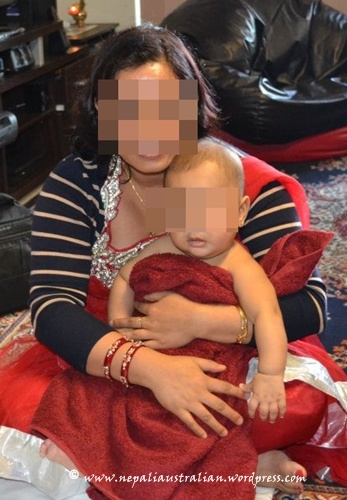
The ceremony begins at home. On the morning of Pasni, the baby will be showered and wrapped in a towel for the ceremony to begin. The Fufu (Babies dad’s sister) of the baby will hold the baby during this ceremony. Normally Fufu and other women in the family wear red sari.

Special Pasni dress

kalli

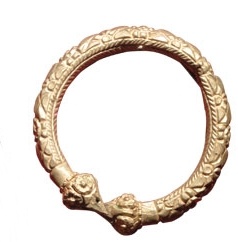
The place where the ceremony is to be held is cleaned and all the required ritual puja plate and food are arranged. Then the elder lady of the family will start the puja with the help of the priest. The first step is to put tika on the forehead of the baby, then the baby is given a special outfit, usually made of red velvet and embroidered with silver and golden threads. Gold and silver ornaments are also given to the baby, like heavy silver anklets (kalli) carved with dragon at both the ends to keep the bad omens away from the baby as well as gold bracelet.

Once it is handed over, the baby is dressed in this special outfit and the ornaments and further ritual starts. First the baby is given dubo ko mala (a garland of holy grass). Then it is followed by puja and symbolic feeding of kheer (rice pudding) or the first bite of solid food. The baby is then offered all kinds of foods to taste from Thaa bu (a plate which has eggs, yogurt, wine, fruits, Roti, meat, fish) .

Thaa Bu

Baby will be also offered a tray of stuffs like books symbolising learning, jewels symbolising wealth, a pen symbolising wisdom, clay symbolising property, food items symbolising a love for food (There can be anything symbolising a career. A friend of mine had stethoscope symbolising a doctor) and it is believed that depending on what the baby pickes, it will determine his/her future career. Family and friends have a great time cheering the little one while he makes his choice.

Baby trying to pick a object during pasni ceremony

There are lots of food and gifts given to the child from his/her mother’s family. It will also include Sagun. Sagun typically consists of a boiled egg, smoked fish, a bara (pan-fried black lentil patties), haku chhoila (smoked buffalo meat) and aila (wine) and ends with dhau (yogurt). Also all the family and relatives bless the baby with gifts or money. It’s a beautiful and elaborate ritual.

Sagun

After that maternal uncle (mum’s brother) carries the baby to the nearest temple so the baby can get blessing from the gods. In front of the temple, the baby is fed with some Prasad (offerings) and this will conclude the ceremony.

It is an occasion for celebration, and family and friends are invited to attend. These days Pasni ceremonies in Kathmandu are very lavish and are held in party function rooms much like a wedding ceremony. The guests, numbering in their hundreds bring gifts for the child and party late into the night.