Remember a few months ago, I wrote about my travel to Venice, Italy. While we were there our guide, showing a line on the wall, had mentioned that sometimes the water comes up to that level. At that time I was thinking how it would be in Venice when the water is so high up. He said that in 1872, the whole Venice was flooded and still from time to time, the water goes up quite high.
And now I understand what he meant. The water in Venice has risen to be the sixth highest since 1872 and flooded 70 per cent of the city.
Heavy rains and high tides have brought some of the worst flooding to Venice in years. The “acqua alta”, or high water, is common this time of year but this year it went a lot higher than normal. Venice suffered its worst flooding in 22 years as water in the Italian city rose to more than 1.5 metres (five feet) deep before beginning to recede.
Makeshift wooden walkways had to be used to cross areas of St Mark’s square, with transportation proving difficult for residents.
BEFORE
AFTER
I really hope everything will be back to normal soon and the tourists there will be happy to go around and see the beautiful city.
Ani Choying Drolma also known as Choying Drolma and Ani Choying is a Buddhist nun and musician from the Nagi Gompa nunnery in Nepal. She was born on June 4, 1971, in Kathmandu, Nepal.
She is known in Nepal and throughout the world for bringing many Tibetan Buddhist chants and feast songs to mainstream audiences. Ani Choying Dolma is an exceptional singer, admired by fans in Nepal and throughout the world. People are moved to tears by the plaintive purity of her voice, and the haunting melodies of her ancient songs and hymes, passed from master to pupil for many centuries.
She was trained formally in the sacred chants by her Lama, Tulku Urgyen Rinpoche. Her motivation in singing these great powerful mantras to the wider public is to bring benefit to all who hear them. Ani-la tours Europe, North America and many counties of Asia, has released numerous CDs. The funds she raises from her singing are supporting an increasing number of charity projects through her Nuns Welfare Foundation.
Ani Choying has always believed that nuns have a great desire and potential to make the world a better place, if only given equal opportunities. Arya Tara School, opened in 2000, aims to equip nuns to help and to serve their communities in a professional and humanitarian capacity. With a fully developed and realized potential, she believes that her nuns will be able to not only help themselves, but also to help others.
In brief, aims to help young nuns bring their compassion into fruition, actively, effectively, skillfully and meaningfully. Traditionally, says Ani Choying, women’s education is neglected in Asia. “most of the girls at my nunnery are from rural areas either in Tibet, India or Nepal, patriarchal cultures where women are expected just to cook, clean and bear children. Even in the nunnery, they are taught to read classical Tibetan in order to do the religious practice, but many cannot write their own names.” Her school would educate them in Literacy, Maths, Science, Medical and Nursing skills, and Buddhist philosophy.
To finance her school, Anila generates income through musical endeavors. In 1997, Ani-la began performing and recording Cho for audiences around the world, connecting Westerners to Tibetan culture and music. Ani Choying has gained wide popularity in Nepal as well, after she released her first Nepali CD “Moments of Bliss” in 2004 for which she was bestowed with laurels for her fantastic soothing voice.
A supporter of the school once wrote: “We were invited to see a concert by a Buddhist nun at a 500 year-old monastery in Patan. Thinking this would be a unique experience, we jumped at the opportunity. To our delight we were entertained by a talented, witty and charming woman performing traditional Tibetan songs and chants. At the end of the concert we learned that this humble Buddhist nun was performing to raise money to build a monastery and school for less fortunate woman and children in Nepal, India and Tibet. Her selflessness and commitment was so great that we felt we must help support her cause.”
She is currently here in Australia touring the country. Here is the extract of interview from Sydney morning herald by Jack Marx.
In person, the 41-year-old has a mesmerising presence, most of which is transmitted by her eyes – big, brown, expressive. To sit just inches from them, immersed in their sincerity, gives a journalist one of those rare moments when he knows he will fail his readers by not having them all there to experience it for themselves.
Drolma is also a trifle disarming for those with stereotypical expectations of a Buddhist nun. She has a fondness for Cadillacs (she was the first nun to drive a car in Nepal) and Whitney Houston, and when asked last year by the Himalayan Times why she had published her autobiography in the first place, she replied: “Honestly, it was money.”
She also betrays a peculiar fascination with Australian immigration officers.
“I do get distracted, like everyone else,” she says, when I ask her how a celibate Buddhist nun combats lustful thoughts. “But there’s a difference between getting distracted for a moment and getting distracted for a lifetime. I mean, if there’s a nice-looking guy then, okay, I will look.
I rejoice that this guy is looking really nice. For instance, when I first came to Australia, I faced the immigration officers, and I really liked them. They looked so … cool.”
Immigration officers? Cool?
“They were! They were happy and whistling while they were checking the passports and stamping them … and the guy I was dealing with had this tattoo and he was a cool dude. And I thought: ‘Wow!’ But that was it.
“You know, romantic love is a very popular habit, but it’s not something I like to practise. When you think carefully about it, it’s really just another addiction – an addiction to a certain person. ‘I love this person so much I can’t let him go!’ It’s not correct.
“If you really, truly love someone, you simply wish the best for them, not yourself. If you’re wishing the best for them on the condition that they’re making you happy, it’s more like a business. That’s not the kind of love we should develop for each other. It will hurt someone in the end, always.”
Drolma claims that the Buddhist faith cannot “do magic” (like, say, cure someone of addiction to the demon drink), but her performances suggest the contrary. Her voice is sweeping, dynamic and entirely in the control of its mistress – like a Himalayan Elizabeth Fraser (Cocteau Twins, This Mortal Coil), Choying Drolma’s voice is an intoxicating experience.
“You should come to Nepal,” she urges me. “You really should! You would love it there, and I think it would be very enlightening for you. And, if not, we have many great bars you might enjoy.”
Here is some of her music. Even you don’t understand the wording, I am sure you will fall in love with the melody.
This is my favourite song from her albums.
Her songs and original music has also appeared on various albums, including “Head Massage” by Soul Flip, BMG company and the “Buddha Bar” compilation by George V Company in France.
Ani Choying began recording the melodious Chö songs in 1996, and the first album, Choying Drolma and Steve Tibbetts Chö, was released in 1997. In the spring of 2000 Ani Choying’s second CD was released, Sina Vodjani & Choying Drolma Dancing Dakini. Immediately after this release, Ani Choying began to record her third CD, Choying, in a local Kathmandu studio. Although one hundred copied of this CD were sold in April, Choying’s official release is still in the works. Ani Choying has performed Chö in concert in both the United States, in 1998 and 1999, and in Europe, in 1999. In 2000 she has performed at festivals in both the United States and Europe. Ani Choying recorded her first Nepali CD Moments Of Bliss with local musicians in Kathmandu itself and released her album in 2004. Again in 2004, Ani Choying Drolma released another album with Steve Tibbets- Selwa (meaning “clear” or “awake”) for Six Degrees Records.
In June 2005, she released her second Nepali album titled “Smile” and “Inner Peace” is Ani Choying’s sixth CD and it consists of 4 mantras sung in melody. All of the money raised through Ani Choying’s performances and record sales go directly to the Nuns Welfare Foundation.
At the age of 13, she joined Nagi Gompa, a Buddhist nunnery on Shivapuri Mountain on the northern slope of the Kathmandu valley. Her education and spiritual training was supervised by the renowned meditation master, Tulku Urgyen Rinpoche. She was educated in Buddhist meditation, chants, rituals and ceremonies and quickly advanced to the position of the chanting master in the nunnery.
Later, she resigned from this position to become Tulku Urgyen Rinpoche’s personal health attendant and served him until his parinirvana (passing away) in February 1996. From seeing Tulku Urgyen Rinpoche’s altruistic life-style, always giving to others, without considering his own welfare, she developed a sincere desire to use whatever capacities she has to benefit beings as much as possible. Because Tulku Urgyen Rinpoche himself held nuns in the same regard as monks, Ani Choying Drolma believes that creating more opportunities for nuns to study and to develop their own capacities for skillful and compassionate action is the best way she can dedicate herself to her teacher’s vision throughout her life. She is committed to do whatever she can to promote the advancement of nuns, not only for their own benefit but because they will then be better prepared to serve and benefit others.
The last day of Tihar is Bhai Tika which is also called Bhatridutiya in Sanskrit. “Bhai” means brother in Nepali. The festival culminates in Bhai Tika, a day that rests on the premises of love, rituals, beautiful hues, reverence and puja done especially for one’s brother. This occasion honors brother-sister relationships, celebrating the holy emotional bond that they share. It is marked by offering special prayers for one’s brother’s prosperity and long life.
Legend holds that when the Kirati King Bali Hang fell mortally ill, his sister Jamuna looked after him and guarded him. When Yamaraj, the God of Death, came for Bali Hang’s soul, Jamuna pleaded with him to wait until she finished worshipping her brother; that is, until Panchami (Bhai Tika). She then conducted a long and elaborate ceremony for her brother, and performed the same for Yamaraj. She also put forth some conditions: that Yamaraj should not take Bali Hang until the tika, which she had smeared on his forehead, fades away; until the water sprinkled on her brother dries; and until the makhmali flowers wilt. Over the years Yamaraj sent his messengers to inspect the flowers, and when the next Bhai Tika puja arrived Yamaraj admitted that he had lost Bali Hang’s soul to his pious sister and granted him a long life.
The modern day Jamunas remember the legend and perform the rituals with much enthusiasm, love and gaiety. They believe that the required rituals will protect their brothers from untimely death and that they will enjoy a long life, health and prosperity.
In this day, sisters apply sacred Tika on their brother’s forehead and pray to Lord Yama for her brother’s long life and prosperity.
Some of the ethnic groups in Nepal use the Pancha Rangi Tika (Five coloured Tika) for Bhai Tika. First a base, rice flour is applied vertically on the forehead then yellow, green, red, blue and white colour Tika are put on top of this line in a row.
But in the Newar culture, we just use rice, vermilion and yogurt, mix them and use that as a Tika.
Those who do not have a brother or sister visit Yamarajeswor Temple at Rani Pokhari, in downtown Kathmandu. There they pay homage to Lord Shiva and receive bhai tika. Interestingly, the temple remains locked up all year round except on this particular day.
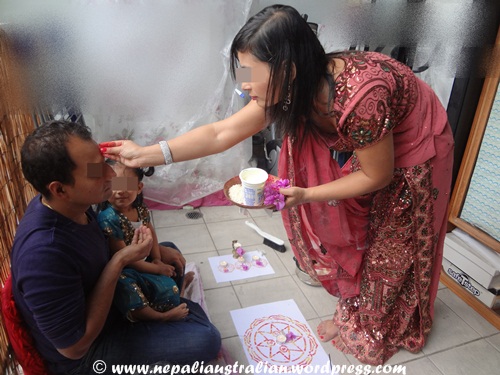
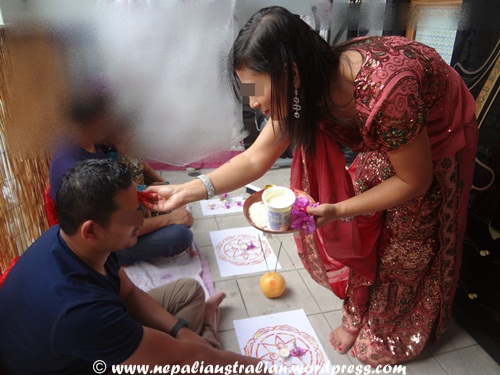
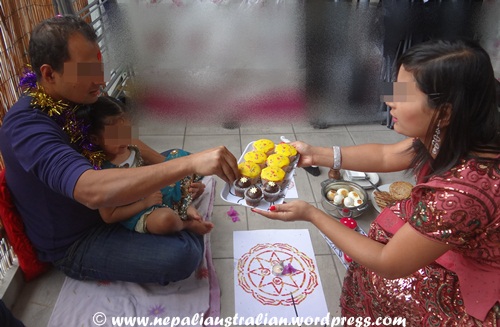
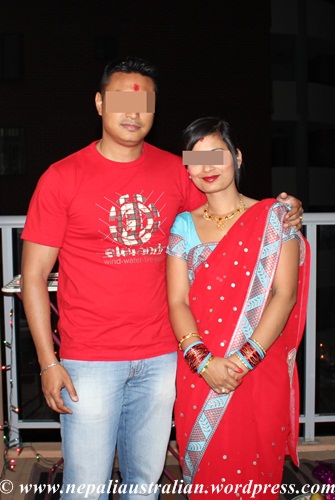
For this occasion, I had invited my brothers and their families to my place and we did the Bhai Tika on my balcony.
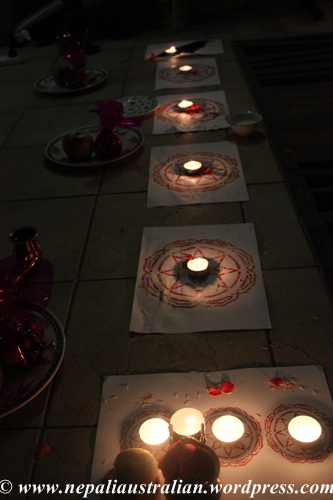
Before the Bhai Tika, just like in Maha Puja, the floor was purified by sprinkling water on it, and then we made Mandaps in front of a row of seats on the floor where my brothers were sitting. I used a copy of the same Mandap which was designed by AS but this time I printed them on A3 paper.
In Nepal, the Mandaps are made by hand on the floor using oil, rice flour, vermilion, puffed rice and sometimes beans. The number of the Mandaps needed is three plus the number of people doing the Puja. So I had two big Mandaps, for my brothers, in a row and three smaller Mandaps at the top of the row for the Family Deity (Kuladevata), Yamaraj and Janmaraj, and one crow drawn at the end of the row symbolising Lord Yama.
Beside the three Mandaps at one end, I also had a Sukunda with a candle on it.
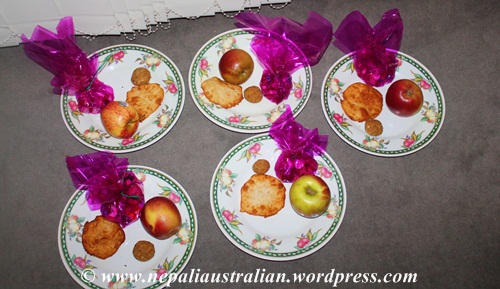
Then I put all the sweets and Rotis that I had made or bought as well as some fruits around the Mandap along with the sweets, Masala and Sagun.
Then I had trays with fruits like mangoes, oranges, apples, cup-cakes, lamingtons and cakes. I bake it and wrote Happy Bhai Tika on it.
I made Masala at home this year with dry coconuts, dry dates, raisins, almonds, pistachio nuts, apricots, dry figs, cashews, cloves, cardamoms, beetle nuts, hard shelled walnuts, palm sugar cubes and lots of Chocolates. I used clear cello wrap and colourful bows to make it look beautiful.
For Sagun, I boiled the eggs, took the shell out and fried them in a pan. I made Bara, fried some chicken, fish and cut fresh garlic.
I made Mala out of tinsel and bought Jajanka in a Nepali grocery store.
Jajanka is made of many rounds of a white cotton thread forming a circle of about two feet in diameter and tied with a small piece of colourful cloth in order to have no ends. Jajanka symbolizes the integration of the beginning with the end. It is about creation, maintenance and fullness of life. Normally the Mala is supposed to be of Makhmali ful/Supadi ful (Globe Amaranth) as it never dries and always looks fresh.
My Bhai tika process
First I gave Nasala, a few drops of water, in the palm of the right hand of my brothers to sprinkle some into the mouth and rest over the body for purification.
I worshipped the Family Deity and Yama’s Mandap with water, rice, flowers, and vermilion powder.
I gave water, rice, flowers, and vermilion powder to my brothers, first to worship the Mandap of the House God and then the crow, then to worship their own Mandaps. The Mandap is used as a medium to present the various offerings to the self.
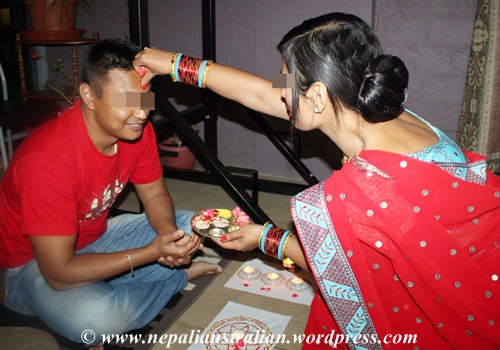
Then I put Tika made of vermillion, rice and yogurt on my brothers’ forehead and gave them flowers to put on their head as a blessing form God. This was followed by Mala and Jajanka around their neck.
Normally in Nepal, they use Itaa (special long strands made using white cloth soaked in mustard oil) but here we used tea light candles instead. I gave both my brothers the candles. They took the candle from my hand, lit them and put them on their Mandap. This light is believed to brighten the inner self and keep evil at bay.
Then I took some water in an Ankhura (a small pitcher for Puja) filled with oil and water and Dubo in my hand and circled around my brothers three times.
Then I gave them some rice and flower in their hand. I then gave trays of Rotis, fruits, Masala, sweets and clothes to them and they had to hold them and keep them from touching the ground. Then I took some rice and flower in my hand and showered each of them and worshipped the god within them. Only after that could they put the trays down.
Then my brothers put Tika on my forehead, touched my feet for my blessings and gave me the gifts they had brought for me.
I gave them the Sagun. For Sagun, you put a plate of egg, Bara, meat and fish in the right hand and yogurt or alcohol in the left hand.
Once everyone finished eating the Sagun, we used Kucho (broom) to sweep the mandaps starting from the top end of the row of Mandaps to the bottom of the row, touching each Mandap to erase them and concluded our Bhai Tika.
Today is Goru Puja, Govardhan Puja, Mha Puja and Nepal Sambat.
Goru Puja
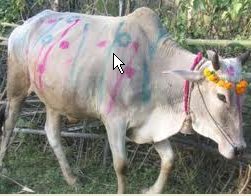
Nepal is mostly an agricultural country so oxen are considered important animals as they help in ploughing the fields. That is why on this day they are worshiped with tika, garland and offered nice food.
Govardhan Puja
Govardhan Puja is performed by making a hill called govardhan parbat using Cow dung. Cow dung has big importance in Hindu culture. In the olden days it was used for everything from light at night (Methane) to polish mud floors of traditional houses. Even now no Puja is complete without cow dung in Nepali Hindu culture.
It is believed that once there was a drought in a village in Vridavan. The villagers were very worried and they wanted to perform a big Puja in honour of Lord Indra, the God of rain. But Lord Krishna convinced them that, they should not pray to Lord Indra since it was the Mount Govardhan that brought the rain and not Lord Indra. This made Lord Indra very angry and in his wrath he sent forth a big thunderstorm to flood the village. Lord Krishan lifted the Mount Govardhan as an umbrella above the village to protect the villagers and their cattle from the rain and flood.
Mha Puja
In this day, after sunset Newar community perform Mha Puja.
“Mha” means body in the Newari language so on this day the Newa people worship their body and their inner self in the evening. They believe that the soul never dies and our body is only a vehicle and so we need to understand and respect our body as it is the chosen vehicle for this incarnation. This Puja is believed to bring prosperity and physical well-being.
Members of the family, first males followed by females, sit cross-legged in a row. The elder group of females plays the role of facilitators for each member. A mandap, decorated with different colours and various grains, fruits and flowers, is drawn for each member of the family.
In between the grains and fruits lies a mini mandap of oil, which represents the human soul. The human soul is placed between various grains and fruits so that a person will prosper throughout the year since each object represents a particular God and it is believed that each deity will bless the person. An oil lamp with velvet cloth wick equal in length to one’s own face is lit on top of the mandap facing all four cardinal directions so that a person will be renowned in all the places of this earth.
Apart from worshipping oneself, all the household entities like brooms, water pots, utensils and machines are also worshipped in the same way.
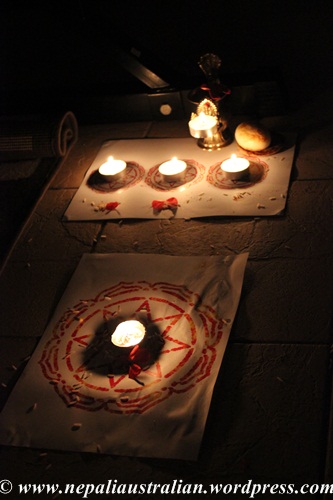
I performed Mha Puja with my brother and his family this year. This year my cousins are in Nepal so there were only 4 of us unlike 9 last year. For the Puja, first the floor was purified by sprinkling water on it then we made mandaps in front of a row of seats on the floor where we were sitting. Our mandap was designed by AS and I had printed them out on A4 paper but in Nepal they are made by hand on the floor using oil, rice flour, vermilion, puffed rice and sometimes beans.
The number of the mandaps needed is three plus the number of people doing the puja. We need three smaller mandaps at the top of the row for the Family Deity (Kuladevata), Yamaraj and Janmaraj, one mandap for each of the member performing Mha Puja. Then at the end of the row, we had a crow drawn symbolising Yama the God of death.
Normally the puja is done by the eldest member of the family but this year I did the process as my elder cousin is not in Sydney.
Process of doing Mha Puja (according to my knowledge):
First I gave Nasala, a few drops of water, in the palm of the right hand of everyone to sprinkle some into the mouth and rest over the body for purification.
I worshipped the Family Deity and Yama’s mandap with water, rice, flowers, and vermilion powder.
I gave water, rice, flowers, and vermilion powder to each individual to worship their own mandaps. The mandap is used as a medium to present the various offerings to the self.
Then I put tika on everyone’s forehead and gave them flower to put on their head.
Normally in Nepal, they use Itaa (hand woven long strands made using white cloth soaked in mustard oil) but here we used tea light candle instead. I gave each person the candle and everyone took the candle from my hand, lighted them and put them on their mandap. This light is believed to brighten the inner self and keep evil at bay.
I used rice and flower to shower each individual and worshipped the god within.
Then I gave every a plate with roti, sweets, fruits and masala.
Then,I gave Sagun to everyone. For Sagun, you put a plate of egg, bara (lentil cake), meat (chicken), a piece of garlicand fish in the right hand and yougurt in your left hand.
Once everyone finished eating the sagun, we used kucho (broom) to sweep the mandaps from top of the row to the bottom touching each mandap to conclude Mha puja.
Nepal Sambat
This day is also New Year’s day for Newar community and is called Nepal Sambat. Nepal Sambat is the national lunar calendar of Nepal. The era started on 20 October 879 AD and was in widespread use for all daily purposes until the beginning of the 20th century. It appeared on coins, stone and copper plate inscriptions, royal decrees, chronicles, Hindu and Buddhist manuscripts, legal documents and correspondence.
The customs of celebrating Nepal Sambat started from October 880 AD. According to a popular legend, there used to be a learned person in Bhaktapur who ordered porters to get sand from Lakhu Tirtha, a river in Kathmandu because he knew that it would turn into a heap of gold the next day. A person named Shankhadhar Sakhwaa came to know about it, and he enticed the porters to leave the sand in his place.
The next day, the sand turned into gold and with that gold he paid off the debt of all the people in the Kathmandu Valley. So from that day, people started celebrating it as their New Year to commemorate their happiness.
Even today, people are very enthusiastic to welcome the New Year. Every year, the day starts with a rally and the greeting of “Nhu Daya Bhintuna!” which means “Happy New Year”. Different programmes and functions are also organised in the Kathmandu Valley every year on this day.
The months of the year in Nepal Sambat are
Nepal Sambat month
Corresponding Gregorian month
Kachha lā
November
Thin lā
December
Pohe lā
January
Sil lā
February
Chil lā
March
Chau lā
April
Bachha lā
May
Tachha lā
June
Dil lā
July
Goon lā
August
Yen lā
September
Kau lā
October
It is Nepal Sambat 1133 this year. Nhu Daya Bhintuna everyone!!!
Also from this day, boys in groups go door to door singing special songs called Deusi similar to the Bhailo sung during Laxmi Puja. You can write just about any Deusi song as long as each line ends with the word `Deusi’ or `Deosuray’. A group of males get together, carry what-ever musical instruments they have or can play, and sing Deusi door to door blessing the home and family in return for money and/or refreshments. Teenagers perform various Deusi songs to collect money for their picnic.
It is considered auspicious to have these groups come to your front door. The house owner will offer them some rotis, fruits and money and they sing Deusi songs blessing the household with good fortune.
A Sample of Deusi Song. Includes a similar meaning in English
Bhana Mera Bhaiho Deusuray. (Say it my brothers, Say it. Deusuray)
Sormelai Kana Deusuray. (Say it louder and say it in tune. Deusuray)
Rato Batoo Deusuray. (Red mud trail. Deusuray)
Chiploa Batoo Desuray. (Slippery trail. Deusuray)
Laddai Paddai Deusuray. (Slipping and Sliding. Deusuray)
Akeya Hami Deusuray. (Finally we made it to your home! Deusuray)
…. …. Deusuray
…. …. Deusuray
…. …. Deusuray
Yo Garma Laxmi Deusuray. (In this home Lord Laxmi. Deusuray)
As I mentioned in my previous post, today is Gai Puja and Laxmi Puja as well.
In the morning of this day, the cow, the mother of the universe, is worshiped. According to Hinduism, the human infant is fed breast milk by its human mother for three years. After weaning, the cow acts as the surrogate mother providing milk for the rest of the human life – through childhood, adult age and old age. Cows are the mothers of the universe, the sacred animal. Hindus consider a cow as sacred and used its milk, dung and even urine for purification purpose. Those performing Cow puja place her manure in different parts of the home, drink a drop or two of the cow’s urine, as a part of a purification process. Also dip a blade of grass into the urine and lightly sprinkle it on each other’s body to become closer to the mother of the universe – cow.
People in villages who have a cow worship their cow but most of the people in Kathmandu don’t have a cow so they either go to a priest’s house or to a temple to worship the cow.
Cow is worshiped by putting tika on their forehead and a garland around their neck. They are offered a delicious meal and fruits.
A cow also symbolises wealth and a form of goddess Laxmi.
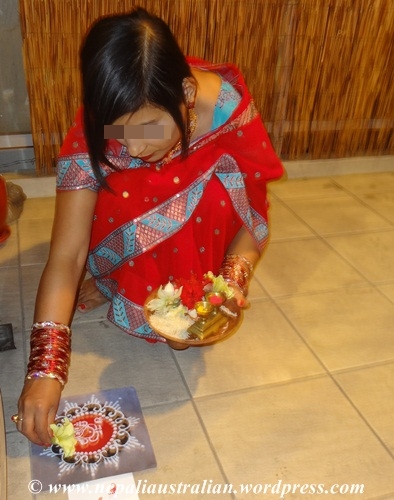
In the afternoon, the whole house is cleaned in preparation for welcoming the goddess of wealth, Laxmi. Most of the houses have their front door decorated with a mandap and have a trail of red mud leading to their Puja room (worship room in the house) .
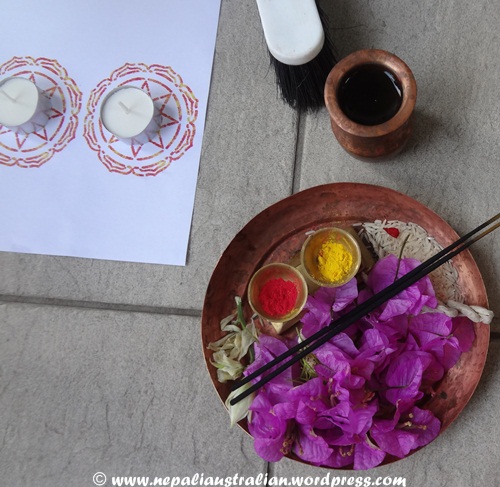
Laxmi Puja is performed using flowers, incense, oil lamps, color-powders, bell and money (both notes and coins). Laxmi puja is performed at dusk using red mud, and puja is often done by a female in the family.
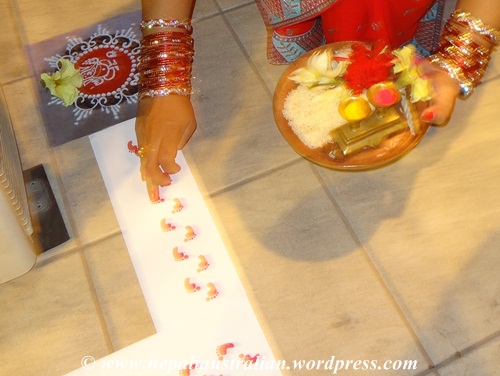
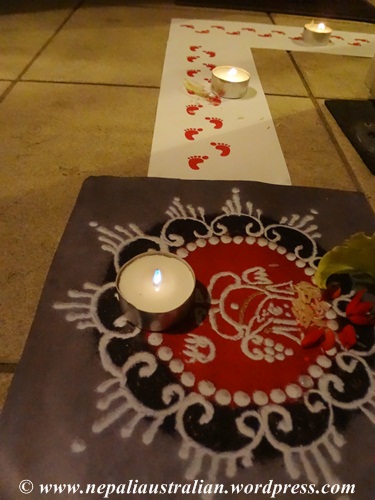
When I was young, I used to help mum do this. It was one of my favourite holiday activities. First, red mud is used to make a trail leading to the Puja room. Once it is dry, a mixture of flour and water is used to make a symbolic footprint of Goddess Laxmi on the floor entering the home. Once the flour footprints have dried, vermillion mixed with oil is put on them along with some flowers. This results in a trail of small red footprints from the main door of the house to the Puja room symbolising that Goddess Laxmi has entered the house.
The entire house is decorated with flower garlands and lit oil lamps in every doors and windows.
Also people use firecrackers to celebrate the festival.
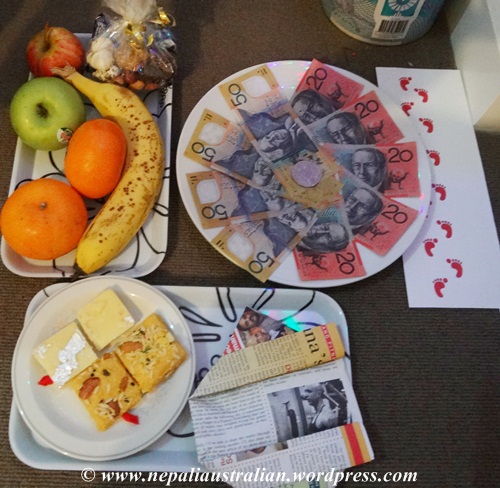
In Australia, we can’t do all this so I printed out small footsteps on paper and used that as an alternative to lead the Goddess Laxmi to our Puja area. Also at the start of the footsteps, I had a mandap of Lord Ganesh.
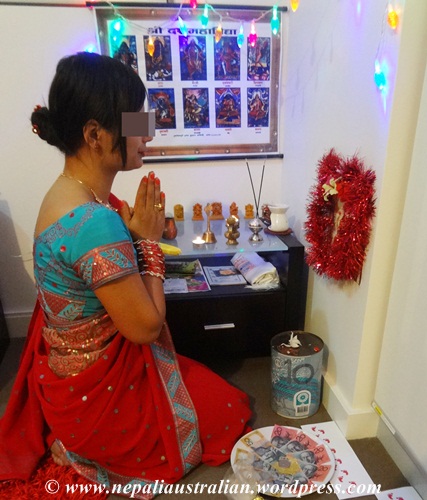
I set up a photo of goddess Laxmi with some notes and our piggy bank in the Puja area.
Then I performed Puja using tika, flower, garland, fruits, roti and masala.
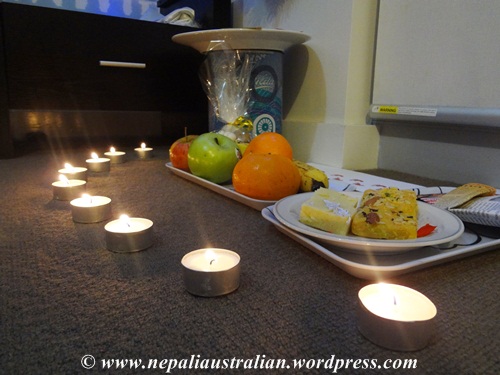
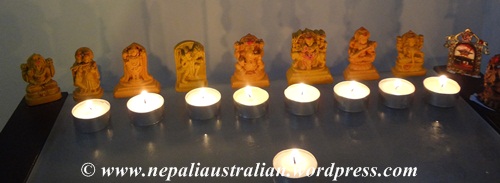
I had candles lit in the puja area as well as twinkle lights to simulate the ambience of Tihar.
Laxmi puja is not only for households but is also performed by businesses. Business-Laxmi-Puja is done exactly the same way as is done in home. Usually the company’s cashier performs the puja during which time the entire office including office compounds are lit with various lights including electrical, candle lights, and oil lamps and usually the staffs are invited to participate in the puja procession.
From this day on for the next 3 days, there will be women in groups coming door to door singing special songs called Bhailani. It is considered auspicious to have these groups come to your front door. The house owner will offer them some rotis, fruits and money and they sing Bhailo blessing the household with good fortune.






































 nepaliaustralian