Category Archives: Nepali Festivals

Asthami : Dashain

Hindus all over Nepal is celebrating Maha Ashtami today, the eighth day of Dashain, by worshipping Goddess Durga.

From ritualistic aspects,  Maha Ashtami holds very important value. On this day, the fiercest embodiment of the Goddess is worshipped. Goddess Durga is believed to bestow peace, longevity and perpetual happiness on her devotees.

People also read the Durga Saptashati scriptures today. The Durga Saptashati is divine recitals consisting of 700 slokas , or verses, divided into three parts – the first relating to Maha Kali, the second to Maha Lakshmi, and the third to Maha Saraswati.

Undertaking Durgasaptashati Patha  is supposed to destroy fear and the devotee is blessed with a benevolent mind. Chanting sacred hymns of Durgasatshati is also believed to eliminate poverty and free the devotee of all the sorrows.

The Goddess Durga is described as Sarvaswarupa (the one which incorporates every kind of form), Sarveshwari (the one who observes the function of all) and is possessed of all the divine powers and attributes. Goddess Durga can destroy all the illnesses and physical maladies of her devotee. 

Goddess Durga has 108 divine names and merely remembering or chanting the holy names can remove all the sufferings and bless the devotee with wealth and prosperity. 

The divine principle of Goddess Durga is supposed to manifest in nine rupas (forms) during the auspicious period of Dashain (the auspicious period of nine divine nights) and these divine forms are deified as Navdurga (nine divine manifestations of Durga) which are ascribed these divine names:

1. Shailputri, 2. Brahmacharini, 3. Chandraghanta, 4. Kushmanda, 5. Skandamata, 6. Katyayani, 7. Kalaratri, 8. Mahagauri, 9. Siddhidatri. 


Devotees throng the various shrines of the goddess in Kathmandu Valley from early morning today to offer prayers and to sacrifice animals like goats and ducks at different temples of Bhagwati including Bhadrakali, Kalikasthan, Guheswori, Mahankaal, Taleju Bhagwati, Daskshinkali, Sankata Shova Bhagwati and Naxal Bhagwati. Blood, symbolic for its fertility, is offered to the Goddesses.

Today, sacrifices and special offerings are made at Dashainghars and Kots as well. The old palace in Basantapur Hanuman Dhoka, is active throughout the night with worships and sacrifices in almost every courtyard. In Dasain Ghar at midnight , a total of 54 buffaloes and 54 goats are sacrificed in observance of the rites. After the offering of the blood, the meat is taken home and cooked as “prasad”, or food blessed by divinity. This food is offered, in tiny leaf plates, to the household Gods, and then distributed amongst the family. Eating this food is thought to be auspicious. Appropriately enough, the night of this day is called Kal Ratri (Black Night). 

While the puja is being carried out great feasts are held in the homes of common people.

People who do not sacrifice animals offer sacrifices of various vegetables and fruits in place of animals.

Some Hindus will also be fasting this day.

In Newari culture, we eat Kuchi Bhwey to mark this day. We were invited for the feast at my cousin house.

It consists of 9 Newari dishes which are

Kuchi bhwey

Fulpati: Dashain

After Ghatasthapana, the next major excitement arrives with Fulpati, also known as Saptami, which is the seventh day of the festival. Today is Fulpati. Phool(Ful) means flower and pati means leaves and plants in Nepali. FulPati literally means flowers, leaves and plants.

On this day, in the past when the Nepal was ruled by a king, the jamara to be used by the royal family was brought from Gorkha Palace, their ancestral house. The Fulpati (jamara and the other items that are necessary for tika) is brought after a three day walk from Gorkha district which is about a hundred and sixty nine kilometres away from the valley of Kathmandu. A parade is held at Tundikhel ground in Kathmandu.


However, since 2008 when the monarchy was abolished, the two-century old tradition was changed so that the holy offering of Fulpati goes to the residence of the Prime Minister. The Prime Minister has taken over the king’s social and religious roles after the fall of the royal government. The Fulpati is brought from Gorkha to Dhading district from where six Brahmins carried it to Jamal. From Jamal, the Fulpati filled with holy water, banana stalks, jamara and sugarcane tied with red cloth to be offered to Goddess Durga, is carried by Bhramans on a decorated palanquin under a gold tipped and embroidered umbrella to the Dashain Ghar in Hanuman Dhoka. The Gurujyuko Platoon, the Nepal army, Nepal police, and high-ranking officials of Armed Police and civil service, band music, and panchebaja bands also join the Fulpati parade. While the sacred items are being placed in Hanuman Dhoka palace, there is a majestic display of the Nepalese Army along with a celebratory firing of weapons that continues for ten to fifteen minutes honouring Fulpati. Army parade in Tundikhel is watched by the President, Prime Minister and other high level dignitaries in conventional formal dress.

All government as well as private offices close down from today encouraging people to go back to their respective ancestral homes and receive blessings from Durga Bhawani as well as their elders.

According to historian Prakash Darnal, the Fulpati celebration was started during the rule of Late King Prithivi Narayan Shah, after he united the small kingdoms into one Nepal.

Though Dashain begins with Ghatasthapana, the festival gets special flavour from the day of Fulpati.

As there is not much happening in Sydney for Fulpathi, we just gather in my house and had Samay Baji. This is a newari style Bhoj that we have in Nepal during Dashain. I will write details about the Samay Baji in my next post. This it what it looks like.

The festival will continue with Maha Asthami on Monday, Nawami on Tuesday and Dashami on Wednesday.

Dashain

Dashain is the 15 day Hindu festival celebrated in Nepal. It is the longest Hindu festival and it falls around September – October, starting from the bright lunar fortnight and ending on the day of full moon. Dashain is also popularly referred to as Bada Dasain, Dashera, Vijaya Dashami etc.

This year Dashain starts today, 16 October which is Ghatasthapana (Literally pot establishing). Ghatasthapana is the first day of Dashain and it is the day in which Jamara is planted on a pot or Kalash. The other important days for the festivals are Day 7 called Fulpati (21 October), Day 8 called Maha Asthami (22 October), Day 9 called Maha Nawami (23 October) and Day 10 called Dashami (24 October). The festival ends the 15th day with Purnima, full moon.

Every year Nepalis, remember the message “Good always wins over the evil”, with the celebration of the great festival of Bada Dashain.

Legend behind Dashain

King Ram Chandra, whose wife Sita was kidnapped by King Rawan, with the help of hanuman and its military, conquered Rawan on the tenth day, after regular worship of Durga Bhawani for 9 days. The 10th day is the victory day. We put tika on our forehead as prasad of the victory.

Another legend goes like this.

Demons, or Asuras, became very powerful and ambitious and continually tried to defeat the Devas, or Gods, and capture Heaven. One Asura, Mahishasur, in the form of a bull, grew very powerful and created havoc on the earth. Asuras started defeating the Devas and chasing them away from the heaven. The world was crushed under Mahishasura’s cruelty; the Devas put their energy together and form Shakti, a single mass of incandescent energy, to kill Mahishasur.

A very powerful band of lightning emerged from the mouths of Brahma, Vishnu and Shiva and a young, beautiful female virgin with ten hands appeared. All the Gods gave their powers and special weapons to her. This Shakti blended to form the goddess Durga. Riding on a lion, Durga Bhawanu fought Mahishasur. The battle raged for nine days and nights. Finally on the tenth day of Ashvin shukla paksha, Mahishasur was defeated and killed by Durga. This is the day of celebration.

Day 1: Ghatasthapana

Ghatasthapana marks the beginning of Dashain. It literally means installing a pot which symbolizes Goddess Shakti. In this day, Jamara is planted establishing the holy Kalash vessel, which represents the goddess Durga. Goddess Shakti is believed to reside in the Kalash vessel during the Dashain.

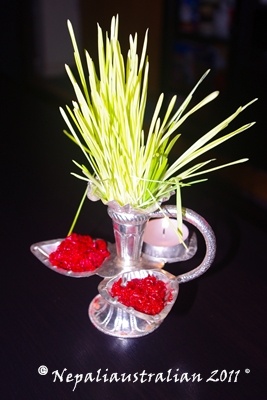
Today, everyone in Nepal will plant Jamara to mark the start of Dashain. Normally, Jamara is planted in Puja ghar (prayer room). Jamara pot is kept away from direct sunlight, and holy water is offered to it every day, so that by the tenth day of the festival the seed will have grown to five or six inches long yellow grass. This sacred grass is known as Jamara.

Today, before coming to work, I planted my Jamara as well :). It is the second time I have planted Jamara and I am hoping like last year, it will be a good one so I can use this for puja and tika .
How to plant Jamara

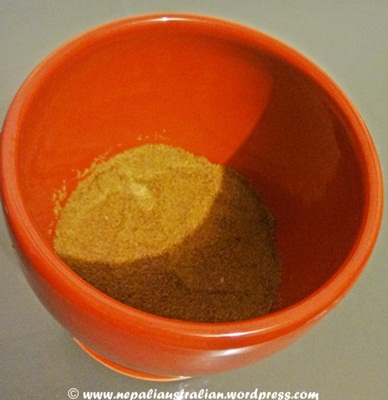
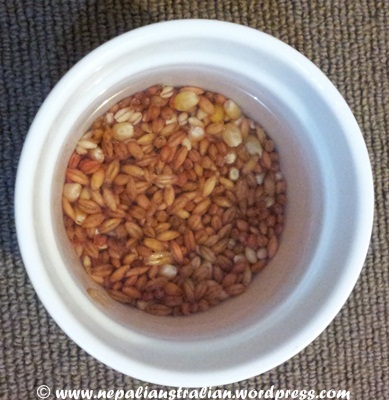
  • Soak barley seeds overnight. I used a Jamara mix (barley, corn, wheat) from Nepali grocery shop.
  • Get a deep bowl or container with a flat bottom. I am using a clay flower pot this year. Fill it with a layer of sand about 2 inches thick.

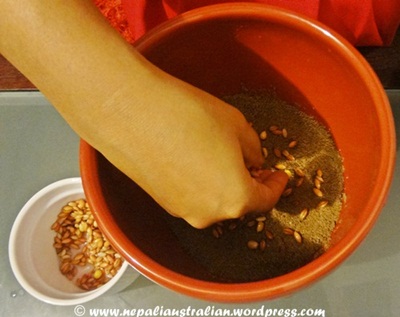
  • Sprinkle a layer of soaked Jamara mix into the container.

  • Make sure it is only one layer of the seeds so they have enough room to sprout.
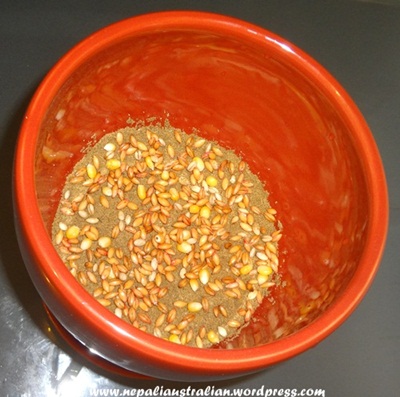
  • Cover the seeds with a thin layer of sand.

  •  Sprinkle some water in the container. The sand should be moist, but not soggy.

  • Cover the container and put it in a dark corner, away from the sun.

  • Check the container daily to make sure that the sand is moist.

  • Your Jamara should be is ready for Tika.

Click here to see how Jamara looks like from my last year’s post.

If you are in Nepal, you will see lots of signs of Dashani which will remind you that the festival season is on.

Lots of kites in the sky

Flying kites has been a very important part of celebrating Dashain in the country as it is considered to be one way of reminding god not to send rain anymore. When I was a kid, we used to gather on the rooftop of the house and take turns flying kites. My brothers and his friends would be there and I would be there trying to learn how to fly kite. They used to teach me but most of the time I dropped the kite too low when I was taking control and one of them would jump in and take over  before someone could cut it in the sky, with so many kites fighting already.

When you cut someone else’s kite, you shout ‘Changa Chet‘ literally meaning Kite, cut! If we had a big group of friends we even used to take metal plates or metal buckets with metal spoons and bang them to make a loud noise to celebrate the Changa Chet. I know it might sound weird but it was lots of fun.

Ohoo, how I miss my childhood Dashain.

Kites are not only for kids but adults get into the spirit and have some fun too.

Everyone playing cards

Gambling is illegal in the Nepal but it is usually permitted in public places during this festival. While children are busy flying kites during Dashain, the older members of the family pass their time by getting together and playing cards with each other for money and fun all day long.

As a kid, I remember playing cards using 1 shuka (a quarter /25 paisa) and trying to win more money. It was so much fun to team up with the cousins and play it as a group. That is the only time we didn’t get scolding from our elder for playing cards.

 Everyone busy shopping for new clothes

I would never have thought as a kid I would ever own 100s of dresses or shoes in my lifetime. As a kid, Dashain was especially exciting as I got to buy new clothes along with a new pair of shoes which I could wear during the festivals. All of my friends used to gather during Dashain and show off our new dress and shoes 🙂

Buying and wearing new clothes is an important part of the festival. As many people are living in the villages below the poverty line and for them it is often the case that new clothes come only with Dashain. Almost all the shops in the country have festival offers and discounts. This makes shopping even more attractive to people. Clothes have the highest sales during the festival.

To get into the Spirit of Dashain, we went shopping last weekend and I bought two dresses and a pair of shoes. My husband bought a jacket and a few t-shirts :). I am wearing my new dress today so Dashain has already made an impact in our lives.

Swings everywhere

During Dashain, bamboo swings are constructed a week before Ghatasthapana in many parts of the country as a way of celebration. These bamboo swings are called ‘ping’ in Nepali. These kinds of swings present the best of local culture, tradition, community spirit and fun.

These swings are constructed with the help of community members using traditional methods which make the use of ropes made from tough grass, bamboo poles and wood etc. Theses swings are dismantled only after the festival of Tihar which is 2 weeks after Dashain.

The heights of some swings exceed twenty feet and one can swing really high. One can see people of all ages enjoying the swing. It is especially famous with the children.

I used to love these swings. It goes so high that the adrenaline kicks in. I used be a bit scared to get on at first but once you are on it, it is a great feeling. I am sure these kinds of swings won’t be allowed in western countries as it will be consider a health hazard as it doesn’t have any safety harness 🙂

Dashain Fairs everywhere

Different kinds of fairs are also organized during the festival. Usually small fairs are organized in the villages with the Ferris wheels for children and other items of entertainment for the adults. However, in the city it is the commercial fairs and celebration events that are usually organized.

My memories of Dashain fairs are of Bhrikuti Mandap Dashain Mela. My parents used to take my brother and me there and we were allowed to buy treats. They had concerts, dance shows, magic shows, family games, Band competitions, games, food, and a lot more. They also had stalls with goats, chickens, ducks etc. and great for people who want to buy animals to sacrifice for Nawami.

Also these days they organise lots of musical concerts during these festivities.

In Sydney, during Dashain there are lots of musical concerts with Nepali artists visiting down under to celebrate the festivals. Dashain festival and dance parties are also organised here to make merry and have a get together.

Animals slaughtered

This is probably the worst part of Dashain for me that thousands of animals such as buffaloes, ducks, goats, etc. are slaughtered during Dashain every year.

It is considered an important ritual since it is believed that the goddesses are appeased by such sacrifices. Almost all the temples, especially the temples of Goddess Durga and Kali  around the country are offered with thousands of sacrifices.

Asthami and Nawami are the days when the sacrifices reach their peak. While thousands of animals are sacrificed to appease the goddesses, people also slaughter animals for the purpose of feasts. Since a large number of feasts and gatherings are organized throughout the fifteen days of the festival, the demand for meat goes up considerably. Hence to meet the demands the slaughtering of animals becomes considerably high during the festival.

However, for the past few years the animal rights activists in the country have been continuously opposing these acts of slaughtering of animals in such a manner. They have been requesting people to stop such inhuman acts of killing the innocent animals and instead have suggested them to offer fruits and vegetables to the Goddesses since they believe that it is mentioned nowhere in the Hindu religious books that such sacrifices appease the gods and goddesses.

I do know that we need meat from animals but I still think it doesn’t need to be cruel killing of animals for the meat. I am sure there can be less violent way of killing animals for their meat.

As I am not into killing animals and also I can’t do that in Australia so I will be using coconut instead to mark Nawami. I will keep you posted about Dashain for the next 15 days.

A relaxed mind, a peaceful soul, a joyful spirit, a healthy body; be a heart full of love, may you have all these every day. Happy Dashain everyone!!!
Indra Jatra

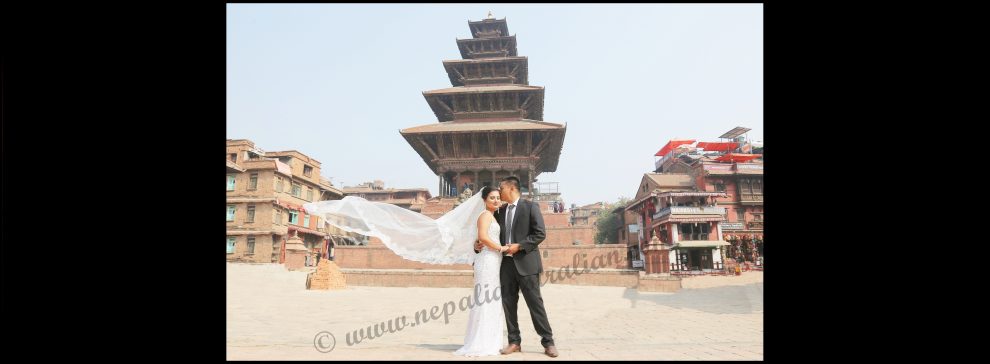
Today is Indra Jatra.

Indra Jatra is one of the biggest religious street festivals in Kathmandu. The festival of Indra Jatra takes place in September each year and heralds the end of the monsoon season. It is primarily in honour of the rain god, Indra. It is also known as Yenyā in Newari/Nepal Bhasa.

The 8 day long Indra Jatra Festival begins on the 12th day (Dwadasi) of the bright half (Shukla Pakshya) of the lunar month Bhadra and concludes on the 4th day ( Chaturthi) of the dark fortnight of lunar month Ashwin but the most important day is the 3rd day when the procession of Kumari -the Living Goddess and other deities are taken out.

According to an ancient legend, the young Indra, disguised as a farmer, descended to earth in search of Parijat, a white flower, his mother, Dagini, needed to perform a ritual. He found the Parijat, but was caught while trying to take the flower by the owner of the meadow where he found the flowers. He was bound and imprisoned in Kathmandu until his mother, worried about his extended absence, came looking for him. When the city folk realized who they had imprisoned, they agreed to release Indra but on the condition that he would return to the earth every year during that time and be displayed as a prisoner for 7 days and that he would provide enough rain (dew during winter) for the crops. So, during this festival, images of Lord Indra are displayed for 7 days, but in captivity. Dagini promises enough dew throughout the winter to ensure a rich crop and to take back with her to heaven all those who had died in the past year.

The Indra Jatra festival thus honours the recently deceased and pays homage to Indra and Dagini for the coming harvests.

People from all over Nepal, mostly those who live within the Kathmandu Valley, gather at Hanuman Dhoka in Kathmandu. The first day of the festival is viewed by a large number of people. It begins when a huge, carefully selected pole, carried via Tundikhel (Kathmandu’s parade ground), is erected outside the Hanuman Dhoka in Kathmandu. A flag of Lord Indra is tied at the apex of the pole.

A young male goat is sacrificed to the forest deity before the tree is brought down to carve the pole. The giant facade of Aakash Bhairab, which remains hidden behind the caged bar throughout the year, is opened today for the next three days. Local Newari ethnics pour the home brewed beer into the mouth of Bhairab and people compete to get a sip when the drink spouts out. People display the images of Lord Indra and make sacrifices of goats and roosters. There is a brief dances during the pole erecting ceremony.

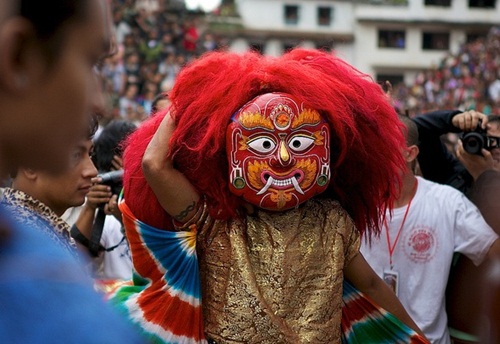
Classical dancers also assemble at the spot, wearing different kinds of traditional masks and costumes and dancing around the courtyard of Hanuman Dhoka to celebrate Indra’s visit.

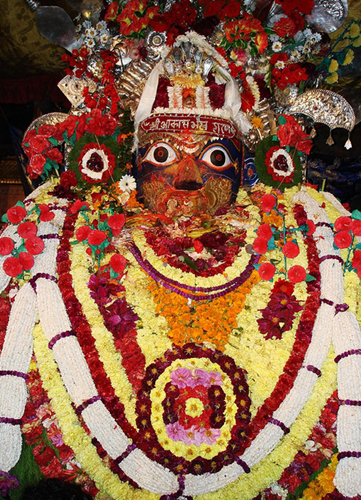
On the third day of the festival of Indra Jatra, the living goddess Kumari is taken out in a procession in a chariot. Kumari – the Living Goddess of Nepal comes out from the seclusion of her residence and tours the city on a temple chariot. Along with Kumari, other deities like Ganesh – the elephant headed God, and Bhairav are also paraded throughout the city.

Kumari is greeted from the balcony of the old palace by the president. The procession then continues out of Durbar Square towards Hanuman Dhoka where it stops in front of the huge Seto Bhairab mask. The Kumari greets the image of Bhairab and then, with loud musical accompaniment, beer starts to pour from Bhairab’s mouth! Getting a sip of this beer is guaranteed to bring good fortune, but one lucky individual will also get the small fish that has been put into the beer – this is said to bring even more good luck.

Numerous other processions also take place around the town until the final day when the great pole is lowered and carried down to the river.

Teej 2012

Today is the Fasting day of Teej as I have explained in my previous post.

Like every year, this year as well we celebrated Dhar khane din of Teej in Sydney with lots of food and music. Even though we are so far away from home, it feels good to be celebrating Nepali festivals with friends and family here.

As always we donned our red sari and jewelleries and met at one of our friends place. We all cooked a dish for the entrée and dinner.

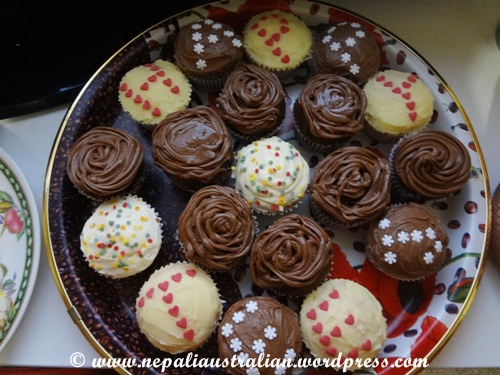
I baked some cupcakes this year. To mark the day, I even put “HAPPY TEEJ’ on the cup cake.

While the girls danced on Teej songs and had fun, the boys were busy playing cards and enjoying in their own way.

Later in the evening we played a game called Antakshari (literally “from the last letter”: Singing competition where each group sings a song that begins with the letter with which the previous group’s song ended) with girls in one group and boys in the other.

We only sang Nepali songs. There were lots of times when both the team were lost for songs but the final result; Girls won the contest. It was so fun when everyone was racking their brain to get a song and we had lots of old songs. Nice game.

It was a fun celebration. Here are some of the photos from the celebration.

Happy Teej Everyone!!!