Category Archives: Nepal

Celebrating 15 Years of Blogging with You All

Hey everyone! 🎉

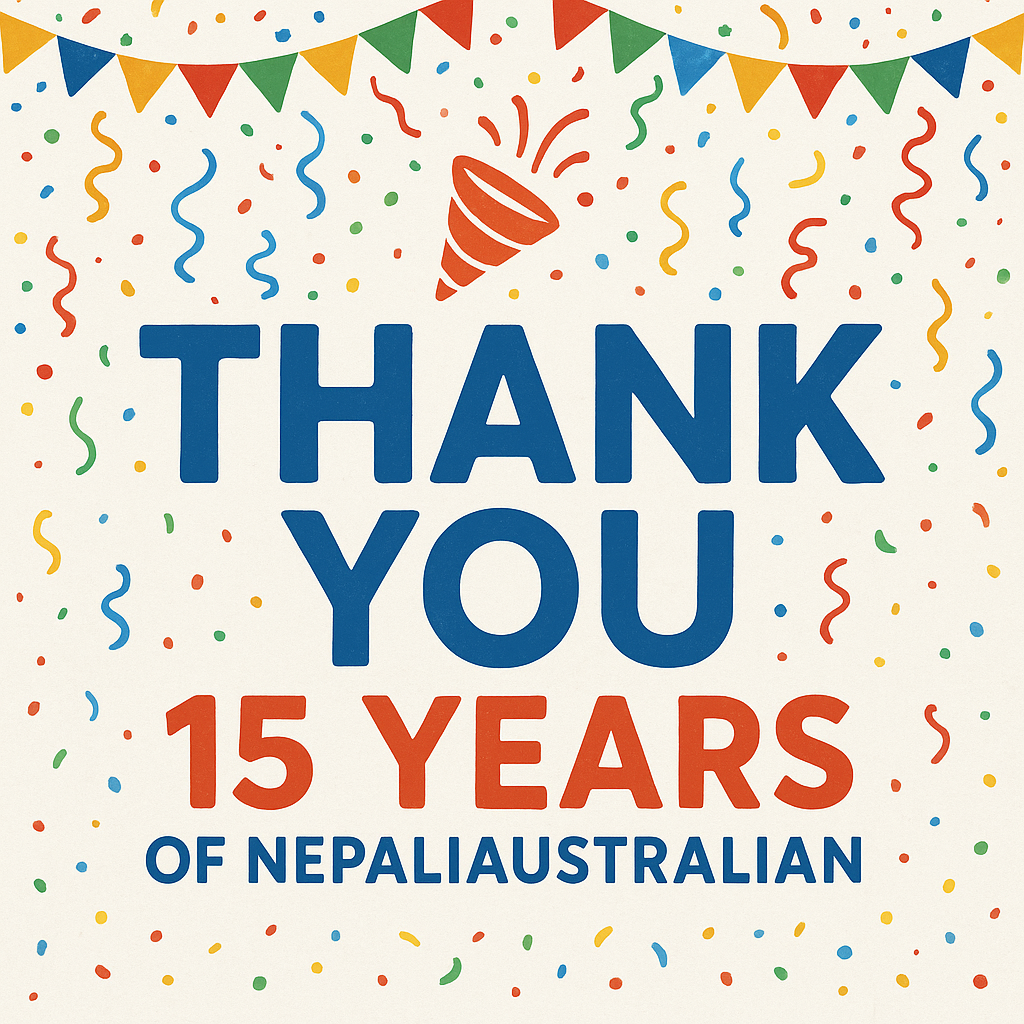
Wow — I can hardly believe it’s been 15 years of storytelling, culture-sharing, travel adventures, food experiments, motherhood moments, and little parenting wins here at Nepaliaustralian. What started as “just something to do” has become a corner of the internet that means a whole lot to me — and that’s all thanks to you.

A quick look back

For those who are newer here, here’s a peek at how this journey has unfolded:

  • I’m M, a Nepali-born IT Business Analyst by day, globetrotter at heart, a writer for the soul, and very much in love with bridging the cultures of “East” and “West” through stories, recipes, traditions, and family life
  • Nepaliaustralian isn’t just about me — it’s about all of us who know what it’s like to grow up in one culture and live in another, who miss home sometimes, who love traditions, who try cooking a dish from back home and find joy in small things like language, festivals, or simply sharing memories.

Where we are now — thanks to YOU

As of just over a year ago (when the blog turned 13), here’s what we had reached:

  • 1,109 posts
  • 81 pages
  • Over 10,700 comments (that’s you chiming in ❤️)
  • About 2.5 million page views
  • Some 1.38 million readers spanning 230 countries

And today, as we celebrate 15 years, I’m proud to see how far we’ve come — more stories, more recipes, more journeys, more words. Your support has carried this blog through all of it.

What it’s meant to me

This space has been:

  • My way to keep the language and culture alive — whether it’s Nepali or Nepal Bhasa.
  • A way to explore marriage, family, parenting, identity — the awkward bits, the surprising bits, and the really beautiful bits.
  • A reminder that even thousands of kilometres away, your stories, your love, your feedback, your comments matter.

There have been days when I wasn’t sure who was reading, or whether it would “amount to anything,” but then someone would leave a comment about missing home, or cooking a recipe you found here, or learning a word you forgot — and it’d remind me why I started.

Thank You

I owe so much to:

  • You, dear readers — for sticking with me, for reading the long posts, for sharing, for correcting me, for making suggestions, for engaging.
  • Family & friends — for patience when I disappeared on trips or got carried away writing or editing.
  • Guest writers/contributors — whose voices have enriched this place so much.
  • Every person who’s ever liked, shared, sewn, cooked, translated, messaged, snapped, or just quietly nodded along.

Without you, there is no Nepaliaustralian.

Looking ahead

Because 15 years is real, and I’m excited for what’s next:

  • More travel stories — nearer, farther, unknown places waiting.
  • More deep dives into culture, language, tradition — especially around Newari, Nepali, festivals.
  • More family stories — parenting, raising kids between homes, between cultures.
  • More recipes (of course!) and food adventures because there’s always a flavour of home to explore.
  • More connection — I hope to hear more from you: your stories, your memories, your hopes, your favourite posts, and what you want to see more of.

Here’s to 15 years. Here’s to all the words we’ve shared and will share. Here’s to you — because none of this is possible without you.

Thank you for reading, for commenting, for being here. You’re the heart of Nepaliaustralian.

With love and gratitude,

M
From Nepaliaustralian
XOXO

Nepal at a Crossroads: Reflections on a Defining Week

First of all, thank you to everyone who has reached out to me over the past few days. Your kindness has meant so much. My family in Nepal is safe, and for that I am deeply grateful.

On 8 September 2025, Nepal entered what feels like a defining moment in its history. After years of frustration with a system plagued by corruption, nepotism, and unaccountable leadership, thousands of young people — many of them students — took to the streets of Kathmandu and other cities.

The government’s sudden decision to ban 26 popular social media platforms — including Facebook, Instagram, YouTube, and X (formerly Twitter) — became the spark that ignited this uprising. But underneath it all, the real driver was anger at the corruption and dysfunction that have paralysed Nepal’s politics for so long.

For Gen Z, this ban wasn’t just about apps being switched off — it was about being silenced. And this generation decided they would no longer accept that. What began as peaceful demonstrations against censorship quickly transformed into a nationwide movement calling for an end to corruption and real accountability in government.

The protests started peacefully, exactly as the young people had planned — with chants, banners, and a clear call for accountability. But the government chose to confront them aggressively. In Kathmandu, as protesters tried to move closer to restricted zones around Parliament, security forces responded with tear gas, water cannons and live ammunition. What had begun as a hopeful, organised demonstration quickly spiralled into chaos.

The images and live videos were heartbreaking. Young people who had set out to make their voices heard were suddenly caught in a storm of violence. Lives were lost, many more left injured, and the streets descended into chaos. Homes, businesses, and government buildings were damaged or set ablaze. What started as a hopeful demand for change turned into scenes of destruction and grief.

As the protests grew, so did the confusion. Social media feeds were flooded with conflicting reports, rumours, and fake news. Some accounts exaggerated events, while others downplayed them. For those of us following from outside, it was incredibly difficult to know what was real. Sorting fact from fiction became one of the hardest parts of understanding what was happening — a reminder of just how dangerous misinformation can be in moments of crisis.

The human cost has been devastating. At least 51 people have been killed so far, including protesters, police officers, and bystanders. Thousands more have been injured. Families have been torn apart in the process.

The political consequences have been equally dramatic. Home Minister Ramesh Lekhak resigned, taking moral responsibility for the bloodshed. The government, under immense pressure, was forced to lift the social media ban that had sparked the protests. And in the most significant shift yet, Prime Minister K.P. Sharma Oli stepped down.

Nepal’s Parliament has been dissolved, and a historic transition is now underway. Former Chief Justice Sushila Karki has been appointed as the interim Prime Minister, becoming the first woman ever to hold the role. New elections have been scheduled for 5 March 2026 — a date many Nepalis are already marking with both hope and uncertainty.

Like so many others, I feel shock, sadness, and anger. It’s hard to comprehend how quickly things escalated, and how many lives have been lost or disrupted. Yet, amid the grief, there’s something powerful about seeing people — especially the youth — stand together and say “enough is enough.”

Nepal is at a crossroads. Change is never easy, and it often comes at a painful cost. But I truly hope this moment becomes the turning point that leads to real accountability, genuine reform, and a brighter future for the country I love.

Please follow me on Instagram! and Please follow me on TikTok to stay updated on my adventures.

Take care,

M from Nepaliaustralian
XOXO

🌸 Shrawan Celebration 2025 – A Night to Remember 🌸

This year, the month of Shrawan felt truly unforgettable for me. 🌿 In Nepal, Shrawan is such a meaningful month. It’s the time when many people devote themselves to Lord Shiva, wear green bangles and outfits, and take part in fasting and prayers. It’s also when friends and family come together, enjoy each other’s company, and celebrate the joy of life.

To make it special, I invited my neighbours over for a little celebration at home. What started as a simple idea turned into one of the best evenings I’ve had in a long time. We had so much laughter, good food, music, and even a bit of dancing. The highlight for many of us was the mehendi session — sitting together, drawing henna designs, and showing them off afterwards added such a festive touch. The smell of fresh mehendi, the bright green bangles, and all the colours around us really brought out the Shrawan spirit.

It reminded me how beautiful it is to celebrate traditions not just for their religious value, but also for the way they bring people closer. Having my neighbours join in, share stories, and enjoy the evening made it feel like we weren’t just celebrating Shrawan, but celebrating friendship, community, and togetherness.

This Shrawan left me with a heart full of gratitude, and I’m already excited to carry on this little tradition in the years ahead. 💚✨

Please follow me on Instagram! and Please follow me on TikTok to stay updated on my adventures.

Take care,

M from Nepaliaustralian
XOXO

Nepal Bhasa Bites: Lesson 7 : Colours

Nepal Bhasa, also known as Newar language, is the mother tongue of the Newar community, the indigenous people of the Kathmandu Valley in Nepal. With its rich literary tradition, unique script, and deep cultural significance, Nepal Bhasa is more than just a language—it’s a living heritage that carries centuries of history, art, and identity. Although it has faced challenges over time, recent efforts have sparked a revival, with younger generations taking pride in learning and preserving it. Whether you’re a language enthusiast, part of the diaspora, or simply curious, exploring Nepal Bhasa opens a beautiful doorway into the vibrant world of Newar culture.

Here is Lesson 7 : Colours
Let’s begin.

If you spot any mistakes, please don’t hesitate to correct me. I greatly value your feedback and suggestions.

Please check all Nepal Bhasa posts here.

M from Nepaliaustralian

XOXO

Please follow me on Instagram! and Please follow me on TikTok

Nepal Bhasa Bites: Lesson 6 : Family & Relations

Nepal Bhasa, also known as Newar language, is the mother tongue of the Newar community, the indigenous people of the Kathmandu Valley in Nepal. With its rich literary tradition, unique script, and deep cultural significance, Nepal Bhasa is more than just a language—it’s a living heritage that carries centuries of history, art, and identity. Although it has faced challenges over time, recent efforts have sparked a revival, with younger generations taking pride in learning and preserving it. Whether you’re a language enthusiast, part of the diaspora, or simply curious, exploring Nepal Bhasa opens a beautiful doorway into the vibrant world of Newar culture.

Here is Lesson 6 : Family & Relations
Let’s begin.

If you spot any mistakes, please don’t hesitate to correct me. I greatly value your feedback and suggestions.

Please check all Nepal Bhasa posts here.

M from Nepaliaustralian

XOXO

Please follow me on Instagram! and Please follow me on TikTok