Category Archives: Travel

Piazza di Trevi, Spanish Steps and Dinner: Rome, Italy

On our first day in Rome, we went to the Trevi Fountain and Spanish Steps and then ended in Italian restaurant.

The Trevi Fountain

The Trevi Fountain is a fountain in the Trevi district in Rome, Italy. Standing 26 metres (85.3 feet) high and 20 metres (65.6 feet) wide, it is the largest Baroque fountain in the city and one of the most famous fountains in the world.
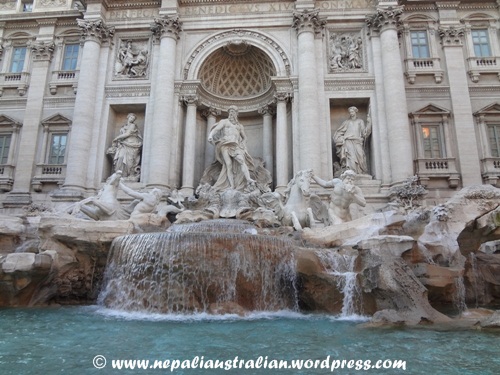
The fountain gets its name from the fact that it sits at the junction of three roads or in Italian “tre vie”. Traditionally Romans built rather elaborate fountains at the terminal point of their aqueducts.

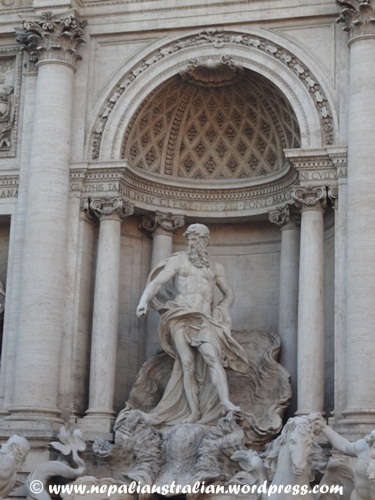
Supplied by water from the Acqua Vergine aqueduct and a triumph of the baroque style, it was based on the design of Nicolo Salvi and was completed in 1762. The design centres on the triumphant figure of Neptunus Rex, standing on a shell chariot drawn by winged steeds and led by a pair of tritons. Two allegorical figures in the side niches represent good health and fertility.
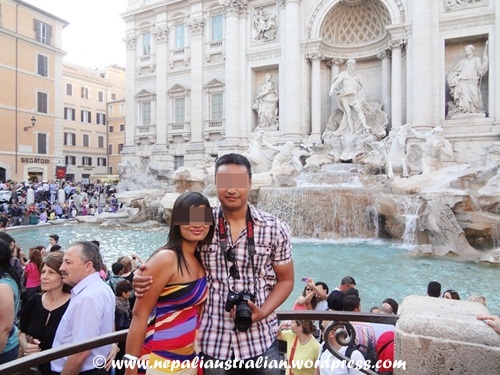
The legend has it that if you throw a coin into this fountain it guarantees your return to Rome. An estimated 3,000 euros are thrown into the fountain each day. The money has been used to subsidize a supermarket for Rome’s needy; however, there are regular attempts to steal coins from the fountain.
The Trevi Fountain is beautiful, but it can also be overwhelmingly crowded, so keep an eye out while you take pictures and hold on tight to your bags. We were told by our guide again and again to beware of pickpocket so we were very careful when we were in the crowd.

Spanish Steps

The Spanish Steps are a set of steps in Rome, Italy, climbing a steep slope between the Piazza di Spagna at the base and Piazza Trinità dei Monti, dominated by the Trinità dei Monti church at the top. The monumental stairway of 138 steps was built with French diplomat Étienne Gueffier’s bequeathed funds of 20,000 scudi, in 1723–1725, linking the Bourbon Spanish Embassy, and the Trinità dei Monti church that was under the patronage of the Bourbon kings of France, both located above — to the Holy See in Palazzo Monaldeschi located below.
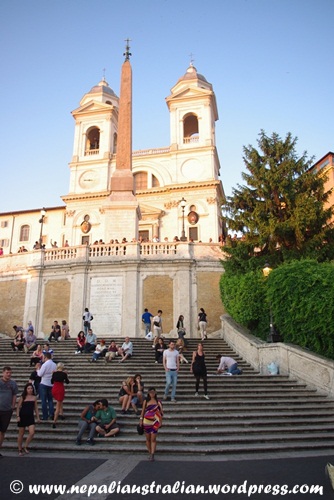
The Spanish Steps are the longest and widest staircase in Europe.
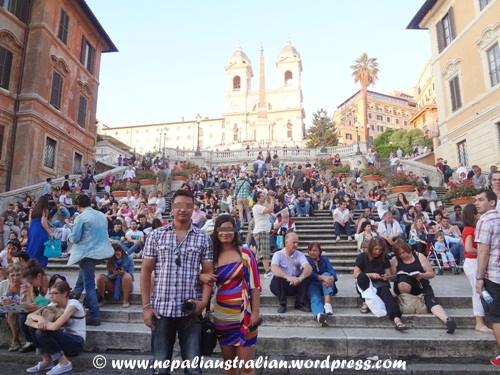
We stopped there on the way to the restaurant for our dinner. There were lots and lots of people everywhere; basically it is a set of steps with the church on the top and fountain at the bottom. But it had the vibe like the Times Square in New York with lots of people on the steps or around the fountains taking pictures, having their lunch or just reading a book.

We climbed the stairs and went to the top of the stair and it was amazing to see so many people from the top.
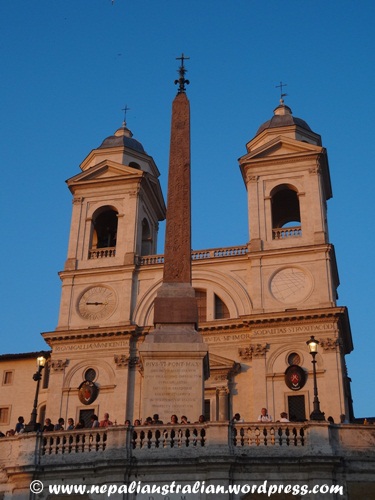
The streets nearby are full of up-market designer shops likes of Gucci, Max Mara, Salvatore Ferragamo, Giorgio Armani and Louis Vuitton as well as bars and restaurants and are enjoyable to stroll around in.

If you are tired and want to rest for a while it is a good place to stop while you are in Rome but for us we had around an hour there and it was time for us to meet our guide to go for our dinner.

Disappointing Italian dinner

After our mini tour of Rome, we went to an Italian restaurant for dinner. I have to say this was one of the places where I was disappointed with the food as well as the restaurant itself.

We went to this restaurant and they served us a four course meal.  They started with salad and Bruschetta, followed by Pasta. Then the main was Chicken or Beef and dessert was ice cream with fruits.  Even with so much food, it was just an average experience. There were two musicians playing music during the whole time and a waiter was giving red roses to all the ladies. I found the food bland and the place too crowded.

Inspite of the dinner, overall we had a great day.

Please click here for more photos.

Helensburgh Hindu temple

I am sure you get the vibe from my blog that I am not a very religious person but I do enjoy going to the temple occasionally. My husband always reminds me how religious my mum is and he finds it a bit surprising that I am not like my mum in the religion department. I always tell him, “If I have a clean heart and make sure that I am not hurting anyone in my day to day life, God will consider me as a good citizen and will be happy with me. There is no need to really visit a temple all the time or pray for hours :)”.

There are not that many Hindu temples in Sydney and most of them are not close to where I live so planning is required to visit one.

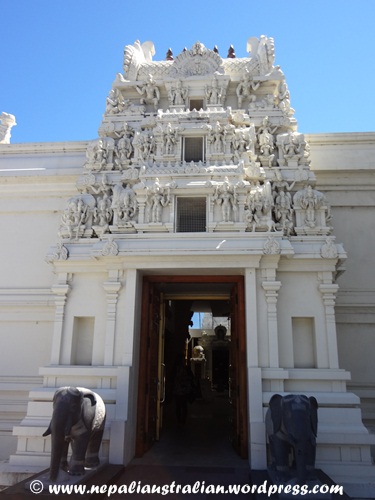
From time to time I feel like I should go to the temple and pay my respect so I drag my husband along for some prayer. Last weekend we managed to go to a temple in Helensburgh called Sri Venkateswara Temple. It is around 45 minutes’ drive from my apartment or an hour from Sydney city center (55km). The temple is built on top of a hilly area 400 feet above sea level. It has four ‘praharam’ (encircling corridors). Sri Venkateswara Temple was built in 1978 by the Indian people in Australia as a South Indian-style Hindu temple.

So far there is no Nepali temple in Sydney but they are planning to build a version of Nepal’s famous Pashupathi in Sydney.

At the temple devotees are supposed to leave their footwear outside and wash their hands and feet before they enter the temple. The temple area inside has small shrines for each of the Gods. There are priests performing rituals at each of the shrines at a pre-determined time.

There is a temple counter inside which provides visitors with more information about temple rituals and prayers.  They also sell puja for $15 which goes towards maintenance of the temple. You get a plate of puja which has Sindoor, flowers, dhup and fruits. Also, you can buy diyo (oil lamp) if you want to light just the diyo.

The temple has deities like Lord Venkateswara, Goddess Mahalakshmi ,Lord Chandramouleeswarar, Goddess Thripurasundari , Lord Ganesh, Lord Subrahmanya , Lord Navagraha, Goddess Durgambika , Lord Rama , Goddess Andal , Lord Krishna, Lord Brahma , Lord Hanuman, Lord Garuda  , Lord Sudharsana , Lord Viswakshena , Lord Dhakshinamurthy and Lord Chandikesa.

I have seen lots of South Indian weddings being performed inside the temple in my previous visits.

I know it doesn’t sound so right but I love to go to this temple because they serve a great Indian food in their canteen during weekends. I always have Masala Dosa (made by stuffing a lightly cooked filling of potatoes, fried onions and spices in a fermented crepe or pancake made from rice batter and black lentils) and Vada (a donut  shaped dish made from lentils and gram flour or potato) . They are so cheap but so yummy. They do sell other South Indian vegetarian dishes as well but those two are my favourite especially with masala tea (spiced Indian style milk tea).

The temple opens 8am – 7pm, week-ends and public holidays; 8.00am to 12.00pm and 4.00pm to 7.00pm on weekdays.

Sistine Chapel : Vatican

Before I had visited Vatican I knew about Sistine Chapel but it had never interested me. But I was in awe of the whole place when I got there. I think the biggest credit goes to our guide who was so good at explaining all the details about the chapel that I wanted to share the information with all of you. I am sure many of you know a lot about this famous chapel already but I still am sharing what I learned.

As you know I am not a Christian but still the history behind the chapel is so interesting that anyone will fall in love with this architectural beauty and its frescos by Renaissance artists including Michelangelo, Sandro Botticelli, Pietro Perugino, Pinturicchio and others.

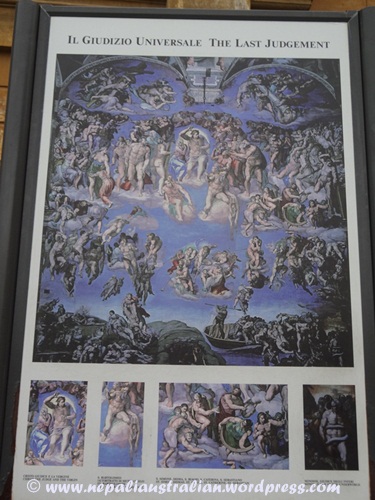
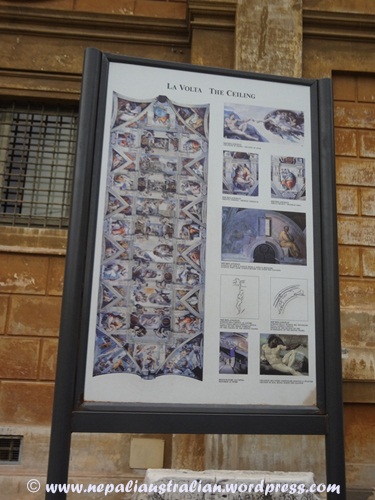
When we entered the Sistine Chapel, no photography was allowed but these are photos I took in the garden where the guide explained the detail about the chapel. Rest of the photos are from the internet.(I have no idea how they managed to take these photos.)

There are 1,100 sq. m of paintings in the chapel, and its beauty is astounding. Even though there were so many people inside the chapel, I was lost looking at the amazing pace while our guide was talking into our headphones.

From time to time I heard a guard in the Sistine Chapel enforcing the No Talking rule and hundreds of tourists instantly complied but just for a few seconds.  Then the buzz began again but I was just lost in one of history’s monumental artistic achievements.

The Sistine Chapel ceiling, painted by Michelangelo, was exhibited to the public for the first time on November 1st 1512. It was quite shocking at the time as it appears to depict an image of God – forbidden by the Church.

Michelangelo considered himself more of a sculptor than a painter, which is one reason he was reluctant to accept the commission of Pope Julius II to come to Rome and paint the ceiling of this building.  It had originally been built in the 1470s at the behest of Pope Sixtus IV.

The building had undergone some renovations due to structural flaws; Michelangelo started in on the new ceiling in 1508.  There were problems:  For one thing, he had relatively little experience with fresco.  That technique involves applying paint to wet plaster, so the artist and his assistants had to estimate how much plaster they thought they could paint before the surface dried.

Another issue was even more basic:  How do you work on a large horizontal surface that is 60 feet above the floor?  The easiest approach would have been to build scaffolding towers, but the pope and cardinals wanted the floor to be clear so they could continue holding their meetings in the chapel.

Michelangelo figured out a way to bolt the scaffolding into the side walls; he and his assistants climbed up to their perch and did that marvelous work while leaning backward.  The first half of the ceiling — the eastern side — was completed in 1510.

The scenes are all from the Old Testament and relate to rebirth and new beginnings (God creating the World, God creating Adam and Eve, Garden of Eden and Noah’s Ark) and therefore indirectly relate to how the della Rovere family helped achieve its own rebirth of the church.

Look at the interesting view of the ceiling below, the combination of large scenes combined with smaller scenes and the painted illusion of sculpture and a cornice is incredible.  Everything you see below is painted and creates both a striking illusion and a powerful narrative.

The stories were painted in backwards chronological order. You can see how much his style was changed and simplified from the first scene showing Noah and the Flood.  In that early painting the scene is crowded with figures.  His work becomes much more effective when he simplifies his style.

He uses the human figure to represent the entire story, leaving out many of the symbols, landscape and backgrounds that other artists were using.  His studies in human anatomy are evident and this key work shaped the direction of the Renaissance.


When that scaffolding was taken down, Michelangelo was dissatisfied with the result.  There were too many figures in the panels, he felt; from the floor they appeared small.  When you visit the Sistine Chapel, you’ll notice that the figures in the other end, starting with the iconic “Creation of Adam”, are larger.

There are also paintings on the walls, including some by eminent artists like Boticelli and Ghirlandaio, who was Michelangelo’s teacher.  By far the most impressive wall painting, though, is the massive “Last Judgment” behind the altar on the west end, which took Michelangelo several more years to complete.

I found this amazing 360 degree view of the Sistine Chapel online. Check out this interactive video.

http://www.vatican.va/various/cappelle/sistina_vr/index.html

Here are some interesting facts about the Sistine chapel

Sistine Chapel Fact #1:

Did you know that the Sistine Chapel was built by a Pope named Pope Sixtus the Vl, hence the name Sistine Chapel?

Sistine Chapel Fact #2:

Did you know that Michelangelo was only 32 years old when he began painting the ceiling of the Sistine Chapel and completed it in only 4 years?

Sistine Chapel Fact #3:

Did you know that the Sistine Chapel was built to house the Cardinals while they deliberated on who should become the next Pope?

Sistine Chapel Fact #4:

Did you know that the famous chimney that releases black smoke telling us the Pope has died and white smoke telling us we have a new Pope is set up in the Sistine Chapel? You can see the marks where it sits towards the back right of the chapel?

Sistine Chapel Fact #5:

Did you know that no artist in history suffered as much as Michelangelo suffered in the 4 years it took him to complete the ceiling of the Sistine Chapel? He suffered with his knees, back and neck and he still managed to live to be 89 years old.

Sistine Chapel Fact #6:

Did you know that Michelangelo painted the Last Judgement (the front wall of the Sistine Chapel) 28 years after he finished the Sistine ceiling?

Sistine Chapel Fact #7:

Did you know that Michelangelo’s enemy, Rapheal, was originally asked to paint the Ceiling of the Sistine Chapel but refused. He suggested Michelangelo knowing he was a sculpture and not a painter.

Sistine Chapel Fact #8:

Did you know that the Sistine Chapel was completely cleaned between the years 1980 to 199. It was paid for by the camera company Fuji Film. Fuji Film now own all copyright to the paintings, and that is why there is no photography allowed in the Sistine Chapel.

Sistine Chapel Fact #9:

Did you know that Pope Julius ll (the Pope that commissioned Michelangelo to paint the ceiling of the Sistine Chapel) sold Indulgences in order to pay Michelangelo for his work? Selling Indulgences meant that people could pay money to get time off Purgatory.

Sistine Chapel Fact #10:

 Did you know that there are 3 Botticelli paintings in the Sistine Chapel, painted 24 years before Michelangelo began the Ceiling?

Please click here more photos.

Chinese garden of Friendship

Last weekend, we went to visit a hidden treasure of Sydney, in the middle of the city in Darling Harbour.

Initiated by the local Chinese community to share their rich cultural heritage and celebrate Australia’s 1988 Bicentenary, the Chinese Garden is the result of a close bond of friendship and cooperation between the sister cities of Sydney and Guangzhou in Guangdong Province, China. The Chinese Garden of Friendship was designed by Sydney’s Chinese sister city, Guangzhou.

Even though I have been living in Australia for so long I have never been inside the Chinese garden. I have walked past the garden numerous times but for some reason never thought to go inside. Last weekend the weather was so good that I and my husband decided that we must go out and enjoy the sunny day. So we took a train to the city and walked to Darling Harbour from Town Hall train station.

We were in the garden by 11am and there were only 3 people on the queue to get tickets to go inside. We got the ticket and it cost us just $6.00. We started our tour from the right hand side door of the garden.

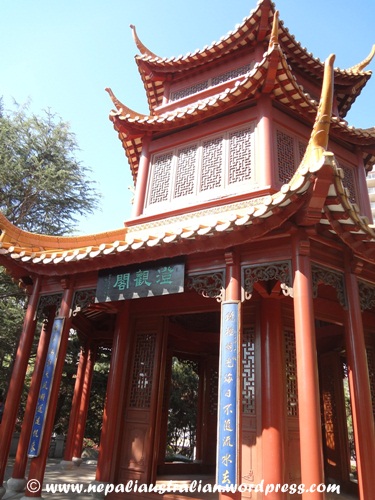
The whole garden cannot be seen from any one point within the garden. It has a number of features including the Dragon Wall symbolizing the bond between New South Wales and Guangzhou, the Water Pavilion of Lotus Fragrance, the Twin Pavilion and The Tea House that offers traditional Chinese tea and other refreshments. The garden is a popular venue for weddings, providing many beautiful backgrounds for photographs.

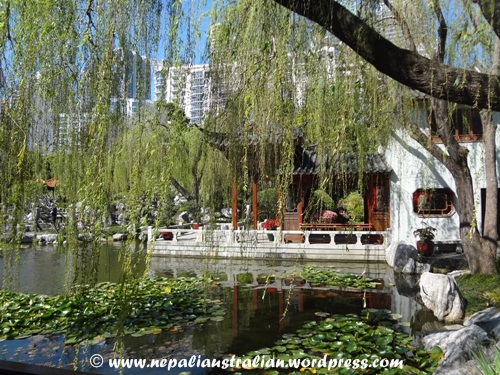
We were there to enjoy the day so we just walked around the garden and enjoyed the sun taking photos from time to time. There was a big pond in the middle of the garden and it had big colourful fishes. I actually forgot that we were in the middle of the city once we were inside. As spring has started here, there were so my beautiful flowers in the garden. I just loved everything in it: the trees, well-trimmed plants, beautiful spring flowers, calm lotus pond and the magnificent temple.

It was peaceful, serene, beautiful and calming. There is a waterfall which gives the feeling that you are in some national park. There are some alcoves to rest and overlook the whole garden to just soak in its natural beauty. We took so many photos as wherever I turned there was a beautiful view. The garden isn’t large but there are plenty of places to sit and take in the views. It took us about an hour to meander through the garden.

We saw a beautiful bridal carriage which is the imperial bridal carriage was used by Chinese Emperors in ancient times with extremely ornamental decorations. The jade carriage is typical of the historical carriages of past dynasties. It is believed 100 skilful artists were engaged in the laborious and intricate carving work. Over 300 tons of raw jade were used, the finished weight approx. 2 tons.

The carriage has a canopy decorated with entwining dragon motif with two lanterns in front. The main body of the carriage is carved into elaborate openwork of dragon, phoenix and fairies which are the symbol of Luck, Prestige and Authority. The two front shafts are cut as two lively charging dragons, guiding the carriage. Behind the carriage are two ornamental fans, which symbolise Royal Dignity.

The age and the cost of the carriage are unknown, however it is believed the carriage came from the Chinese Province of Guangdong and it is said to be the only carriage known to be outside China.

As we were walking around we saw a few people wearing traditional Chinese costumes and taking photos so we decided to find out more about it.

We found a place in one corner of garden where you can hire a costume for $10 and pretend to be a Princess/Queen/Emperor/Empress. They let you roam the garden with the costumes as long as you like and parade around the gardens and take as many photos as you like.

So me and AS decided to dress up as well and become Chinese for a while. I choose a red dress and the lady in the shop helped me to do my hair. AS choose a dark blue one and even got a long white beard to try with his costume. This was one of my favourite photos of the day.

Once we were dressed, the lady from the shop took a few of our photos. From there we walked the whole garden taking photos in different locations. We felt like we were in some movie walking around in the costumes and taking photos. Lots of people stopped to look at us and a few even asked us to pose so they could take a photo of us :). It was a really interesting experience to feel like we were in China.
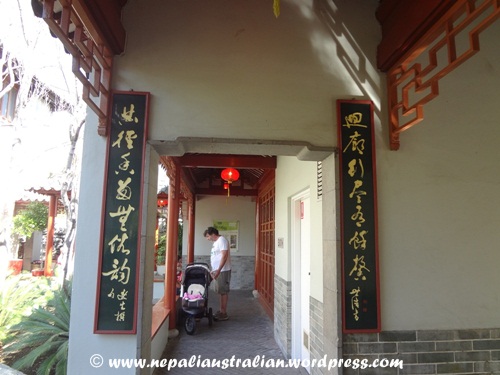
I saw two girls wearing the costumes so we took photos with them as well. It was so much fun. I really loved it.

If you feel hungry there is a teahouse. You can also hire a 45-minute audio tour in English and Mandarin, if you like.

For the price, we had an amazing day, relaxing and wonderful.

St Peters Basilica : Vatican

We went to St Peter’s Basilica on Vatican city tour.  One must wear proper cloth that covers shoulders and legs in order to go into the Basilica.

St Peter’s Basilica is the largest Christian church in the world. It is the symbolic “Mother church” of the Catholic Church and is regarded as one of the holiest Christian sites.

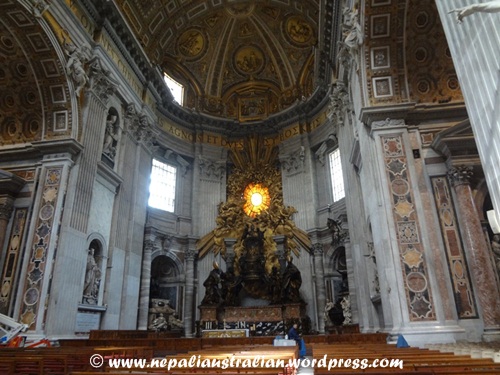
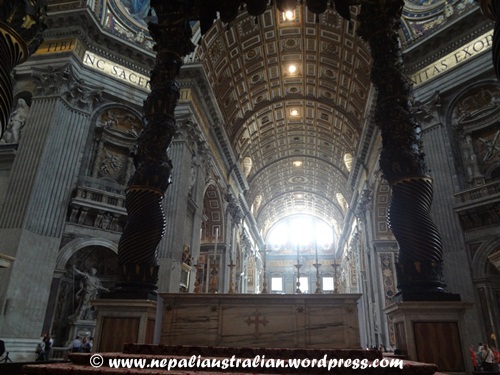
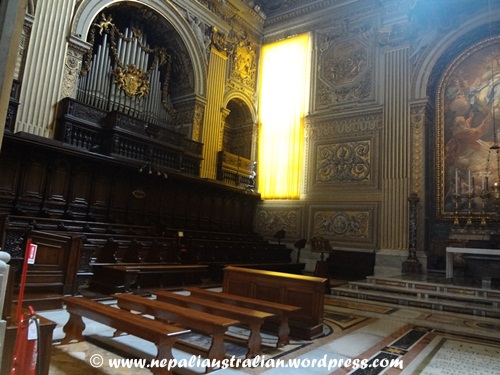
Stepping inside St. Peter’s Basilica, you can see and feel the grandness of the church.  The place is so huge and beautiful that it must have cost a fortune to construct something so amazing. The church roof was really high and the letters on the wall just below the roof were actually over 6 feet tall even though they looked so small from the floor of the church. We could see people on the gallery near the roof and they were the same size as the letters.

The big altar, the decorated ceilings, the sun shining through the stained glass windows of the basilica were just awesome and the main altar was about 10 stories high. The details on every pole were just awesome and we could have easily spent hours admiring the work of great architects and sculptures. The natural light coming from above illuminates the church and spreads subdued radiance all around.

The Papal Altar and rising above it is the Baldacchino

The altar in St. Peter’s is made of bronze, just the way the requestor wanted it to be.  The designer at the time, however, was unable to find enough bronze in all of Rome to make it.  So, the requestor told the designer to use the bronze in the Pantheon.  So, the designer went and drilled numerous holes in the Pantheon, taking out the bronze he needed to finish his work.

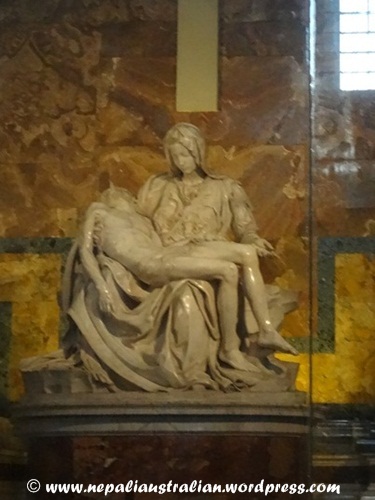
The whole church is filled with renaissance monuments, statues, trimmings, and sculptures in meticulous motifs/details and maintained in utmost attention. In there, we also saw the famous Renaissance masterpiece that was sculpted by Michelangelo called Pietà.

Pieta

The structure is pyramidal, and the vertex coincides with Virgin Mary’s head. The statue widens progressively down the drapery of Mary’s dress, to the base, the rock of Golgotha. The figures are quite out of proportion, owing to the difficulty of depicting a fully grown man cradled full-length in a woman’s lap. Much of Mary’s body is concealed by her monumental drapery, and the relationship of the figures appears quite natural. Michelangelo’s interpretation of the Pieta was far different from those previously created by other artists, as he sculpted a young and beautiful Mary rather than an older woman around 50 years of age.

Here is an interesting story behind the Pieta.

Created by Michelangelo before he was famous, Michelangelo never put his name on his works.  No matter what the work is, you can’t find his name anywhere.  There is an exception, of course.  Shortly after Michelangelo made it, another sculptor of the time began to claim that the Pieta was his work.  This was of course quickly disproven, but Michelangelo got fed up with it.  He snuck into St. Peter’s late one night, and carved this across the sash running across Mary’s breast:  MICHAELA[N]GELUS BONAROTUS FLORENTIN[US] FACIEBA[T] (Michelangelo Buonarroti, Florentine, made it).  There is one more important piece of information about the Pieta.

It sits today behind thick bullet-proof glass.

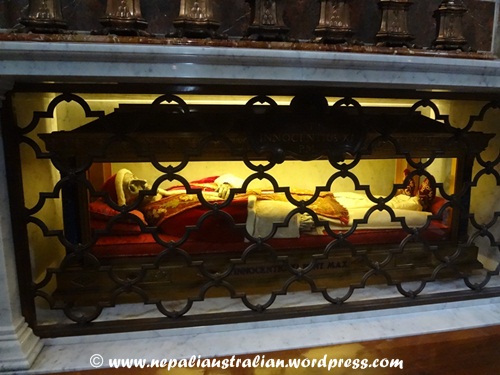
Next was the chapel of the tomb of Pope John Paul II, whose remains were placed beneath the altar.

We also saw a statue of St. Peter with the foot extremely worn down from all of the people touching it. It is believed that if you touch his foot, your wishes will be fulfilled.

The bronze statue of Saint Peter

We also had a chance to go down the grottoes, beneath the basilica, where there are many tombs. Although surrounded by tombs, it did not have an eerie feeling.

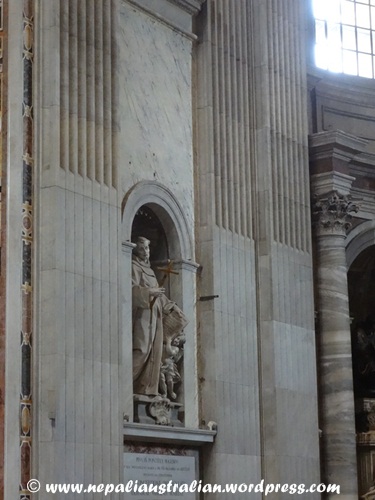
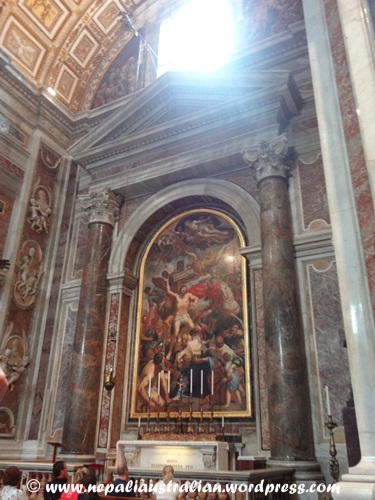
Here are few photos from the Basilica. Even though our guide told us what each of the statues and altars were about, I couldn’t recall them when I looked at the photos after coming back to Australia. Thanks to internet, I managed to identify most of them.

Altar of Falsehood

Altar of St Jerome

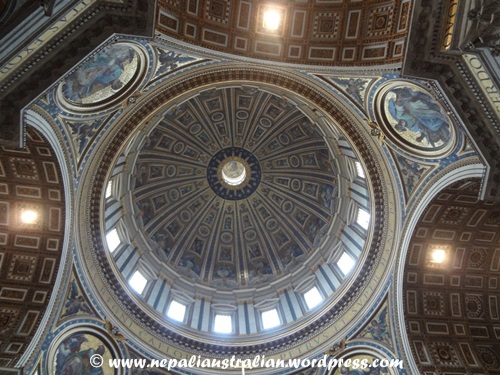
Michelangelo’s dome

Please click here for more photos.