Friday the 13th

This morning I came to work and was making breakfast in the kitchen. I was talking to my colleague while she was making her breakfast. She accidentally knocked her coffee cup and it smashed into a gazillion pieces. She was quite annoyed that she had to start the Friday morning cleaning the mess and was complaining about it. Just then one of our colleagues came in and remarked that it’s Friday the 13th today so a smashed cup isn’t unusual. It hadn’t occur to me before but after hearing him, I did some digging on the internet about it so here you go.

Normally, western society seems to be less superstitious than eastern society but Friday the 13th is a date considered to be bad luck in western superstition.

Does Friday the 13th freak you out? If so, hold on to your rabbit’s foot extra tight, because there are three of these supposedly unlucky dates in 2012, and today (July 13) is one of them, but the good news is it’s the last.

Read on for 13 strange facts about this day of superstition. (www.msnbc.msn.com)

1. This year is a special one for Friday the 13ths: There are three of them: Jan. 13, April 13 and July 13. The dates fall exactly 13 weeks apart. That hasn’t happened since 1984.

2. If that scares you, you may have paraskavedekatriaphobia (also known as friggatriskaidekaphobia). Those are the scientific terms for fear of Friday the 13th. Triskaidekaphobia is fear of the number 13.

3. It’s not clear when or why Friday the 13th became associated with bad luck. The association may be biblical, given that the 13th guest at the Last Supper betrayed Jesus. His crucifixion was the next day, apparently a Friday. Or maybe 13 suffers from coming after the more-pleasing number 12, which gets to number the months, the days of Christmas and even the eggs in a dozen. (There are also 12 signs of the zodiac, 12 gods of Olympus, 12 labours of Hercules, 12 tribes of Israel and 12 apostles of Jesus.)

4. Whatever the reason, fear of 13 has spread far and wide: Hotels and hospitals often skip the 13th floor, and even airports quietly omit gate 13 sometimes.

5. The next year in which we’ll have three Friday the 13ths is 2015. They’ll fall in February, March and November.

6. If you think your Friday the 13th is likely to be bad, be glad you aren’t a 14th-century Knight Templar. On Oct. 13, 1307, officers of King Philip IV of France raided the homes of thousands of these Crusades warriors, imprisoning them on charges of illegal activities. Though the charges weren’t proven, more than 100 died of terrible torture, according to “Tales of the Knights Templar” (Warner Books, 1995).

7. Fittingly, director of psychological thrillers Alfred Hitchcock was born on the 13th — Friday, Aug. 13, 1999, would have been his 100th birthday. Perhaps aptly titled “Number 13,” a film that was supposed to be Hitchcock’s directorial debut never made it past the first few scenes and was shut down due to financial problems. He allegedly said the film wasn’t very interesting. (Meanwhile, Fidel Castro was born on Friday the 13th, in August 1926.)

8. Why does the Friday the 13th superstition stick so firmly in our minds? According to Thomas Gilovich, who chairs the department of psychology at Cornell University, our brains are almost too good at making associations.

“If anything bad happens to you on Friday the 13th, the two will be forever associated in your mind, and all those uneventful days in which the 13th fell on a Friday will be ignored,” Gilovich said in a statement.

9. For pagans, 13 is actually a lucky number. It corresponds with the number of full moons in a year.

10. President Franklin D. Roosevelt is said to have avoided travel on the 13th day of any month, and would never host 13 guests at a meal. Napoleon and President Herbert Hoover were also triskaidekaphobic, with an abnormal fear of the number 13.

11. Mark Twain once was the 13th guest at a dinner party. A friend warned him not to go. “It was bad luck,” Twain later told the friend. “They only had food for 12.” Superstitious diners in Paris can hire a quatorzieme, or professional 14th guest.

12. Stockbroker and author Thomas W. Lawson, in his 1907 novel “Friday the Thirteenth,” wrote of a stockbroker’s attempts to take down Wall Street on the unluckiest day of the month. Reportedly, stock brokers after this were as unlikely to buy or sell stocks on this unlucky day as they were to walk under a ladder, according to accounts of a 1925 New York Times article.

13. This fear of Friday the 13th can be serious business, according to the Stress Management Center and Phobia Institute in Asheville, N.C., which, among other things, offers therapy to help people overcome their fear of the freaky Friday. Their estimates suggest hundreds of millions of dollars, up to $900 million, are lost due to people’s fear of flying or doing business as usual that day, though that number isn’t backed up with other estimates.

Do you believe in Friday 13th being unlucky?

Bath, Somerset – England

The days we did our driving trip, we went to Bath as well. It is a city in the county of Somerset in the south west of England. It took us more than 3 hours to get from Brighton to Bath and the drive was very pleasant through green fields of English country towns. When we were getting close to Bath, we saw rows and rows of terraced houses, they looked so beautiful that I almost lost control of the car in the excitement.

As we got closer to Bath, the only thing that worried me was narrow roads there. They were so tiny that I thought I couldn’t pass through with the small Volkswagen Polo we were on. Then I saw these big tours buses going from both direction and that made me even more sacred. Once we reached Bath, after wandering around for a while, we finally managed to get paid parking and were ready to start our Bath adventures.

 Bath has elegant Georgian architecture and the major attraction in Bath is the Roman baths. The ancient Romans built huge Roman Baths because of the natural thermal springs, leaving behind traces of the largest Roman baths outside of Italy. The Roman Baths are below the modern street level. There are four main attractions in Bath: the Sacred Spring, the Roman Temple, the Roman Bath House and the Museum holding finds from Roman Bath. The buildings above street level date from the 19th century.

From Roman Bath, we then went to Bath Abbey which is a Church of Saint Peter and Saint Paul. The work on the church made me think of Westminster Abbey (which I had only seen on TV but was going to see in London the next day). It was a really nice building both from the outside as well as the inside.

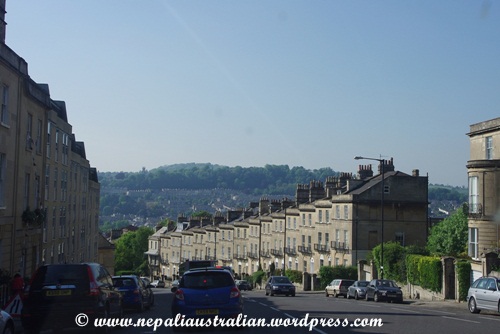
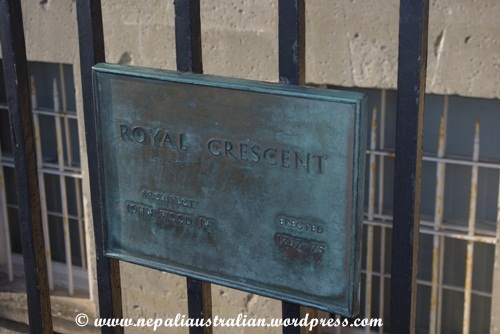
From there we went to the Royal Crescent via the Royal Avenue. The Royal Crescent was really impressive and looked so beautiful with its Georgian architecture. It is a residential row of 30 houses laid out in a crescent. From the convex side the whole complex looks like one long building shaped like a crescent. It was designed by the architect John Wood the Younger and built between 1767 and 1774 and it is among the greatest examples of Georgian architecture. The houses in the Crescent are a mixture of tenures — most are privately owned but a substantial minority of the property is owned by a housing association.

Number 1 Royal Crescent is a museum, which was then being renovated, is maintained by the Bath Preservation Trust. It illustrates how wealthy owners of the period might have furnished such a house.

I really loved the idea of so many houses looking the same. When we went closer to these houses, we saw that they had different coloured door but apart from that everything else looked the same. Even after 300 years they looked solid and beautiful and definitely well preserved. In front of the Royal Crescent, there is a big park and there were hundreds of people basking in the sun. Most of them seemed to be young and having fun with BBQ and Frisbees while others were just lying around soaking up the sun and enjoying the sunny English day.

From there we walked towards the Royal Circus. It is also a place surrounded by large townhouses build in a circle divided into three segments of equal length, each of the curved segments faces one of the three entrances, ensuring that whichever way a visitor enters there is a classical facade straight ahead.

In Bath, everywhere I looked, there was a house or shops so rich with history that it made me wonder how the people who lived there must feel. Even the cobble stoned roads still had a classical look. You could see flowers decorating the road sides and in lots of small cafes and restaurants. We stopped at one of the cafés, called The Bridge Coffee Shop, to have some coffee and cake and were very surprised to see the prices. It was £ 2.50 for a coffee and £3.50 for a cake to take away while £3.50 for a coffee and £4.50 for a cake to eat in. We decide to get a take away and then went to a park in front of the Bath Abbey.

After our coffee break we passed through the famous Pulteney Bridge that crosses the River Avon. The bridge had a flower shop, an antique map shop, and a juice bar. In the river below there was a cruise boat and along the river bank, there was a walking track and beautiful gardens.

After walking around Bath for a while, it was time for us to get back to Brighton as it was a 3 hour drive. This time we took a freeway via Oxford and Reading. The sun was setting by the time we reached Brighton and AS took some beautiful shots of the setting sun.

Please click here for more photos.

Learn Nepal Bhasa / Newari – Chapter 10

English Nepal Basa
Water lah
Cooking pot Ka-sah-ri
Cup Ka-yah (-yo)
Fork Kaa-taa
Griddle Dwaah
Kitchen knife Ku-inn
Ladle Dha-wah
Pan Taa-kyaa
Pitcher Ghah
Plate De-maa
Spatula Cha-tann
Spoon Cham-chaa
Stove Bhu-tuu(-too)
Utensils Tha-la-ba-la
Beans Buu-bah (boo-)
Breakfast Kau-laa
Meat Laa
Minced meat Chunn-laa
Chicken meat Khaa-yaa laa
Curry Ka-waaph
Dinner Be-li (belly)
Egg Kheynn
Feast Bhway
Fish Nyaa (Kenya)
Fruits Si-saa-bu-saa
Lunch Jyah-naa
Relish a-chaar
Rice Jaa
Snack Tuch-chaa

Please click here for previous chapters.

Learn Nepal Bhasa / Newari – Chapter 9 – Things

English Nepal Basa
Bag Mhi-chaa
Basket Daa-laa
Bell Gaa (nasal)
Book Sa-phuu
Broom Tu-phi
Cap Ta-pu-li
Comb Ka-ki-chaa
Glasses Chas-maa
Key Taah-chaa
Paper Bhoo
Rope Khi-pah (-paw)
Soap Saa-buu
Stick Ka-thi
Straw mat Su-kuu (-coo)
Towel Ru-maal
Umbrella Ku-saa
Ash Nau
Betel leaf/nut Gwaah/gway
Branch Si-maa ka-chaa
Clay Chaa
Dream Mah-gas
Ghost Sik (seek)
Help Gwaa-haa-li
Idiot Gwaa-jyah
Love Ma-ti-naa
Money Dhya-baa
Sand Phi
Stone Lwa-haa
Thief Khuu
Wage Jayaa-laa
Wood Sii
Work jyaa

Please click here for previous chapters.

Stonehenge : England

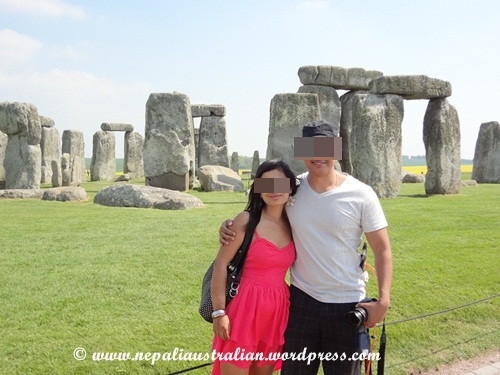
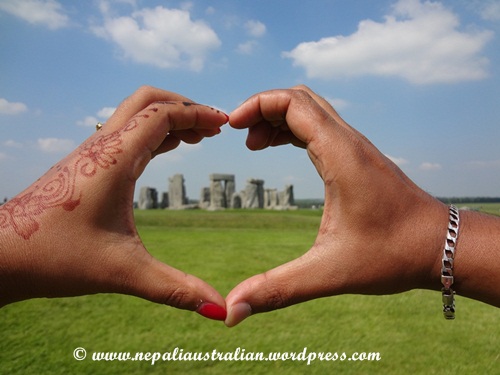
I had always been fascinated by Stonehenge as there is so much mystery surrounding it. So when we were in England, I made sure to go and visit it. We drove through the beautiful landscape of county of Wiltshire, 13km north of Salisbury and arrived at Stonehenge. The day was quite sunny , we parked the car and hurried towards the fence surrounding the henge to look at it closely. As we walked along the fence for a while, we couldn’t find the entrance. I had to ask one of the passerby and he showed me the way, which was next to the parking lot. All the people we had seen close to the fence were not planning to go inside so they were just looking at it through the fence.

While doing my research, I found that lots of people were disappointed that they were not allowed to walk among the stones. From what I read they were not happy that they were really far from the stones and but not so with me. I really loved the place.

As there were no queues to go inside, we paid £7.80 per person grabbed a couple of audio guides and walked through a tunnel under the road that separated the parking space from the henge and a staircase to go up to the Stonehenge. The audio guide can play in several languages and can be stopped and started at each point on the tour which worked well and allowed everying to go at their own pace. As it was a warm summer day, the place looked beautiful with this massive field of green grass around the Stonehenge. There were busloads of tourists everywhere and it was a bit crowed but me and my husband just took our time to look around. There was a path around the Stonehenge which had markers with number for the self-guided audio tour.

It was nice to know the history of the place. Around 8,000 BC, as the early humans discovered agriculture and farming, they dug five huge mastholes near what would later be Stonehenge.  Today, the Stonehenge parking lot covers the location of those mastholes and the only indication that prehistoric activity once took place at that spot is a round white circle which could very well be confused with a roundabout marker.

In 5,000 years, the early human civilizations advanced and developed.  They became nomads, conquerors, architects and sculptors.  They developed communities oriented around farming and hunting, domesticated ancient cows and buffalo, and wandered far across the earth to gather materials and equipment to celebrate their faith and beliefs.  And, it is around this time that the prehistoric humans in England discovered the circle.  Just as the ancient Egyptian monuments were mostly triangular and pyramidal, the henges are primarily circular or oval.

So, what is a henge?  A henge is identified by a circular ditch with an internal bank, with or without monuments in the center.  There are hundreds of henges scattered across England but the most famous are the ones in the Salisbury area.

Stonehenge was the centre of ancient Britain, according to a study which claims the monument symbolised the unification of eastern and western communities. A new study by researchers from five British universities suggests Stonehenge may in fact have been built as a sign of peace between people from the east and west of the country after a period of conflict.

The stones, which come from different locations as far afield as southern England and west Wales, may have been used to represent the ancestors of some of Britain’s earliest farming communities, researchers suggest.

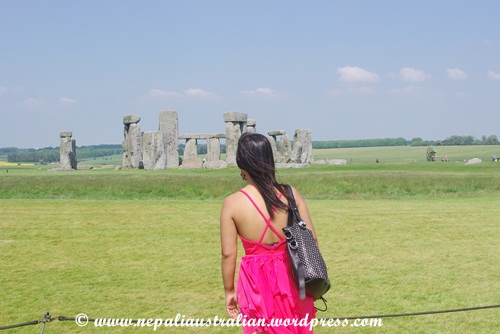
As we follow the path when we got to the area where we could see the stone from closest point on the path, it looked amazing and I can’t even imagine how people thought of making something so massive. Stonehenge looked different from different angles and it still seemed so mysterious with its grand presence.

As we continue to circle around Stonehenge, we came across a large stone called the Heel stone. It is a 16 feet long tertiary sandstone.

 After we finish our walk around Stonehenge, we stopped in front of the exit and looked at it again. It feels as if I was looking at a piece of history which is so mysterious and at the same time so beautiful.

 Here are some facts of Stonehenge.

  • Stonehenge was built between 3100 – 1100 BCE.
  • The circle was aligned with the midsummer sunrise, the midwinter sunset, and the most southerly rising and northerly setting of the moon.
  • The ground plan and structural engineering of Stonehenge incorporate sophisticated mathematical and geometrical understandings on the part of its builders.
  • There were two types of stones used in its construction: the ‘bluestones’ (weighing as much as four tons and brought from 240 miles away) and the Sarsen stones (averaging eighteen feet in height and twenty-five tons in weight).
  • It has been estimated that the construction of Stonehenge required more than thirty million hours of labour.
  • More than nine hundred stone rings exist in the British Isles. Of these, Stonehenge is the most well-known.
  • The megalithic monuments of Britain and Europe predate those of the eastern Mediterranean, Egyptian, Mycenaean and Greek cultures.
  • The Druids had nothing to do with the construction of the stone rings. Druids are known to have conducted their ritual activities mostly in sacred forest groves.

Please click here for more photos.