Lately, my husband and I have been making an effort to stay active together, and it’s been such a great experience. We do whatever we can — sometimes it’s a morning walk, other times an evening stroll after work, or even joining a local community fitness session at the park on weekends.
It’s not about sticking to a strict schedule; it’s about finding time to move, unwind, and enjoy each other’s company while doing something healthy. Even on busy days, just a short walk makes such a difference — it helps us clear our minds, catch up, and feel re-energised.
What I love most is that we keep it simple and fun. Some days we’re full of energy, other days we take it slow — but we always encourage each other and make it part of our routine. At the end of the day, it’s all about balance, laughter, and spending quality time together while keeping fit.
Here’s to more walks, more sunshine, and staying healthy together. 🌿💪
This weekend will be one to remember! A few of us friends came together to recreate a traditional Newari bhoj (feast) right here in Sydney, and it turned into an incredible celebration of food, friendship, and culture.
Since moving here, we’ve always talked about how much we miss home — the gatherings, the laughter, the aroma of spices filling the air during family feasts. So this time, we decided to make it happen. We planned a full traditional bhoj, cooked everything from scratch, and recreated the full Newari dining experience — sitting on the floor, eating with our hands on lapate patta (leaf plates), and sharing every dish with love and pride.
From early morning prep to the last round of washing up, everyone was involved — chopping, frying, marinating, and tasting. The kitchen was buzzing with excitement, the music was playing, and the smell of roasted spices and garlic was everywhere.
Our Newari Bhoj menu was truly a feast for the senses:
🍚 Chura (Beaten Rice) – Light and crisp, the perfect base to go with every dish. 🥢 Bhatmas (Roasted Soybeans) – Crunchy and salty, perfect to nibble on while serving. 🍳 Anda (Egg) – Fried sunny side up and also served on top of aalu-wo — a must-have in any bhoj! 🥩 Chhoyela / Chhwela – Spicy grilled meat with roasted garlic, ginger, and mustard oil — smoky, juicy, and full of flavour. 🥔 Aalu Tama – A tangy and hearty curry made with potatoes, bamboo shoots, and black-eyed peas. 🥞 Bara/Wo – Traditional black lentil patties fried to perfection, topped with egg and minced meat. 🥒 Bodi Sadeko – Marinated black-eyed beans mixed with onions, chillies, garlic, and coriander — spicy and refreshing. 🥬 Saag – Sautéed leafy greens, simply cooked but full of flavour. 🥦 Cauli Aloo Tarkari – Cauliflower and potato curry with turmeric, cumin, and a touch of tomato. 🥔 Aloo Achar – Spicy potato pickle with sesame paste and a tangy kick. 🍅 Tomato Achar – Fresh, zesty tomato pickle with garlic and coriander — a perfect balance for the rich dishes. 🐟 Fish Curry – Tender fish cooked with aromatic spices and herbs. 🍖 Sekuwa – Juicy grilled meat, smoky and perfectly charred. 🍶 Newari Raksi – The traditional homemade spirit — smooth, warm, and perfect for the occasion. 🥩 Takha – Savoury jelly made from buffalo meat broth, a true Newari delicacy. 🍲 Paau Qwaa – Warm, spicy soup that brings comfort to the end of the meal. 🍦 Dhau (Yoghurt) – Sweet and creamy — the perfect way to finish the bhoj.
Once everything was ready, we arranged the lapate patta, sat cross-legged on the floor, and served each dish in the traditional sequence. It felt like being back in Kathmandu during festival time — laughter, chatter, and the clinking of glasses filled the room. Everyone had their hands full of food, their hearts full of memories.
What made it even more special was how everyone contributed — someone brought fresh ingredients, someone took charge of the grill, and others helped decorate and serve. Cooking together made us feel connected — not just to each other, but to our roots, our family traditions, and the essence of being Newar.
This wasn’t just a meal — it was a celebration of heritage, togetherness, and belonging. In the heart of Sydney, for a few hours, it felt like we were back home — sharing love and laughter over a lapate patta full of food that carried generations of stories.
Here’s to keeping our Newari culture alive no matter where we are — through food, friendship, and shared memories.
This year’s Tihar has been truly special for me. It’s our second biggest festival, and it goes on for five beautiful days filled with light, laughter, music, and togetherness. Since moving to this new place, I’ve been lucky to be surrounded by a wonderful Nepalese community — and celebrating Tihar here has been nothing short of amazing.
Each day of the festival brought its own charm and meaning: ✨ Day 1 – Kaag Tihar (Crow Day): We started by offering food to crows, messengers of Yama, the god of death, to ward off sadness and bad news for the coming year.
🐕 Day 2 – Kukur Tihar (Dog Day): We honoured our loyal friends — dogs — by placing garlands, tika, and delicious treats for them. Seeing everyone’s pets proudly wearing flowers and tikas was heartwarming.
🐄 Day 3 – Gai Tihar and Laxmi Puja: Morning began with worshipping cows, a symbol of prosperity and motherhood. As the evening arrived, we lit up our homes with diyas and candles to welcome Goddess Laxmi. The streets shimmered with light, and the air was filled with laughter, music, and the scent of incense.
👭 Day 4 – Govardhan Puja / Mha Puja: This day felt especially meaningful as we performed Mha Puja — a beautiful ritual of self-purification and self-respect. We celebrated life and energy with our family and neighbours, creating a deep sense of connection and gratitude.
🎶 Day 5 – Bhai Tika: The final day was emotional and full of love — sisters placing tika on their brothers’ foreheads, wishing them long life, happiness, and prosperity.
Throughout these five days, the best part was coming together with our neighbours to play Deusi–Bhailo every evening. We went from house to house singing, dancing, and sharing laughter. Everyone contributed — some cooked, some sang, some played the madal or guitar — and every night ended with food, stories, and joy.
This Tihar reminded me of home — of warmth, light, and community. It wasn’t just a festival; it was a celebration of connection, tradition, and belonging.
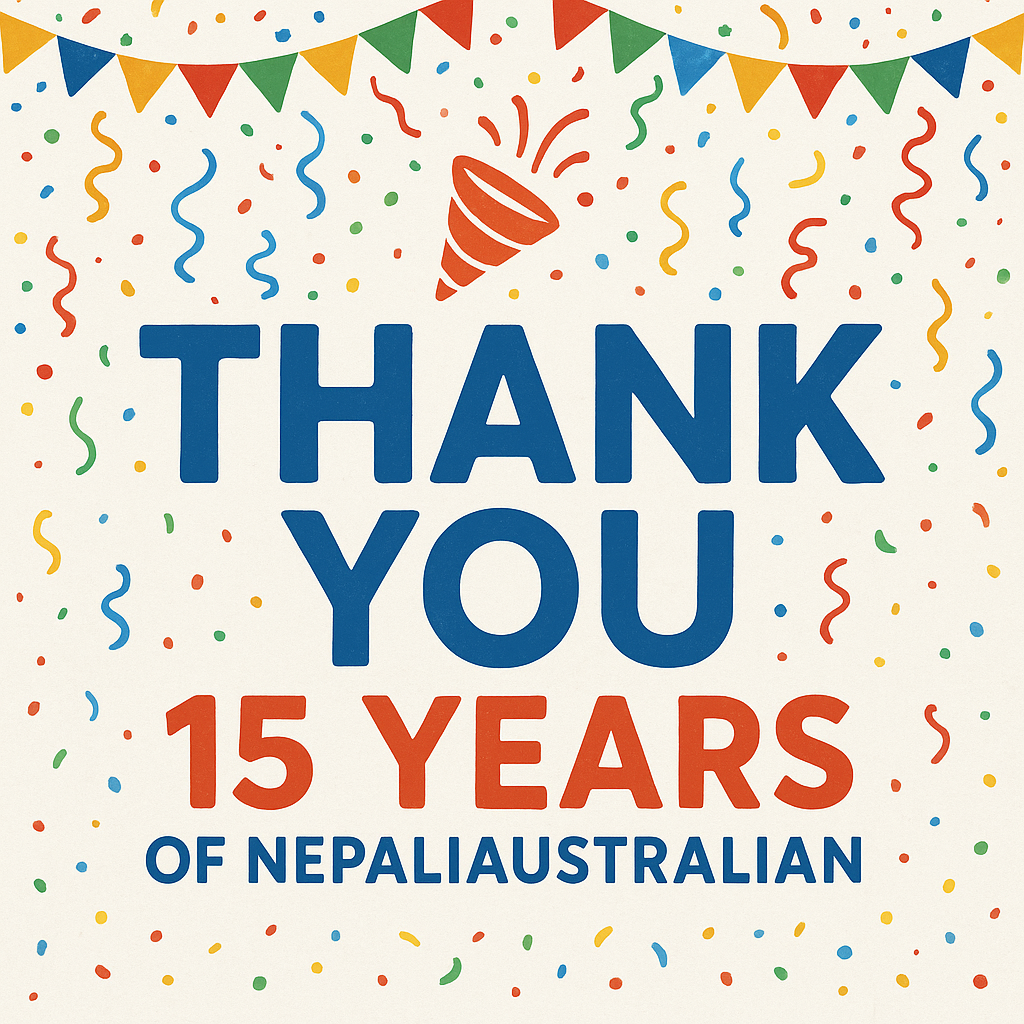
Wow — I can hardly believe it’s been 15 years of storytelling, culture-sharing, travel adventures, food experiments, motherhood moments, and little parenting wins here at Nepaliaustralian. What started as “just something to do” has become a corner of the internet that means a whole lot to me — and that’s all thanks to you.
A quick look back
For those who are newer here, here’s a peek at how this journey has unfolded:
I’m M, a Nepali-born IT Business Analyst by day, globetrotter at heart, a writer for the soul, and very much in love with bridging the cultures of “East” and “West” through stories, recipes, traditions, and family life
Nepaliaustralian isn’t just about me — it’s about all of us who know what it’s like to grow up in one culture and live in another, who miss home sometimes, who love traditions, who try cooking a dish from back home and find joy in small things like language, festivals, or simply sharing memories.
Where we are now — thanks to YOU
As of just over a year ago (when the blog turned 13), here’s what we had reached:
1,109 posts
81 pages
Over 10,700 comments (that’s you chiming in ❤️)
About 2.5 million page views
Some 1.38 million readers spanning 230 countries
And today, as we celebrate 15 years, I’m proud to see how far we’ve come — more stories, more recipes, more journeys, more words. Your support has carried this blog through all of it.
What it’s meant to me
This space has been:
My way to keep the language and culture alive — whether it’s Nepali or Nepal Bhasa.
A way to explore marriage, family, parenting, identity — the awkward bits, the surprising bits, and the really beautiful bits.
A reminder that even thousands of kilometres away, your stories, your love, your feedback, your comments matter.
There have been days when I wasn’t sure who was reading, or whether it would “amount to anything,” but then someone would leave a comment about missing home, or cooking a recipe you found here, or learning a word you forgot — and it’d remind me why I started.
Thank You
I owe so much to:
You, dear readers — for sticking with me, for reading the long posts, for sharing, for correcting me, for making suggestions, for engaging.
Family & friends — for patience when I disappeared on trips or got carried away writing or editing.
Guest writers/contributors — whose voices have enriched this place so much.
Every person who’s ever liked, shared, sewn, cooked, translated, messaged, snapped, or just quietly nodded along.
Without you, there is no Nepaliaustralian.
Looking ahead
Because 15 years is real, and I’m excited for what’s next:
More travel stories — nearer, farther, unknown places waiting.
More deep dives into culture, language, tradition — especially around Newari, Nepali, festivals.
More family stories — parenting, raising kids between homes, between cultures.
More recipes (of course!) and food adventures because there’s always a flavour of home to explore.
More connection — I hope to hear more from you: your stories, your memories, your hopes, your favourite posts, and what you want to see more of.
Here’s to 15 years. Here’s to all the words we’ve shared and will share. Here’s to you — because none of this is possible without you.
Thank you for reading, for commenting, for being here. You’re the heart of Nepaliaustralian.
First of all, thank you to everyone who has reached out to me over the past few days. Your kindness has meant so much. My family in Nepal is safe, and for that I am deeply grateful.
On 8 September 2025, Nepal entered what feels like a defining moment in its history. After years of frustration with a system plagued by corruption, nepotism, and unaccountable leadership, thousands of young people — many of them students — took to the streets of Kathmandu and other cities.
The government’s sudden decision to ban 26 popular social media platforms — including Facebook, Instagram, YouTube, and X (formerly Twitter) — became the spark that ignited this uprising. But underneath it all, the real driver was anger at the corruption and dysfunction that have paralysed Nepal’s politics for so long.
For Gen Z, this ban wasn’t just about apps being switched off — it was about being silenced. And this generation decided they would no longer accept that. What began as peaceful demonstrations against censorship quickly transformed into a nationwide movement calling for an end to corruption and real accountability in government.
The protests started peacefully, exactly as the young people had planned — with chants, banners, and a clear call for accountability. But the government chose to confront them aggressively. In Kathmandu, as protesters tried to move closer to restricted zones around Parliament, security forces responded with tear gas, water cannons and live ammunition. What had begun as a hopeful, organised demonstration quickly spiralled into chaos.
The images and live videos were heartbreaking. Young people who had set out to make their voices heard were suddenly caught in a storm of violence. Lives were lost, many more left injured, and the streets descended into chaos. Homes, businesses, and government buildings were damaged or set ablaze. What started as a hopeful demand for change turned into scenes of destruction and grief.
As the protests grew, so did the confusion. Social media feeds were flooded with conflicting reports, rumours, and fake news. Some accounts exaggerated events, while others downplayed them. For those of us following from outside, it was incredibly difficult to know what was real. Sorting fact from fiction became one of the hardest parts of understanding what was happening — a reminder of just how dangerous misinformation can be in moments of crisis.
The human cost has been devastating. At least 51 people have been killed so far, including protesters, police officers, and bystanders. Thousands more have been injured. Families have been torn apart in the process.
The political consequences have been equally dramatic. Home Minister Ramesh Lekhak resigned, taking moral responsibility for the bloodshed. The government, under immense pressure, was forced to lift the social media ban that had sparked the protests. And in the most significant shift yet, Prime Minister K.P. Sharma Oli stepped down.
Nepal’s Parliament has been dissolved, and a historic transition is now underway. Former Chief Justice Sushila Karki has been appointed as the interim Prime Minister, becoming the first woman ever to hold the role. New elections have been scheduled for 5 March 2026 — a date many Nepalis are already marking with both hope and uncertainty.
Like so many others, I feel shock, sadness, and anger. It’s hard to comprehend how quickly things escalated, and how many lives have been lost or disrupted. Yet, amid the grief, there’s something powerful about seeing people — especially the youth — stand together and say “enough is enough.”
Nepal is at a crossroads. Change is never easy, and it often comes at a painful cost. But I truly hope this moment becomes the turning point that leads to real accountability, genuine reform, and a brighter future for the country I love.


















 nepaliaustralian