
Teej, a festival celebrated by many Hindu women, has its roots in ancient religious texts. According to legend, King Himalaya promised to marry his daughter Parvati to Lord Vishnu, but Parvati desired Lord Shiva instead. To win his favor, Parvati retreated to the forest, performing severe penance for 100 years without success. One day, she established a Shiva Lingam and fasted without food or water. Moved by her intense devotion, Lord Shiva appeared and granted her wish, leading to their marriage. This event, said to have taken place on the third day of the bright fortnight in the month of Bhadra, became the origin of Teej, celebrated by Hindu women ever since.
However, in Newar culture, the practice of Teej fasting does not apply. This is because Newar women undergo a unique set of marital rituals that set them apart from other Hindu traditions.
The Three Marriages of Newar Women
In the Newar tradition, a woman experiences three symbolic marriages during her lifetime:
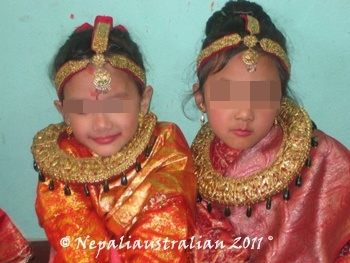
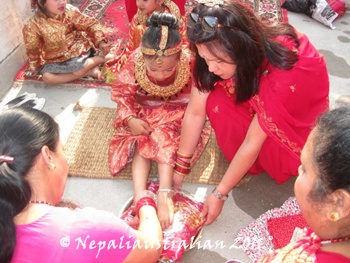
- Ihi (Bel Marriage): In this ceremony, a young Newar girl marries a Bel fruit (symbolising Lord Suvarna Kumar or Hiranya Garbha). This ritual takes place before the girl reaches puberty and is a highly significant spiritual bond.
- Bara Tayegu (Gufa or Surya Darshan): In this second marriage, the girl symbolically marries the Sun during a special ceremony that typically occurs at the onset of her first menstruation. It is believed that this marriage to the Sun protects her from evil forces and ensures her purity.
- Marriage to a Man: The third and final marriage is with a human partner when the girl reaches adulthood.
The Significance of Bel and Sun Marriages
The Ihi ceremony, or Bel marriage, is performed with great reverence. The girl fasts and conducts rituals with the Bel fruit, along with a Kalash, Vajra, and Chakra, while her father ceremonially “gives her away.” The marriage is considered complete, and the girl is now symbolically married to Lord Suvarna Kumar.
The Bara Tayegu ceremony, also known as Gufa or Surya Darshan, involves a 12-day seclusion where the girl avoids sunlight, followed by a symbolic marriage to the Sun. This ritual signifies that the girl is now protected by the Sun’s divine energy, keeping her safe from negative influences.
After these sacred ceremonies, Newar women are considered perpetually married to Lord Suvarna Kumar and the Sun, ensuring they will never become widows. Because of these Vedic-Tantric rituals, Newar women are spiritually secure in their marital status, and there is no need for them to fast for the well-being of a future husband or for marital bliss, which is the central premise of Teej.
Why Newar Women Don’t Fast for Teej
Although Newar women are followers of Sanatan Hinduism, their religious practices exempt them from the need to observe the Teej fast. Since they are already symbolically married to Lord Suvarna Kumar through the Ihi ceremony, their marital status is spiritually guaranteed. They will never become widows, and thus, there is no religious requirement to fast for their husband’s long life or marital happiness.
For this reason, Newar women, while deeply embedded in Hindu traditions, do not celebrate Teej in the same way other Hindu women do. Their rituals provide them with a different, yet equally sacred, assurance of marital bliss.
Modern Practices and Changes
In recent times, however, some Newar women have started fasting during Teej, influenced by other Hindu communities. While there is no harm in choosing to observe this fast voluntarily, it is essential to recognise that it is not a religious obligation for Newar women.
Newar women already possess a profound spiritual connection through their unique marital rituals. Therefore, while observing Teej fasting is a personal choice, it’s important to understand that Newar culture provides its own beautiful path to marital fulfilment, without the need for Teej observances.
M from Nepaliaustralian
XOXO
Please follow me on Instagram! and Please follow me on TikTok


















 nepaliaustralian