Category Archives: Nepali Festivals

Kukur Puja: Tihar

Today is second day of Tihar which is Kukur Puja as well as Laxmi Puja. Some years due to the placement of moon and other planets in the universe, some of the pujas fall on the same day.

I will write about Laxmi Puja tonight after I perform my Laxmi Puja at home.

Kukur Puja

The second day of Tihar is called “Kukur Puja” or “Khicha Puja” (“worship of the dogs”) by the Newars.

A dog is considered as man’s best friend and for Hindus, a dog is also considered as the steed of God “Bhairab” as well as Yama’s (God of death) gate keeper. The Hindu epic Mahabharata talks about the close relationship dogs have enjoyed with mankind. According to it, a dog is said to have accompanied Dharmaraj Yudhisthir on his journey to heaven alive. Dogs howling is considered a bad omen as it means that, they saw “Yama coming to take someone away.

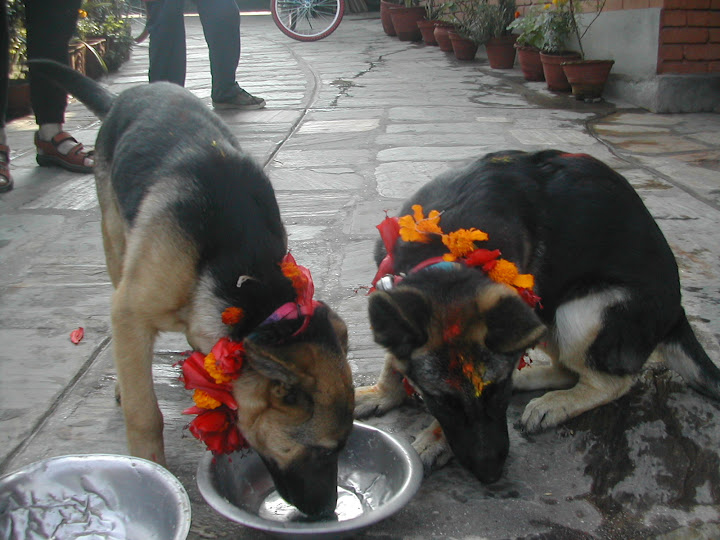
The dog is revered as a faithful and loyal animal which has been in the company of humans since ages. Around the year, dogs help humans by guarding their houses. So on the second day of Tihar, dogs are worshipped by putting tika on their forehead and a garland around their neck. They are offered a delicious meal consisting of meat and other dishes.

People perform the puja on their own dogs if they have one at home; otherwise they perform the puja on stray dogs. On this day you can see many stray dogs with red tika and a flower gland in Nepal.

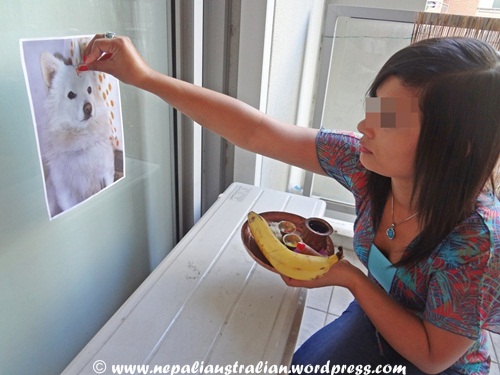
We don’t have a dog here but my parents have a dog called “Chhotu”.

So I performed my Kukur Puja with his photo. I really am grateful to him that he is there to protect and warn my parents against thieves and the likes.


I miss him so much.I hope we will have our own dog one day to do this puja. 🙂

Happy Tihar!!!

Tihar

Today we start the second biggest festival, after Dashain, for Hindu from Nepal.

This festival is celebrated in five days starting from the thirteenth day of the waning moon in October.

 The five days are called

  • Kaag / Kag (crow) Puja
  • Kukur (dog) Puja
  • Laxmi Puja and Gai (cow) Puja
  • Goru Puja,Gobhardan Puja , Mha Puja and Nepal Sambat
  • Bhai Tika

We also refer to Tihar as ‘Panchak Yama’ which literally means ‘The five days of the Lord of the underworld’. We also worship ‘Yamaraj’ in different forms in these five days.

In other words this festival is meant for life and death.The five-day festival is considered to be of great importance as it shows reverence to not just the humans and the Gods, but also to the animals like crow, cow and dog, who maintain an intense relationship with the humans. It is also a time for cooking great meals at home, brothers and sisters shopping for gifts, flying kites, decorating homes and streets, playing cards with friends, resting and relaxing.

Tihar is also called The Festival of Lights, as many diyo or candles or decorative lights are lit both inside and outside the houses to make them bright at night. All the houses are cleaned and decorated with the belief that Goddess Laxmi will enter the house that is clean so people light candles, oil lamps and other lights and thus during the night the entire village or city looks like millions of sparkling gems.

There is a story, which tells why this revelry is celebrated so widely. Once there was a king who was living his last days. His astrologer had told him that a serpent would come and take his life away. The king did not want to die so he asked the astrologer if there was any way to escape death. The king was advised to sleep with lit oil lamps all around his bed and decorate the palace with oil lamps on the day of Laxmi puja so that Goddess Laxmi would talk to the serpent not to take his life. It did happen; the serpent was convinced by Goddess Laxmi. The serpent took the king to Yama Raj and told him that it was not yet the king’s time to come to the underworld. So Yama Raj opened his ledger and in it the kings remaining age was written zero, but the serpent cleverly put seven before zero. Thus the king lived for seventy more years. So form then onwards Tihar is widely celebrated worshipping the lord of the underworld and Goddess Laxmi.

Another mytological reasons behind the celebration  is that Lord Ram return to Ayodhya  after 14 years of exile. He killed Ravan on Nawani of Dashain thus we celebrate Dashain and his home-coming is celebrated in Tihar with lights and flowers.

Tihar is also celebrated by playing Langurburja. It is a game similar to the British dice game “Crown and Anchor”. I remember taking money from dad and running to play a game with my friends. The game is played with 6 dice and a mat. The mat has similar symbols, as the dice, and they are spades, hearts, diamonds, clubs, crown and flag. The player can choose one or more symbols to bet his money on. If he gets at least one die with the same symbol which he bet on, he wins. If he gets two then he wins 2:1, the more he gets on the throw the more money he wins. As a kid we used to play for 25 paisa (equivalent to less than a cent in AUD now) a game. It was more for fun than for the money. I am sure they now play with more money than that.

Adults mostly play cards instead of Langurburja.

It also incorporates the Newar’s New Year, which is called Nepal Sambat.

Last weekend, I went shopping in preparation of the festival and bought lots of sweets, fruits and food.  I couldn’t find all the things I will need for Tihar and I was a bit disappointed in Nepali/Indian grocery in Sydney who are charging arms and legs for things we use for Tihar. Just an example, we need jajanka for Tihar which normally would cost around Rs 10 in Nepal but are selling for $2 (Rs180) each in Sydney!

Kaag Puja / Kag Puja

The first day of Tihar is Kaag / Kag (crow) puja which falls on 12 November this year.

Crow is supposed to be a henchman for Lord Yamaraj. Hindus believe crows to be messengers of good or bad news. With its croaking, it conveys messages like visitor coming to the house etc. It is also believed to be a messenger of Yama, the God of death

To avert grief and death in the family, Hindus worship crows during Kaag / Kag Tihar offering it sweets and various dishes. On this day crows are offered food on a plate made out of leaves in the morning before anyone in the house takes in food. In Nepal a crow is not killed cause as a legend says that one crow had happened to drink the water of life. Thus you can see crows everywhere sitting without the fear of human beings. Once you leave offerings on the balcony, a crow will come and eat the food.

Where there are no crows, any winged animal of the heavens (bird) will enjoy the feast.

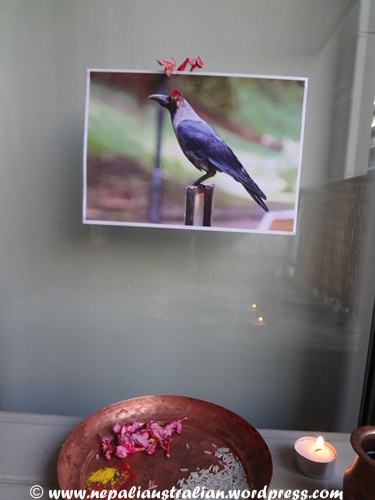
In Australia, I haven’t seen many crows around so I printed a photo of a crow and performed the Puja this morning. I had a shower and then prepared puja. Here are some photos of Kaag / Kag puja from this morning 🙂

Happy Tihar everyone!!!

I will write about other days like Kukur Puja, Gai Puja and Laxmi Puja, Goru Puja , Govardhan Puja , Mha Puja and Nepal Sambat and Bhai Tika as the festival progresses.
Dashain ko Nakhatey

Dashian is almost finished now. Today is the last day of Dashain and the celebrations are over until mid-November when we celebrate Tihar.

After Tika, last five days of Dashain are celebrated by visiting relatives and getting tika and blessing from them. As far as I know, in Chhetri and Bhaun culture, they normally visit relative to get blessing on Dashami itself. They don’t need invitation for tika so they go to the  their elders’ house and get blessing. That day is a big day for them as they get to meet lots of relatives.

But in Newar culture, we cannot go to anyone’s house until we get an invitation. If a daughter is married, she won’t even go to her parents’ house until the invitation arrives. This invitation is called Nakhatey in Newari. Normally relatives consult each other so so that the Nakhateys don’t fall on the same day and everyone gets to attend all Nakhateys.

Going for the Nakhatey is a big part of Dashain for Newars in Nepal. I remember growing up going to houses of my relatives to get tika, blessings and daskchhina (money). It was a fun filled affair with lots of yummy food as well as money to collect.

In Sydney as well, we had a few Nakhateys. We were invited to AS’s cousin’s house as he is the eldest of AS’s relatives in Sydney. We had tika and Nepali food. I wore my sari and got into a festive mood. We got tika from AS’s cousin and we also put tika to his younger cousins.

We also had tika from my Dai , his wife and we put tika to their daughter.

So my Dashain for this is over 🙂

Vijaya Dashami : Dashain

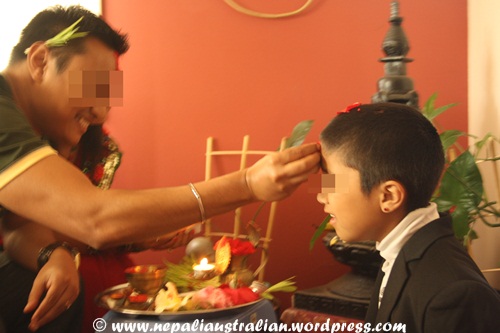
The tenth day of Dashain is called ‘Dashami’. It is also known as Vijaya Dashami and it was the day Goddess Durga was victorious over the demons. It was also the day Lord Rama won the war with the demon king, Ravana, supposedly through the Durga’s blessing. The day is, hence, symbolic of good triumphing over evil. It is on this day that the jamara is finally utilized; the elders put tika (a mixture of rice, yogurt and vermilion) and Jamara on the forehead of younger relatives to bless them with abundance in the upcoming years.  The red Tika also symbolizes the blood that ties the family together.

Elders give “Dakshina”, a small amount of money, to younger relatives at this time. People visit elders in their home to receive blessings. The importance of Dashain also lies in the fact that on this day family members from far off and distant relatives come for a visit as well as to receive tika from the head of the family.

This continues to be observed for five days till the full moon during which period families and relatives visit each other to exchange gifts and greetings. This ritual of taking tika from all the elder relatives (even distant relatives) helps in the renewal of the community ties. This is one reason why the festival is celebrated with so much of vigor and enthusiasm.

Before the collapse of the monarchy system in Nepal, thousands of people ranging from the ministers, diplomats to the general public used to gather in the old royal palace to take the tika and blessing from the king, who is considered to be the incarnation of Lord Vishnu. However after the collapse of the monarchy system the president of the country who is considered the head of the state has been continuing the tradition by offering the tika to the general public and ministers.

A lot of feasting takes place in the meantime and everyone makes merry. Dramas of Goddess Durga fighting demons are also frequently staged.

The last day of the festival which lies on the full moon day is called ‘Kojagrata’ Purnima. The literal meaning of Kojagrata is ‘one who is awake’. On this day Goddess Laxmi who is believed to be the goddess of wealth is worshiped as it believed that goddess Laxmi descends on earth and showers whoever is awake all night with wealth and prosperity. As a result, many spend the night playing cards and doing other activities. The festival concludes when the remaining jamara and the holy vessel are disposed of by bringing them to the river.

This morning, I woke up, performed puja at home with Jamara and then went to my brother’s place where all my family gathered to celebrate Dashain. It was fun filled affair with lots of food, playing cards and having Tika ceremony.

P.S. I am so happy to share that my Jamara grew really well this year. It became longer than last year.  🙂 Here are some photos.

Nawami: Dashain

Today is Nawami (Ninth) day, a day before the Vijaya Dashami. Sacrifices continue throughout Nawami in Nepal. Today god Vishwas Karma, the God of creativity is worshiped. All artisans, craftsmen, tradesmen worship their tools, equipment and vehicles like cars, bikes, trucks etc. for protection against accidents during the year. Animals are also sacrificed to cars, trucks etc. to get the blessing from goddess Durga for protection for vehicles and their occupants against accidents during the year.

The Taleju temple at Hanuman Dhoka is opened for the public only once a year on this day. Thousands of people go and pay their respect to the goddess. Temples of the goddess are filled with people from dawn till dusk. There are local processions – local bands play music and a feast is organized – in the Taleju Bhawani Temple in Hanuman Dhoka Palace premises.

Today also the official military sacrifices are held in the ‘Kot’ courtyard at Hanuman Dhoka. The government allows foreigners to witness this function so hundreds of tourists and diplomats eagerly gather here.

Animals, mostly buffaloes are slaughtered by the hundreds to honour Durga the goddess of victory to seek her blessing. Military bands play war tunes, guns boom and officers with beautifully decorated medals in full uniform are present there. When the function ends the courtyard is filled ankle deep with blood from the sacrifices.

Kumari, the living goddess, also blesses the public on this day from her residence at Kumari Bahal.

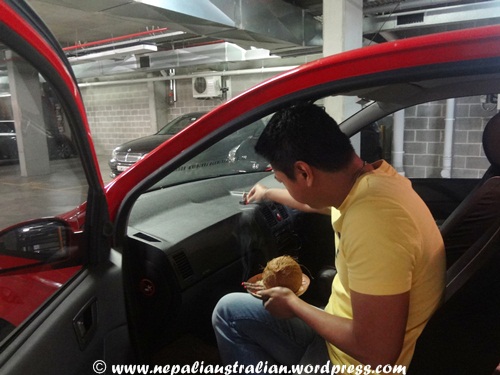
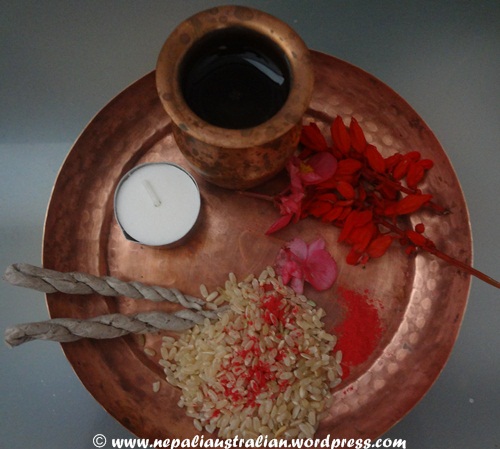
This morning we performed car puja as well. I am sure in Nepal, it is performed in a bigger scale but if you are not in Nepal and want to perform the puja, I am sharing how I did it here.

How to perform car puja:

  • Make sure the vehicle is clean.

  • Take your shoe off before puja.
  • Prepare puja thali with sindoor, rice, flower, dhuup, batti, fruits and any other puja saman you have.

  • Also prepare an ankura (vessel) with water. If you don’t have a ankura then use a glass/tumbler.
  • Start the puja by sprinkling water in front of the car and its four wheels.

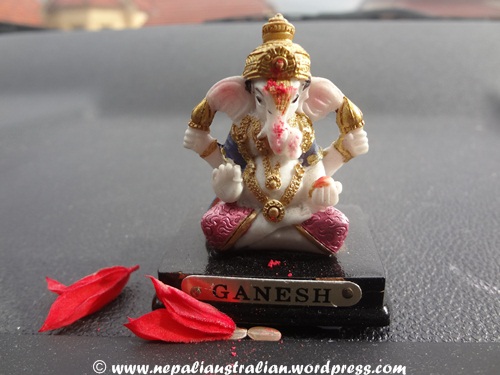
  • If you have any idol of a god inside the car, perform the puja inside first by putting sindoor, tika and flower on the idol.

  • I have an idol of Lord Ganesh inside our car.

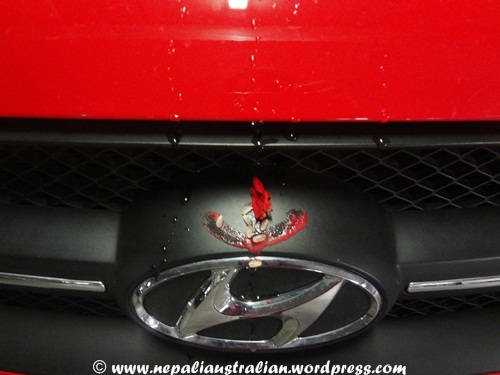
  • In front of the car use sindoor to make a half moon by using the third finger of right hand and put tika and flower. Also do the same on all four wheels of the car.

  • Now light the batti (I used tea light candle) and dhuup and show it to the God inside the car, the front of the car and move to all the wheels by circling  them around three times in a clockwise direction.

  • Normally animals are sacrificed during the Puja and the vehicles are given their fill of blood but we used a hard shelled coconut instead.
  • Crack the coconut in front of the car on the floor

  • Sprinkle the coconut water in front of the car as well as all wheels.

  • The coconut is kept as prasad (holy food offering given to God during pujas) and eaten later.

  • In Nepal they also put mala (flower garland) in front of the car.
  • The puja is finished.