Category Archives: Nepali Festivals

Gai Puja and Laxmi Puja

The third day of Tihar is Gai Puja and Laxmi Puja.

In the morning of this day, the cow is worshiped. Hindus consider a cow as sacred and used its milk, dung and even urine for purification purpose. Cows are worshipped with tika and garland with a nice meal. People in villages who have a cow worship their cow but most of the people in Kathmandu don’t have a cow so they either go to a priest’s house or to a temple to worship the cow.

 A cow also symbolises wealth and a form of goddess Laxmi.

In the afternoon, the whole house is cleaned in preparation for welcoming the goddess of wealth, Laxmi. Most of the houses have their front door decorated with a mandap and have a trail of red mud leading to their Puja room(worship room in the house) .

When I was young, I used to help mum do this. It was one of my favourite holiday activities. First red mud is used to make a trail leading to the Puja room. Once it is dry , a mixture of flour and water is used to make a symbolic footprint of Goddess Laxmi on the floor entering the home. Once the flour footprints have dried, vermillion mixed with oil is put on them along with some flowers. This results in a trail of small red footprints from the main door of the house to the Puja room symbolising that Goddess Laxmi has entered the house.

In Australia we can’t do this so I printed out small footsteps in a piece of paper and use that as an alternative to lead the Goddess Laxmi to our Puja area. We also put our piggy bank in the Puja area.

Laxmi Puja is also done by businesses to have a prosperous year ahead. They put tika on Goddess Laxmi’s idol as well as their cash register and deposit safes.

From this day on for the next 3 days, there will be women in groups coming door to door singing special songs called Bhailani. It is considered auspicious to have these groups come to your front door. The house owner will offer them some Rotis, fruits and money and they sing Bhailo blessing the household with good for fortune.

Hapyy Tihar!!!

Kukur Puja

The second day of Tihar is Kukur (dog) puja.

A dog is man’s best friend and for Hindus, a dog  is considered as the steed of God “Bhairab” as well as Yama’s (God of death’s)  gate keeper. Dogs howling is consider bad as it means that, they saw “Yama “ coming to take someone away.

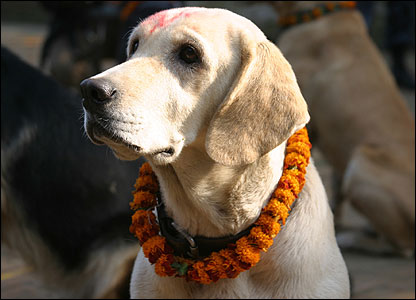
Around the year, dogs help humans by guarding their house . So on the second day of Tihar, dogs are worshipped by putting tika on their forehead and a garland around their neck. They are offered a delicious meal consisting of meat and other dishes. People perform the puja on their own dogs if they have dog at home,  otherwise they perform the puja on stray dogs. On this day you can see so many stray dogs have red tika and flower gland in Nepal.

We don’t have a dog here but my parents have a dog called “Chootu”. So I performed my Kukur Puja with his photo. I really am grateful to him that he is there to protect and warn my parents against thieves and the likes.

Happy Tihar!!!

Kaag Puja / Kag Puja

The first day of Tihar is Kaag (crow) puja / Kag puja.

Hindus believe crows to be messengers of good or bad news. With its croaking, it conveys messages like visitor coming to the house. It is also believed to be a messenger of Yama, the God of death.

To avert grief and death in the family, Hindus worship crows during Kag Tihar offering it sweets and various dishes. In Nepal, once you leave offerings on the balcony, crow will come and eat the food.

In Australia, I haven’t seen many crows around so I printed a photo of a crow and performed the Puja this morning. According to my mum, whatever you can do where you are is good enough, you just need to have faith in your belief and perform your duties as per you faith.

Happy Tihar!!!

Tihar

Thanks to my fellow blogger Basundhara (Nepal mero maya) for taking such an interest in my blog. I am writing Tihar posts with your comments in mind.

Tihar is the second biggest festival of Hindus in Nepal. It is celebrated over 5 days which are:

Each day has different significance.

This year Tihar is from 25 October to 28 October.

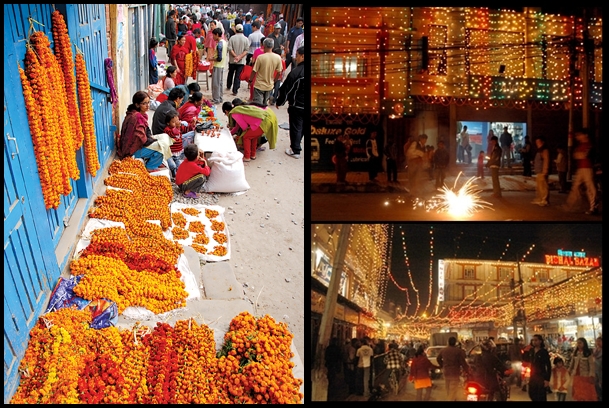
Tihar is also called the festival of lights so houses in Nepal are decorated with lights and garlands of the marigold flowers.  Normally houses are decorated either using traditional diyos  (oil-fed lamps made with clay ), candles or electrical lights hangings from the roof in front of the house. During the night if you walk through the main roads of the city, it looks beautiful with the houses all around light up for the festival.

There are lots of stories/ mytological reasons behind the celebration of Tihar. One of them is that Lord Ram return to Ayodhya  after 14 years of exile. He killed Ravan on Nawani of Dashain thus we celebrate Dashain and his home coming is celebrated in Tihar with lights and flowers.

One of the thing I remember about Tihar is playing Langurburja. It is a game similar to the British dice game “Crown and Anchor”. I remember taking money from dad and running to play a game with my friends. The game is played with 6 dice and a mat. The mat has similar symbols, as the dice, and they are spades, hearts, diamonds, clubs, crown and flag. The player can choose one or more symbols to bet his money on. If he gets at least one die with the same symbol which he bet on, he wins. If he gets two then he wins 2:1, the more he gets on the throw the more money he wins. As a kid we used to play for 25 paisa (equivalent to less than a cent in AUD now) a game. It was more for fun than for the money. I am sure they now play with more money than that.

Adults mostly play cards instead of Langurburja.

Tihar is celebrated a bit differently in various ethnic groups in Nepal. I will be writing my post based on the Newari culture.

As the festival progresses, I will keep posting more on what I did and what each day is about.

Happy Tihar!!!

Happy “Dashami”

The tenth day of Dashain is called  ‘Dashami’. On this day we take Tika and Jamara from our elders and receive their blessing.  The red Tika also symbolizes the blood that ties the family together. Elders will give “Dakshina”, or a small amount of money, to younger relatives at this time.

This year Tika was on Thursday so after work, I performed Puja at home. Then we went to my cousin K’s place for tika. We had a Nepali bhoj and lots of fun.

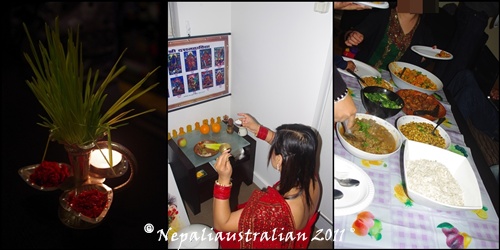
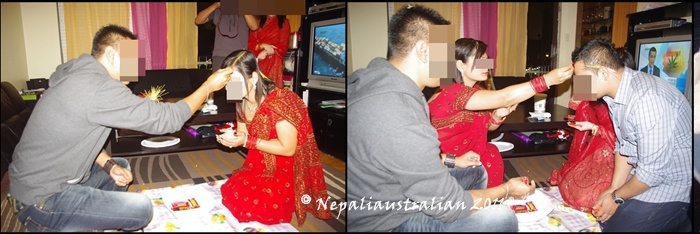
Here are some pics from the day.


L-R Jamara, Me performing Puja, yummy food


L-R AS putting tika on me, Me putting tika on my brother