Category Archives: Nepali Festivals

Ghoda Jatra

As always, no month passes in Nepal without a festival and today it is Ghoda Jatra (Festival of horses).

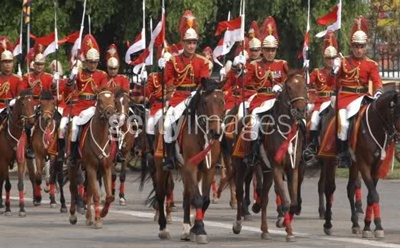
On this day there is a grand parade in Tundikhel, a large open ground in the middle of the city. It is believed that this festival began after the Kathmandu people buried a demon under the soil of Tundikhel show grounds. They say that he may rise again and cause terror in the world if he is not trampled on by horses each year. So every spring, this victory over evil is celebrated by organizing processions and grand display of show jumping, motorcycling feats, parachuting, aerobatics, bicycle races and gymnastics. The president, prime minister, ministers and other official along with, the Living Goddess Kumari, and thousands of people from all over the country observe this Jatra.

After this great function of horse ridding in Kathmandu, there is the Khat Jatra of the eight sister goddesses. The Newars of Kathmandu city observe this day as a family get together or ‘Pachare’. The chariot of Goddesses Lutidevi, Swetakali, Kankeshwori and Bhadrakali is brought to Ason, and the family get together of eight sister goddesses also takes place, as legend says.

At Bal Kumari area, in Patan during Ghode Jatra festival, a horse is intoxicated with spirit and an equally drunk person in a traditional Newari attire rides it and the townspeople chase the intoxicated animal through the streets amidst much cheering and clapping. This race is thought to have been commenced in the olden times by a certain king of Patan to give a better show in comparison to Tundikhel’s parade, as in those days no one from Patan could attend the show in Kathmandu as it was a rival kingdom, a time when Kathmandu valley was divided into three kingdoms of Kathmandu, Patan and Bhaktapur.

Holi / Phagu Purnima

Holi is one of the many festivals celebrated by Hindus in Nepal. It is also known as Phagu Purnima which is a festival of colours.

Holi is celebrated in two days in Nepal, today as Phagu Purnima (except in Terai)  and tomorrow in Terai region as Holi.

Chir of Holi

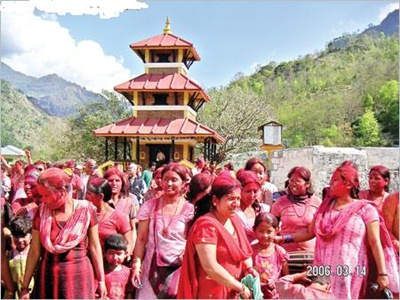
People install  Holi pole, “Chir’, a bamboo pole, fringed with strips of cloth representing good luck charms indicating the arrival of the Holi festival. This Chir pole is erected a week before the Holi festival is celebrated at all the three heritage squares of Nepal namely Kathmandu Durbar Square, Bhakatpur Durbar Square and Patan Durbar Square. Once the erecting is done, people throw red vermillion powder in the air as the symbol to mark the beginning of  Holi, a time for fun and frolic. It is said to symbolize the tree on which lord Krishna hung the milkmaids’ garments while they were bathing. At the end of the festivities the Chir is taken to a bonfire.

Here are some of the legends behind Holi (source: internet)

There is a popular legend behind the installation of Chir. The story is again about the mischievous nature of Lord Krishna who loved to play pranks with the milkmaids or gopis. Playful as he was, it is said that once he seduced all the local girls with his dashing good looks. He then danced with them all and when they were fully engrossed in him, then he thought they were ripe for a tease. He doused them in coloured water and stole all their clothes while they were bathing in the water of river Yamuna. Naughty Krishna then hung their clothes on a tree to bug them. Chir symbolizes that very tree.

Holika gets burnt in the fire

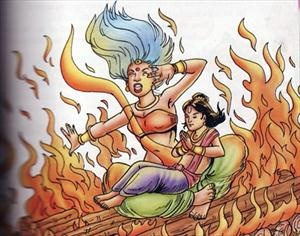
Another myth following Holi, reveals that a fiend named Holika together with her brother, an atheist king by the name of Hiranyakasyapu conspired to kill his son Pralhad because Pralhad was an ardent devotee of Lord Vishnu. But their attempts always failed for Lord Vishnu protects those who love him. Finally, Holika who having received a blessing from Lord Bramha to be immune to fire, jumped in a bonfire with Pralhadin her lap. But Brahma’s blessing could only be used for

Colours for Holi

good purposes and so Holika was consumed by the fire where as Pralhad was saved by the grace of the Gods. Thus, Holi is said to be celebrated to rejoice Holika’s extermination and the traditional bonfires are believed to commemorate her death.

Yet another legend says that there was an Ogress known as Putna. Lord Krishna’s devil uncle Kansa seeked the help of Putna to kill infant Krishna by feeding him poisonous milk.Putna disguised herself as a simple and pious woman and treacherously fed baby Krishna with her poisoned breast. Lord Krishna, however, sucked her blood which revealed the monster behind that pious woman and laid her to death.

On the night before Holi, there is a practice to burn an effigy of Putna – the Ogress who nearly killed Lord Krishna. The tradition is symbolic of victory of divinity over demonic forces. It also shows the end of winter and darkness – as typified by Putna.

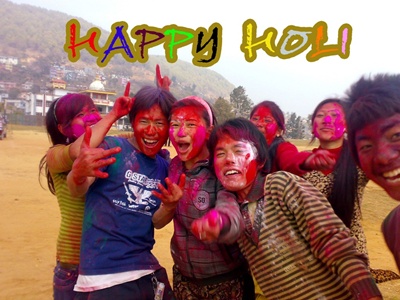
I used to love Holi while growing up. It used to be a few days off from school and we loved playing will lola (water filled balloons) and abeer (colours). It was time of fun and frolic. People spent the day smearing coloured powder all over each other’s faces, throwing coloured water at each other, having parties, and dancing.

Lola

The only drawback of Holi in Kathmandu is for young girls and women who get lola thrown at them everywhere they go. I remember being bombarded by hundreds of balloons from someone’s roof top on the way to school or on the way back. It was days before the real Holi and it used to piss me off. Can you imagine, you are going somewhere and you are drenched with water from these balloons? Also as you know clean water is not available easily in Nepal so I am not even sure, what kind of water they used. I used to fight with these people who spoiled the real meaning of Holi.

If you are in Nepal, hope you are having a great time.

Sydney is celebrating Holi at the end of the month so hoping to go and have some fun then.

Happy Holi everyone !!!

Happy Holi

Losar

Nepal is describe as ‘Char jat ra chhatis barna ko yo sundar desh’ which translate into Nepali is a beautiful, multilingual and multi-cultural country. If you have met many people from Nepal, you might have noticed how different they look from each other. Please click here for my post ‘Different Look of Nepali people’ for details. Also in Nepal, there are lots of celebrations for different cultural group and ethnic group.

Today is Losar, a festival in Nepal which is celebrated by Mongolian Nepali, mainly by Gurung community as well as Rai, Tamang, Sherpas to welcome their New Year. Losar is celebrated on the first full moon of the first month according to a lunar calendar. On the solar calendar it falls between January and March. Lho means year or age and Sar means new or fresh. The word Lhosar means New Year or beginning of new era.

It is a National Holiday in Nepal so people can celebrate the festival.

Losar is the time when family member gathers and celebrate with cultural processions and feasting. Also on this day, older people give money and blessing to younger ones. I remember when I was young; I used to go to my friend’s place to celebrate Losar as my family doesn’t celebrate Losar (I am from Newar culture so we have our New Year during Tihar. Click here for more info). In her house, I used to get some money as well as lots of delicacies among which I liked sel roti (special Nepali bread) and achar the most.

One of the highlights of this day is that the people who celebrate Losar dress in their traditional outfit and go around Buddist temples. Men wear Bhangra, a white cloth shirt-like apparel tied across the chest and open like a bag at the back (for carrying things), and a Kachhad, like a short sarong or kilt while women wear maroon velvet Ghalek (blouses), enhanced by large gold earrings and semi-precious stone necklaces. Even kids are dressed up in traditional outfits.

To mark the day, all the Buddhist monasteries in the country are decorated with colourful prayer flags and the monks offer prayers for good health and prosperity, If you are in Nepal, the places to visit will be Bouddha and Swayambhu stupas where there will be crowds of people gathered to welcome the New Year.

In Sydney, there is a gathering this weekend to celebrate Losar. There will be many people dressed in traditional dress and there will be entertainment like cultural dance and singing. The best of all, there will be lots of Nepali food including Sel roti and momos

Happy Losar everyone!!!

Maha Shivaratri

If you know Nepal, you might already know that there are lots of festivals every month. Today, we have one of those festivals and it is called Maha Shivaratri. It is believed that Shivaratri is the night when Lord Shiva was created by his own divine grace so this day is celebrated by Hindus with enthusiasm. Shivaratri literally means ‘ the night consecrated to Shiva’.

Maha Shivaratri is a national holiday in Nepal.

According to a legend, Parvati performed tapas, prayed and meditated on this day to ward off any evil that might befall her husband on the moonless night. Since then, Maha Shivaratri is believed to be an auspicious occasion for women to pray for the well-being of their husbands and sons. An unmarried woman prays for a husband like Shiva, who is considered to be the ideal husband. Another legend is that Shiva and Shakti married each other on this day.

There is one more legend of Shivaratri associated with Samudra Manthan, a battle between devas and asuras during which a pot of poison came out of the ocean and on the request of gods, Lord Shiva drank the poison. The poison was so potent that it changed the colour of His neck to blue. For this reason, Lord Shiva is also called Neelkanth (one whose throat is blue).

So basically this festival is in honour of the Hindu God Shiva. Today all the Shiva temples will be very busy. One of the best places to see the celebration will be Pashupatinath temple in Kathmandu located on the banks of the sacred Bagmati River. There will be thousands of people from all over the world (it is regarded as one of the most sacred temples for Hindus) coming to worship Shiva during the festival.

There will be a mela the days before and after Shivaratri where people fill the roads around the temples of Lord Shiva especially Pashupatinath temple . There will be  holy men, beggars, pilgrims, children and tourists.

The night before Shivaratri, all the devotees from all over the country spend the night lightning sacred fires, singing praises of the deity, and keeping a constant vigil to greet his descent to earth, on the grassy hills around the temple to enjoy the warmth of good companionship and chatting around.

At midnight, the celebration begins officially with priests inside the temple making special offerings. Then devotees will take a dip in holy Bagamati river and start their fasting. They offer Bael leaves to Lord Shiva. They will spend the whole day singing sacred songs around the temple. As all the Sadhus are treated as guest , they will be offered free food and accommodation during Shivaratri.

Shivaratri is the only day in the year where marijuana and bhang is legal in Nepal so on this day devotees indulge in smoking them. It is believed that Lord Shiva is fond of these substances and marijuana is taken as a Prasad.

There are lost of tourists around the Pashupatinath temple on this day as there are lots of Sadhus with ash all over the body and devotees with colourful draping chanting hymns of Lord Shiva.

It is believed that if you worship Lord Shiva this day and fast by eating only vegetarian food, all your sins are forgiven. So there will be queues kilometres long in the Pashupathnath temple whole day.

Also this day, kids and youth block the road for vehicles to collect money which they use to buy bhoj in the evening. Mostly vehicles owners are happy to give a rupee or two. When I was a kid I do remember the block in our area made some of the vehicle owners angry with the kids blocking the roads.

Today I worshipped Shiva’s idol at home in the morning and took his blessings. Hope all my sins will be forgiven and we will be blessed with an awesome 2012.

Happy Shivaratri everyone!!!

Bhai Tika

The fifth day of Tihar is Bhai Puja.

Bhai” mean brother in Nepali. This festival is mainly for brothers and sisters.

It is believed that this tradition was started by Yama (the God of death) and his sister Yamuna because of their affection for each other.

In this day, sisters apply sacred Tika on their brother’s forehead and pray to Lord Yama for her brother’s long life and prosperity.

Yamaleswor temple

Some of the ethnic groups in Nepal use the Pancha Rangi Tika (Five coloured Tika)  for  Bhai Tika. First a base, rice flour is applied vertically  on the forehead then yellow, green, red, blue and white colour Tika are put on top of this line in a row. But in the Newa culture, we just use rice, vermilion and yogurt, mix them and use that as a Tika.

For this occasion, I had invited my brothers and their families to my apartment and we did the Bhai Tika on my balcony.

This is how I did my Bhai Tika.

Mandap Puja

Before the Bhai Tika, just like in Mha Puja, the floor was purified by sprinkling water on it, then we made Mandaps in front of a row of seats on the floor where my brothers were sitting. I used a copy of the same Mandap which was designed by AS but this time I printed them in A3 paper. In Nepal the Mandaps are made by hand on the floor using oil, rice flour, vermilion, puffed rice and sometimes beans. The number of the Mandaps needed is three plus the number of people doing the Puja. So I had two big Mandaps, for my brothers. in a row and three smaller Mandaps at the top of the row for the House God (Kuladevata), Yamaraj and Janmaraj, and one crow drawn at the end of the row symbolising Lord Yama.

Beside the three Mandaps at one end, I also had a Sukunda with a candle on it.

Bhai Tika

Then I put all the sweets and Rotis that I had made or bought as well as some fruits around the Mandap along with the Masala and Sagun.

The Rotis I made at home this year were

  • Besana ko ladoo
  • Puri
  • Nimki
  • Lal Mohan
  • Strawberry cup cake
  • Chocolate cup cake

(I will post recipes in my next post)

I also bought Soan Papdi.

Then I had trays with fruits like mangoes, peaches, plums, rockmelons, oranges, apples and pears.

Masala and Tshirt

I made Masala at home this year with dry coconuts, dry dates, raisins, almonds, pistachio nuts, apricots, dry figs, cashews, cloves, cardamoms, beetle nuts, hard shelled walnuts, palm sugar cubes and lots of Chocolates. I used clear cello wrap and colourful bows to make it look beautiful.

For Sagun, I boiled the eggs, took the shell out and fried them in a pan. I made Bara (lentil cakes, for which I will share recipe later), fried some chicken, fish and cut fresh garlic.

Jajanka

I made Mala out of tinsel and bought Jajanka in a Nepali grocery store. Jajanka is made of many rounds of a white cotton thread forming a circle of about two feet in diameter and tied with a small piece of colourful cloth in order to have no ends. Jajanka symbolizes the integration of the beginning with the end. It is about creation, maintenance and fullness of life. Normally the Mala is supposed to be of Makhmali ful/Supadi ful (Globe Amaranth) as it never dries and always looks fresh.

I also bought  T-shirts for both of them.

Bhai tika process

  •  First I gave Nasala, a few drops of water, in the palm of the right hand of my brothers to throw some into the mouth and rest over the body for purification.
  • I worshipped the House-God and Yama’s Mandap with water, rice, flowers, and vermilion powder.
  • I gave water, rice, flowers, and vermilion powder to my brothers first to worship the Mandap of the House God and then the crow, then to worship their own Mandaps. The Mandap is used as a medium to present the various offerings to the self.
  • Then I put Tika made of vermillion, rice and yogurt on my brothers forehead and gave them flowers to put on their head as a blessing form God. This was followed by Mala and Jajanka around their neck.

    Putting TIka

  • Normally in Nepal, they use Ita (special long threads made using white cloth soaked in mustard oil) but here we used tea light candles instead. I gave both my brothers the candles. They  took the candle from my hand, lit them and put them on their Mandap. This light is believed to brighten the inner self and keep evil at bay.
  • Then I took some water in an Ankhura (a small pitcher for Puja) filled with oil and water and Dubo in my hand and circled around my brothers three times.

    Making circle with oil and water

  • Then I gave them some rice and flower in their hand. Then I gave trays of Rotis, fruits, Masala, sweets and clothes to them and they had to hold them and keep them from touching the ground. Then I toke some rice and flower in my hand and showered each of them and worshipped the god within them. Only after that could they put the trays down.
  • Then my brothers put Tika on my forehead, touched my feet for my blessings and gave me the gifts they had brought for me. 
  • I gave them the Sagun . For Sagun, you put a plate of egg, Bara, meat and fish in the right hand and yogurt or alcohol in the left hand
  • Once everyone finished eating the Sagun, we used Kucho (broom) from top end of the row of Mandaps to the bottom of the row, touching each Mandpa to erase them and conclude our Bhai Tika.

This slideshow requires JavaScript.