The fifth day of Tihar is Bhai Puja.
“Bhai” mean brother in Nepali. This festival is mainly for brothers and sisters.
It is believed that this tradition was started by Yama (the God of death) and his sister Yamuna because of their affection for each other.
In this day, sisters apply sacred Tika on their brother’s forehead and pray to Lord Yama for her brother’s long life and prosperity.

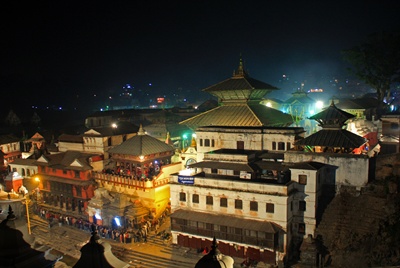
Yamaleswor temple
Some of the ethnic groups in Nepal use the Pancha Rangi Tika (Five coloured Tika) for Bhai Tika. First a base, rice flour is applied vertically on the forehead then yellow, green, red, blue and white colour Tika are put on top of this line in a row. But in the Newa culture, we just use rice, vermilion and yogurt, mix them and use that as a Tika.
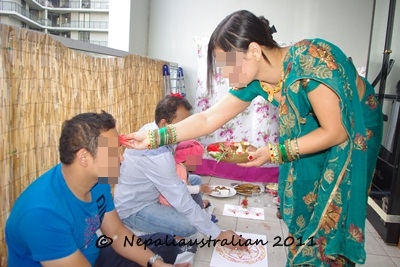
For this occasion, I had invited my brothers and their families to my apartment and we did the Bhai Tika on my balcony.
This is how I did my Bhai Tika.

Mandap Puja
Before the Bhai Tika, just like in Mha Puja, the floor was purified by sprinkling water on it, then we made Mandaps in front of a row of seats on the floor where my brothers were sitting. I used a copy of the same Mandap which was designed by AS but this time I printed them in A3 paper. In Nepal the Mandaps are made by hand on the floor using oil, rice flour, vermilion, puffed rice and sometimes beans. The number of the Mandaps needed is three plus the number of people doing the Puja. So I had two big Mandaps, for my brothers. in a row and three smaller Mandaps at the top of the row for the House God (Kuladevata), Yamaraj and Janmaraj, and one crow drawn at the end of the row symbolising Lord Yama.
Beside the three Mandaps at one end, I also had a Sukunda with a candle on it.

Bhai Tika
Then I put all the sweets and Rotis that I had made or bought as well as some fruits around the Mandap along with the Masala and Sagun.
The Rotis I made at home this year were
- Besana ko ladoo
- Puri
- Nimki
- Lal Mohan
- Strawberry cup cake
- Chocolate cup cake
(I will post recipes in my next post)
I also bought Soan Papdi.
Then I had trays with fruits like mangoes, peaches, plums, rockmelons, oranges, apples and pears.

Masala and Tshirt
I made Masala at home this year with dry coconuts, dry dates, raisins, almonds, pistachio nuts, apricots, dry figs, cashews, cloves, cardamoms, beetle nuts, hard shelled walnuts, palm sugar cubes and lots of Chocolates. I used clear cello wrap and colourful bows to make it look beautiful.
For Sagun, I boiled the eggs, took the shell out and fried them in a pan. I made Bara (lentil cakes, for which I will share recipe later), fried some chicken, fish and cut fresh garlic.

Jajanka
I made Mala out of tinsel and bought Jajanka in a Nepali grocery store. Jajanka is made of many rounds of a white cotton thread forming a circle of about two feet in diameter and tied with a small piece of colourful cloth in order to have no ends. Jajanka symbolizes the integration of the beginning with the end. It is about creation, maintenance and fullness of life. Normally the Mala is supposed to be of Makhmali ful/Supadi ful (Globe Amaranth) as it never dries and always looks fresh.
I also bought T-shirts for both of them.
Bhai tika process
- First I gave Nasala, a few drops of water, in the palm of the right hand of my brothers to throw some into the mouth and rest over the body for purification.
- I worshipped the House-God and Yama’s Mandap with water, rice, flowers, and vermilion powder.
- I gave water, rice, flowers, and vermilion powder to my brothers first to worship the Mandap of the House God and then the crow, then to worship their own Mandaps. The Mandap is used as a medium to present the various offerings to the self.
- Then I put Tika made of vermillion, rice and yogurt on my brothers forehead and gave them flowers to put on their head as a blessing form God. This was followed by Mala and Jajanka around their neck.

Putting TIka
- Normally in Nepal, they use Ita (special long threads made using white cloth soaked in mustard oil) but here we used tea light candles instead. I gave both my brothers the candles. They took the candle from my hand, lit them and put them on their Mandap. This light is believed to brighten the inner self and keep evil at bay.
- Then I took some water in an Ankhura (a small pitcher for Puja) filled with oil and water and Dubo in my hand and circled around my brothers three times.

Making circle with oil and water
- Then I gave them some rice and flower in their hand. Then I gave trays of Rotis, fruits, Masala, sweets and clothes to them and they had to hold them and keep them from touching the ground. Then I toke some rice and flower in my hand and showered each of them and worshipped the god within them. Only after that could they put the trays down.
- Then my brothers put Tika on my forehead, touched my feet for my blessings and gave me the gifts they had brought for me.
- I gave them the Sagun . For Sagun, you put a plate of egg, Bara, meat and fish in the right hand and yogurt or alcohol in the left hand
- Once everyone finished eating the Sagun, we used Kucho (broom) from top end of the row of Mandaps to the bottom of the row, touching each Mandpa to erase them and conclude our Bhai Tika.
This slideshow requires JavaScript.
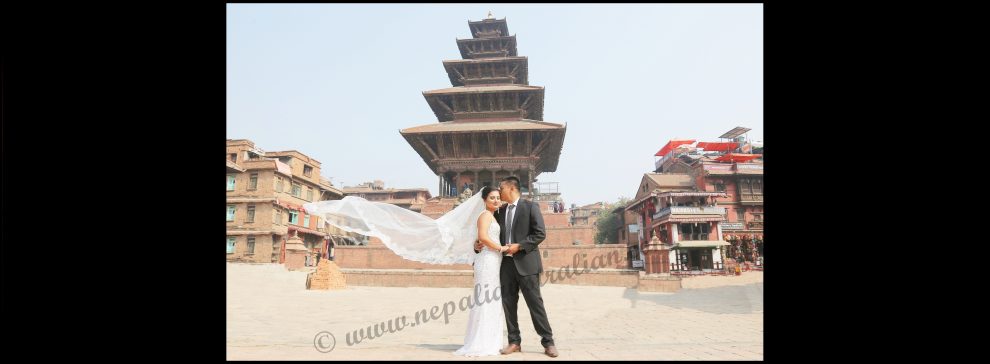
 Today is Losar, a festival in Nepal which is celebrated by Mongolian Nepali, mainly by Gurung community as well as Rai, Tamang, Sherpas to welcome their New Year. Losar is celebrated on the first full moon of the first month according to a lunar calendar. On the solar calendar it falls between January and March. Lho means year or age and Sar means new or fresh. The word Lhosar means New Year or beginning of new era.
 Losar is the time when family member gathers and celebrate with cultural processions and feasting. Also on this day, older people give money and blessing to younger ones. I remember when I was young; I used to go to my friend’s place to celebrate Losar as my family doesn’t celebrate Losar (I am from Newar culture so we have our New Year during Tihar. Click here for more info). In her house, I used to get some money as well as lots of delicacies among which I liked sel roti (special Nepali bread) and achar the most.
 One of the highlights of this day is that the people who celebrate Losar dress in their traditional outfit and go around Buddist temples. Men wear Bhangra, a white cloth shirt-like apparel tied across the chest and open like a bag at the back (for carrying things), and a Kachhad, like a short sarong or kilt while women wear maroon velvet Ghalek (blouses), enhanced by large gold earrings and semi-precious stone necklaces. Even kids are dressed up in traditional outfits.
 To mark the day, all the Buddhist monasteries in the country are decorated with colourful prayer flags and the monks offer prayers for good health and prosperity, If you are in Nepal, the places to visit will be Bouddha and Swayambhu stupas where there will be crowds of people gathered to welcome the New Year.