Category Archives: Nepali food

Update from Nepal Part 3

Skinny and photogenic

90% of the people I meet in Nepal told me that I am too skinny and I need to put on some weight. I am not underweight so I am happy with it and as you all know I try very hard with exercise and healthy food to maintain my figure but most people in Nepal have their own ideas about my weight.

IMG_2614

In the beginning I used to get annoyed about it but now I am so used to it that I ignored all these comments with a smile :). Also if you look around Kathmandu, most gals are either similar weight like mine or even skinnier than me so I have no idea why they think I need to put on weight. I have a feeling being married is one of the factor.

Anyway I am learning to just ignore and concentrate in good eating habit no matter what people say. Also AS is on my side telling me I am OK and we just need to concentrate on being healthy. I am very happy to have such a wonderful hubby who understands me so well. But I think he has an ulterior motive as well. He doesn’t want me gaining weight and buying more clothes as I won’t fit into my current ones then 🙂

Most of the people especially from AS’s side has seen me only during the wedding. That time I was a bride so I was fully made up in the traditional attire. After the wedding, lot of his relatives added me on their Facebook. So that is the only way they have seen me in causal dresses.

Anyway, I have heard from lot of his relatives that I am photogenic. I am not sure I should take that as a compliment or not. I am just wondering because, normally I think photogenic means I look good on photo but at the back of mind I was wondering, does that mean I don’t look good in person.

Anyway I got that comment from many people so just sharing what’s on my mind here 🙂

Maghe Sankranti

According to Nepali calendar, it was Maghe Sankranti (1st of Magh) a few days ago.  Please click here to read more about this festival.

As I am married now, I was invited to AS’s grandparents house to celebrate the festival with my in-laws. AS missed the occasion but I was glad I was there as I got to meet all his relatives again.

As I mentioned in my post, this day we eat laddoos (sesame seeds candy ball), chaku (molasses), ghee (clarified butter), sweet potatoes, yam, khichari (mixture of rice and lentils), ginger and salt  and green leaf spinach. So a big feast was ready in the house when we got there.DSC04802DSC04800DSC04799

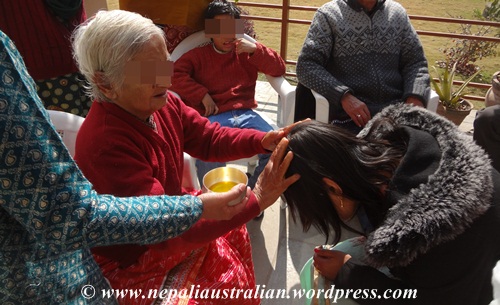
First his grandma put mustard oil on our head and blessed us then we all enjoyed the food. It was fun catching up with my new family.

DSC04779

After a few days of Magh 1, AS’s Mama (Mum’s brother) also invited us for Maghe Sankranti. In Newari culture normally, daughter’s family invites SIL, daughter and their kids after the festival as nakhatya (festival invitation in newari) to celebrate the festival.

DSC04803-tile

I got to meet more family members in this function as well. As you must have guessed,there was a feast prepared which included laddoos, chaku (molasses), ghee (clarified butter), sweet potatoes, yam, khichari, green leaf spinach and many more  dishes. .

Ma fussy chu ( I am fussy)

Sometime words have two different meaning in different languages and I got caught into that recently.

The other day I was in a departmental store trying on few make-up items. The sales gal was doing her job well convincing me to buy something so in reply I said, “ Ma fussy chu ( I am fussy), so let me think about it.” But she understood completely different thing.

Fussy (pronounced Fashi ) means con in a gentle way in Nepali language. So she thought I was telling her that she tried to con me into buying something else. For a minute I didn’t understand her reply as it was out of context when she said, “Don’t worry I am telling you the truth” but after a while I understood that she thought I thought she was conning me into buying something different.

Now I think before I say something as it might have a different meaning here.

Pasni Party

While AS was here we were invited to a Pasni of one of our friends’ kid along with my parents. They live in Sydney near us but they came here to host the function like my brother. It was nice to go to this function and enjoy Nepali way of socialising. I met a few friends and relatives in this function because in Nepal, somehow everyone seems to be related. 🙂

4994_10151470613096833_1587926127_n

Wedding party experience

I am writing this as my own experience and have no intention to disrespect any caste.

As I have told you in my post here, Nepal is a country of four castes and thirty six sub castes which means all of these castes have their own tradition and rituals.

I am from Newar caste and in our culture wedding parties goes till late at night. It is common to see Newari party starting around 6 pm and finish at 12 midnight but other castes like chhetri or bhaunu may have wedding parties that start in the afternoon and finish a bit early like 6-7pm.

One of my friends (a chherti by caste)  had invited me for his sister’s wedding. He asked me if I needed a physical invitation card but I said it’s OK as I didn’t want to bother him. So I went to the party hall where he had told me in that day with one of my cousins.

When we reach the hall, the hall was almost empty so I thought either I mix up the day or the venue. But as I entered, I saw my friend. It was 7 pm at most but there were only a few people left there. Even the bride and groom had left as they had to travel few hours to reach their home.

He informed us that the party was almost over. I was a bit embarrassed because I didn’t know what to say. I had tried to contact him earlier to find out the details but he was unavailable as he was flying in from the US the same day. Even my mum had reminded me to check the time but I just assumed that it would be same as ours but I was so mistaken.

I was happy to meet my friends after a while but it was a bit embarrassing situation and for the first time in my life I reached a party when it was almost over.

Latest update

I am having a great time with my parents. I am spending lots of time with them talking and having a great time. We have been to many temples around Kathmandu which I will post details of later. I am really glad that I extended my 2 weeks holiday to spend with them as they are very happy to have me here and I am very happy to be here.

I still miss AS a lot but I will be seeing him soon. We talk on the phone or Skype everyday so I am happy to be in Kathmandu in my birth home.

Take care everyone till my next post.

Samay Baji

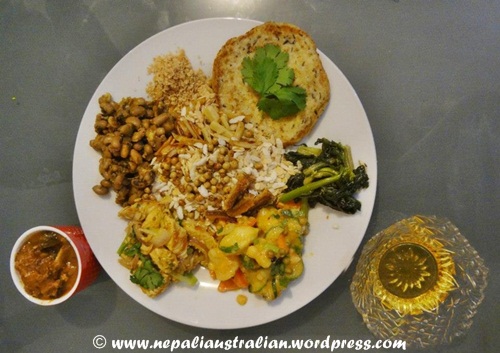
Samay Baji is one a traditional Newari dishes in Nepal that is prepared during festivals.

https://i0.wp.com/3.bp.blogspot.com/_Ds9jH5Hnnmk/TCCAuaSTC2I/AAAAAAAAAxE/aNa1lrjoQ7k/s1600/samayabaji.jpg

Typically it consists of  a variety of baji (beaten rice), haku musya (black soyabean), chhoela (smoked meat), puka-la (spicy roasted meat), aalu acha (boiled potato marinated with pickle), bhuti (boiled beans with spices), khen (boiled egg), panchkwa (bamboo shoot, potato, beans mixed curry), wo or bara (black lentil shallow fried pancakes, lava-palu (ginger and garlic), achar (pickle), wauncha (green vegetables) and aaila (Newari liquor). If you don’t have aaila, it can be replaced with any whiskey.

Samay baji is Newari food which is offered to the Gods on many occasions by Newars. This is the traditional dish and a regular item in many Newari festivals. Samay Baji is popular among Nepalese people because of its unique taste, unique cooking style and natural spices used in it.

Samay Baji

This year during Dashain, we tried to make Samay Baji and it had

Chiura (beaten rice)

Chiura, called Baji in Newari is beaten rice which is very popular in Nepal. Chiura is a common snack  in Nepal. The snack is made by pounding rice. The dish can be served with yogurt, curry, and or meat.

https://i0.wp.com/bossnepal.com/wp-content/uploads/chiura.jpg

Wo (black lentil shallow fried pancakes)

Wo is a Newari word which means mashed lentils cake and it is prepared from black lentils or green lentils (Mugh beans). Wo is called Bara in Nepali. There are different kinds of Wo depending on what is put in it and how it is cooked.

https://nepaliaustralian.com/wp-content/uploads/2011/11/2.jpg?w=500

Please click here for recipe

Aloo ko achar

Aloo ko achar is a very popular Nepali potato salad which is used in most bhoj in Nepal. There are many variations of this dish.

aloo ko achar (14)

Please click here for recipe

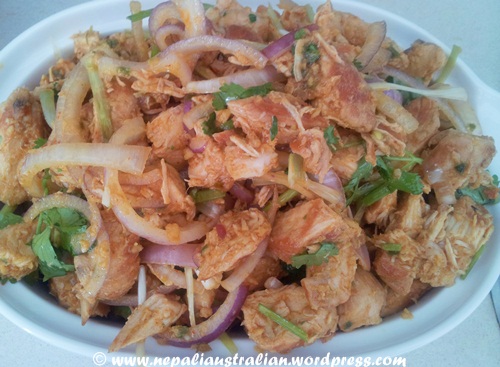
Chicken chhoela (smoked meat)

One of my favourite dishes and very popular in Nepal. an be made with goat , buffalo or chicken meat.

Chicken chhoela (10)

Please click here for recipe

Fried bhatmas (soyabeans)

Heat 1 tablespoon of oil in a pan and fry the soybean. When it is soft take it out of the pan and keep it aside and let it cool.

https://i0.wp.com/topnews.in/files/soya_1.jpg

Bodi (boiled black eyed beans with spices)

Soak bodi overnight. Press it in pressure cooker until cooked. Normally it will take 3-4 whistles. In a pan add oil, heat it a while then add the cooked bodi. Add garlic ginger paster, salt and chill and sauté for a while. Bodi is ready to be served.

https://i0.wp.com/static.flickr.com/62/210106145_c38f120456_b.jpg

Saag (green leaves)

https://i0.wp.com/3.bp.blogspot.com/_3xX21KaxjX4/Sr2Ck-5g4aI/AAAAAAAADLA/y8z7nsb-Cq4/s400/Sep-22-2009%2B003.jpg

You can use any type of green leave for this like English Spinach, Choy sum or Bok choy. You can either boil or fried it with some salt.

Khasi ko masu (Goat curry)

Khasi ko masu is one of the main dishes eaten during Dashain in Nepal. It can be made in different ways depending on personal preference.

goat curry (7)

Please click here for recipe

Fried fish

Just fry a few anchovies in oil.

https://i0.wp.com/1.bp.blogspot.com/_0CWdGn9Gu5c/TGag8GesbnI/AAAAAAAAEvA/vm2um9bllEE/s1600/netli%2Blast.jpg

Lava-palu (ginger and garlic)

Peel fresh garlic and cut into half.

https://i0.wp.com/farm4.static.flickr.com/3565/3602580339_ff9bfdde72.jpg

Peel ginger and cut into thin slices.

https://i0.wp.com/www.tigersandstrawberries.com/wp/wp-content/gingersliver.jpg

  • aaila (alcohol)

In Nepal, they make home-made rice wine aaila which is colourless. But that day we don’t have the typical newari wine so used rum.

http://theajnabee.files.wordpress.com/2010/10/gedc3073.jpg

Nepali style Goat curry (using a pressure cooker)

goat curry (1)

Ingredients

  • 2 red onions sliced
  • 2 tomatoes dices
  • 500gm goat meat
  • 10 curry leaves
  • 2 tablespoons of coriander powder
  • 2 tablespoons of garam masala
  • 3 tablespoons of ginger garlic paste
  • 3 tablespoons oil
  • 1 tablespoon of chilli powder
  • 2 teaspoons of turmeric powder
  • Salt to taste
  • Fresh coriander to garnish

 Steps

  • Take a pressure cooker and heat oil in it.
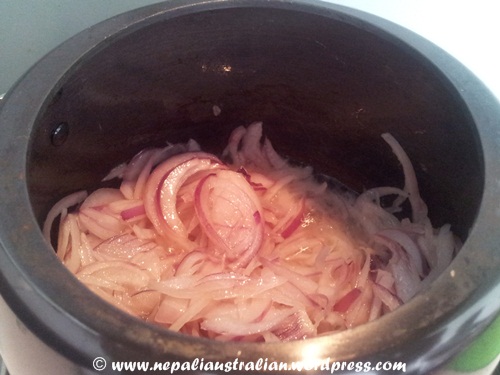
  • When the oil is hot add curry leaves and the finely sliced onions.

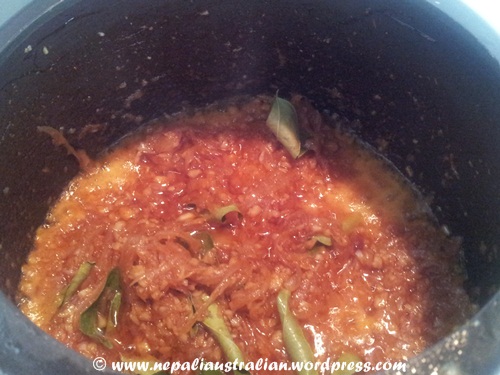
goat curry (2)

  • Add a pinch of salt so that the onion will get cooked quickly and becomes golden brown.

goat curry (3)

  • Add Ginger Garlic paste, garam masala, coriander powder, turmeric powder, salt, chili and let it cook for 2 mins.

goat curry (4)

  • Add finely diced tomatoes and let it cook completely, with the onion.

goat curry (5)

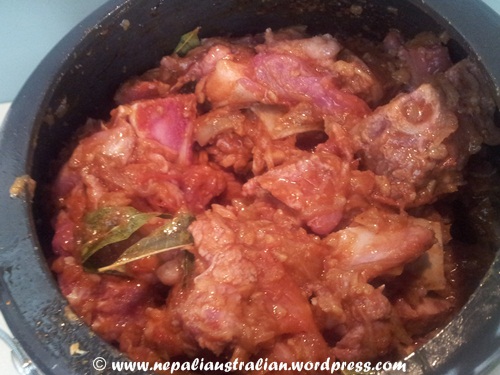
  •  Add the goat meat  to this mixture.
  • Let it cook for 10 min .
  • Add some water, close the cooker lid and keep the flame on medium
  • After 6 full (long) whistles, turn the heat off
  • Let the pressure in the cooker dissipate by itself; do not force the steam out by lifting the whistle etc.

goat curry (6)

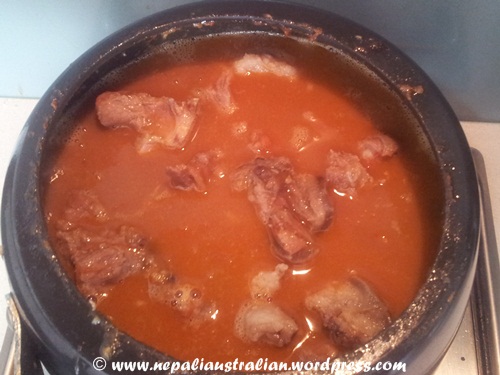
  • When the pressure has dissipated, open the lid and check if the mutton is tender enough if not add some water if required and let the curry cook for about 3-5 min on low to medium heat
  • Garnish the goat curry with fresh coriander and it’s ready to server!

goat curry (7)

You may also like :

*Momo *Aloo ko achar *Chicken chili

Bhogate Sadekoo

One of the things widely eaten in Nepal after the festival of Tihar is, Bhogate Sandheko. Bhogate is called Pomelo (Chinese grapefruit) in English and is used in Nepal during Mha Puja and Bhai Tika. Bhogate Sandheko roughly translates to marinated pomelo in English.

You may also like :

*Momo *Chatamari *Chicken chili

Pomelo is a crisp citrus fruit native to South and Southeast Asia. It is usually pale green to yellow when ripe, with sweet white (or, more rarely, pink or red) flesh and very thick albedo (rind pith).

Pomelo tastes a bit like grapefruit but is sweeter, less tart, and is not bitter. In Australia, we can’t find pomelo so the closest thing to Bhogate is grapefruit which is what I used in Bhai Tika during Tihar.

So like my mum used to, I tried to make Bhogate Sadekoo and am sharing my recipe here.

Ingredients:

  • 1 grapefruit/pomelo
  • 2  oranges  (I used oranges but you can use any fruit)
  • 4 tablespoons of  plain yogurt
  • 2 teaspoon of red chili powder (or to taste)
  • 2 tablespoon of sesame seeds, roasted and ground
  • Salt to taste
  • Sugar to taste (optional)
  • 2 teaspoons of mustard oil
  • 1 teaspoon fenugreek seeds (methi)
  • ½ teaspoon turmeric

Process

  • Peal grapefruit/pomelo and oranges and put it in a bowl .

  • Roast sesame seeds in a pan stirring constantly making sure it turns golden brown, not black.
  • Cool it and grind it.

  • Add yogurt, salt, sugar, sesame powder, red chili powder in the bowl with the pomelo and oranges and mix well

  • Heat a pan with mustard oil in it
  • When hot put fenugreek seeds in it
  • When the fenugreek seeds turn golden brown, take it off the heat and pour oil with fenugreek into the Bhogate mixture in the bowl

  • Mix it well

  • Bhogate Sandheko is ready to serve, yum yum yum 🙂

Aloo dum (Nepali potatoes curry)

Aloo dum is a very popular dish in Nepal. My mum used to cook it almost every day when we were little as both me and my brother were very spoiled and didn’t eat most of the other veggies except potatoes.

Ingredients

  • 4 medium potatoes
  • 1 onion sliced
  • 1 tablespoon of crushed ginger and garlic
  • 2 tomatoes diced
  • 1 teaspoon of cumin seed
  • 1 teaspoon of cumin powder
  • 1 teaspoon of coriander powder
  • 1 teaspoon of chilli powder
  • 1 teaspoon of turmeric powder
  • 2 tablespoons of unflavoured yogurt
  • Salt to taste
  • 2 tablespoon of oil

Steps

  • Boil potatoes and cut into cubes.
  • Heat oil in a wok.

  • When oil is hot, add cumin seeds and let it fry for a few seconds.

  • Add onion in the wok and fry till they are brown.

  • Add diced tomatoes and turmeric powder and fry some more.

  • When the paste starts giving out oil that mean it is cooked so add the boiled potatoes to the wok.

  • Just toss potatoes around and add salt, cumin, chilli, coriander powder and a half cup of water and let it boil.

  • Now add the unflavoured yogurt and mix it well.

  • Take the curry out of heat and serve with rice or roti.

You may also like :

*Momo *Aloo ko achar *Chicken chili