Category Archives: Nepal

Phokso Fry (Nepali style fried lungs)

In Nepal, a goat’s brain (gidi), feet (khutta), head (tauko), stomach skin (bhundi), tongue (jibro), liver (kalejo), kidney, lungs (phokso), fried intestines (aandra), fried solidified blood (rakati) are considered delicacies and are in very high demand in Dashain and during festivals.

I know some of you might feel squeamish even thinking about eating offal but believe me if you love your meat, you will love these dishes. Another is that eating offal uses the parts of the beast that might otherwise be wasted. As it takes 10 kilos of cereal to produce one kilo of meat, then we should not be wasting any part of the carcass. Unless you deliberately avoid meat, eating offal should be regarded as “green”.

As I am from Newar community so it is very common in our household to have these delicacies.

Most of you may not know it but fried lungs are one of the tastiest of delicacies. If done the right way, Phokso fried (fried lungs) are very tasty. AS was craving it when we were in Nepal. As we were a bit scared to eat out, my MIL decided to cook one at home and at the same time teach AS and me how to do it.

In order to have a perfect Phokso fried, you must make sure you buy fresh lungs without any punctures. In Nepal, they blow air into the lungs at the butcher’s to show that it is a good one.

Phokso Fry  (1)

Once lungs are ready, it must be cleaned properly to make sure there is no blood left in the vessels. To clean it, pour water in it through its trachea multiple times until all coagulated blood remaining in the lungs come out. At the end, pour a few tablespoonful of oil into each lung.

Ingredients:

  • 1 khasi ko phokso (goat lungs)
  • 2 cups all-purpose flour
  • 2 eggs
  • 1/4 teaspoons turmeric powder
  • 1/2 teaspoons coriander and cumin powder
  • 1/4 teaspoons chilli powder
  • 1 1/2 teaspoons salt
  • 1 teaspoon garlic ginger paste
  • 4 cups water
  • kitchen strings
  • 1 small potato to use as stopper

Process:

  • Put the flour in a dish and place all ingredients over it. Mix all ingredients together until all lumps are gone. The mix should be a bit watery.

Phokso Fry  (2)

  • To make sure there are no lumps in the mixture; strain the mixture through the strainer. Use whisker if required.

Phokso Fry  (3)

  • Fill a plastic bag (we used milk bag in Nepal but you can use zip lock bag) with the mixture. Place the end of the trachea into the opening of the bag and clamp your fingers over them to seal them. Pump the mixture in the bag into the trachea.

Phokso Fry  (5)

  • When the lungs become full you will notice that the outer skin will be smooth and shiny.

Phokso Fry  (6)

  • When the lungs are full, don’t just let the trachea go as the lungs will pump the mixture out quite rapidly. Keep holding the trachea!
  • To seal the trachea, peel and cut the potato and insert the cut potato into the opening of the trachea. Shove it inside then fold and seal trachea by tying with a kitchen string. This will make sure the batter doesn’t flow out while it is being boiled.

Phokso Fry  (7)

  • In a big pot, boil water and add turmeric powder.

Phokso Fry  (8)

  • Add the lungs and cook it. You may need to turn it over to make sure all sides get cooked.
  • Once the lungs are cooked, let it cool down before cutting it.

Phokso Fry  (9)

  • Slice the lungs into pieces a few centimetres thick pieces.
  • In a fry pan, heat oil and lay the sliced lungs in one layer.
  • Once one side is crispy and brown in colour, turn and fry the other side.

Phokso Fry  (10)

  • Take the fried lungs out on a plate.
  • Mix salt, chill power and cumin powder in the plate.

Phokso Fry  (11)

  • Sprinkle this mix on the fried lungs.

Phokso Fry  (12)

  • It is best served hot.
  • Enjoy!!!

Swayambhunath: Kathmandu, Nepal

Going regularly to a temple is big part of Nepali culture. You will often see people of all age going to a temple early in the mornings. While in Nepal, we tried to go to different temples as well. For us it was more of going to see the place than for religion but if we were to get blessed while we were there then even better :). One of the temples we visited was Swayambhunath, also know was Monkey Temple by tourist in Kathmandu.

One day we were invited for lunch to our aunt’s house, which is near to Swayambhunath, so we decided to visit the temple before we went for lunch. Swayambhunath is an ancient religious complex atop a hill in the Kathmandu Valley, west of Kathmandu city. Even though Swayambhunath is a Buddhist stupa, yet it is equally popular with the Hindu pilgrims as well.

Swayambhu (21)

Legend has it that Kathmandu Valley was once an enormous lake, out of which grew a lotus. The valley came to be known as Swayambhu, meaning “Self-Created.” The name comes from an eternal self-existent flame (svyaṃbhu) over which a stupa was later built.

Swayambhunath is also known as the Monkey Temple as there are holy monkeys living in the north-west parts of the temple. They are holy because Manjushree, the bodhisattva of wisdom and learning was raising the hill which the Swayambhunath Temple stands on. He was supposed to leave his hair short but he made it grow long and so head lice grew on them. It is said that the head lice transformed into these monkeys.

Swayambhu (15)

The Bodhisattva Manjusri had a vision of the lotus at Swayambhu and traveled there to worship it. Seeing that the valley could be a good place for settlement and to make the site more accessible to human pilgrims, Manjusri cut a gorge at Chovar. The water drained out of the lake, leaving the valley in which Kathmandu now lies. The lotus was transformed into a hill and the flower became the Swayambhunath stupa.

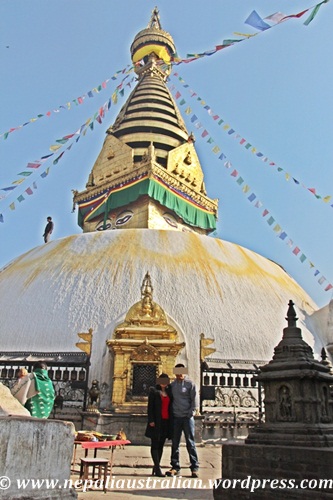
As we were driving to the hill where Swayambhunath stupa is, we could really see how beautiful the temple is.  Around the bend of some roads, the temple comes into full view, and we can see the large Buddha’s eyes, sitting below a golden roof at the peak, keeping watch over the valley.

These large pair of eyes, which represent Wisdom and Compassion, on each of the four sides of the main stupa. Above each pair of eyes is another eye, the third eye. It is said that when Buddha preaches, cosmic rays emanate from the third eye which act as messages to heavenly beings, so that those interested can come down to earth to listen to the Buddha. The hellish beings and beings below the human realm cannot come to earth to listen to the Buddha’s teaching, however, the cosmic rays relieve their suffering when Buddha preaches.

Swayambhu (26)

The dome at the base represents the entire world. When a person awakes (represented by eyes of wisdom and compassion) from the bonds of the world, the person reaches the state of enlightenment. The thirteen pinnacles on the top symbolize that sentient beings have to go through the thirteen stages of spiritual realizations to reach enlightenment or Buddhahood.

Swayambhu (1) Swayambhu (28)

When we reached the gate leading to the steps, there were many monkeys all over the place. Some people were feeding monkeys which were running everywhere. I am scared of monkeys as a monkey had snatched a bag from my hand when I was kid so I went and hid behind my husband and brother when I saw them running towards us. I have to say they are pretty well behaved as they don’t bother you unless you annoy them.

Swayambhu (22)

On the side of the gates, there were ladies selling Puja items like candle, flowers and souvenirs.

Swayambhu (31)

There are 365 steps and it is believed that there’s a step for each day of the year, starting at the gate and ending at the stupa. We started to climb the stairs and more monkeys emerged. I stayed close to AS and I was fine. We took a few photos as we climbed up and as we went higher the view got even better. There were many beggars sitting on either sides of the stairs as well and some of them I felt really sorry for as they had small children with them.

Swayambhu (12) Swayambhu (13) Swayambhu (11) Swayambhu (2)

Swayambhu (6) Swayambhu (5)

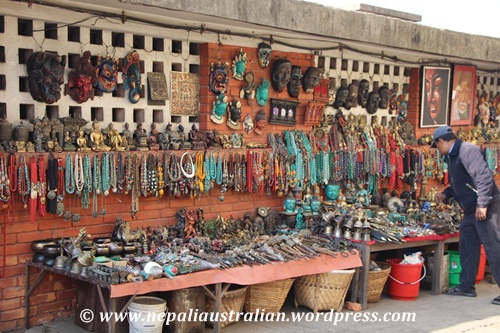
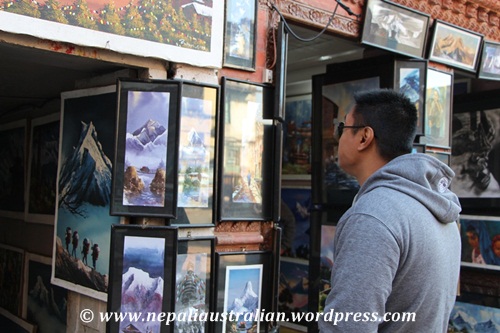
As we reached the top, we could see more monkeys everywhere. There were also stalls selling the usual touristy items. There were many interesting, well-done acrylic paintings of the Himalayas, Nepali hand puppets and other handicrafts.

Swayambhu (7) Swayambhu (30)

Swayambhu (20)

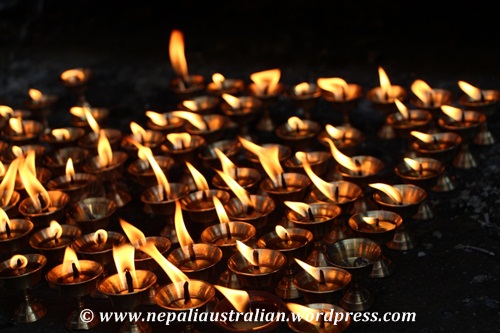
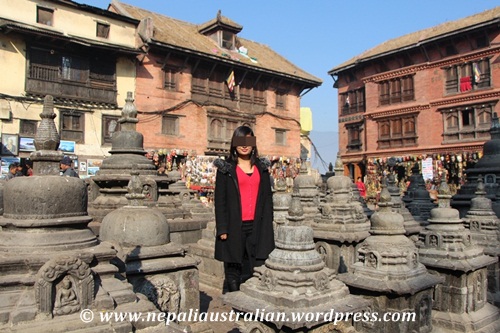
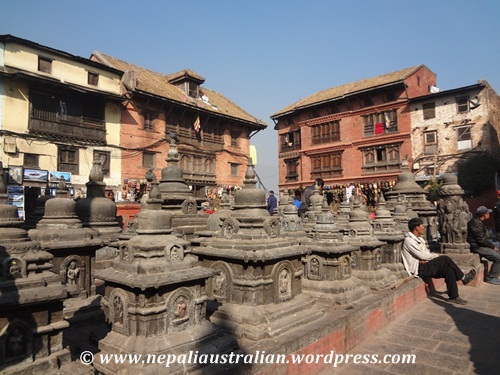
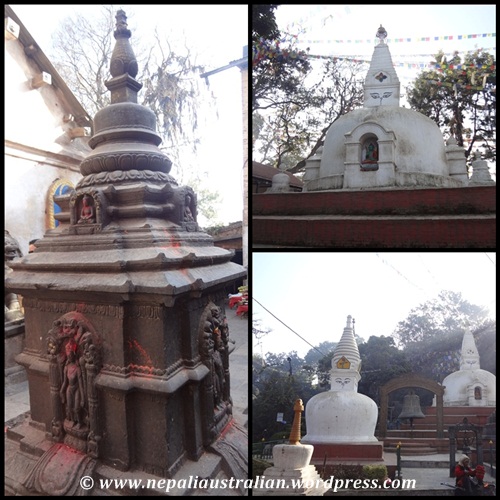
There were also lots of people worshipping in the temple with diyo and candles. I could see prayer flags around the stupa and lots of diyo lit in front of the temple next to stupa. The Swayambhunath complex consists of a stupa, a variety of shrines and temples, some dating back to the Licchavi period as well as a Tibetan monastery, a museum and a library.

Swayambhu (19)

Swayambhu (14)

Swayambhu (29) Swayambhu (25) Swayambhu (3)

 As we walked around the temple, we rotated the prayer wheels. A prayer wheel is a cylindrical “wheel” on a spindle made from metal, wood, stone, leather or coarse cotton. Traditionally, the mantra Om Mani Padme Hum is written in Sanskrit on the outside of the wheel. According to the lineage texts on prayer wheels, prayer wheels are used to accumulate wisdom and merit (good karma) and to purify negativities (bad karma).

Swayambhu (32)

Swayambhu (23)

At one end of the temple area, there is a viewpoint from where you can see the entire Kathmandu. I remember coming there when we were young and we used to try to find our house from there but these days due to population and pollution, you can’t see very far. I felt really sad to see how Kathmandu has changed in the last decade and definitely not for the better in terms of the environment.

Swayambhu (24)

Swayambhu (17)

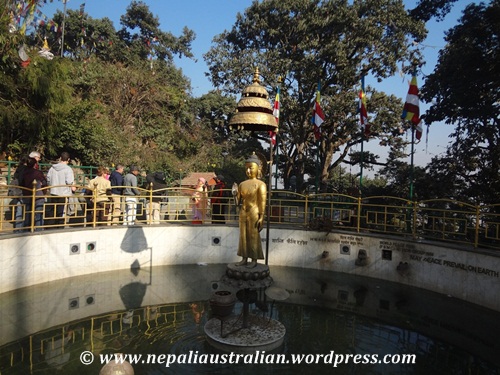
After looking around for a few more minutes, we decided to back down to the car. As you come down, there is a golden statue of Buddha surrounded by water. People were throwing coins into a bucket there and it is believed if your coin enters the bucket, it will bring good luck. My brother and SIL were trying their luck so AS asked me to throw some coins as well. It reminded me of the Trevi fountain when we were in Italy. There were lots of coins lying around the statue there as well but I am sure, the amount of money thrown here is nowhere near the amount in the Trevi fountain.

Swayambhu (9)

After our visit to the temple, we were really hungry so we went to our aunt’s house for lunch 🙂

Swayambhu (10)

Swayambhu (18) Swayambhu (8)

Swayambhu (27)

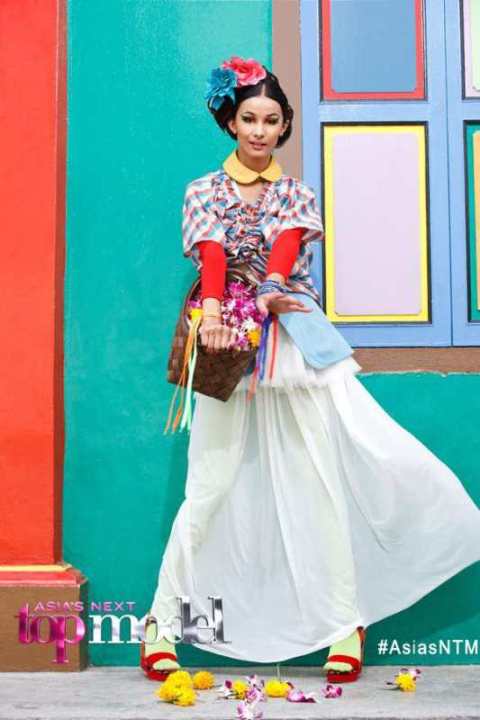
Aastha journey’s in Asia’s Next Top Model

I am sure you remember Aastha Pokharel who was representing Nepal for Asia’s next Top Model here.  I was really busy lately so didn’t have time to catch up but finally I was able to watch up to Episode 10 over the weekend. I am already a big fan of this show as it gives aspiring models a big chance in their career and at the same time teachs them how to be a better model giving them opportunities to learn during the show.

Asia’s Next Top Model started out with 14 contestants from all over Asia and Aastha was representing Nepal. The show is doing really well and I love every challenge they get.

Here is what has happened with Aastha so far. I really thinking she is doing a great job and has a huge potential to be a world class model.

Episode 1 Little India Shoot

Episode 2 Wearing Prada for Harper’s Bazaar

Her group won the best group and she won best photo for this shoot and she deserve it.

Episode 3 Chinese Zodiac Shoot: Aastha as a rat

In this episode all the girls were given a makeover and Aastha’s long hair was cut short. She was really not happy with her new look and it took its toll on her photo-shoot. I do like her new look .

Episode 4 Photo with hot Jason Godfrey

Aastha really impressed judges with this shot and was the runner up on the ‘Be Sexy’ shoot.

Episode 5 French Riviera shoots

I really like this photo of Aastha. She was runner up on this shot as well but I really think it was the best shot.

Episode 6 Tresemme Beauty Shoot

For this episode, everyone made an ad for Tresemme writing their own script and performing in a commercial.  Aastha won this challenge with the following ad.

Episode 7 Environmental campaign

In this one Aastha struggled and her photo was not so great.

Episode 8 A haute couture red dress

During this shoot Aastha was told she needs to keep her energy up during the shoot. But I loved this shot of her. Aastha came third.

Episode 9 Underwater photo-shoot

This was one of the worst one for Aastha was it was an underwater shot and she cannot swim. But I am so proud of her since she managed to overcome her fear of the water and gave a great shot.

Episode 10 Movement and passion

I really like her ad for Suvaru with Girls on the Move concept.

Later during the photo-shoot, Aastha complained that her dress and hair wasn’t working for her. I felt bad for her but she still managed to give nice shot which judges thought had a great pose but her face was blank.

If you are interested please click the following to watch it from the start. I am waiting for the last 2 episodes to come on YouTube now  🙂

You may also like :

*Aastha Pokharel representing Nepal on Asia’s Next Top Model  *More stars shines under Prabal Gurung’s collection *Varsha Thapa: First international fashion model from Nepal

Forever Blackout

This article was published in +977 (a Nepalese Lifestyle Magazine in Australia) in Feb 2013 issue.

977post

Living in Australia we always hear things happening in Nepal like strikes, Nepal Band, political instability, traffic problem, pollutions and of course load shedding. We always sympathise with the people who have to live with these conditions and we feel sorry for them as they how to put up with all this hardships in life.

I have to admit it is easy to say “Bichara” and move on with our happy life in Australia but it is a different ball game when you are facing the problem first hand. I have been in Nepal for a few weeks now and I had never imagined how much load shedding can affect one’s life until now. How can you lead a normal life if you have to live without electricity for 12 hours a day and it is predicated to be more hours in coming weeks.

Living in Sydney I never have to plan my life around electricity but in Kathmandu you must be a great planer if you want to live a smooth life. Most days, working people of Kathmandu won’t see electricity at their home as there will be no lights when they leave home and there is still no light when they come back  home. It’s like you live in the city that has no electricity at all.

Currently, the only days, I wake up with electricity is twice a week on Sundays and Mondays and rest of the week, no lights during mornings and evenings. If I want to do something that requires electricity, I need to wait till 11 or 12 in the afternoon and quickly finish my chore before electricity goes out again.

It is winter here so if I want to shower with hot water using the hot water geyser, I must run and turn on the geyser as soon as electricity comes on as it is a luxury of only for 4-5 hours. Also I must iron my clothes, charge my entire electrical appliance in that time as well otherwise I have to wait another 7 hours before I can use all the gadgets.

Some people have even water problem because of load shedding. If water is supplied when there is no electricity most people can’t fill their tank which is on their rooftop so they have to ration water to live for day to day life.

We all know that Nepal has a huge hydropower potential. Nepali rivers and the steep gradient of the country’s topography provide ideal conditions for the development of some of the world’s largest hydroelectric projects, approximately 40,000 MW of economically feasible hydropower but currently Nepal has developed only approximately 600 MW of hydropower. Therefore, bulk of the economically feasible generation has not been realized yet.

Nepal is not able to generate even half of the 900 MW peak supply demand during dry season. The electricity demand in Nepal is increasing by about 7-9% per year and so has pollution in major city like Kathmandu so until and unless major hydro electricity projects get started in Nepal, there seems no hope of people of Nepal to expect normal electricity supply in the country.

I hope Nepal will  get its act together soon and generate electricity not only for whole Nepal but also to export electricity to India and China, both of which are in need of more power to fuel their development goals.

There are a few alternatives that people are using in Nepal when power is out like inverter or solar electricity but not everyone can afford this luxury which means people are still using candles everyday like in 1800 in this 21st century to do their everyday tasks.

Most evening if you walk around Kathmandu, the whole street has no light which make the city less safe to go out after sunset affecting lots of shops and restaurants around the country.

Now you can imagine how lucky we are in Australia and rest of the world to have electricity facility and how privileged we are not to have to plan our life around electricity. And I salute all the Nepalis in Nepal who are still happy despite living in a country with major blackouts everyday.

My nephew’s Pasni Party

After the Pasni Puja in the morning everyone was tired including the little one but there was no time to rest as we had a reception organised for 300+ people that evening to celebrate the Pasni ceremony. Pasni ceremonies have become very lavish these days, with large parties of not just close relatives, but also colleagues and friends being invited for the event. As my nephew was the first grand kid for my parents and for my SIL’s parents, they wanted to make sure everyone necessary was invited.

After lunch my MIL, FIL and AS left for home to get some rest and also to get ready for the evening. So as soon as I finished eating, I rushed to my parents’ house to prepare for the evening. There was not much to do as these days you just need to order catering in the party venue and they look after everything for you.

PARTY PASNI (11) PARTY PASNI (9)

So I just made sure that mum was ok with what to wear for the evening and she didn’t need any help. My SIL had 2 of her cousins helping her to get ready. We had already decided that my nephew was going to change into a red velvet pasni dress with blue and gold embroidery that I had bought for him.

PARTY PASNI (2)

So it was my turn to be ready and be there before guest arrived. I first went and did my hair and make-up. I was so excited to wear the special sari I had designed and ordered. It took me more than 2 hours to finally be party ready. When I was done AS picked me up to go to the party venue.

PARTY PASNI (7)

When we arrived at the venue, most of our close relatives were there already and a photo session was going on with my nephew.

PARTY PASNI (14)

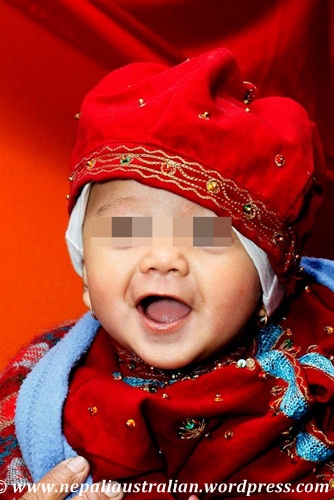
He was looking really cute and adorable in the red velvet special pasni dress.We made sure we got heaps of family photos as well as photo of the little man.

PARTY PASNI (1)

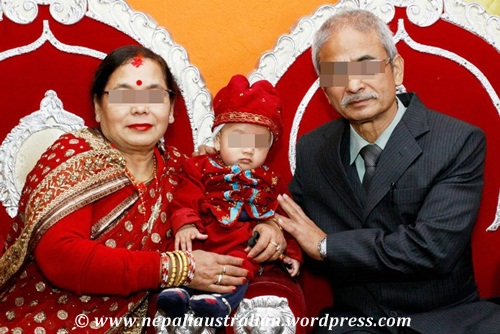
Proud Grandparents

???????????????????????????????????

Slowly guests started to come one by one. There were lots of relatives from my mum and dad’s sides so I spent lots of time mingling and making sure that everyone was looked after properly.

PARTY PASNI (10)

PARTY PASNI (4)

Also AS’s side of the family including his aunts, uncles and cousins were invited. Once they arrived at the party I was even busier as I had to talk to everyone and make sure they were eating and drinking properly.

PARTY PASNI (13)

By this time, the dance floor was slowly getting busy with my uncles, aunts and cousins dancing. I wanted to join them as well but it was a bit hard for me initially as I didn’t know what my in-laws would think. For me party has always been more about dancing and fun more than food but being a new DIL and having all AS’s close relatives at the party, I didn’t want to  go and jump on the dance floor.

PARTY PASNI (6)

But then one of AS’s aunt showed her desire to join the dance floor and asked me if we shouldn’t enjoy ourselves too. That was the only excuse I needed so I asked all AS’s relative to join us on the dance floor. And yes, that included my MIL as well. I am so glad my MIL took it well and did show her few moves . It was really fun and nice of everyone to just go with the flow attitude. Also AS and his cousins joined and we had a great time. I had to go away from dance floor from time to time to meet relatives who had recently arrived but I was really enjoying everything. I also had few of my good friend joining us for the celebration.

PARTY PASNI (8)

The evening went quickly and slowly guest started to leave in ones and twos. By the end of the evening only close relatives were left so we all had our meal as well. We made sure everything was OK and then left for home.

PARTY PASNI (5)

Proud Grand ma

It was really great to be a part of the celebration and it was nice to meet everyone during the celebration.  One of the nicest memories I had from Nepal this trip.

PARTY PASNI (12)

Happy Fufu

And my nephew was an angel whole day. He didn’t cry and was smiling at everyone. He was held by more than 200+ hands that evening but he was just smiling and playing with everyone that everyone was so impressed to see such a playful happy baby.

He is growing up so fast and every time I see him, there are some nice changes with him. These days he has learnt how to move his fingers in the “come here” sign so it is so cute to watch him do that. Sometimes he is so amazed that he can do that, he keeps on looking at his own hands. Also he is falling in love with himself. Every time he is in front of the mirror, all he does is smile,