This is a continuation of my previous post. Please read the previous post here.
So where were we? Yes, AS has finally come to meet me at LA airport. Surprise surprise!!!

We greeted each other and it was hard to believe he was in front of me after so many years. We hadn’t seen each other for ages, more than 7 years. He still looked the same as I remembered him from the school days. He was still skinny like I remembered with his glasses and that big smile. His hair was a bit longer but still somewhat similar. He looked tired but seemed genuinely happy to see me.
He asked me if I had plan for rest of the time there. I told him that it would be annoying to go to touristy places with my big luggage so I was thinking to spend the time in the airport itself. Also I was scared to miss my flight due to traffic in LA if we ended up going somewhere far.
So we decided to sit around the food court and he helped me push the heavy trolley.
Once we sit down and started talking, it didn’t feel like we hadn’t met for so long. It was as if we had always been in touch. Lots had happened in those years so we had lot of topics to talk about. I was surprised how both of us were so comfortable with each other even after so many years. He told me what was happening with his life and I updated about my life. We talked about anything and everything.
We remembered our school days when we used to go out for lunches and go to our favourite café to have tea and chicken and vegetable pastries.

We also played pool (pocket billiards or pool billiards) and I learnt all the rules and how to play it then.

Also all the hiking trips we went too.

Ohoo, those carefree days! How I wish time had stopped then and we could be happy like then forever in life.
Our group of friends used to go to Hotel Soaltee every month or so. They had a gaming centre where you buy tokens and play games. All of us used to have paid satellite TV then so, once a month when we used to get the guide, it would come with tokens for the game centre. So all of us would collect them and go to this centre and have fun. They had games like bowling, mini basketball as well as usual gun and car games.

What we used to do was use those tokens and may be buy a few more and spend the afternoon there. It was so much fun as we would be more that 8+ people at a time. Also most of the games used to give winning tickets. Once you had a certain number of tickets, you could get some prize. I remember getting a Goofy from Disney using our tickets. As you know in these centres, you really need many tickets to get any reasonable prize. That Goofy was possible when all our tickets were combined but they let me keep the goofy at that time.

I brought that Goofy with me to Australia when I first came to Australia as it was one of the things that reminded me of my friends from school. Now that Goofy is even more special as AS is in my life now.
He also told me he still had a gift we (me and one of my friends) gave him for his birthday. I was scratching my head trying to remember what exactly it was. I was glad when he explained to me and I remembered. It was a crystal swan we picked up from a gift shop because we didn’t knew what to buy a guy. So we decided on a show piece. But it was ages ago and I had completely forgotten about it. I know it is bad but I also don’t remember what they (him and other friends) gave me for my birthdays then and I didn’t dare to ask him.

Also we talked about how fun it was when we used to go to tuition together and go to temples afterwards. I think our tuition with only two other friends gave us more time to know each other. Those were the days when we used to visit each other’s home more often. Because the place we went for extra tuition was closer to my place, it was normal for everyone to drop into my home. Now I feel blessed to have parents with an open mind. They never minded that I had friends (which included few female ones but many males) over all the time.
In Nepali society especially then, it is not usual for a girl to have many male friends. And bringing them home was big NO NO. I remembered my cousins who had never brought a male friend home. It was not allowed. But my parents were awesome to have trust and faith in me to let me do what I wanted. They never minded or complained about my friends. My girlfriends used to come for overnight stays while my male friends could come to visit anytime. Most of them had lunch or dinner at our place if they were there during meal times. Also my parents were really cool coming to talk to my friends and getting to know them better. I definitely have to remember this when we have our own kids one day.
Also we talked about the day he came with my other friends to airport, the day I left Kathmandu for Sydney. Going through the pictures, I find it really sweet that more than 30 people were there at the airport that day to bid me good bye which included my family and friends I do remember him at airport that day but nothing more than that.

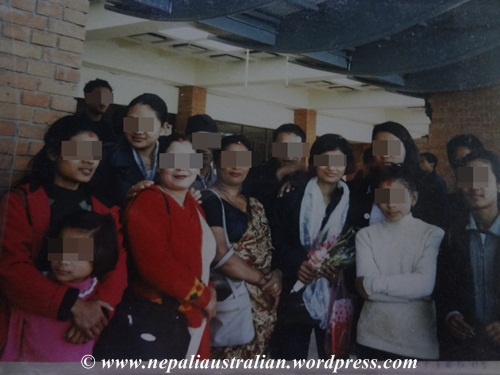


I was highly emotional during that time. My little cousins were crying while my parents had tears in their eyes. I stayed really strong during the whole time and cried only once I was inside the airport. I knew if had I started crying there, then everyone else would cry as well. Even though I was really young then, I guess I was a strong girl to leave everything behind to start afresh in a strange land with no help. But today I have to say that was one of the best decisions of my life as my life wouldn’t have been same without that major decision.
During our conversation, he asked me about my husband and kid. I must tell you all why he asked the question.
You know I told you before how I used to get annoyed with AS that he used to disappear for more than six months at a time. I wouldn’t know anything about him and then he would suddenly pop up with a few lines in an email. So one of those days I sent him the following email.
Hello AS,
Hope you are doing great. Just dropped in to say hi.
It looks like, “ Out of sight, out of mind” applies to you perfectly.
I believe you must be married with kids by now.
If u are in hi5 or Facebook, add me so it will be easy to keep in touch.
Take care
M
To this he replied after a month (It was quick for his track record).
Hey,
Out of sight but not the mind 🙂 not for friends..
I’d kind of dropped off the online world it seems.. Back again.
I’m still in India.. Where u at and how u doing 🙂 lots of guys gone off and married.. NP, GB.. But not me yet 🙂 what about u? I’d think u must be 🙂
Mail me, take care.
AS
To that I replied after a week
hey hey hey
Finally u manage to reply….God you must be very busy? ;-P
So u r still working in India. What r u doing these days?
I know lot of our frds r married and got kids too. Remember NS, she got 2 kids now.
Anyway what about u ?how many u got now? How about a girlfriend if not wife…..
Why aren’t you in Facebook still? sign up…come on b more social man……
My life is rocking, got married and had one kid and life is going. Such is life.
Still in Sydney and having lots of fun
Don’t disappear, keep in touch
Take c are
M
Can you believe, he replied to above email in two days?
Hey M,
Not planning to disappear 🙂
good to hear u’r married and a kid too..
Can’t quite believe that when I think of the past and Kathmandu 😉
I’m still in India but going to US this weekend. I got a job there.. Will be there for about a year at least.. Then probably I too will get married…
Gotta find a nice girl for that though:-D
Keep mailing… Take care
AS
And he completely disappeared after this email until I sent him the email about my holiday plans to the US almost a year later. Remember the one he took 6 months to reply?
So when he asked about my husband and kid I was a bit confused initially Suddenly I remembered our email exchange. I told him that my husband and kid are fine in Sydney and I was on holiday alone. He told me he was expecting to meet my husband and my kid at the airport that day.
It was really hard for me to play along any longer so I started laughing out loud. He was surprised and I had to explain to him that I had already forgotten about the email until he asked me about my husband and kid. I was not married and definitely had no kid. I was pulling his leg in the email because I was annoyed with him for disappearing for so long.
I don’t know if he was glad or not but he told me he had believed me 100% when I told him I was married with a kid. Lots of our friends were married by then and some even had kids so it was not unusual.
After that we talked about normal topics. One of the things I remember telling him was to open a Facebook account so we could keep in touch easily. He said he will do that and I knew it would be another year before I see his email or account.
After the first few hours we decided to have lunch. There was not much choice so we went for burger and chips with drinks. He remembered I was vegetarian during our school days and was surprised that I had started eating meat again. I told him that I ate meat from the time I came to Australia.

Actually my parents made me eat meat before I left Nepal. When I applied for my visa to Australia, they were really worried about me as I was a teenager and there was no one in Sydney who would look after me. It was hard for them to send me so far away. Then to top of all that one of my cousins who used to live in Australia told them that life was very hard for vegetarians in Australia so I might have a tough time adjusting. So they told me if I don’t start eating meat I wouldn’t be allowed to go. I really wanted to come to Australia for a fresh start so I gave in.
I still remember the first time I ate meat. Tears were coming down from my eyes when my mom served me minced chicken with lots of mushrooms. As it had been years since I hadn’t had any meat, I could taste the meat even thought it was hidden within mushroom.
I don’t regret my decision right now as I love meat. Also I know my parents did all that because they loved me and they wanted to make sure I would be OK in Australia.
Back to LA airport: I and AS were catching up with my experience in US. I met a few common friends from school so I was sharing my experience with him. It was so nice to meet these friends after so long as well. If I think about it right now, I really don’t know what else we talked about but more than 4 hours passed just like that at one table in the food court. By that time we were hungry again and we decided to have another round of food. This time it was Mexican tacos and burritos. I remember complaining to AS that I didn’t like Mexican food in US. I know, Mexico is next door so those Mexican foods must be very authentic. But I love Mexican food in Sydney and it was so different from what they sell here. It’s the same like how we didn’t enjoy pizza in Italy, how ironic.

I couldn’t believe how fast time flew and it was time for me to check in for my flight to Sydney. He helped me again with my luggage and we went to the check in counter to check in my luggage.
I had one more hour before I had to go inside to clear immigration and board the plane. I was having such a nice time with AS at that point that I was sorry I was leaving.
The last hour passed pretty quickly and it was time for me to board the plane. I almost forgot but at last minute we took a few pictures together. It was a good time and I am glad we caught that on camera forever. I told him that I would email the photos once I reached Sydney.


I made him promise to keep in touch with me and not to disappear for six months like before. He swore that it won’t happen again and bid me good bye with the same smile on his face, the one I remembered him from our school days.
With sadness, I went inside the immigration area and turned around to look at him one last time thinking I may not see him ever in my life again.
The post is getting long so I will write more in next post. Hope you will come back and read more 
You may also like :
| *Arranged marriage: My perspective | *Ta, Timi, Tapai and Hajoor | *Our Story : The Beginning – Part 1 |