I was talking to one of my good friends on Skype recently. She is happily married with a 4 years old daughter. We have been friends for a long time but as she lives in Nepal and I live here, talking to her is always a treat. Every time we have a conversation we share our personal life and feelings.
I knew she hasn’t been very happy about a few things after her marriage. But recently I found her really happy and alive. I commented to her how glad I was to see her so happy. She told me she is happy because now she is free to wear what she wants. She said she is feeling better about herself now that she has control over her life.
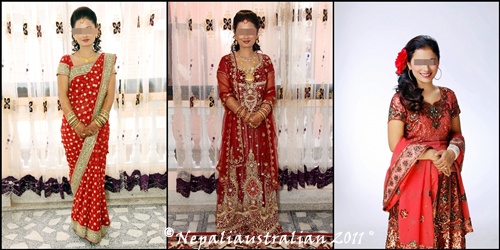
Right then it struck to me that for the first few years after her wedding, she was wearing only Sari and Kurta. So here I am writing about the marriage attire for women in Nepal after marriage.
I have never lived outside of Kathmandu in Nepal. Both my parents are originally from Kathmandu so whatever I am going to write will most probably be the view of city life in Nepal.
In Nepal, for a long time, girls have freedom to wear what they want. I am not talking about low cut short skimpy dress but still they are allowed to wear what they want to a certain extent. I have seen my mum’s photos from her school and college days where she was wearing bell-bottom pants or big floral print t-shirt or beautiful colourful dresses.. Normally people let their daughters wear what they want and these days fashion in Kathmandu is not far behind western cities. So every time I go back to Nepal, I am amazed to see girls wearing low cut dress, short shorts or boob tube dresses and tops. I remember when I was there even halter dresses were not popular. But these days there seems to be not much restriction on what you can wear.

But things turn 180 degrees once the same girl gets married. Let’s take an example of my friend. She was wearing whatever she wanted for the last 20+ years of her life but as soon as she was married, she was forced to wear only Kurta and Sari for 2 years after the wedding. She did want to wear pants and dresses but her MIL and her husband’s immediate family member were against it so she couldn’t do anything about it. It is like my daughter/sister can do anything but if the girl is my  DIL or SIL then they have to be seen as a traditional Nepali woman. I know things have changed a lot in the last few years as most of the women work after the marriage as well so they have to wear a uniform or still wear pants as it is more comfortable. But at the same time I have seen many families that didn’t allow their daughter in-laws to wear what she wants but instead says “You are a daughter in law now so you must wear only traditional attire. What will the neighbours says if they see you in pants or dress!” What a double standard.
I know in Nepal not only the in-laws but your own family will expect you to change how you dress, like my mum expected from me once I was married, but I believe society should accept the newlywed woman even if she prefers to wear pants or any other dress than just laying down a rule that married women must wear a Kurta or Sari. If she chooses to wear Sari and Kurta , let her but don’t make it compulsory. I love wearing Sari and Kurta on occasions as I feel very feminine in them but I can’t wear them everyday. For me it is not practical.
I have a cousin who got married recently and changed her dressing style completely after the wedding. I believe it is all expected from you and if you want no conflicts with your new family, girls just follow the rules.
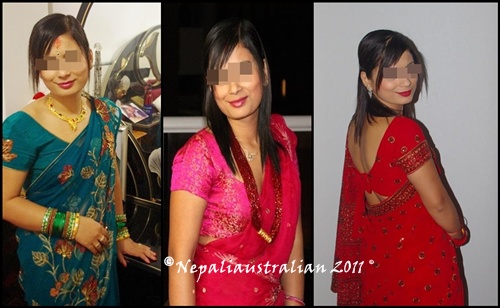
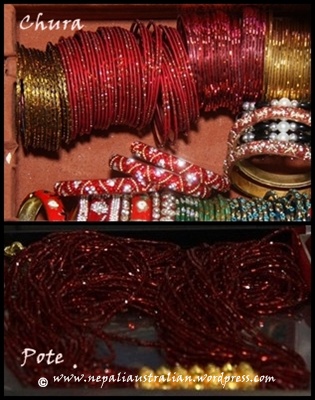 So the normal accepted attire for women after wedding in Nepal are Kurta and Sari with Sindoor(vermilion) on their head, glass chura(glass bangles) on their hands and pote (Glass beads) around their neck. My mum thought I would be wearing pote and chura after the wedding even here in Sydney. The first time I Skyped with her after our return to Sydney, post wedding, she suggested to me that I should either wear chura or pote now onwards. I told her I do wear them when I am wearing Sari or Kurta but I can’t wear them with my pants and dresses. I am sure she is not very happy about it but she does understand my point and hasn’t said anything after that. My MIL on the other hand has never mention anything close to this yet and I am very glad because I can’t be blunt with her, like I can with my mum, about my reasons for not wearing them here. But the best thing is that she is very understanding.
After the wedding I stayed with my in-laws for 10 days before leaving for our honeymoon. On those 10 days I wore only sari. Mostly it was my choice as I was having fun being a new bride and loving my saris and also it was expected that a woman to look certain way once they are married.
I am not sure how things will be when I go to Nepal again. To start with, I have to live with my in-laws most of the time. I will be visiting my parents but will be expected to spend more time in my husband’s house. So there will be the problem like what I will be allowed to wear or what is accepted of me.
Here in Australia, I wear whatever I want. I haven’t changed my dressing style after my wedding so I am not sure what I am going to do when I go to Nepal. I am sure I can’t wear shorts and short dresses. Normally I used to wear pants with a not too tight t-shirt but I am not sure what will be expected of me. May be I will just wait for now and worry about it when I book my next flight to Kathmandu. But thinking about it sometimes gives me a headache.
I believe that woman should still have the freedom to choose what they want to wear after getting marriage just like before marriage. I am sure we won’t dress like teenagers when we are in our mid 20s. Otherwise if society forces women to dress in a certain way then it might make them unhappy, like my friend, which will affect the relationship with the in-laws. I hope this will change soon so a woman doesn’t feel obligated to do things she really doesn’t want to. I know society changes according to time so I hope Nepali society will change in this aspect soon and will not differentiate between married women and single women in terms of clothing.























 nepaliaustralian