Category Archives: Nepal

Everything about Nepal

Maha Shivaratri

If you know Nepal, you might already know that there are lots of festivals every month. Today, we have one of those festivals and it is called Maha Shivaratri. It is believed that Shivaratri is the night when Lord Shiva was created by his own divine grace so this day is celebrated by Hindus with enthusiasm. Shivaratri literally means ‘ the night consecrated to Shiva’.

Maha Shivaratri is a national holiday in Nepal.

According to a legend, Parvati performed tapas, prayed and meditated on this day to ward off any evil that might befall her husband on the moonless night. Since then, Maha Shivaratri is believed to be an auspicious occasion for women to pray for the well-being of their husbands and sons. An unmarried woman prays for a husband like Shiva, who is considered to be the ideal husband. Another legend is that Shiva and Shakti married each other on this day.

There is one more legend of Shivaratri associated with Samudra Manthan, a battle between devas and asuras during which a pot of poison came out of the ocean and on the request of gods, Lord Shiva drank the poison. The poison was so potent that it changed the colour of His neck to blue. For this reason, Lord Shiva is also called Neelkanth (one whose throat is blue).

So basically this festival is in honour of the Hindu God Shiva. Today all the Shiva temples will be very busy. One of the best places to see the celebration will be Pashupatinath temple in Kathmandu located on the banks of the sacred Bagmati River. There will be thousands of people from all over the world (it is regarded as one of the most sacred temples for Hindus) coming to worship Shiva during the festival.
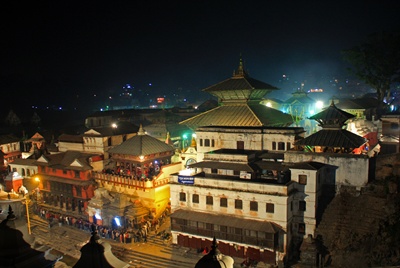
There will be a mela the days before and after Shivaratri where people fill the roads around the temples of Lord Shiva especially Pashupatinath temple . There will be  holy men, beggars, pilgrims, children and tourists.

The night before Shivaratri, all the devotees from all over the country spend the night lightning sacred fires, singing praises of the deity, and keeping a constant vigil to greet his descent to earth, on the grassy hills around the temple to enjoy the warmth of good companionship and chatting around.

At midnight, the celebration begins officially with priests inside the temple making special offerings. Then devotees will take a dip in holy Bagamati river and start their fasting. They offer Bael leaves to Lord Shiva. They will spend the whole day singing sacred songs around the temple. As all the Sadhus are treated as guest , they will be offered free food and accommodation during Shivaratri.

Shivaratri is the only day in the year where marijuana and bhang is legal in Nepal so on this day devotees indulge in smoking them. It is believed that Lord Shiva is fond of these substances and marijuana is taken as a Prasad.

There are lost of tourists around the Pashupatinath temple on this day as there are lots of Sadhus with ash all over the body and devotees with colourful draping chanting hymns of Lord Shiva.

It is believed that if you worship Lord Shiva this day and fast by eating only vegetarian food, all your sins are forgiven. So there will be queues kilometres long in the Pashupathnath temple whole day.

Also this day, kids and youth block the road for vehicles to collect money which they use to buy bhoj in the evening. Mostly vehicles owners are happy to give a rupee or two. When I was a kid I do remember the block in our area made some of the vehicle owners angry with the kids blocking the roads.

Today I worshipped Shiva’s idol at home in the morning and took his blessings. Hope all my sins will be forgiven and we will be blessed with an awesome 2012.

Happy Shivaratri everyone!!!

Pushkar Shah – Cycling around the world in 11 Years

I was watching a film ‘Life in a day’ and the Korean cyclist reminded me of a cyclist from Nepal–Pushkar Shah. 

I remember I was still in Nepal when he took his bicycle and went to conquer the world. I haven’t heard about him for a while so when I did my research found his website

http://www.pushkarshah.com/ 

Who better than the man himself to describe about him and his mission. 

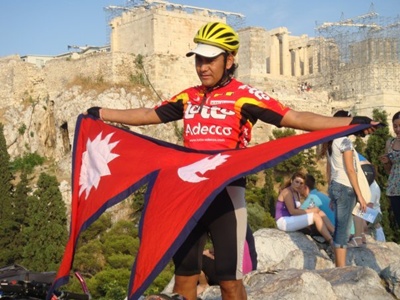
“On November 29, 1998 I set out on an 11 year-long journey to capture my dream, the dream of riding 221,000-kilometres around the world on my bicycle to spread the message of peace and hope for my country and for the world. This mission is not about material gain or international fame. It’s simply about spreading the message of peace. If you see a Nepalese guy panting and puffing on a bicycle with a sticker “I ride therefore I am” please yield and for one second think about how you as an individual can contribute to world peace. This is my tenth year and I have already toured 150 countries and hope to complete the world tour in a total of 11 years. During my tour, I visit schools and clubs in different communities and like to speak about peace, respect for other religions and cultures, living in harmony, respect for human rights and democratic values. 

I like to meet civic leaders and exchange views. After graduation from college, I worked as a school teacher and participated in the Democracy Movement in Nepal in 1990. I was arrested and imprisoned many times for my political activism. It had a deep impact on me and I decided to embark on a world tour spreading the message of Peace. I began my journey with only 100 Nepalese Rupees (One Euro) given to me by my mother. I have no official sponsor and have thus far been able to pursue my dream through the kindness and generosity of the many strangers who have befriended me along the way. 

When I began my journey ten years ago, many people did not believe that such a trip was possible and said that I would get no further than India. As of July 2009 I have visited 150 countries in Asia, Asia Pacific, North America, Central America, South America, Caribbean, African, Middle East and the Europe

In May 2010, I cycled from Kathmandu to the Everest base camp.” 

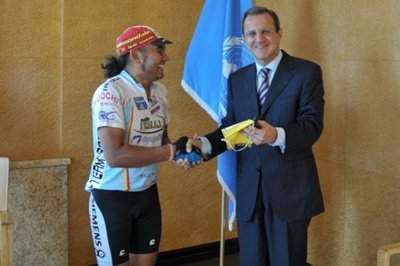
Here are some of the photos of his trips. 

I know that he was a courageous man to even attempt to cycle around the world with very little support and money. I still remember the day he left Kathmandu, there was this big event for his farewell and it made the headlines in the country. 

Currently he is back in Nepal and is still cycling for various causes.

Post marriage attire for women in Nepal

I was talking to one of my good friends on Skype recently. She is happily married with a 4 years old daughter. We have been friends for a long time but as she lives in Nepal and I live here, talking to her is always a treat. Every time we have a conversation we share our personal life and feelings.

I knew she hasn’t been very happy about a few things after her marriage. But recently I found her really happy and alive. I commented to her how glad I was to see her so happy. She told me she is happy because now she is free to wear what she wants. She said she is feeling better about herself now that she has control over her life.

Right then it struck to me that for the first few years after her wedding, she was wearing only Sari and Kurta. So here I am writing about the marriage attire for women in Nepal after marriage.

I have never lived outside of Kathmandu in Nepal. Both my parents are originally from Kathmandu so whatever I am going to write will most probably be the view of city life in Nepal.

In Nepal, for a long time, girls have freedom to wear what they want. I am not talking about low cut short skimpy dress but still they are allowed to wear what they want to a certain extent. I have seen my mum’s photos from her school and college days where she was wearing bell-bottom pants or big floral print t-shirt or beautiful colourful dresses.. Normally people let their daughters wear what they want and these days fashion in Kathmandu is not far behind western cities. So every time I go back to Nepal, I am amazed to see girls wearing low cut dress, short shorts or boob tube dresses and tops. I remember when I was there even halter dresses were not popular. But these days there seems to be not much restriction on what you can wear.

But things turn 180 degrees once the same girl gets married. Let’s take an example of my friend. She was wearing whatever she wanted for the last 20+ years of her life but as soon as she was married, she was forced to wear only Kurta and Sari for 2 years after the wedding. She did want to wear pants and dresses but her MIL and her husband’s immediate family member were against it so she couldn’t do anything about it. It is like my daughter/sister can do anything but if the girl is my DIL or SIL then they have to be seen as a traditional Nepali woman. I know things have changed a lot in the last few years as most of the women work after the marriage as well so they have to wear a uniform or still wear pants as it is more comfortable. But at the same time I have seen many families that didn’t allow their daughter in-laws to wear what she wants but instead says “You are a daughter in law now so you must wear only traditional attire. What will the neighbours says if they see you in pants or dress!” What a double standard.

I know in Nepal not only the in-laws but your own family will expect you to change how you dress, like my mum expected from me once I was married, but I believe society should accept the newlywed woman even if she prefers to wear pants or any other dress than just laying down a rule that married women must wear a Kurta or Sari. If she chooses to wear Sari and Kurta , let her but don’t make it compulsory. I love wearing Sari and Kurta on occasions as I feel very feminine in them but I can’t wear them everyday. For me it is not practical.

I have a cousin who got married recently and changed her dressing style completely after the wedding. I believe it is all expected from you and if you want no conflicts with your new family, girls just follow the rules.

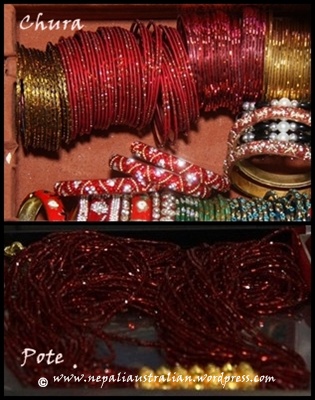
So the normal accepted attire for women after wedding in Nepal are Kurta and Sari with Sindoor(vermilion) on their head, glass chura(glass bangles) on their hands and pote (Glass beads) around their neck. My mum thought I would be wearing pote and chura after the wedding even here in Sydney. The first time I Skyped with her after our return to Sydney, post wedding, she suggested to me that I should either wear chura or pote now onwards. I told her I do wear them when I am wearing Sari or Kurta but I can’t wear them with my pants and dresses. I am sure she is not very happy about it but she does understand my point and hasn’t said anything after that. My MIL on the other hand has never mention anything close to this yet and  I am very glad because I can’t be blunt with her, like I can with my mum, about my reasons for not wearing them here. But the best thing is that she is very understanding.

After the wedding I stayed with my in-laws for 10 days before leaving for our honeymoon. On those 10 days I wore only sari. Mostly it was my choice as I was having fun being a new bride and loving my saris and also it was expected that a woman to look certain way once they are married.

I am not sure how things will be when I go to Nepal again. To start with, I have to live with my in-laws most of the time. I will be visiting my parents but will be expected to spend more time in my husband’s house. So there will be the problem like what I will be allowed to wear or what is accepted of me.

Here in Australia, I wear whatever I want. I haven’t changed my dressing style after my wedding so I am not sure what I am going to do when I go to Nepal. I am sure I can’t wear shorts and short dresses. Normally I used to wear pants with a not too tight t-shirt but I am not sure what will be expected of me. May be I will just wait for now and worry about it when I book my next flight to Kathmandu. But thinking about it sometimes gives me a headache.

I believe that woman should still have the freedom to choose what they want to wear after getting marriage just like before marriage. I am sure we won’t dress like teenagers when we are in our mid 20s. Otherwise if society forces women to dress in a certain way then it might make them unhappy, like my friend, which will affect the relationship with the in-laws. I hope this will change soon so a woman doesn’t feel obligated to do things she really doesn’t want to. I know society changes according to time so I hope Nepali society will change in this aspect soon and will not differentiate between married women and single women in terms of clothing.

Maghe Sankranti

I think many of you know already that from my previous posts that Nepal follows a different calendar than the Gregorian calendar. So the months are different and the start and end of the months do not match with the Gregorian calendar. Also Nepali people have lots of festivals according to their own calendar. 

On Sunday, 15 January, it was 1st of Magh  2068. This day is called Maghe Sankranti. It is the end of winter and start of warmer days in Nepal which is also believed to bring an end to the ill-omened month of Poush when all religious ceremonies are forbidden. 

Normally people go to holy rivers around the country  like Devghat, Dolalghat, Sankhamul Ghat to take a holy dip in the morning and offer auspicious food like laddoos (sesame seeds candy ball), chaku (molasses), ghee (clarified butter), sweet potatoes, yam, khichari (mixture of rice and lentils) and green leaf spinach to the gods. Then in the afternoon and evening there will be a bhoj (get together) to eat all these food they have prepared. 

Chaku (Molasses) is a viscous by-product of the processing of sugar cane, grapes or sugar beets into sugar. 

Laddoos (sesame seeds candy ball) is made with black or white sesame seed and chaku . They are sweet like candy and very tasty. 

In Newari culture, this day is also known as ‘Ghyo-Chaku Salu’ which means the day to eat chaku (molasses) and ghee (clarified butter). 

Days leading to this festival, you will see vendors in the street selling lots of sweet potatoes and yam as well as molasses  and black and white sesame candy balls all across the country. I love the white ones 🙂 

When I was in Nepal, I remember going to my grand ma’s house with my brother and she would put mustard oil on our head and bless us. Then we would be given khichari with melted Ghee and Chaku with sweet potatoes and yam. I really miss those days. 

Happy Maghe Sankranti!!!

Sari

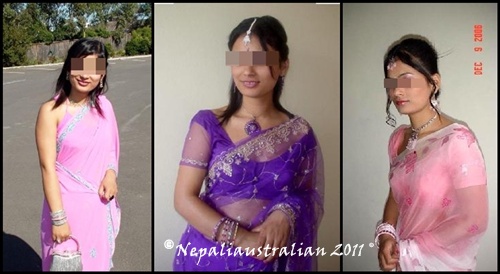
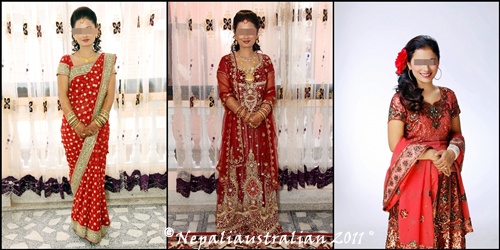
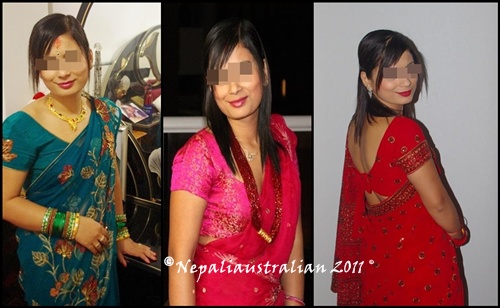
Wikipedia defines sari as a strip of unstitched cloth, worn by females, ranging from four to nine metres in length that is draped over the body in various styles. But for me sari always signifies Nepal and femineity.

There were times when I needed two people to help me wear a sari but now I can proudly say that I know how to wear a sari without any help. (I may need to try a few times to get it right 🙂 )

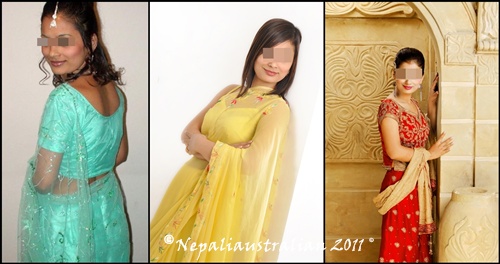
Over the years I have been lucky to have occasions to wear my different saris. Here are some of the photos I want to share with you.