The third day of Tihar is Goru Puja, Govardhan Puja, Mha Puja and Nepal Sambat.
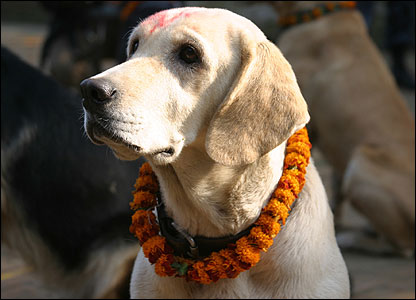
 Nepal is mostly an agricultural country so oxen are considered important animals as they help in ploughing the fields. That is why on this day they are worshiped with tika, garland and offered nice food.
Also this day small hillocks made out of cow dung is worshiped. It is believed that once there was a drought in a village in Vridavan. The villagers were very worried and they wanted to perform a big Puja in honour of Lord Indra, the God of rain. But Lord Krishna convinced them that, they should not pray to Lord Indra since it was the Mount Govardhan that brought the rain and not Lord Indra. This made Lord Indra very angry and in his wrath he sent forth a big thunderstorm to flood the village. Lord Krishan lifted the Mount Govardhan as an umbrella above the village to protect the villagers and their cattle from the rain and flood.
This is also the day Mha puja is performed by the Newa people.
 “Mha” means body in the Newa language so on this day the Newa people worship their inner self in the evening. They believe that the soul never dies and our body is only a vehicle and so we need to understand and respect our body as it is the chosen vehicle for this incarnation. This Puja is believed to bring prosperity and physical well-being.
 I performed Mha Puja with my brother , his family and with my cousins on my brother’s balcony. First the floor was purified by sprinkling water on it, then we made mandaps in front of a row of seats on the floor where we were sitting. Our mandap was designed by AS and I had printed them out in A4 paper but in Nepal they are made by hand on the floor using oil, rice flour, vermilion, puffed rice and sometimes beans. The number of the mandaps needed is three plus the number of people doing the puja. We need three smaller mandaps at the top of the row for the House God (Kuladevata) , Yamaraj and Janmaraj, one mandap for each of the member performing Mha Puja. Then at the end of the row, we had a crow drawn symbolising Yama the God of death.
Normally the puja is done by the eldest member of the family but this year I did the process as my elder cousin is not in Sydney.
Process of doing Mha Puja:
- First I gave Nasala, a few drops of water, in the palm of the right hand of everyone to throw some into the mouth and rest over the body for purification.
- I worshipped the House-God and Yama’s mandap with water, rice, flowers, and vermilion powder.

- I gave water, rice, flowers, and vermilion powder to each individual to worship their own mandaps. The mandap is used as a medium to present the various offerings to the self.
- Then I put tika on everyone’s forehead and gave them flower to put on their head.
- Normally in Nepal, they use Ita (special long threads made using white cloth soaked in mustard oil) but here we used tea light candle instead. I gave each person the candle and everyone took the candle from my hand, lighted them and put them on their mandap. This light is believed to brighten the inner self and keeps evil at bay.
- I used rice and flower in my hand to shower each individual and worshipped the god within.
 I gave Sagun to everyone. For Sagun , you put plate of egg , bara (lentil cake), meat,piece if ginger and fish in the right hand and yougurt in your left hand.
 - Once everyone finished eating the sagun, we used kucho (broom) from top to bottom touching each mandap to conclude Mha puja.


This day is also New years day for Newar community which is called Nepal Sambat . It is Nepal Sambat 1132 this year. Happy New Year!!!
Also from this day, boys in groups go door to door singing special songs called Deusi similar to the Bhailo sung during Laxmi Puja. It is considered auspicious to have these groups come to your front door. The house owner will offer them some rotis, fruits and money and they sing Deusi songs blessing the household with good fortune.
Happy Tihar!!!

















 nepaliaustralian