Category Archives: Travel

Sambhav Nepal Project

My regular reader, Ijya Paudel, will be going to Gorkha, Nepal in order to volunteer for a program called Sambhav Nepal with a mission to provide Nepali kids with proper schooling and she likes to share her project with all of you here.

Sambhav Nepal is a registered non-profit, non-political, social organization aiming to establish and implement sustainable education, health, and community development programs in isolated areas of Nepal. Presently, the organization is working in 29 VDC’s of the Gorkha district.They are a community organization that deals with advocacy, skill building and most importantly education. When we grow up in a Western and developed society we often take things for granted.

Sambhav Nepal works with governmental schools, which are very low funded and ran inefficiently. The students in these schools are struggling with getting regular school supplies and proper education. They do not have adequate furniture, stationary, books, art supplies, sports equipment or a proper library.

Where you are born shouldn’t determine whether you get an education or not. By donating, you give these kids what they are missing the most: A CHANCE. An opportunity to show that they can be somebody.

My goal is to raise $2000 dollars by the end of November, 2013. I want to donate this sum of money so these students could get a chance at a better education. These $2000 dollars would not only buy their school supplies and furniture but, also help provide the students with proper school uniforms. These students just need a little help to reach their potential. We can do so by donating a small amount of money.

If you donate any amount starting from $5 dollars and above, your name will be entered in a raffle. At the end of this project, I will be drawing a random name and you will win an iPad.

Please consider this as a chance to help those who really need it. Giving back is a beautiful thing. I hope you consider.

You can donate at www.youcaring.com/nepal2013 If you have any further question please do not hesitate to contact me on ijyapaudel@gmail.com

Please help Ijya by donating and sharing this page. Thank you everyone.

Etiquette for travelling like a local

While travelling to many countries around the world, I have noticed that different actions means different thing in different countries.

As always, when traveling, be respectful and observe local customs, including manners of dress and public behavior but it is also good to know local etiquette.

Did you know it was rude to blow your nose into a handkerchief in Japan or pat someone’s head in Thailand?

Here is some guide to etiquette for travelling like a local.

Greetings

In Switerzland, if you’re meeting someone for the first time, stretch out your hand and say grüezi (hello). If you meet a friend, then you kiss them three times: offering first your right cheek, then left, then right again. The latter exchange is for women greeting women and men greeting women. The boys stick with a handshake or maybe a man hug. Remember to not actually plant a big smacker on someone’s cheeks: think air kiss instead.

When you go into a store say grüezi to the sales people, and when you leave say adieu (goodbye). People may also greet strangers with a grüezi when passing in the street, and always on hiking trails. Bitte (please) and merci or danke (thank you) are also appreciated here.

Dinning

In China, a round dining table is more popular than a rectangular or square one. As many people who can be seated comfortably around it conveniently face one another. The guest of honour is always seated to the right of the host; the next in line will sit on his left. Guests should be seated after the host’s invitation, and it is discourteous to seat guests at the place where the dishes are served.

Addressing

In Nepal,Nepalese address each other using didi (“older sister”), bahini (“younger sister”), daai (“older brother”), bhaai (“younger brother”), buwa (“father”) and aamaa (“mother”) with everyone even though they are not related. To be more formal or respectful, they add ji to the end of someone’s name, as in “namaste, John-ji”.

Body language

Every nation has its inappropriate gestures, such as giving a thumbs up in Italy, which is the equivalent to raising the middle finger in America. In the UK, giving a peace sign with the palm faced inward is also considered vulgar.

Many countries have customary body language signals that may seem odd to some, such as nose-touching (hongi) in New Zealand or sticking out the tongue in India.

Shaking hands in Russia is considered extremely unlucky, while in much of the South Pacific, locals will clasp hands for minutes at a time as a sign of respect. Additionally, in Morocco and Tunisia, greetings sometimes last up to 10 minutes, tallying up lengthy handshakes along with numerous kisses on the cheek.

Job

It’s rude to ask people in Argentina what they do for a living. Wait until they want to bring it up in conversation.

Aaaatchoo!

In Japan, never blow your nose into a handkerchief. The Japanese word for snot is hanakuso, which translates to “nose sh-t”, so they don’t like the idea of anyone carrying it around with them.

Flowers

Watch out Carnations are used at funerals in Germany, Poland and Sweden. Chrysanthemums are used at funerals in Belgium, Italy, France, Spain and Turkey. It’s unlucky to give odd numbers of flowers in China and Indonesia, but odd numbers of flowers are lucky in Germany, India, Russia and Turkey.

Gloves off

In Europe, you’ll be considered rude if you don’t take your gloves off before shaking hands. (Even if it’s freezing outside.)

The bill

In restaurants in Spain, always request the bill at the end of a meal. Waiters think it’s rude to bring it to you before you have asked for it.

Eye level

In Scandinavia and Germany, you should look your fellow travellers in the eye when you are toasting. In Russia, the custom is to drink the vodka in one gulp.

Head matters

At holy places in Thailand and other Buddhist countries, never pat anyone on the head. The head is sacred.

Thumbing

The thumbs-up sign is a rude gesture in Egypt and Iran.

No thanks

As much as you might have enjoyed a meal in India, don’t thank the host because saying “thank you” is seen as a form of payment, and may be taken as an insult.

Foot blunder

In most of Asia, feet are thought of as being dirty, so it’s disrespectful to point your feet or show the bottom of your shoes to anyone. Don’t do it.

Right is right

The left hand is considered the dirty hand in Africa and Sia, so use only your right hand when you eat.

Reading the cards

If you are on business in Japan, the business card exchange is a ritual you need to know about. Receive the card with both hands and a slight bow, then read it carefully. Never put it into your pocket or write on it.

Palming

When getting a taxi in Greece, don’t raise your hand as you would to signal stop. Greeks consider the forward-facing palm to be offensive, so turn your hand so that the palm is towards you (and keep the fingers together).

 I didn’t mean that

In the Philippines, never refer to someone who has invited you to an event as your “hostess”; it means “prostitute”.

Wink, wink

Never wink at anyone in India, unless you know it has sexual connotations.

Public transport

When using public transport in Australia, it is rude to board before letting other passengers disembark. It is polite to move from the aisle to the window seat if it is vacant, to allow others passengers to sit down easily. This is also true when entering a lift or elevator. A person who enters an elevator before all the occupants have vacated will most probably be met with a noticeable scowl of disapproval.

Please share the unique etiquette from your country and any experience you have while travelling.

You may also like:
*Mustang in Lonely Planets Best in Travel 2013 List *Itchy feet *Zoo visit in Nepal

Thai red curry chicken

Ingredients

  • 2 tablespoons vegetable oil
  • 1kg chicken thigh fillets, trimmed,  cut in half crossways
  • 4 tablespoons of Thai red curry paste
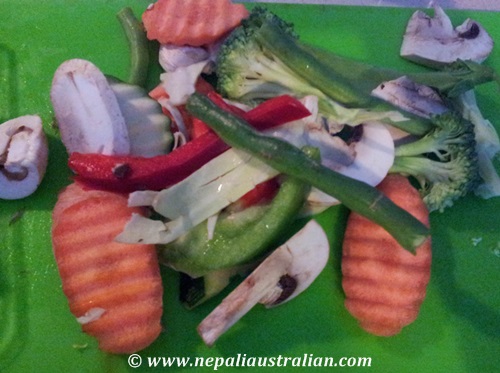
  • 150g total – fresh mushrooms, capsicum. broccoli, beans trimmed and sliced
  • 230g can sliced bamboo shoots, drained
  • 1 tablespoon fish sauce
  • 400ml can coconut milk

Procedures

  • Heat oil in a large frying pan over medium-high heat.
  • Add the curry paste and make sure it is cooked properly until its aromatic smell started to come through.
  • Add chicken and cook until golden brown.

Thai red chicken curry (1)

  • Reduce heat to low. Add coconut milk and stir until curry paste has dissolved. Add mushroom, bamboo shoots, vegetables.

Thai red chicken curry (2)Thai red chicken curry (3) Thai red chicken curry (5)

  • Thai red chicken curry (4)Stir to combine.
  • Cover and cook on high for 5 minutes.
  • Add fish sauce and cook on high for a further 10 minutes.

Thai red chicken curry (6)

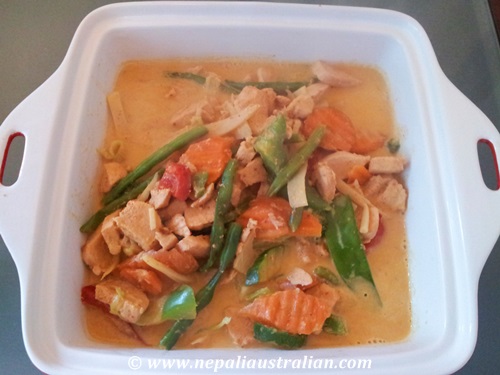
  • Thai red curry chicken is ready to be served.

Thai red chicken curry (7)

You may also like :

*Jamie Oliver Szechuan stir fry with chicken and brown rice *Jamie Oliver’s Chicken Tikka Masala *Jamie Oliver’s Dan Dan Noodles

Chicken gravy means chicken gravy only, no chicken please

I know the title is very confusing but I will try to explain it.

Last night, AS and I were out and so we decided to eat out. We were discussing what to eat when we saw this South Indian restaurant. I like Indian food so it looked like a good choice to both of us.

We went inside and were given a six sitter table as they didn’t have any empty table for two. I didn’t know much about South Indian dishes expect Dosa so I asked AS as he had spent 5 years in South India.

Anyway, finally we decided to eat Chicken 65 and set meals. AS ordered Anjappar popular non veg  meal which comes with Chappati, rice, chettinad chicken, mutton gravy, fish gravy, rasam, kootu, poriyal , curd and appalam.  For me, I decided to go with Anjappar regular meals that comes with rice, chicken gravy, mutton gravy, fish gravy, rasam, kootu, poriyal , curd and appalam. I knew I couldn’t finish all that but I wanted to try the meal. We got extra chicken as AS told me, from his experience in India, that the meal would have only a few small pieces of meat.

While we are waiting for our food, one of the waiters came and asked if they could sit some other customers on our table too. Don’t get me wrong, I am all up for socialising but not when I am out with my husband trying to enjoy dinner together, I really didn’t want a total stranger on the same table sitting next to us listening to our conversation. So we said Sorry but we wouldn’t be comfortable to have others on the same table. I know it seems rude but they still had tables available in the restaurant but it seemed they didn’t want to use another six sitter table for just three people.

I was actually shocked to see that they even asked about it but AS told, me that it is common in dhabas in India but not in a proper restaurant.

I have eaten North Indian meals before so I was thinking this would be similar but I was so wrong. Firstly, the food was so spicy that I knew I couldn’t eat it all and to top it off, the chicken gravy, fish gravy and goat gravy were just that, gravy, no meat. When I was reading the menu, I had thought it meant chicken with gravy but, no it actually meant just gravy.  I am sure I am not the only one who would be confused by the menu. It seemed quite funny to both me and AS. I was just glad that we had ordered a separate chicken dish which was good but quite spicy.

During the meal, one of the waiters came and tried to put some more dishes on the table. We told him that we hadn’t ordered any more food and he left. He was going around the restaurant and had no clue which table the food he was carrying was for. The tables had numbers but I guess because they put more than one customer in one table, the waiters were getting confused.

Seriously, they are running a nice looking restaurant in Sydney but it was a bit chaotic. AS was telling me that he felt like he was in India with loud South Indian music from the TV, the Bollywood music from speakers and waiters running around in every direction.  But even if their idea was to create an authentic South Indian restaurant environment, they should have given a customer like me a choice to go for a medium spicy meal so that I could at least eat my food. Or maybe I am asking too much from them. I guess I will stick with my favourite dosa when I visit a South Indian restaurant. Anyway I ended up eating only around 1/3 of my meal as it was too spicy. I do eat spicy food but this was super spicy.

The other thing I observed while having dinner was the waiters. I saw one waiter dressed so inappropriately. Sorry I do not want to make fun of him but he is in a customer service business and he was wearing a Wallaby hat (bright yellow), multi coloured jacket and a sunnies while he served and the other waiter was wearing a black shirt with sequence embroidery as if he was going to a club. I seriously think they need a dress code so that the customer can identify the wait staff. I am not really judging people but the business definitely could have used some rules in place.

Please let me know what are some good South Indian dishes (not too spicy though), if you know any. I am always up for trying new food  🙂

Please share you different experience trying new food.

Have a great weekend everyone

XOXO

M from nepaliaustralian

You may also like :

*Forster *Easter Long weekend trip *Snowy Mountains: Australia

Mustang in Lonely Planets Best in Travel 2013 List

The other day I was so happy to read the following article and I am sharing it here. Yes, Mustang, the picturesque town in Nepal has mangaed to get on the list of best places to travel in 2013 list.

I have never been there and I hope to go there in the near future. Here are some information regarding the place.

Only a few years ago it was “nobody’s been there”, now it’s heading towards “last chance to see”. The completion of a road connecting Mustang to China in the north and the rest of Nepal to the south will make all the difference.

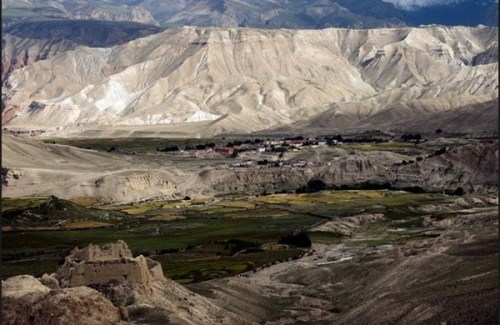
Lo Manthang, or Mustang as it’s usually called, has been dubbed “little Tibet” or “the last forbidden kingdom”; though politically a part of Nepal, in language, culture, climate and geography, it’s closer to Tibet. The remote region is north of the Himalayan watershed and on the Tibetan plateau, and just south of the border with “big Tibet”, the Chinese one.

Life in Mustang revolves around tourism, animal husbandry and trade. Apart from nine kilometers between Chhusang and Syangboche (just south of Ghiling (Geling)), it is bisected, as of August 2010, by a new road linking it to the Tibet Autonomous Region (TAR) to the north and to the rest of Nepal to the south. Plans call for these final nine kilometers to be linked within the next few years, at which time the road would become the lowest drivable corridor through the Himalayas linking the Tibetan Plateau to the tropical Indian plains. The highest point would be 4660 m at Kora La on the Mustang-TAR border. Currently, the easiest and only widely used road corridor, from Kathmandu to Lhasa via the Arniko Rajmarg (Arniko Highway), traverses a 5125 m pass.

The below is an excerpt from the October edition of National Geographic magazine.

“Mustang, a former kingdom in north-central Nepal, is home to one of the world’s great archaeological mysteries. In this dusty, wind-savaged place, hidden within the Himalaya and deeply cleaved by the Kali Gandaki River—in spots, the gorge dwarfs Arizona’s Grand Canyon—there are an extraordinary number of human-built caves.

Some sit by themselves, a single open mouth on a vast corrugated face of weathered rock. Others are in groups, a grand chorus of holes, occasionally stacked eight or nine stories high, an entire vertical neighborhood. Some were dug into cliffsides, others tunneled from above. Many are thousands of years old. The total number of caves in Mustang, conservatively estimated, is 10,000.

No one knows who dug them. Or why. Or even how people climbed into them. (Ropes? Scaffolding? Carved steps? Nearly all evidence has been erased.) Seven hundred years ago, Mustang was a bustling place: a center of Buddhist scholarship and art, and possibly the easiest connection between the salt deposits of Tibet and the cities of the Indian subcontinent. Salt was then one of the world’s most valuable commodities. In Mustang’s heyday, says Charles Ramble, an anthropologist at the Sorbonne in Paris, caravans would move across the region’s rugged trails, carting loads of salt.”

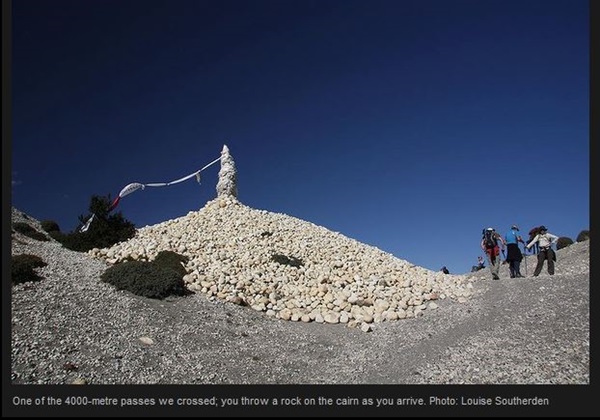
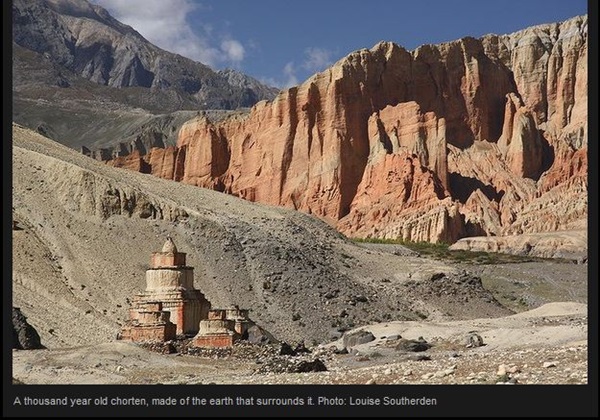
Mustang has an average elevation of 13,000ft and is located to the north of the mountain giants of Dhaulagiri and Annapurna and is therefore north of the main Himalayan range and geographically is part of the highlands of Tibet. It is a vast high valley, arid and dry, characterized by eroded canyons, colorful stratified rock formations and has a barren, desert like appearance.

Naturally, most of the history is now a matter of legend rather than recorded fact, but it seems clear that Lo was once part of Ngari, part of Tibet and a rather loose collection of feudal domains. It was incorporated into the Tibetan Empire under the most famous of the Tibetan kings Songtsengampo. It was an important means of crossing the Himalaya from Tibet to Nepal, and many of the old salt caravans passed through Mustang. By 14C much of Ngari became part of the Malla Empire, whose capital was Sinja in western Nepal. It became an independent kingdom in its own right, under the rule of Ame Pal, the founder king of Lo in 1380. The present royal family can trace its history 25 generations back to Ame Pal, and the city of Lomanthang, was the centre of their power.

Well known, intrepid explorers such as Professor David Snellgrove and the Italian scholar Guiseppi Tucci visited Mustang in the 1950’s and it has largely been their tales of a Tibetan like arrid region that has fuelled interest in the area.
If you love nature or trekking, I am sure you will love it there so do make a plan to go and visit this beautiful place.

Enjoy some amazing photos from Mustang.

Climbers and scientists follow a trail above the Kali Gandaki River in Nepal’s remote Mustang region. More than 60 feet above are rows of unexplored man-made caves dug centuries ago. There may be thousands in the region.
© Cory Richards/National Geographic

To reach a series of caves dug into a cliff 155 feet above the valley floor, Matt Segal scales a rock face so fragile it often breaks off to the touch. Linked by a ledge, the 800-year-old caves, empty now, may once have stored manuscripts.
© Cory Richards/National Geographic

Dusk falls over the temples and homes of Tsarang, once the region’s most important town. In Mustang, where the centuries have not disrupted the traditional rhythm of life, the caves offer clues to a time when the remote Himalayan kingdom was a hub linking Tibet to the rest of the world.

Mustang (1) Mustang (2) Mustang (3) Mustang (4) Mustang (5) Mustang (6) Mustang (7)All the images below Credit: Gilles Sabrie for The New York TimesMustang (8)The Kali Gandaki riverbed in Kagbeni, Nepal. Most trekkers enter Nepal’s Upper Mustang region at Kagbeni. Mustang (9)North of Kagbeni, trekkers make their way along a high trail near Samar. Last year, nearly 3,000 tourists entered Upper Mustang, according to government statistics. Mustang (10)Farmers harvesting in the village. Mustang (12)A nomad’s necklaces. Much of Upper Mustang is desolate, inhabited by about 5,400 people.Mustang (11)A view of Lo Manthang, the walled capital of Mustang.  Mustang (13)A closer view of the capital. Mustang (14)A man appears at his window in Lo Manthang. Mustang (15)Shadows of people on horseback appear in the barren landscape around Mustang’s capital. Mustang (16)Just to the southeast lies Yara. Mustang (17)A farmer stands in fields near Lo Manthang. Mustang (18)Locals haul baskets between rows of prayer wheels. Mustang (21)Another view of Yara. Mustang (22)Tashi Kabum, a cave temple near Yara, opened to the public only a few years ago.Mustang (20)Inside the cave, a fresco representing Chenrezig. For Tibetan Buddhists, Chenrezig was a bodhisattva embodying compassion.

You may also like:

*Manakamana Temple *Cheers to new year 2070 *Zoo visit in Nepal