Goru Puja, Govardhan Puja, Mha Puja and Nepal Sambat

Today is Goru Puja, Govardhan Puja, Mha Puja and Nepal Sambat.

Goru Puja

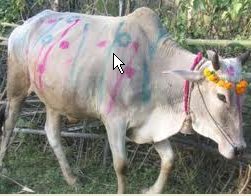
Nepal is mostly an agricultural country so oxen are considered important animals as they help in ploughing the fields. That is why on this day they are worshiped with tika, garland and offered nice food.
Govardhan Puja

Govardhan Puja is performed by making a hill called govardhan parbat using Cow dung. Cow dung has big importance in Hindu culture. In the olden days it was used for everything from light at night (Methane) to polish mud floors of traditional houses. Even now no Puja is complete without cow dung in Nepali Hindu culture.

It is believed that once there was a drought in a village in Vridavan. The villagers were very worried and they wanted to perform a big Puja in honour of Lord Indra, the God of rain. But Lord Krishna convinced them that, they should not pray to Lord Indra since it was the Mount Govardhan that brought the rain and not Lord Indra. This made Lord Indra very angry and in his wrath he sent forth a big thunderstorm to flood the village. Lord Krishan lifted the Mount Govardhan as an umbrella above the village to protect the villagers and their cattle from the rain and flood.

Mha Puja

In this day, after sunset Newar community perform Mha Puja.

“Mha” means body in the Newari language so on this day the Newa people worship their body and their inner self in the evening. They believe that the soul never dies and our body is only a vehicle and so we need to understand and respect our body as it is the chosen vehicle for this incarnation. This Puja is believed to bring prosperity and physical well-being.

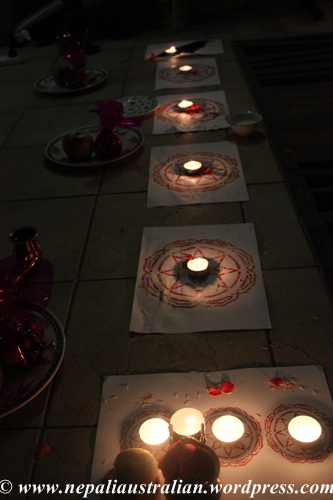
Members of the family, first males followed by females, sit cross-legged in a row. The elder group of females plays the role of facilitators for each member. A mandap, decorated with different colours and various grains, fruits and flowers, is drawn for each member of the family.

In between the grains and fruits lies a mini mandap of oil, which represents the human soul. The human soul is placed between various grains and fruits so that a person will prosper throughout the year since each object represents a particular God and it is believed that each deity will bless the person. An oil lamp with velvet cloth wick equal in length to one’s own face is lit on top of the mandap facing all four cardinal directions so that a person will be renowned in all the places of this earth.

Apart from worshipping oneself, all the household entities like brooms, water pots, utensils and machines are also worshipped in the same way.

I performed Mha Puja with my brother and his family this year. This year my cousins are in Nepal so there were only 4 of us unlike 9 last year. For the Puja, first the floor was purified by sprinkling water on it then we made mandaps in front of a row of seats on the floor where we were sitting. Our mandap was designed by AS and I had printed them out on A4 paper but in Nepal they are made by hand on the floor using oil, rice flour, vermilion, puffed rice and sometimes beans.

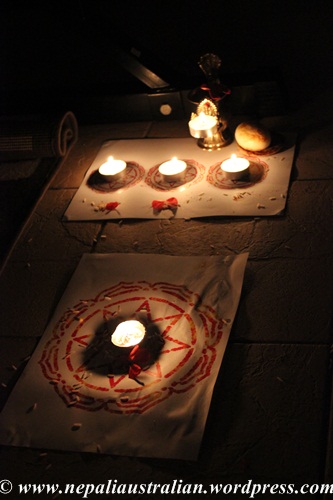
The number of the mandaps needed is three plus the number of people doing the puja. We need three smaller mandaps at the top of the row for the Family Deity (Kuladevata), Yamaraj and Janmaraj, one mandap for each of the member performing Mha Puja. Then at the end of the row, we had a crow drawn symbolising Yama the God of death.

Normally the puja is done by the eldest member of the family but this year I did the process as my elder cousin is not in Sydney.

Process of doing Mha Puja (according to my knowledge):

  • First I gave Nasala, a few drops of water, in the palm of the right hand of everyone to sprinkle some into the mouth and rest over the body for purification.
  • I worshipped the Family Deity and Yama’s mandap with water, rice, flowers, and vermilion powder.
  • I gave water, rice, flowers, and vermilion powder to each individual to worship their own mandaps. The mandap is used as a medium to present the various offerings to the self.
  • Then I put tika on everyone’s forehead and gave them flower to put on their head.
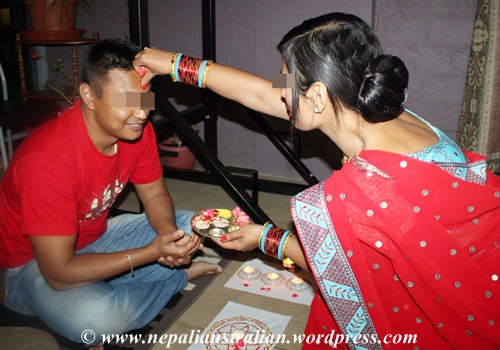
  • Normally in Nepal, they use Itaa (hand woven long strands made using white cloth soaked in mustard oil) but here we used tea light candle instead. I gave each person the candle and everyone took the candle from my hand, lighted them and put them on their mandap. This light is believed to brighten the inner self and keep evil at bay.
  • I used rice and flower to shower each individual and worshipped the god within.
  • Then I gave every a plate with roti, sweets, fruits and masala.
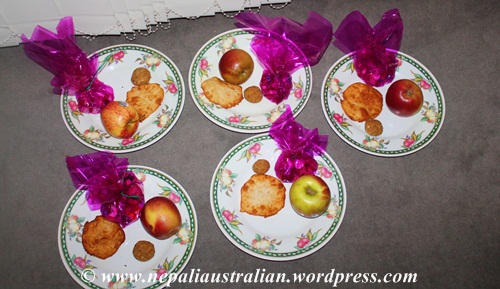
  • Then,I gave Sagun to everyone. For Sagun, you put a plate of egg, bara (lentil cake), meat (chicken), a piece of garlicand fish in the right hand and yougurt in your left hand.

  • Once everyone finished eating the sagun, we used kucho (broom) to sweep the mandaps from top of the row to the bottom touching each mandap to conclude Mha puja.

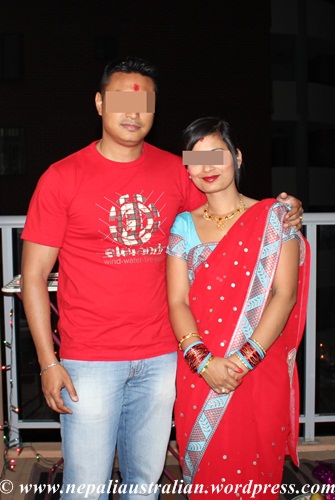
Nepal Sambat

This day is also New Year’s day for Newar community and is called Nepal Sambat. Nepal Sambat is the national lunar calendar of Nepal. The era started on 20 October 879 AD and was in widespread use for all daily purposes until the beginning of the 20th century. It appeared on coins, stone and copper plate inscriptions, royal decrees, chronicles, Hindu and Buddhist manuscripts, legal documents and correspondence.

The customs of celebrating Nepal Sambat started from October 880 AD. According to a popular legend, there used to be a learned person in Bhaktapur who ordered porters to get sand from Lakhu Tirtha, a river in Kathmandu because he knew that it would turn into a heap of gold the next day. A person named Shankhadhar Sakhwaa came to know about it, and he enticed the porters to leave the sand in his place.

The next day, the sand turned into gold and with that gold he paid off the debt of all the people in the Kathmandu Valley. So from that day, people started celebrating it as their New Year to commemorate their happiness.

Even today, people are very enthusiastic to welcome the New Year. Every year, the day starts with a rally and the greeting of “Nhu Daya Bhintuna!” which means “Happy New Year”. Different programmes and functions are also organised in the Kathmandu Valley every year on this day.

The months of the year in Nepal Sambat are

Nepal Sambat month Corresponding Gregorian month
Kachha lā November
Thin lā December
Pohe lā January
Sil lā February
Chil lā March
Chau lā April
Bachha lā May
Tachha lā June
Dil lā July
Goon lā August
Yen lā September
Kau lā October

 It is Nepal Sambat 1133 this year. Nhu Daya Bhintuna everyone!!!

Also from this day, boys in groups go door to door singing special songs called Deusi similar to the Bhailo sung during Laxmi Puja. You can write just about any Deusi song as long as each line ends with the word `Deusi’ or `Deosuray’. A group of males get together, carry what-ever musical instruments they have or can play, and sing Deusi door to door blessing the home and family in return for money and/or refreshments. Teenagers perform various Deusi songs to collect money for their picnic.

It is considered auspicious to have these groups come to your front door. The house owner will offer them some rotis, fruits and money and they sing Deusi songs blessing the household with good fortune.

A Sample of Deusi Song. Includes a similar meaning in English

Bhana Mera Bhaiho Deusuray. (Say it my brothers, Say it. Deusuray)

Sormelai Kana Deusuray. (Say it louder and say it in tune. Deusuray)

Rato Batoo Deusuray. (Red mud trail. Deusuray)

Chiploa Batoo Desuray. (Slippery trail. Deusuray)

Laddai Paddai Deusuray. (Slipping and Sliding. Deusuray)

Akeya Hami Deusuray. (Finally we made it to your home! Deusuray)

…. …. Deusuray

…. …. Deusuray

…. …. Deusuray

Yo Garma Laxmi Deusuray. (In this home Lord Laxmi. Deusuray)

Sadthai Aaun Deusuray. (May always come. Deusuray)

Hamilai Denus Deusuray. (Give us what you have money or meal)

Bidtha Garnus Deusuray. (Please give us now, say good bye to us, so we can go sing for the next house!)

 Happy Tihar!!!

Gai Puja and Laxmi Puja : Tihar

As I mentioned in my previous post, today is  Gai Puja and Laxmi Puja as well.

In the morning of this day, the cow, the mother of the universe, is worshiped. According to Hinduism, the human infant is fed breast milk by its human mother for three years. After weaning, the cow acts as the surrogate mother providing milk for the rest of the human life – through childhood, adult age and old age. Cows are the mothers of the universe, the sacred animal. Hindus consider a cow as sacred and used its milk, dung and even urine for purification purpose. Those performing Cow puja place her manure in different parts of the home, drink a drop or two of the cow’s urine, as a part of a purification process. Also dip a blade of grass into the urine and lightly sprinkle it on each other’s body to become closer to the mother of the universe – cow.

People in villages who have a cow worship their cow but most of the people in Kathmandu don’t have a cow so they either go to a priest’s house or to a temple to worship the cow.

Cow is worshiped by putting tika on their forehead and a garland around their neck. They are offered a delicious meal and fruits.

 A cow also symbolises wealth and a form of goddess Laxmi.

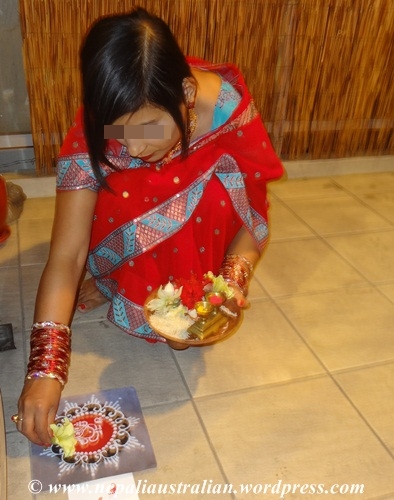
In the afternoon, the whole house is cleaned in preparation for welcoming the goddess of wealth, Laxmi. Most of the houses have their front door decorated with a mandap and have a trail of red mud leading to their Puja room (worship room in the house) .

Laxmi Puja is performed using flowers, incense, oil lamps, color-powders, bell and money (both notes and coins). Laxmi puja is performed at dusk using red mud, and puja is often done by a female in the family.

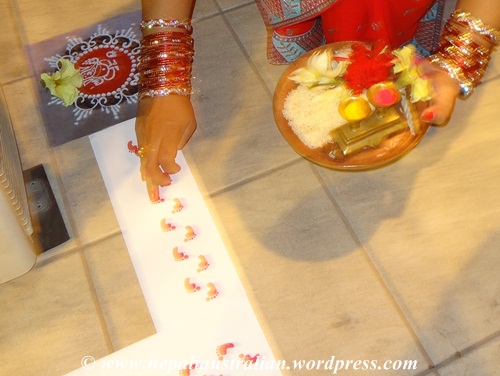
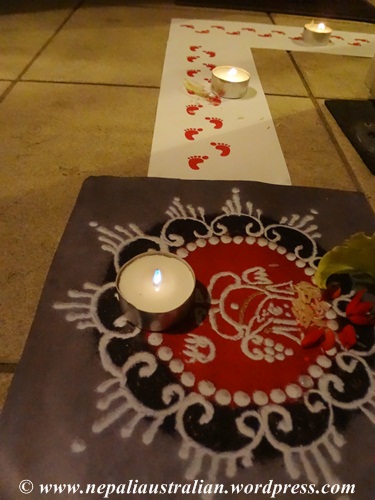
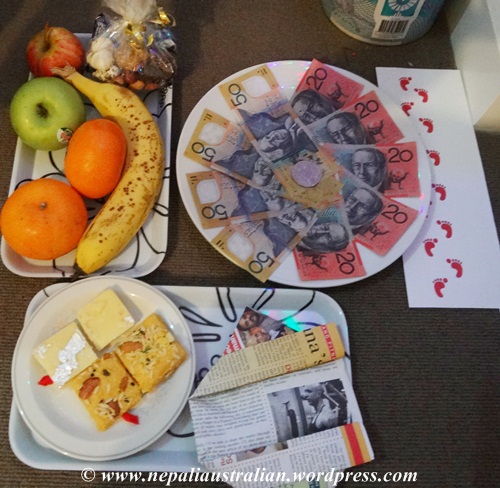
When I was young, I used to help mum do this. It was one of my favourite holiday activities. First, red mud is used to make a trail leading to the Puja room. Once it is dry, a mixture of flour and water is used to make a symbolic footprint of Goddess Laxmi on the floor entering the home. Once the flour footprints have dried, vermillion mixed with oil is put on them along with some flowers. This results in a trail of small red footprints from the main door of the house to the Puja room symbolising that Goddess Laxmi has entered the house.

The entire house is decorated with flower garlands and lit oil lamps in every doors and windows.

Also people use firecrackers to celebrate the festival.

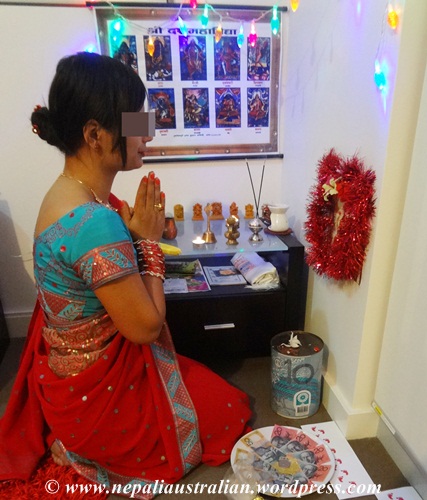
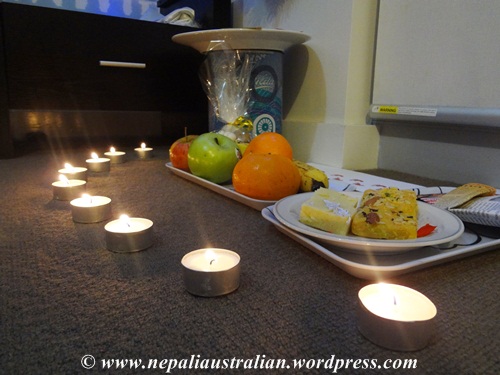
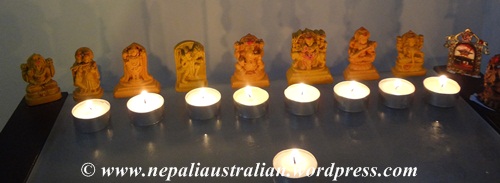
In Australia, we can’t do all this so I printed out small footsteps on paper and used that as an alternative to lead the Goddess Laxmi to our Puja area. Also at the start of the footsteps, I had a mandap of Lord Ganesh.

I set up a photo of goddess Laxmi with some notes and our piggy bank in the Puja area.

Then I performed Puja using tika, flower, garland, fruits, roti and masala.

I had candles lit in the puja area as well as twinkle lights to simulate the ambience of Tihar.

Laxmi puja is not only for households but is also performed by businesses. Business-Laxmi-Puja is done exactly the same way as is done in home. Usually the company’s cashier performs the puja during which time the entire office including office compounds are lit with various lights including electrical, candle lights, and oil lamps and usually the staffs are invited to participate in the puja procession.

From this day on for the next 3 days, there will be women in groups coming door to door singing special songs called Bhailani. It is considered auspicious to have these groups come to your front door. The house owner will offer them some rotis, fruits and money and they sing Bhailo blessing the household with good fortune.

Hapyy Tihar!!!

Kukur Puja: Tihar

Today is second day of Tihar which is Kukur Puja as well as Laxmi Puja. Some years due to the placement of moon and other planets in the universe, some of the pujas fall on the same day.

I will write about Laxmi Puja tonight after I perform my Laxmi Puja at home.

Kukur Puja

The second day of Tihar is called “Kukur Puja” or “Khicha Puja” (“worship of the dogs”) by the Newars.

A dog is considered as man’s best friend and for Hindus, a dog is also considered as the steed of God “Bhairab” as well as Yama’s (God of death) gate keeper. The Hindu epic Mahabharata talks about the close relationship dogs have enjoyed with mankind. According to it, a dog is said to have accompanied Dharmaraj Yudhisthir on his journey to heaven alive. Dogs howling is considered a bad omen as it means that, they saw “Yama coming to take someone away.

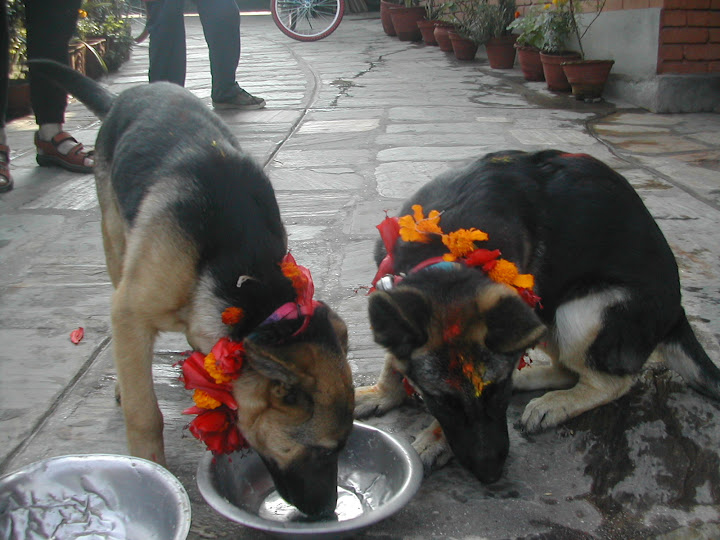
The dog is revered as a faithful and loyal animal which has been in the company of humans since ages. Around the year, dogs help humans by guarding their houses. So on the second day of Tihar, dogs are worshipped by putting tika on their forehead and a garland around their neck. They are offered a delicious meal consisting of meat and other dishes.

People perform the puja on their own dogs if they have one at home; otherwise they perform the puja on stray dogs. On this day you can see many stray dogs with red tika and a flower gland in Nepal.

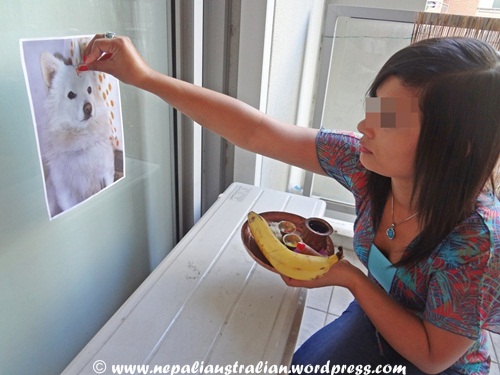
We don’t have a dog here but my parents have a dog called “Chhotu”.

So I performed my Kukur Puja with his photo. I really am grateful to him that he is there to protect and warn my parents against thieves and the likes.


I miss him so much.I hope we will have our own dog one day to do this puja. 🙂

Happy Tihar!!!

Tihar

Today we start the second biggest festival, after Dashain, for Hindu from Nepal.

This festival is celebrated in five days starting from the thirteenth day of the waning moon in October.

 The five days are called

  • Kaag / Kag (crow) Puja
  • Kukur (dog) Puja
  • Laxmi Puja and Gai (cow) Puja
  • Goru Puja,Gobhardan Puja , Mha Puja and Nepal Sambat
  • Bhai Tika

We also refer to Tihar as ‘Panchak Yama’ which literally means ‘The five days of the Lord of the underworld’. We also worship ‘Yamaraj’ in different forms in these five days.

In other words this festival is meant for life and death.The five-day festival is considered to be of great importance as it shows reverence to not just the humans and the Gods, but also to the animals like crow, cow and dog, who maintain an intense relationship with the humans. It is also a time for cooking great meals at home, brothers and sisters shopping for gifts, flying kites, decorating homes and streets, playing cards with friends, resting and relaxing.

Tihar is also called The Festival of Lights, as many diyo or candles or decorative lights are lit both inside and outside the houses to make them bright at night. All the houses are cleaned and decorated with the belief that Goddess Laxmi will enter the house that is clean so people light candles, oil lamps and other lights and thus during the night the entire village or city looks like millions of sparkling gems.

There is a story, which tells why this revelry is celebrated so widely. Once there was a king who was living his last days. His astrologer had told him that a serpent would come and take his life away. The king did not want to die so he asked the astrologer if there was any way to escape death. The king was advised to sleep with lit oil lamps all around his bed and decorate the palace with oil lamps on the day of Laxmi puja so that Goddess Laxmi would talk to the serpent not to take his life. It did happen; the serpent was convinced by Goddess Laxmi. The serpent took the king to Yama Raj and told him that it was not yet the king’s time to come to the underworld. So Yama Raj opened his ledger and in it the kings remaining age was written zero, but the serpent cleverly put seven before zero. Thus the king lived for seventy more years. So form then onwards Tihar is widely celebrated worshipping the lord of the underworld and Goddess Laxmi.

Another mytological reasons behind the celebration  is that Lord Ram return to Ayodhya  after 14 years of exile. He killed Ravan on Nawani of Dashain thus we celebrate Dashain and his home-coming is celebrated in Tihar with lights and flowers.

Tihar is also celebrated by playing Langurburja. It is a game similar to the British dice game “Crown and Anchor”. I remember taking money from dad and running to play a game with my friends. The game is played with 6 dice and a mat. The mat has similar symbols, as the dice, and they are spades, hearts, diamonds, clubs, crown and flag. The player can choose one or more symbols to bet his money on. If he gets at least one die with the same symbol which he bet on, he wins. If he gets two then he wins 2:1, the more he gets on the throw the more money he wins. As a kid we used to play for 25 paisa (equivalent to less than a cent in AUD now) a game. It was more for fun than for the money. I am sure they now play with more money than that.

Adults mostly play cards instead of Langurburja.

It also incorporates the Newar’s New Year, which is called Nepal Sambat.

Last weekend, I went shopping in preparation of the festival and bought lots of sweets, fruits and food.  I couldn’t find all the things I will need for Tihar and I was a bit disappointed in Nepali/Indian grocery in Sydney who are charging arms and legs for things we use for Tihar. Just an example, we need jajanka for Tihar which normally would cost around Rs 10 in Nepal but are selling for $2 (Rs180) each in Sydney!

Kaag Puja / Kag Puja

The first day of Tihar is Kaag / Kag (crow) puja which falls on 12 November this year.

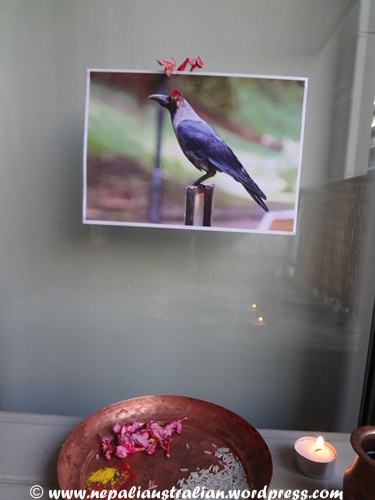
Crow is supposed to be a henchman for Lord Yamaraj. Hindus believe crows to be messengers of good or bad news. With its croaking, it conveys messages like visitor coming to the house etc. It is also believed to be a messenger of Yama, the God of death

To avert grief and death in the family, Hindus worship crows during Kaag / Kag Tihar offering it sweets and various dishes. On this day crows are offered food on a plate made out of leaves in the morning before anyone in the house takes in food. In Nepal a crow is not killed cause as a legend says that one crow had happened to drink the water of life. Thus you can see crows everywhere sitting without the fear of human beings. Once you leave offerings on the balcony, a crow will come and eat the food.

Where there are no crows, any winged animal of the heavens (bird) will enjoy the feast.

In Australia, I haven’t seen many crows around so I printed a photo of a crow and performed the Puja this morning. I had a shower and then prepared puja. Here are some photos of Kaag / Kag puja from this morning 🙂

Happy Tihar everyone!!!

I will write about other days like Kukur Puja, Gai Puja and Laxmi Puja, Goru Puja , Govardhan Puja , Mha Puja and Nepal Sambat and Bhai Tika as the festival progresses.

Tuscany and Florence: Italy

Tuscany is a region in Italy having an area of about 23,000 square kilometres (8,900 sq mi) and a population of about 3.8 million inhabitants. The regional capital is Florence. Tuscany is known for its landscapes, traditions, history, artistic legacy and its permanent influence on high culture. It is regarded as the birthplace of the Italian Renaissance and has been home to many figures influential in the history of art and science.

Driving from Rome to Tuscany was beautiful. There were lots of farm and greenery. We stopped over in Autogril to have some food. Then we drove all the way to Florence.

Once we were dropped off in Florence, we walked with our guide to  Piazza Santa Croce.

Piazza Santa Croce

Piazza Santa Croce is one of the main squares of the centre of Florence, Italy. The Basilica of Santa Croce, the largest Franciscan church in the world, overlooks the piazza. The basilica’s most notable features are its sixteen chapels, many of them decorated with frescoes by Giotto and his pupils, and its tombs and cenotaphs. It is the burial place of some illustrious Italians, such as Michelangelo Buonarroti, Niccolò Machiavelli, Enrico Fermi, Galileo Galilei, Ugo Foscolo, Guglielmo Marconi, Luigi Cherubini, Leon Battista Alberti, Vittorio Alfieri, Gioacchino Rossini, Lorenzo Ghiberti, Lorenzo Bartolini, Pier Antonio Micheli, Bartolomeo Cristofori, and Giovanni Gentile. For this reason it also known as the Temple of the Italian Glories (Tempio dell’Itale Glorie). In front of the Basilica there is famous marble statue made by Enrico Pazzi decidated to Dante Alighieri, and formerly places in the middle of the piazza.

From Piazza we were taken to a leather shop near Piazza Santa Croce where they tried to sell some leather stuffs but to be honest I didn’t like the place as there were pushy salesman trying too hard. So me and my husband got out of the place and enjoyed the outside until everyone was out.

From there we were taken to the tour of Florence with the local guide.

Basilica di Santa Maria del Fiore

It is known as Basilica of Saint Mary of the Flower in english. The Cathedral is gothic in style, and it features a dome that was to become the model and standard for domes which were built in many other major European cities over the next several centuries.  In this era, the dome was a feat of architectural genius by its designer and engineer, Filippo Brunelleschi.  The exterior is covered with marble panels, which are in shades of green, pink, and white , very appropriate Saint Mary of the Flower.

This cathedral is breathtaking on the outside. You could spend hours walking around it marvelling at the intricate work. The interior is also very nice and a lot brighter than I had expected. It’s marble and empty and echoing. Quiet and reflective, as a church should be. But looking up at the fresco will really take one’s breath away. Its definitely a good way to spend some time out of your day in Florence as it seems that relaxing and enjoying yourself is something that you can do in Florence very easily.

Be sure to see the bronze doors on the Baptistry – known as “The Gates of Paradise” by Ghiberti.  The original doors are in the Duomo Museum and were replaced with replicas due to water damage in a huge flood in the 1960’s, vandalism, and other harmful elements.  These doors took over 27 years to complete, and the ten panels depict the Old Testament.  And, this is hard to imagine, but the doors are the first time perspective was used in an artwork.

It is possible to climb to the top of the dome, but this is not for the faint of heart as it requires a reasonable degree of fitness to manage the spiral staircases, the ladders, and the countless number of steps to reach the top.

For us the last stop was Piazza della Signoria with our guide before we got free time to shop and eat.

Porcellino

Porcellino (Italian “piglet”) is the local Florentine nickname for the bronze fountain of a boar. The fountain figure was sculpted and cast by Baroque master Pietro Tacca (1577 –1640) shortly before 1634.

Visitors to Porcellino put a coin into the boar’s gaping jaws, with the intent to let it fall through the underlying grating for good luck, and they rub the boar’s snout to ensure a return to Firenze which has kept the snout in a state of polished sheen while the rest of the boar’s body has patinated to a dull brownish-green.

We also rubbed the snout so hope we will be going to Italy again 🙂

Piazza della Signoria

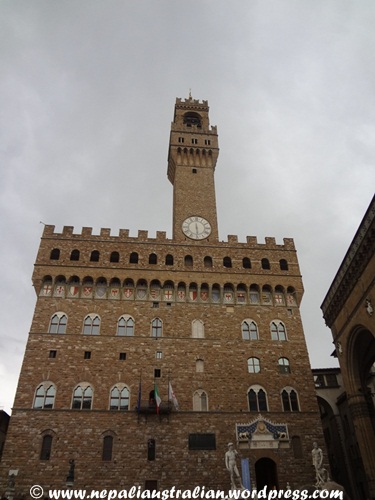
Piazza della Signoria is an L-shaped square in front of the Palazzo Vecchio in Florence, Italy. Florence’s most famous square started to take shape in the mid- to late-13th century when the Guelphs defeated the Ghibellines for control of the city. The piazza’s L shape and the lack of uniformity of its surrounding buildings is the result of the Guelphs leveling many of their rivals’ palazzi. The piazza gets its name from the towering Palazzo Vecchio, whose original name is the Palazzo della Signoria.

Numerous statues designed by some of the most famous Florentine artists decorate the square and the adjacent Loggia dei Lanzi, which serves as an outdoor sculpture gallery. Almost all of the statues located on the square are copies; the originals have been moved indoors, including to the Palazzo Vecchio and the Bargello, for preservation.

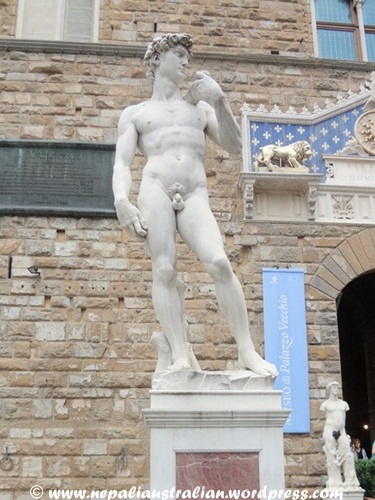
The most famous of the piazza’s sculptures is a copy of Michelangelo’s David (the original is in the Accademia), which stands watch outside the Palazzo Vecchio. Other must-see sculptures on the square include Baccio Bandinelli’s Heracles and Cacus, two statues by Giambologna – the equestrian statue of Grand Duke Cosimo I and Rape of a Sabine – and Cellini’s Perseus and Medusa.  At the center of the piazza is the Neptune Fountain designed by Ammanati.

Palazzo Vecchio

Florence’s City Hall, the Palazzo Vecchio, is one of the most important secular buildings in Florence and one of the city’s top attractions. Palazzo Vecchio was constructed in the late 13th/early 14th century in order to house the government offices for the newly formed Florentine Republic. The architect of the Palazzo Vecchio was Arnolfo di Cambio, the architect of Florence’s Duomo.

Today, the Palazzo Vecchio still contains the office of Florence’s Mayor and the City Council. But most of building is now a museum.

Entrance

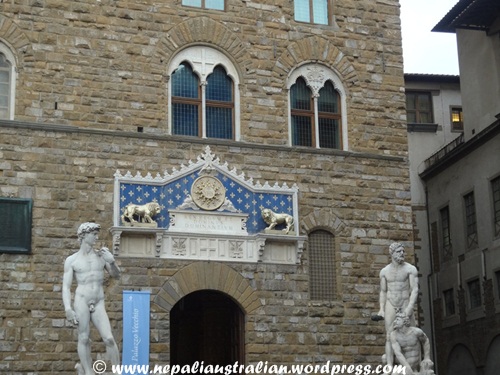
The entrance to the Palazzo Vecchio is flanked by a copy of Michelangelo’s David (the original is in the Accademia) and the statue of Hercules and Cacus by Baccio Bandinelli. Above the door is a gorgeous frontispiece set in a blue background and flanked by two gilded lions.

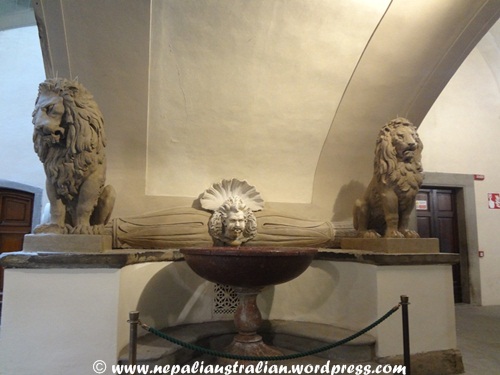
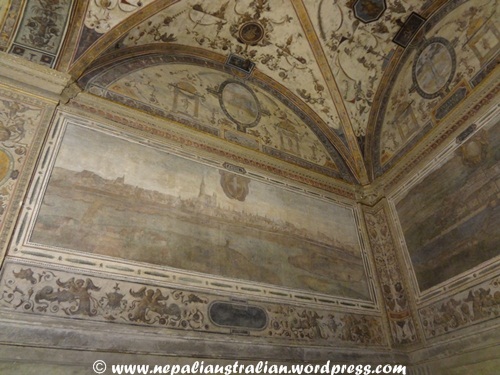
Cortile di Michelozzo: The artist Michelozzo designed the harmonious inner courtyard, which contains arcading set off by gilded columns, a copy of a fountain by Andrea del Verrocchio (the original is inside the palace), and walls painted with several city scenes.

Second Floor

Salone dei Cinquecento: The massive “Room of the Five Hundred” once held the Council of the Five Hundred, a governing body created by Savonarola during his short stint in power. The long room is largely decorated with works by Giorgio Vasari, who orchestrated the redesign of the room in the mid-16th century. It contains an ornate, coffered and painted ceiling, which tells the story of the life of Cosimo I de’ Medici, and, on the walls, gigantic depictions of battle scenes of Florence’s victories over rivals Siena and Pisa.

Leonardo da Vinci and Michelangelo were initially commissioned to produce works for this room, but those frescoes have been “lost.” It is believed that Leonardo’s “Battle of Anghiari” frescos still exist beneath one wall of the room. Michelangelo’s “Battle of Cascina” drawing, which had also been commissioned for this room, was never realized on the walls of the Salone dei Cinquecento, as the master artist was called to Rome to work on the Sistine Chapel before he could begin work in the Palazzo Vecchio. But his statue “Genius of Victory” located in a niche at the southern end of the room is worth a look.

The Studiolo: Vasari designed this sumptuous study for Francesco I de’ Medici, at the time the Grand Duke of Tuscany. The Studiolo is decorated from floor to ceiling with Mannerist paintings by Vasari, Alessandro Allori, Jacopo Coppi, Giovanni Battista Naldini, Santi di Tito, and at least a dozen others.

Third Floor

Loggia del Saturno: This large room contains an ornate ceiling painted by Giovanni Stradano but is most renowned for its sweeping views over the Arno Valley.

The Sala dell’Udienza and the Sala dei Gigli: These two rooms contain some of the Palazzo Vecchio’s oldest elements of interior decoration, including a coffered ceiling by Giuliano da Maiano (in the former) and frescoes of St. Zenobius by Domenico Ghirlandaio in the latter. The stunning Sala dei Gigli (Lily Room) is so called because of the patterned gold-on-blue fleur-de-lys – the symbol of Florence – on the room’s walls. Another treasure in the Sala dei Gigli is Donatello’s statue of Judith and Holofernes.

Several other rooms in the Palazzo Vecchio can be visited, including the Quartiere degli Elementi, which was also designed by Vasari; the Sala delle Carte Geographiche, which contains maps and globes; and the Quartiere del Mezzanino (mezzanine), which houses the Charles Loeser collection of paintings from the Middle Ages and Renaissance periods. 

After the tour we stopped to do some shopping and were taken back to the hotel.

Please click here for more photos.