Chicken choila / chhoela / Choila

I learned this recipe from my BIL (K didi’s husband). He is one of the best cooks around us and he loves cooking. I am sure it is true when they say that when you cook with love, it tastes better. He does put lots of time and effort in his cooking as well.

Ingredients

  • 500gm boneless chicken
  • Few stems spring onion
  • 2 small green chilies
  • 1 red onion finely sliced
  • coriander leaves
  • 5 cloves of fresh garlic
  • 2 inch on fresh ginger
  • 1 teaspoon turmeric powder
  • 2 teaspoons chili flakes
  • 1 teaspoon chili powder
  • 5 tablespoons vegetable oil
  • 1 teaspoon fenugreek seeds (Methi )
  • salt to taste

Steps

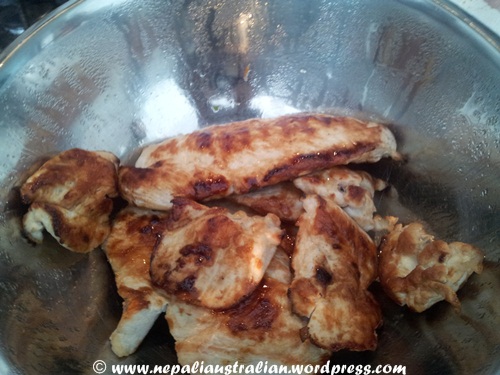
  • Cut chicken breast into thin layers.
  • Heat the non-stick frying pan and sauté the chicken until cooked.

  • Cook on both side and make sure, the chicken doesn’t get burnt.
  • Once both sides are golden brown, repeat the process with all the chicken.

  • When you are doing this in batches, make sure you cover the cooked chicken in a container so it doesn’t become dry. This will also make the chhoela juicy and tender.
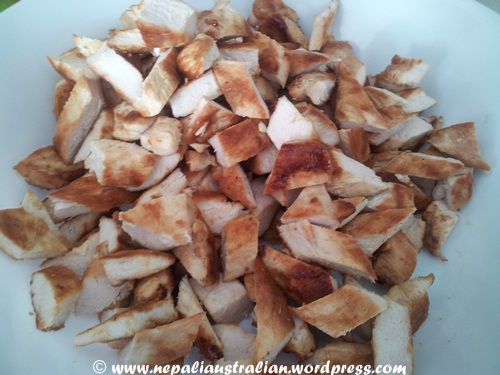
  • Once all the meat is cooked let it cool down for few minutes, slice the chicken into small diagonally into inch size pieces so it looks better for the presentation. Put all the meat in a big bowl.

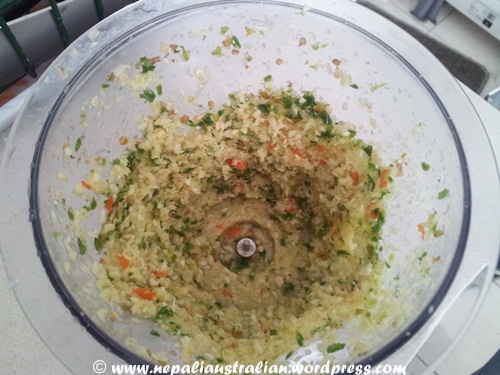
  • Make a paste in the blender using fresh garlic, fresh ginger, fresh chilli and fresh coriander. If you don’t have fresh ginger and garlic, you can used readymade paste but fresh always tastes better.

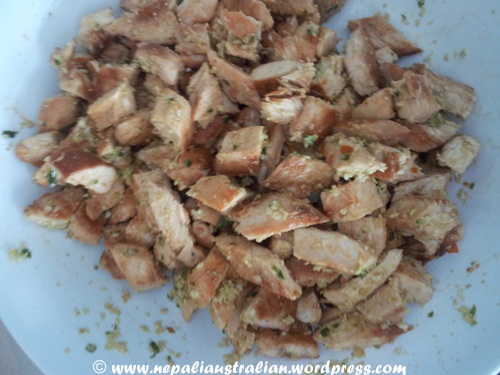
  • Then add this paste along with sliced onions, chili powder, cumin powder, coriander powder, chili flakes, turmeric powder and salt into a bowl with the chicken. Mix it well.

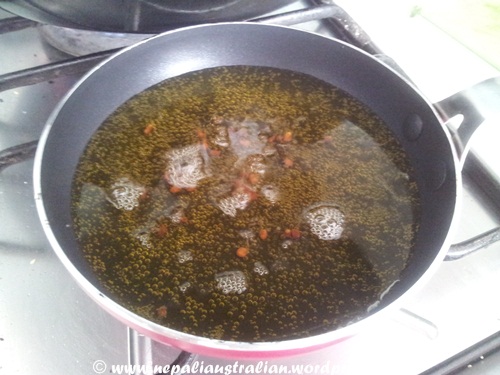
  • Now heat up the pan, add oil and fenugreek seeds and fry it till it turns dark brown. Make sure it doesn’t burn and turn black otherwise it will have a bitter taste.

  • Pour the oil over the chicken and mix it properly.
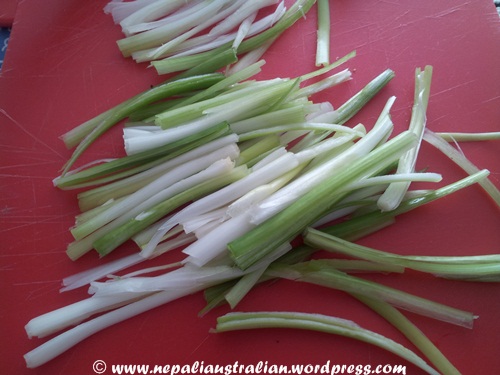
  • Cut the stem of the green onion into about 2 inch long sizes. Slice it into thin slices and add it to the chicken.

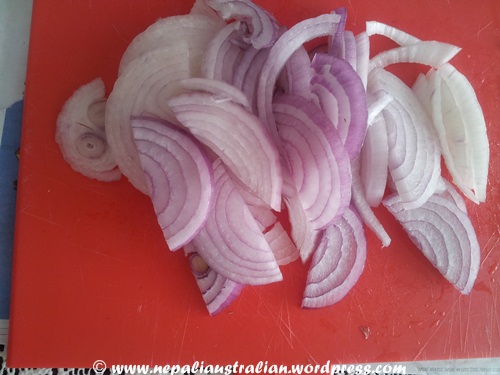
  • Add finely sliced red onion to the chicken

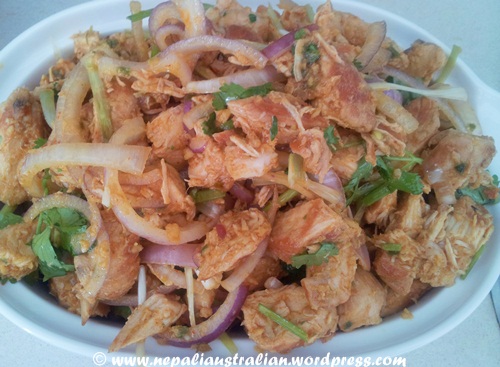
  • Garnish with fresh coriander and Chicken chhoela is ready to be served!

You may also like :

*Chicken chili *Goat curry *Momo

Bhuhari is going to Nepal

Bhuhari means daughter in law in Nepali.

As per our plan, I have booked my flight to go to Kathmandu, Nepal for mid of December.  I know I have been back form my Europe trip not long ago and l haven’t finished blogging about places we visited in Europe but it has been more than a year since we went to Nepal so, it is a perfect time to go again. We will be using our Christmas and New Year break with our annual leave to accommodate this holiday.

We will be going via Bangkok and will be stopping over for 4 days to do some sightseeing , some shopping and meeting AS’s family . We had been to Thailand before but I will be really nice to go again and meet AS’s new niece. She is so cute.

While in Nepali, my nephew will have his Pasni ceremony as well so we have a celebration and a holiday with our family. My brother, sister in law and nephew will be travelling there before us.

I always like to book my holiday in advance so I can look forward to the day and that keeps me going. I am always very eager to go to Nepal and I am this time as well but I have some fear of all the changes I will face.

This time, going to Nepal will be very different for me than ever before. This will be first time for me to go to my home town as a Bhuhari. It may sound strange in western society but life after marriage for Nepali women is very different than here. Lots of things do change which I haven’t really felt because I am in Australia but that will affect me while I am in Nepal.

Every time, I go to Kathmandu, my parents would come to pick me up at the airport but I am not sure what will happen this time. Because I am meant to go to AS’s house (my new home) from the airport. I am thinking to tell my parents not to come to the airport to receive me as I don’t want them to go home without me but instead am planning to go and visit there on the same day in the evening.

I will have to divide my time between two houses this time and I have no idea how I can manage that easily.

Going to Nepal always meant waking up late, not exercising , being spoilt my parents with yummy food , going out and meeting my friends and relatives, a short break to somewhere with my parents and lots of relaxation.

But I am not too sure I can keep this attitude in my new home.  I think it will be very rude to wake up at 8 am and go to kitchen where my MIL will be preparing breakfast for everyone. We have help but still she likes to do lot of things herself. Don’t get me wrong, as I have mentioned before as well, my MIL is very understanding and caring lady but still I can’t be spoilt the way my mum makes me when I am with her.

I am not too sure how I need to plan my days as there are lots of pending invitation we need to attend this time form AS families’ side. As it is a culture in Nepal to invite newlyweds for dinner after their wedding, we got lot of those invitations after our wedding last year. But as we had only 4 days after the wedding, we declined them and told everyone that we will be visiting them next time when we come back to Kathmandu. That means most of our evenings we’ll be dining out either at AS’s relatives’ house or mine’s.

Even in terms of clothing, I don’t know what I will be expected to wear. Like I mentioned in my post before, married women in Nepal dress differently after their wedding. So I am sure I can’t dress however I want. I don’t really mind wearing Sari and Kurta while I am there but it will be mid-winter so I am not too sure how easy it is going to be. Even a year after the wedding I will be a newlywed buhari so I need to learn all the right manners :).

I am sure with all the confusion and anxiety I am still going to have a great time with my two beautiful families, just thinking about it makes me bit anxious sometimes though. There is still a long time till I land in Kathmandu but I can’t wait to write about my experience and Nepal  from Kathmandu  🙂

New rules for use of mobile phones while driving on Sydney roads

As I mentioned in my previous post here, I get really annoyed with drivers who are so careless on the road that they are putting themselves and others in danger. It is not fair that someone is careless and they take the life of some innocent road user or make them injured.

It is a common scene on the road to see a driver holding a mobile while driving. If I could issue fines to these people, I could have made lots of money for the government. Even though talking on a mobile phone while driving is not illegal in Australia, holding it is; but drivers hardly care about these rules until they see a cop car.

But things are changing now. They are making these rules very serious. From 1 November 2012, changes to NSW Road Rules have come into effect. These law changes primarily consist of minor amendments, clarifications and tightening of existing road rules.

Motorists will only be allowed to use a mobile phone while driving if the phone is fixed to a secure mounting or can be used without the driver having to touch any part of the phone. Here are the new rules that were effective from last week. Drivers cannot hold a phone in their hand, other than to pass it to a passenger, and can’t rest it on their legs or hold it between their shoulder and ear.

Provided the phone is mounted in a commercially designed and manufactured cradle, fully-licensed drivers can press buttons on the phone for the purpose to make a call, use GPS systems or listen to music.

Texting and emailing while driving, whether the phone is mounted or not, remains illegal.

I am so glad they are taking things seriously and hope this will help save lots of innocent lives on the road.

Rule states from Roads and Maritime Services’s Centre as below

Use of mobile phones

While a vehicle is moving or stationary (but not parked), a driver may only use a mobile phone to make or receive a call or use the audio playing function:

1.         If the mobile phone is secured in a fixed mounting; or

2.         If not in a mounting, use of the mobile phone must not require a driver to touch or manipulate the phone in any way.

All other functions including texting, video messaging, online chatting, reading preview messages and emailing are prohibited.

The new laws make it clear that a driver in a moving or stationary vehicle (unless parked) MUST NOT HOLD a phone in his or her hand other than to pass the phone to a passenger.

Penalty: 3 demerit points (4 in a school zone) and $298 ($397 in a school zone)

NOTE: Learner and Provisional P1 drivers are not allowed to use ANY function of a phone (including hands-free) while driving.

Police and emergency services vehicles

Police and emergency service drivers may continue to use mobile data terminals in the course of their work to receive job allocations, licensing, registration and other important information.

Visual display units in motor vehicles

A visual display unit (including a mobile phone), which is being used as a driver’s aid function, such as a GPS, may only be used in a motor vehicle if it is secured in a fixed mounting. This mounting must be commercially designed and manufactured for this purpose. It must be positioned in the vehicle to not distract or obscure the driver’s view.

Penalty: 3 demerit points (4 in a school zone) and $298 ($397 in a school zone)

Out and about in Rome

On day 2 of Rome we had the whole day on our own so with fellow travellers from the tour, we took a map and went on a journey to explore Rome, the capital of Italy, by ourselves.

I have read Kathmandu described as city of temples but I didn’t know that Rome is a city of churches. Everywhere we went there were churches, all equally magnificent and beautiful.

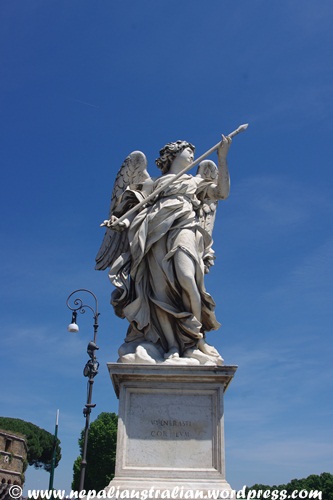
Castle San Angelo

I always wanted to see this castle as I saw it in the move Angles & Demons so I was really happy to see the beautiful castle. The castle looked like some of the forts I have seen in India. It is located right by the Tiber River and was originally built as a mausoleum for Emperor Hadrian in 139 AD.
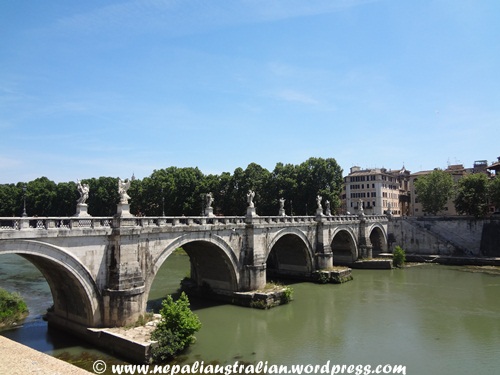
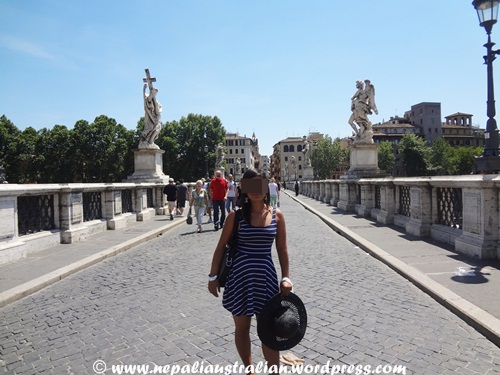
In front of the castle there is a beautiful bridge called Ponte Saint Angelo with 5 angles on either side of it. This is how the castle got its name. The bridge is faced with travertine marble and spans the Tiber with three arches.

On one side of the castle, there was a market that sold souvenirs and food. Also, there was a man dressed as a devil asking money from tourists to take photos with him.

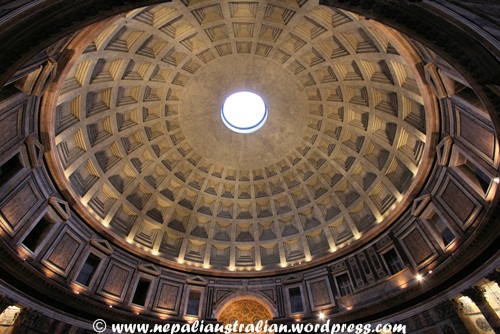
Pantheon

The Pantheon, one of the most fascinating, and mysterious, buildings in Italy. It is a Christian church where they conduct mass every Sunday. The interior of Pantheon is really striking, with its dome a perfect hemisphere and an oculus which is believed to symbolize the all-seeing eye of heaven. At about 142 feet in diameter, the Pantheon’s dome is bigger even than the dome of St. Peter’s Basilica.
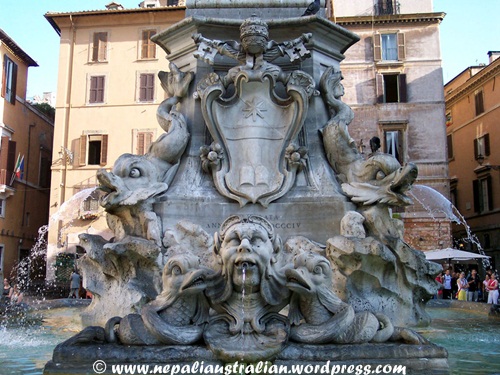
It is one of the best-preserved of all Roman buildings. It has been in continuous use throughout its history, and since the 7th century, the Pantheon has been used as a Roman Catholic Church dedicated to “St. Mary and the Martyrs” but informally known as “Santa Maria della Rotonda.” The square in front of the Pantheon is called Piazza della Rotonda.

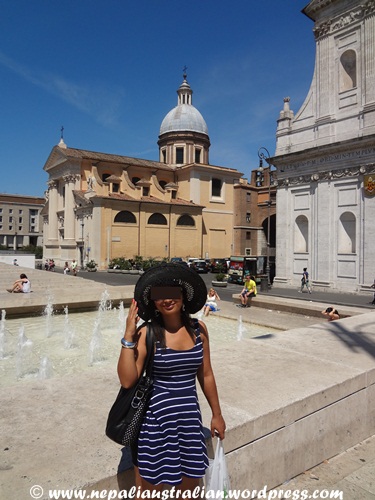
The Piazza della Rotonda was filled with tourists taking pictures and people resting on the steps of the fountain. Along the edges of the piazza there were restaurants and coffee shops.

Raphael, the famous Renaissance painter, is buried inside the Pantheon with his fiancée Maria Bibbiena as well as Vittorio Emanuele II, Italy’s first king.

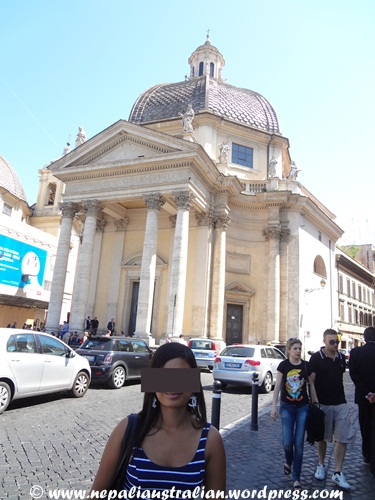
Piazza del popolo

This is one of the most beautiful piazzas in Rome and the effect of the twin churches is amazing. My guide mentioned that the two baroque churches of Santa Maria dei Miracoli and Santa Maria in Montesanto are not exactly alike, but they do look alike on a first sight and the impression one gets is of something unforgettable.
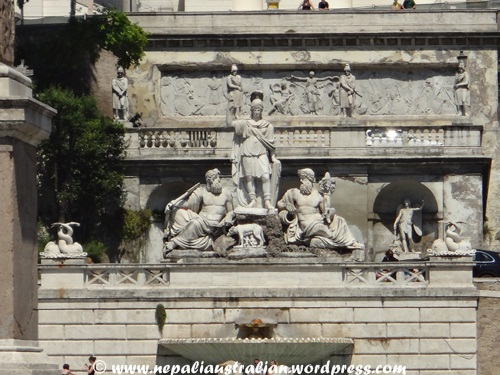
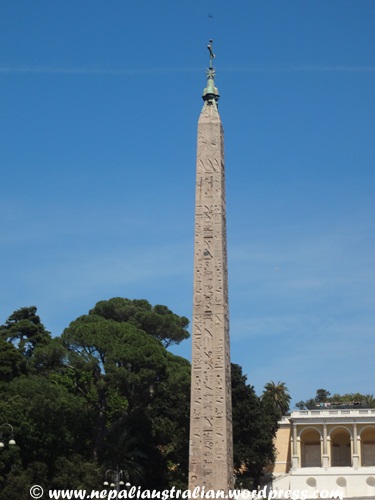
The piazza was created by Latino Giovenale Manetti in 1538 for Pope Paul III and the twin churches were added in the 17th century. The present symmetry was given by the neoclassical architect Giuseppe Valadier in the early 1800’s. In the middle of the square lies a 3000 years old obelisk framed by four small fountains with lions. The piazza is closed to automotive traffic so you can stroll at your own pace and enjoy the sights.
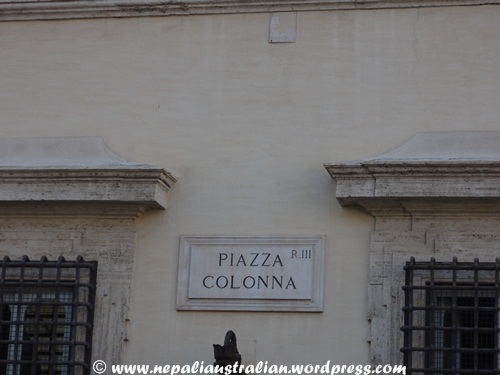
Trajan’s Column (Colonna di Traiano)

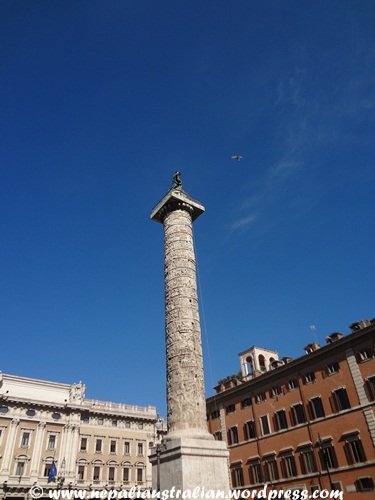
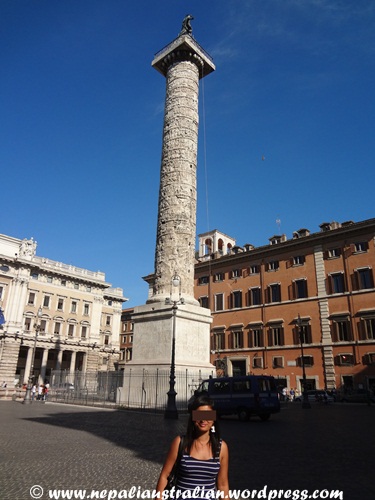
Trajan’s column was built to commemorate military campaigns in Dacia (which is now Romania). The column is a beautiful piece of Roman sculptural art; around the column winds a spiral frieze with over 2500 figures in relief illustrating the battles that took place during Trajan’s military campaigns in Dacia (101-102 and 105-106). At the top the statue of Saint Peter replaced in 1588 a statue of Trajan. The ashes of the emperor and his wife were places in a golden urn in a vault below the column. The column stands in what was once Foro di Traiano (Forum of Trajan) with a huge semicircular market building.

Piazza Navona
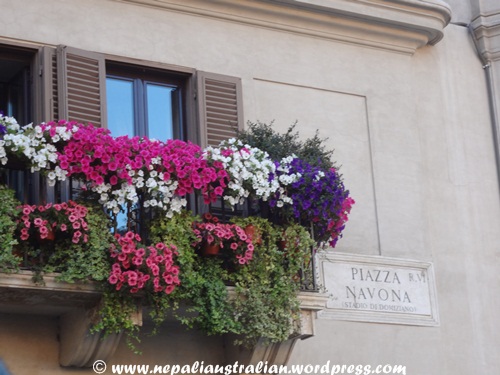
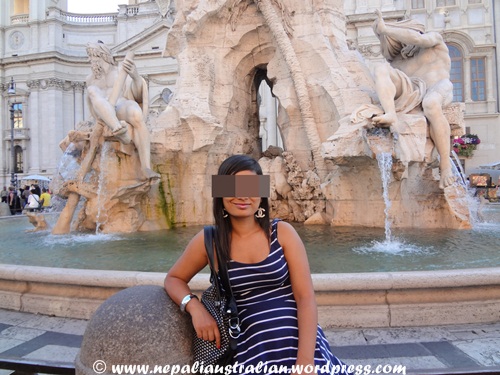
Piazza Navona was built over the site of the 1st century Stadium of Domitian and still preserves the elliptical form of the Roman circus. Medieval jousts, 17-century carnivals, open-air sports and historic festivals took place here; the piazza was also used as market place from mid 15th century to mid 19th century. Today this place attracts tourists and Romans alike, and the cafes and restaurants lining the piazza have tables outside most of the year.

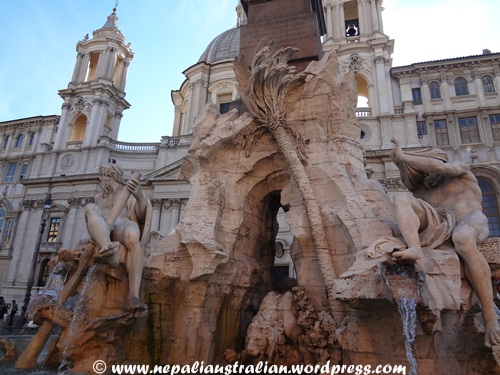
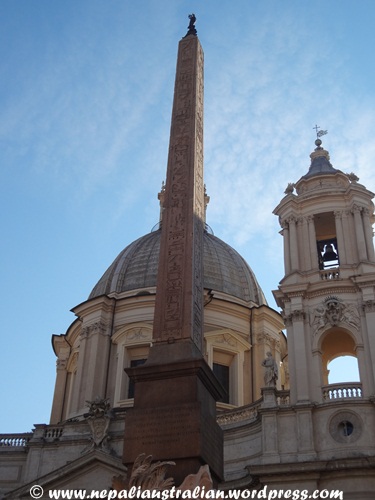
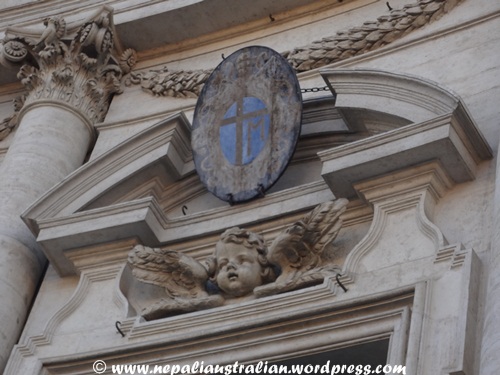
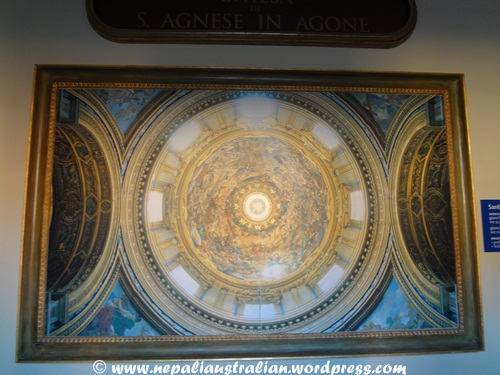
Three beautiful fountains decorate the piazza out of which the most famous is the central Fontana dei Quattro Fiumi (The Fountain of the Four Rivers) by Bernini. Behind this fountain is the church Sant’Agnese in Agone a remarkable example of Baroque architecture.

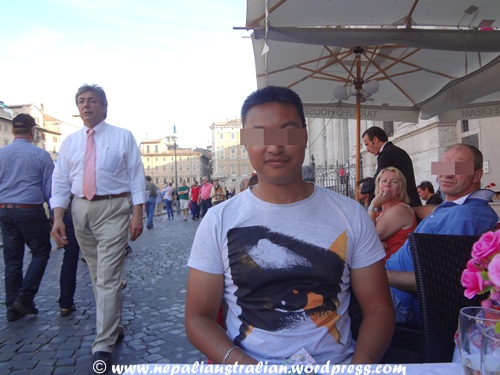
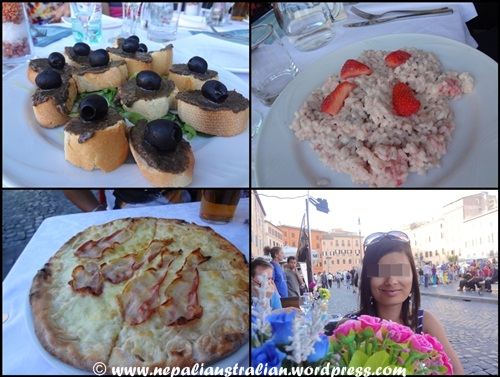
On one of the days we were in Rome, we sat down and had our dinner there.

Piazza Augusto Imperatore

As part of his massive restructuring of Rome and in celebration of the 2000th anniversary of Augustus’ birth, Mussolini created the Piazza Augusto Imperatore with the Mausoleum of Augustus at its center. He had the densely populated neighbourhoods surrounding the Mausoleum destroyed and new buildings constructed on the 4 sides of the Piazza. Only the churches were allowed to remain. The story of this radical transformation is superbly told in Kostoff, 1978.

Office buildings were constructed on 2 sides and a college on a 3rd. On the 4th side, the new pavilion to house the relocated and reconstructed Ara Pacis was built between the Mausoleum and the major avenue beside the Tiber embankment. Within this pavilion, Mussolini had the Ara Pacis itself reconstructed not at the level of the Via di Ripetta, the ground level of buildings in the area, where it might have retained closer relationship to the Mausoleum. Instead, for added visibility and prestige, he had the Ara Pacis reconstructed at the level of the Lungotevere in Augusta, the top level of the ealry 20th century embankment along the Tiber River.

Palazzaccio

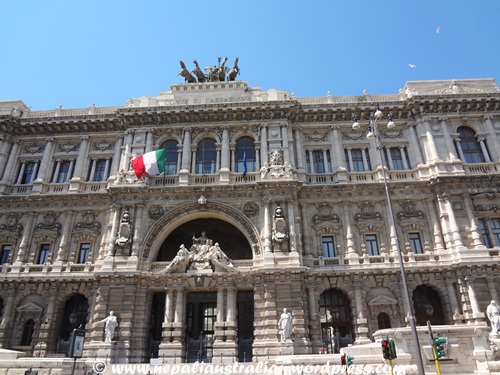
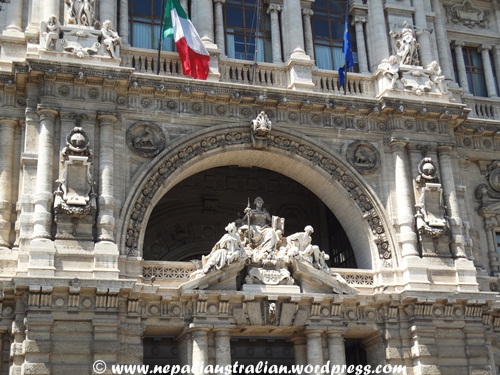
Designed by the Perugia architect Guglielmo Calderini and built between 1888 and 1910, the Palace of Justice is considered one of the grandest of the new buildings which followed the proclamation of Rome as the capital city of the Kingdom of Italy.

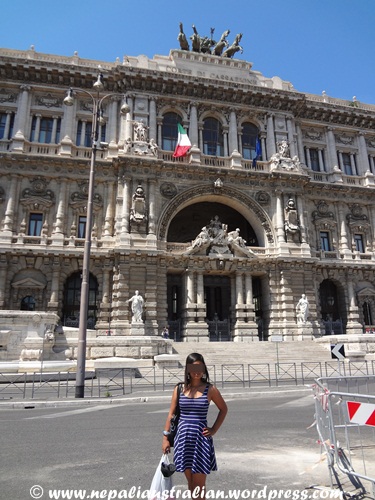
The building’s unusually large size, astonishing decorations, and long period of construction created the suspicion of corruption. In April 1912 a parliamentary commission was appointed to inquire into the matter and it presented its findings the following year. The affair gave rise to the building’s popular nickname of Palazzaccio.
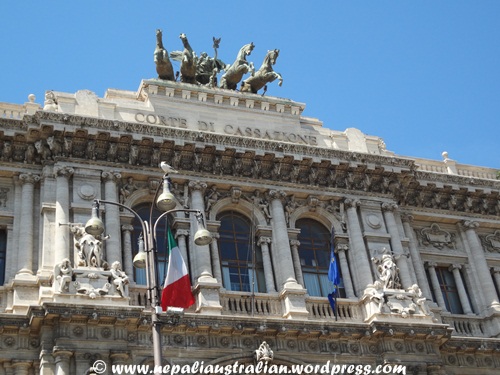
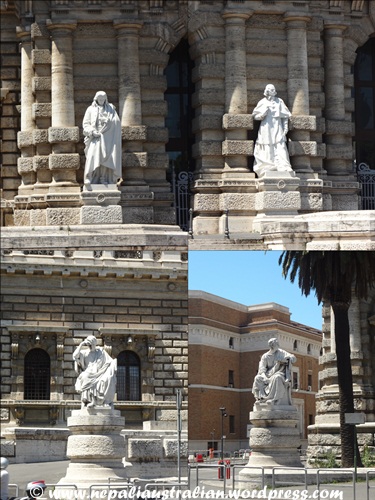
Inspired by late Renaissance and Baroque architecture, the building is 170 meters by 155 in size and is completely covered with Travertine limestone. Above the façade looking towards the River Tiber it is surmounted by a great bronze quadriga, set there in 1926, the work of the sculptor Ettore Ximenes from Palermo. Ten large statues of notable jurists adorn the ramps before the main façade and the internal courtyard. The upper part of the façade looking onto the Piazza Cavour is ornamented with a bronze coat of arms of the House of Savoy. Inside the Hall of the Supreme Court, also known as the Great Hall (or on Calderini’s plans as the Aula Maxima) are several frescoes, begun by Cesare Maccari (1840–1919), who became paralysed in 1909 while the work was unfinished. It was continued until 1918 by Maccari’s former student Paride Pascucci (1866–1954)

Please click here for more photos from Rome. 
Sneak peak on Prabal Gurung for Target

I am so excited to share more from Prabal Gurung for Target range.
Shot in New York City, the Prabal Gurung for Target collaboration ad campaign stars the adorable actress Olivia Thirlby and actor Chris Conroy, looking very much in love, shopping for flowers, strolling the streets of New York. I really like the floral dress and those neon sandals.

And for a non-printed option, we see Thirlby in an adorable black and white dress with a black bow at the neckline.

I love what I am seeing here so far. I am so ready for February 10, when the collection hits Target stores. I even told my husband what to get me for Valentine this year  🙂

If you want to know more about Prabal Gurung, please click these posts.

Prabal Gurung : A Fashion designer from Nepal

The magic of Prabal Gurung continues

Prabal Gurung: Designer in the Spotlight

Love you, Prabal Gurung

Prabal Gurung made a 13 years old boy’s dream come true

More stars shines under Prabal Gurung’s collection

You may also like :

*First look at the full Prabal Gurung for Target collection come true *Love you, Prabal Gurung *Prabal Gurung for Target collection is not coming to Australia 😦