I have talked about healthy eating and exercising multiple times in my blog. I really believe that healthy eating is a life style you choose and live with for the rest of your life. But at the same time as I grow older I am becoming more realistic.
 My husband always reminds me that I can’t wish for a miracle with my body. So I am accepting the fact that as I grow older I need to exercise more to stay fit. For the last few months, I have a new goal, getting my body better for our cruise holiday. Keeping that in mind, I changed my exercise routine.
I used to normally exercise after work and during weekends but now, it has changed completely.
I realised that my one-hour lunch breaks have not been properly utilise. I used to walk in a park but it was not helping a lot so I decided to do intense exercise during that time. Therefore, I do not have to worry about exercise once I am home.
I have been running a couple of time a week, swimming a couple of times a week and playing tennis once a week. Some weeks I work out every afternoon while some weeks I do it 3-4 afternoons. Either way my body is getting a good workout during the lunchtime.

In addition, I realised once I started exercising regularly, I met other colleagues who exercise during the lunch break as well. Now I have a swimming partner twice a week, in a running group once a week and with a tennis group once a week. Not everyone one makes it every week but still it is so good to go and exercise with likeminded people. I also realised when I run or swim with other people, I tend to push myself further than when I exercise alone. I still exercise alone somedays like today I went running alone as everyone else was doing something else but exercising during lunch time seemes a great idea to me.
Now, it has been a few months so if I don’t do something during lunch time, I feel bad. Unless I have a lunch date with someone, which I try to have now and then to socialise, I will go and just run.
Also, I have been swimming with my hubby after work once or twice a week and that is also adding up.
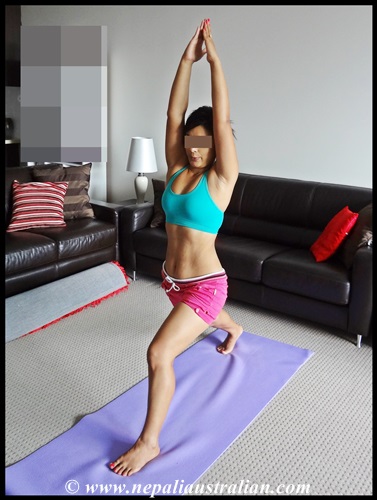
I love yoga so at least once a week on weekends I am practicing yoga.

I don’t have to make excuses after work when I don’t exercise and have more time to think about dinner and other things in our life.
My body is slowly but surely getting where I went it to be. Wish me luck that I can keep this routine for a long time.
My new mantra, I did my best today. Tomorrow I will do better. 🙂
Take care and have a great week,
M from nepaliaustralian
XOXO
Leaving you with an interesting article from Huffington post by Sarah Klein.
This Is What Happens To Your Body When You Exercise
Whether you do it to lose weight, to reach a fitness goal or — dare we say it? — just for fun, exercise changes you.
There’s the red face and the sweating, the pounding heart and pumping lungs, the boost to your alertness and mood, the previously nonexistent urges to talk about nothing but splits and laps and PBs.
But while we all know that staying physically active is essential to a long, healthy, productive life, we don’t often understand exactly what’s happening behind the scenes.
We asked the experts to take us through — from head to toe — what happens in the body when we exercise. Neuroscientist Judy Cameron, Ph.D., professor of psychiatry at the University of Pittsburgh School of Medicine, Tommy Boone, Ph.D., a board certified exercise physiologist, and Edward Laskowski, M.D., co-director of the Mayo Clinic Sports Medicine Center spill the beans on what gets and keeps you moving.
Muscles
The body calls on glucose, sugar the body has stored away from the foods we eat in the form of glycogen, for the energy required to contract muscles and spur movement.
It also uses adenosine triphosphate, or ATP, but the body only has small stores of both glucose and ATP. After quickly using up these supplies, the body requires extra oxygen to create more ATP. More blood is pumped to the exercising muscles to deliver that additional O2. Without enough oxygen, lactic acid will form instead. Lactic acid is typically flushed from the body within 30 to 60 minutes after finishing up a workout.
Tiny tears form in the muscles that help them grow bigger and stronger as they heal. Soreness only means there are changes occurring in those muscles, says Boone, and typically lasts a couple of days.
Lungs
Your body may need up to 15 times more oxygen when you exercise, so you start to breathe faster and heavier. Your breathing rate will increase until the muscles surrounding the lungs just can’t move any faster. This maximum capacity of oxygen use is called VO2 max. The higher the VO2 max, the more fit a person is.
Diaphragm
Like any muscle, the diaphragm can grow tired with all that heavy breathing. Some argue that as the diaphragm fatigues, it can spasm, causing a dreaded side stitch. (Others argue a side stitch is due to spasms of the ligaments around the diaphragm instead, while others believe the spasms to originate in the nerves that run from the upper back to the abdomen and are caused by poor posture!) Deep breathing and stretching can alleviate the discomfort in the middle of a workout, and preemptive strengthening in the gym can ward off future issues.
Heart
When you exercise, heart rate increases to circulate more oxygen (via the blood) at a quicker pace. The more you exercise, the more efficient the heart becomes at this process, so you can work out harder and longer. Eventually, this lowers resting heart rate in fit people.
Exercise also stimulates the growth of new blood vessels, causing blood pressure to decrease in fit people.
Stomach & Intestines
Because the body is pumping more blood to the muscles, it takes some away from the systems and functions that aren’t top priority at the moment, like digestion. That can result in tummy troubles. Movement, absorption and secretion in the stomach and intestines can all be affected.
Brain
Increased blood flow also benefits the brain. Immediately, the brain cells will start functioning at a higher level, says Cameron, making you feel more alert and awake during exercise and more focused afterward.
When you work out regularly, the brain gets used to this frequent surge of blood and adapts by turning certain genes on or off. Many of these changes boost brain cell function and protect from diseases such as Alzheimer’s, Parkinson’s or even stroke, and ward off age-related decline, she says.
Exercise also triggers a surge of chemical messengers in the brain called neurotransmitters, which include endorphins, often cited as the cause of the mythical “runner’s high.”
The brain releases dopamine and glutamate, too, to get those arms and legs moving, as well as gamma-aminobutyric acid, or GABA, a prohibitive neurotransmitter that actually slows things down, to keep you moving in a smooth and controlled manner.
You’ll also likely feel better thanks to a bump in serotonin, a neurotransmitter well known for its role in mood and depression.
Hippocampus
This part of the brain is highly involved in learning and memory, and it’s one of the only sections of the brain that can make new brain cells. Exercise facilitates this, thanks to the extra oxygen in the brain.
Even when you stop exercising, those new brain cells survive, whereas many other changes in the brain during exercise eventually return to their normal state should you become less active.
Hypothalamus
The hypothalamus is responsible for body temperature, as well as salt and water balance, among other duties. As your body heats up, it tells the skin to produce sweat to keep you cool.
Pituitary Gland
This control center in the brain alerts the adrenal glands to pump out the hormones necessary for movement. It also releases growth hormones. As the body searches for more fuel to burn after using up your glycogen stores, it will turn to either muscle or fat, says Cameron. Human growth hormone acts as a security guard for muscle, she says, telling the body to burn fat for energy instead.
Kidneys
The rate at which the kidneys filter blood can change depending on your level of exertion. After intense exercise, the kidneys allow greater levels of protein to be filtered into the urine. They also trigger better water reabsorption, resulting in less urine, in what is likely an attempt to help keep you as hydrated as possible.
Adrenal Glands
A number of the so-called “stress” hormones released here are actually crucial to exercise. Cortisol, for example, helps the body mobilize its energy stores into fuel. And adrenaline helps the heart beat faster so it can more quickly deliver blood around the body.
Skin
As you pick up the pace, the body, like any engine, produces heat — and needs to cool off. The blood vessels in the skin dilate, increasing blood flow to the skin. The heat then dissipates through the skin into the air.
Eccrine Glands
At the hypothalamus’s signal, one of two types of sweat glands, the eccrine glands, get to work. These sweat glands produce odorless perspiration, a mixture of water, salt and small amounts of other electrolytes, directly onto the skin’s surface. When this sweat evaporates into the air, your body temp drops.
Apocrine Glands
This second type of sweat gland is found predominantly in hair-covered areas, like the scalp, armpits and groin. These sweat glands produce a fattier sweat, typically in response to emotional stress, that can result in odor when bacteria on the skin begin to break it down, according to the Mayo Clinic.
Face
The capillaries close to the skin’s surface in the face dilate as well, as they strain to release heat. For some exercisers, this may result in a particularly red face after a workout.
Joints
Exercising puts extra weight on the joints, sometimes up to five or six times more than your bodyweight, says Laskowski.
Ankles, knees, hips, elbows and shoulders all have very different functions, but operate in similar ways. Each joint is lined with cushioning tissue at the ends of the bones called cartilage, as well as soft tissue and lubricating fluid, to help promote smooth and easy motion. Ligaments and tendons provide stability.
Over time, the cushioning around the joints can begin to wear away or degenerate, as happens in people with osteoarthritis, the most common type of arthritis.



 It’s important to keep moving during winter and we all know that but there are some good reasons to keep in mind.


















 nepaliaustralian