Tag Archives: newari culture

Makka Ku

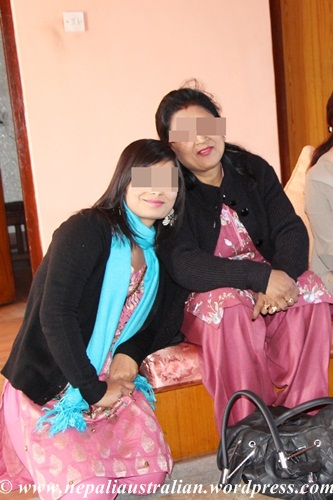
We are still celebrating our wedding after more than 1 and half years. I am still a new bride wherever I go :). While I was living at my new home a few weeks ago, my mum following tradition and sent a Makka Ku (pronounced ‘mock-ka ku’).

Makka ku is a newar tradition in which during the first winter after the wedding, the bride’s family sends some items which are necessary for winter to the groom’s home. Makka means olden style charcoal heater but these days instead of makka, electric heater is sent to keep the newlywed couple warm during the winter, along with a full set of warm clothes for the bride as well as fruits, rotis, blanket, electric heater etc.

Makka ku (1)

As we were in Sydney during our first winter, this winter was perfect time for my parents to follow the rituals for the Makka Ku.

Makka ku (5)

My aunt, my cousin along with my brother came to my new home with sweets and roti like anarsa, fini, laakhamari, ladoo, saun papdi, fruits: like oranges, mandarin, bananas, sugarcane, apples, masala: like cashew, almond and chocolates along with snow peas, yogurt, peanuts, sari, pashmina shawl, shoes, bag, electric heater and a blanket.

Makka ku (4) Makka ku (3) Makka ku (2)

It was a great day for me as I was so happy to celebrate our wedding again as this was one of the best decisions of my life and I am very happy to see both the family very happy with our union.

Makka ku (6)

It was a good time for both families to meet and chat. My family came and sat down with my MIL, AS and BIL and had a good conversation. They also checked out our wedding album which my MIL had made for the house.

Makka ku (7)

I had baked blueberry muffin that morning for tea so we started with tea and muffins and it was followed by Nepali feast for my aunt, cousin and brother. My MIL cooked the feast and I was the helper all morning in the kitchen preparing for the day.

Makka ku (8) Makka ku (9)

After lunch my family left and Makku Ku was concluded. As I told you before, in Nepalese wedding the bride is always the winner and it was true for this function as well as I got a full set of new outfit :).

For details and photos on our wedding functions please click the following links.

Tihar

Today we start the second biggest festival, after Dashain, for Hindu from Nepal.

This festival is celebrated in five days starting from the thirteenth day of the waning moon in October.

 The five days are called

  • Kaag / Kag (crow) Puja
  • Kukur (dog) Puja
  • Laxmi Puja and Gai (cow) Puja
  • Goru Puja,Gobhardan Puja , Mha Puja and Nepal Sambat
  • Bhai Tika

We also refer to Tihar as ‘Panchak Yama’ which literally means ‘The five days of the Lord of the underworld’. We also worship ‘Yamaraj’ in different forms in these five days.

In other words this festival is meant for life and death.The five-day festival is considered to be of great importance as it shows reverence to not just the humans and the Gods, but also to the animals like crow, cow and dog, who maintain an intense relationship with the humans. It is also a time for cooking great meals at home, brothers and sisters shopping for gifts, flying kites, decorating homes and streets, playing cards with friends, resting and relaxing.

Tihar is also called The Festival of Lights, as many diyo or candles or decorative lights are lit both inside and outside the houses to make them bright at night. All the houses are cleaned and decorated with the belief that Goddess Laxmi will enter the house that is clean so people light candles, oil lamps and other lights and thus during the night the entire village or city looks like millions of sparkling gems.

There is a story, which tells why this revelry is celebrated so widely. Once there was a king who was living his last days. His astrologer had told him that a serpent would come and take his life away. The king did not want to die so he asked the astrologer if there was any way to escape death. The king was advised to sleep with lit oil lamps all around his bed and decorate the palace with oil lamps on the day of Laxmi puja so that Goddess Laxmi would talk to the serpent not to take his life. It did happen; the serpent was convinced by Goddess Laxmi. The serpent took the king to Yama Raj and told him that it was not yet the king’s time to come to the underworld. So Yama Raj opened his ledger and in it the kings remaining age was written zero, but the serpent cleverly put seven before zero. Thus the king lived for seventy more years. So form then onwards Tihar is widely celebrated worshipping the lord of the underworld and Goddess Laxmi.

Another mytological reasons behind the celebration  is that Lord Ram return to Ayodhya  after 14 years of exile. He killed Ravan on Nawani of Dashain thus we celebrate Dashain and his home-coming is celebrated in Tihar with lights and flowers.

Tihar is also celebrated by playing Langurburja. It is a game similar to the British dice game “Crown and Anchor”. I remember taking money from dad and running to play a game with my friends. The game is played with 6 dice and a mat. The mat has similar symbols, as the dice, and they are spades, hearts, diamonds, clubs, crown and flag. The player can choose one or more symbols to bet his money on. If he gets at least one die with the same symbol which he bet on, he wins. If he gets two then he wins 2:1, the more he gets on the throw the more money he wins. As a kid we used to play for 25 paisa (equivalent to less than a cent in AUD now) a game. It was more for fun than for the money. I am sure they now play with more money than that.

Adults mostly play cards instead of Langurburja.

It also incorporates the Newar’s New Year, which is called Nepal Sambat.

Last weekend, I went shopping in preparation of the festival and bought lots of sweets, fruits and food.  I couldn’t find all the things I will need for Tihar and I was a bit disappointed in Nepali/Indian grocery in Sydney who are charging arms and legs for things we use for Tihar. Just an example, we need jajanka for Tihar which normally would cost around Rs 10 in Nepal but are selling for $2 (Rs180) each in Sydney!

Kaag Puja / Kag Puja

The first day of Tihar is Kaag / Kag (crow) puja which falls on 12 November this year.

Crow is supposed to be a henchman for Lord Yamaraj. Hindus believe crows to be messengers of good or bad news. With its croaking, it conveys messages like visitor coming to the house etc. It is also believed to be a messenger of Yama, the God of death

To avert grief and death in the family, Hindus worship crows during Kaag / Kag Tihar offering it sweets and various dishes. On this day crows are offered food on a plate made out of leaves in the morning before anyone in the house takes in food. In Nepal a crow is not killed cause as a legend says that one crow had happened to drink the water of life. Thus you can see crows everywhere sitting without the fear of human beings. Once you leave offerings on the balcony, a crow will come and eat the food.

Where there are no crows, any winged animal of the heavens (bird) will enjoy the feast.

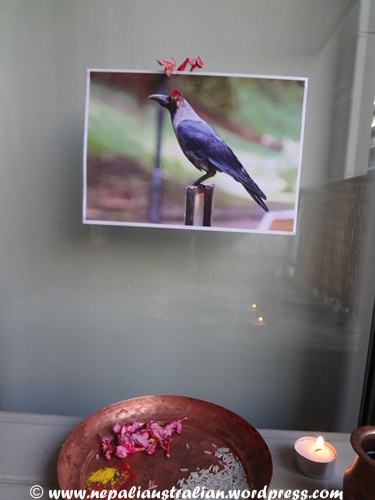
In Australia, I haven’t seen many crows around so I printed a photo of a crow and performed the Puja this morning. I had a shower and then prepared puja. Here are some photos of Kaag / Kag puja from this morning 🙂

Happy Tihar everyone!!!

I will write about other days like Kukur Puja, Gai Puja and Laxmi Puja, Goru Puja , Govardhan Puja , Mha Puja and Nepal Sambat and Bhai Tika as the festival progresses.
Ihi

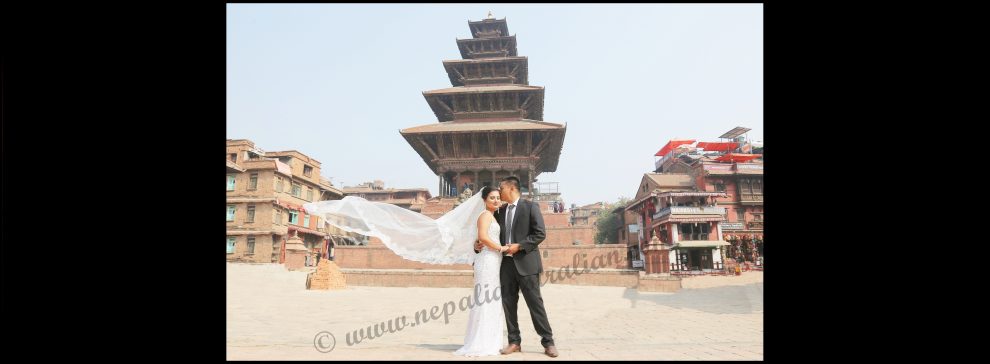
According to Newari tradition, girls are married three times in their lives.

First one is called ‘Ihi’ then ‘Bara Tayegu’ and then the real human marriage.

I am writing about the first marriage in Newar girl’s life which is called ‘Ihi’. “Ihi’ is also known as Bel Bibaha in Nepali. It is performed before a girl turns 13 years old. It is a compulsory ceremony every girl has to go through in most Newar community.

I too had the ceremony held for me but I can’t remember a lot about that day. I was quite small, I think 7 or so years old when the ‘Ihi’ was held for me.

In ‘Ihi’ ceremony, the girl is married to Lord Vishnu with the bel fruit (wood apple) as a witness. This ceremony is performed to save the girl from evil and malicious spirits but the most important reason is to protect the girl from unpleasant humiliation of widowhood.  As I mention in my post Widows in Nepal, it is really hard for the women in Nepal when they become widows. They had to take part in ‘Sati’ process in the old days, so in order to save their daughters from ‘becoming Sati’, Newars started a tradition in which they married their daughters to Lord Vishnu first. So even if her human husband dies in the course of her life, she doesn’t need to take part in ‘Sati’ ritual since her first husband, Lord Vishnu is still alive.

Some also believed this tradition allowed women to be more independent of their husbands. They can divorce or become widows without losing reputation.

Ihi is performed in mass over two days. It is normally organised by priests in their own house or backyard or someone can choose to host it in their house.

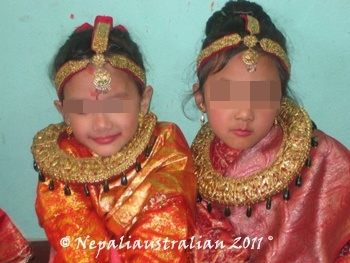
The first day is called Dusala Kriya. On this day, young girls have to bathe with pure water and are dressed like a bride in ankle length skirt, blouse and shawl. These days, you will see them as mini versions of traditional Nepali brides. Then all the girls will gather in the priest’s house. They sit on the floor in a long line with their mothers. Then the Puja begins where these girls go through sequences of ritual actions of purification. They have to worship images of Suvarna Kumara, the golden Bachelor which is an aspect of Lord Vishnu. It normally takes 5-6 hours for this ceremony to be over.

The second day is the most important day of the ritual  ‘Kanyadan’ (giving away of the daughter by the father) is performed on this day. For this day as well, the young girls are dressed as brides and taken for the Puja. On this day, they wear some special ornaments as well.

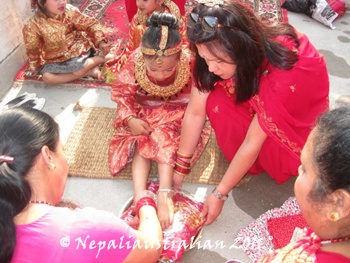
There will be a special person who cut toe nails for all the girls  and then paint the feet with red colour called ‘Alah’. Also at the end of the day, ‘Thaa bu’ , a plate which had eggs, yogurt, wine, fruits, Roti, meat, fish and much more for the girls to eat is served like in the real wedding.

There will be more Puja performed and the day will end by the father doing a ‘Kanyadan’ and giving away his daughter to Lord Vishnu in marriage with the Bel fruit as a witness.

‘Ihi’ is one of the many tradition the Newar community in Nepal follow and is unique to them.

Tihar

Thanks to my fellow blogger Basundhara (Nepal mero maya) for taking such an interest in my blog. I am writing Tihar posts with your comments in mind.

Tihar is the second biggest festival of Hindus in Nepal. It is celebrated over 5 days which are:

Each day has different significance.

This year Tihar is from 25 October to 28 October.

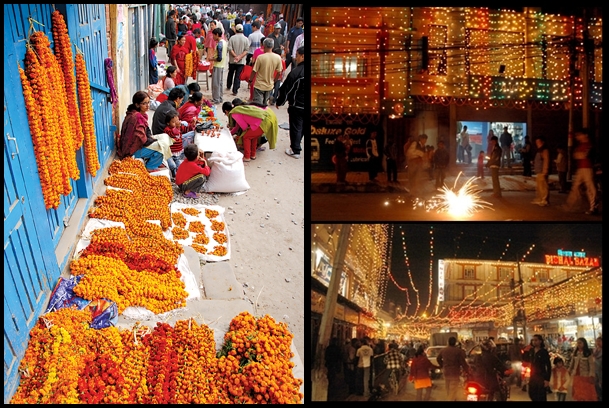
Tihar is also called the festival of lights so houses in Nepal are decorated with lights and garlands of the marigold flowers.  Normally houses are decorated either using traditional diyos  (oil-fed lamps made with clay ), candles or electrical lights hangings from the roof in front of the house. During the night if you walk through the main roads of the city, it looks beautiful with the houses all around light up for the festival.

There are lots of stories/ mytological reasons behind the celebration of Tihar. One of them is that Lord Ram return to Ayodhya  after 14 years of exile. He killed Ravan on Nawani of Dashain thus we celebrate Dashain and his home coming is celebrated in Tihar with lights and flowers.

One of the thing I remember about Tihar is playing Langurburja. It is a game similar to the British dice game “Crown and Anchor”. I remember taking money from dad and running to play a game with my friends. The game is played with 6 dice and a mat. The mat has similar symbols, as the dice, and they are spades, hearts, diamonds, clubs, crown and flag. The player can choose one or more symbols to bet his money on. If he gets at least one die with the same symbol which he bet on, he wins. If he gets two then he wins 2:1, the more he gets on the throw the more money he wins. As a kid we used to play for 25 paisa (equivalent to less than a cent in AUD now) a game. It was more for fun than for the money. I am sure they now play with more money than that.

Adults mostly play cards instead of Langurburja.

Tihar is celebrated a bit differently in various ethnic groups in Nepal. I will be writing my post based on the Newari culture.

As the festival progresses, I will keep posting more on what I did and what each day is about.

Happy Tihar!!!