Tag Archives: religion

Kukur Puja: Tihar

Today is second day of Tihar which is Kukur Puja as well as Laxmi Puja. Some years due to the placement of moon and other planets in the universe, some of the pujas fall on the same day.

I will write about Laxmi Puja tonight after I perform my Laxmi Puja at home.

Kukur Puja

The second day of Tihar is called “Kukur Puja” or “Khicha Puja” (“worship of the dogs”) by the Newars.

A dog is considered as man’s best friend and for Hindus, a dog is also considered as the steed of God “Bhairab” as well as Yama’s (God of death) gate keeper. The Hindu epic Mahabharata talks about the close relationship dogs have enjoyed with mankind. According to it, a dog is said to have accompanied Dharmaraj Yudhisthir on his journey to heaven alive. Dogs howling is considered a bad omen as it means that, they saw “Yama coming to take someone away.

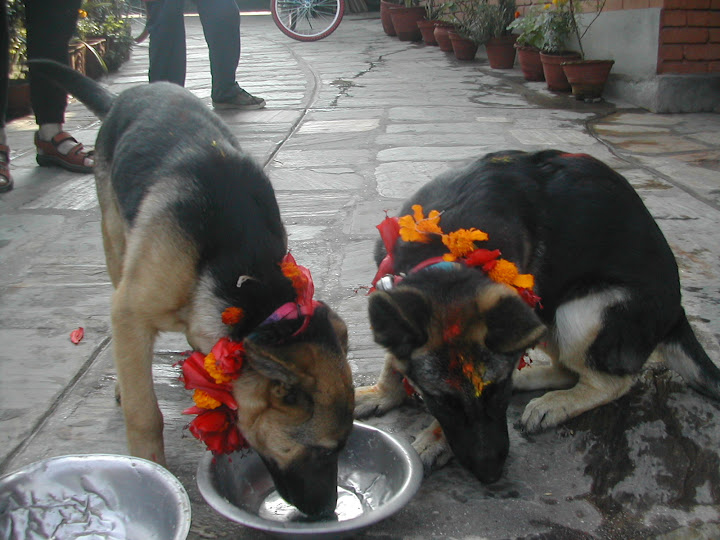
The dog is revered as a faithful and loyal animal which has been in the company of humans since ages. Around the year, dogs help humans by guarding their houses. So on the second day of Tihar, dogs are worshipped by putting tika on their forehead and a garland around their neck. They are offered a delicious meal consisting of meat and other dishes.

People perform the puja on their own dogs if they have one at home; otherwise they perform the puja on stray dogs. On this day you can see many stray dogs with red tika and a flower gland in Nepal.
We don’t have a dog here but my parents have a dog called “Chhotu”.

So I performed my Kukur Puja with his photo. I really am grateful to him that he is there to protect and warn my parents against thieves and the likes.
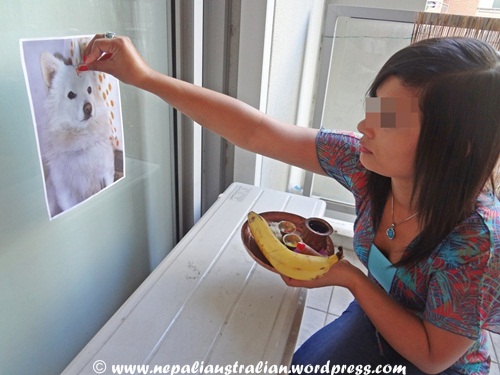
 

I miss him so much.I hope we will have our own dog one day to do this puja. 🙂

Happy Tihar!!!

Asthami : Dashain

Hindus all over Nepal is celebrating Maha Ashtami today, the eighth day of Dashain, by worshipping Goddess Durga.

From ritualistic aspects,  Maha Ashtami holds very important value. On this day, the fiercest embodiment of the Goddess is worshipped. Goddess Durga is believed to bestow peace, longevity and perpetual happiness on her devotees.

People also read the Durga Saptashati scriptures today. The Durga Saptashati is divine recitals consisting of 700 slokas , or verses, divided into three parts – the first relating to Maha Kali, the second to Maha Lakshmi, and the third to Maha Saraswati.

Undertaking Durgasaptashati Patha  is supposed to destroy fear and the devotee is blessed with a benevolent mind. Chanting sacred hymns of Durgasatshati is also believed to eliminate poverty and free the devotee of all the sorrows.

The Goddess Durga is described as Sarvaswarupa (the one which incorporates every kind of form), Sarveshwari (the one who observes the function of all) and is possessed of all the divine powers and attributes. Goddess Durga can destroy all the illnesses and physical maladies of her devotee. 

Goddess Durga has 108 divine names and merely remembering or chanting the holy names can remove all the sufferings and bless the devotee with wealth and prosperity. 

The divine principle of Goddess Durga is supposed to manifest in nine rupas (forms) during the auspicious period of Dashain (the auspicious period of nine divine nights) and these divine forms are deified as Navdurga (nine divine manifestations of Durga) which are ascribed these divine names:

1. Shailputri, 2. Brahmacharini, 3. Chandraghanta, 4. Kushmanda, 5. Skandamata, 6. Katyayani, 7. Kalaratri, 8. Mahagauri, 9. Siddhidatri. 


Devotees throng the various shrines of the goddess in Kathmandu Valley from early morning today to offer prayers and to sacrifice animals like goats and ducks at different temples of Bhagwati including Bhadrakali, Kalikasthan, Guheswori, Mahankaal, Taleju Bhagwati, Daskshinkali, Sankata Shova Bhagwati and Naxal Bhagwati. Blood, symbolic for its fertility, is offered to the Goddesses.

Today, sacrifices and special offerings are made at Dashainghars and Kots as well. The old palace in Basantapur Hanuman Dhoka, is active throughout the night with worships and sacrifices in almost every courtyard. In Dasain Ghar at midnight , a total of 54 buffaloes and 54 goats are sacrificed in observance of the rites. After the offering of the blood, the meat is taken home and cooked as “prasad”, or food blessed by divinity. This food is offered, in tiny leaf plates, to the household Gods, and then distributed amongst the family. Eating this food is thought to be auspicious. Appropriately enough, the night of this day is called Kal Ratri (Black Night). 

While the puja is being carried out great feasts are held in the homes of common people.

People who do not sacrifice animals offer sacrifices of various vegetables and fruits in place of animals.

Some Hindus will also be fasting this day.

In Newari culture, we eat Kuchi Bhwey to mark this day. We were invited for the feast at my cousin house.

It consists of 9 Newari dishes which are

Kuchi bhwey

The Man Who Sued God

I was looking to watch a movie last night and I saw one of my friends Facebook’s status: “OMG (Oh My God) is a great movie.”

So I googled and found out that it is a Bollywood movie and it looked interesting so I convinced my husband to get this movie from our local Asian grocery shop and we watched it together.

It is a film about our relationship with God, how instead of being God-loving, we have become God-fearing. How religion has become a business run by god-men  ( referred to as ‘salesmen’) who aren’t in fact very spiritual at all. While I was watching this movie, it came to me that I have watched a very similar movie before and then I remembered that it was “The man who sued God.”

The Man who sued the god (2001) is an Australian movie that I watched a long time ago and I really liked it. But over time I had completely forgotten about it.

The story was very similar in both movies but one aimed at the Hindu religion and other at the Christian religion but both conveyed the same message. My husband loved OMG and I did as well expect a few instances where it was hard for me to understand Bollywood humour and the subtitle didn’t help at those times.

So if you are into Bollywood movies then do watch OMG (Oh My God) but I am sure you will also love The Man who sued the god.

The story in a nutshell is:

Billy Connolly plays Steve Myers, a lawyer who became a fisherman from frustration. When his one piece of property, his boat, is struck by lightning and destroyed he is denied insurance money because it was ‘an act of God’. He re-registers as a lawyer and sues the insurance company and the church under the guise of God, defending himself.

Billy Connolly is excellent, his wit and charm is on display throughout the film and it is very, very, funny, most of the time. The story itself is very intriguing; it successfully provokes your thoughts and captures your imagination with interesting questions.

I don’t want to spoil your fun so please watch either or even both of the movies and tell me what you think.

ou may also like:

*I’m Addicted to Game of Thrones *The Hunger game **Life in a day

Helensburgh Hindu temple

I am sure you get the vibe from my blog that I am not a very religious person but I do enjoy going to the temple occasionally. My husband always reminds me how religious my mum is and he finds it a bit surprising that I am not like my mum in the religion department. I always tell him, “If I have a clean heart and make sure that I am not hurting anyone in my day to day life, God will consider me as a good citizen and will be happy with me. There is no need to really visit a temple all the time or pray for hours :)”.

There are not that many Hindu temples in Sydney and most of them are not close to where I live so planning is required to visit one.

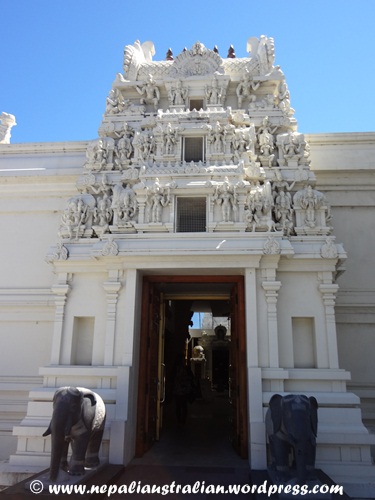
From time to time I feel like I should go to the temple and pay my respect so I drag my husband along for some prayer. Last weekend we managed to go to a temple in Helensburgh called Sri Venkateswara Temple. It is around 45 minutes’ drive from my apartment or an hour from Sydney city center (55km). The temple is built on top of a hilly area 400 feet above sea level. It has four ‘praharam’ (encircling corridors). Sri Venkateswara Temple was built in 1978 by the Indian people in Australia as a South Indian-style Hindu temple.

So far there is no Nepali temple in Sydney but they are planning to build a version of Nepal’s famous Pashupathi in Sydney.

At the temple devotees are supposed to leave their footwear outside and wash their hands and feet before they enter the temple. The temple area inside has small shrines for each of the Gods. There are priests performing rituals at each of the shrines at a pre-determined time.

There is a temple counter inside which provides visitors with more information about temple rituals and prayers.  They also sell puja for $15 which goes towards maintenance of the temple. You get a plate of puja which has Sindoor, flowers, dhup and fruits. Also, you can buy diyo (oil lamp) if you want to light just the diyo.

The temple has deities like Lord Venkateswara, Goddess Mahalakshmi ,Lord Chandramouleeswarar, Goddess Thripurasundari , Lord Ganesh, Lord Subrahmanya , Lord Navagraha, Goddess Durgambika , Lord Rama , Goddess Andal , Lord Krishna, Lord Brahma , Lord Hanuman, Lord Garuda  , Lord Sudharsana , Lord Viswakshena , Lord Dhakshinamurthy and Lord Chandikesa.

I have seen lots of South Indian weddings being performed inside the temple in my previous visits.

I know it doesn’t sound so right but I love to go to this temple because they serve a great Indian food in their canteen during weekends. I always have Masala Dosa (made by stuffing a lightly cooked filling of potatoes, fried onions and spices in a fermented crepe or pancake made from rice batter and black lentils) and Vada (a donut  shaped dish made from lentils and gram flour or potato) . They are so cheap but so yummy. They do sell other South Indian vegetarian dishes as well but those two are my favourite especially with masala tea (spiced Indian style milk tea).

The temple opens 8am – 7pm, week-ends and public holidays; 8.00am to 12.00pm and 4.00pm to 7.00pm on weekdays.

Kumari – The living Goddess

I had this post sitting in my draft box for a while but the article I read in the dailymail online inspired me to finish and post it. Please click here if you want to read it too.

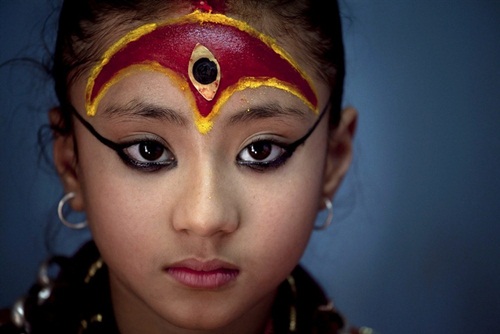
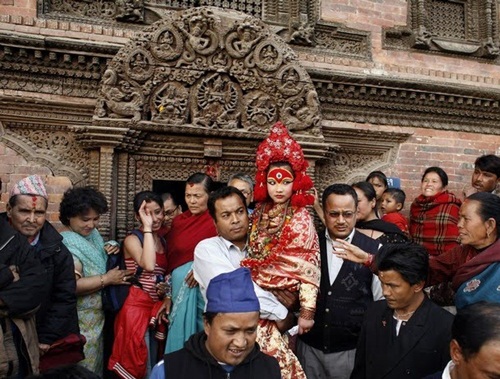
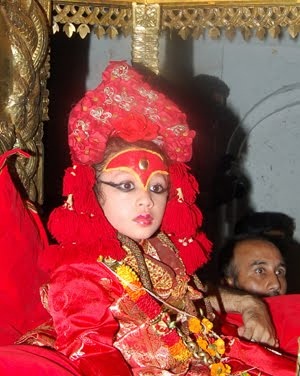
The word kumari literally means virgin in Nepali. Kumari is the only living Goddess in the world worshipped by Hindus and Buddhists in Nepal. The Living Goddesses are young pre-pubescent girls that are considered to be incarnations of the Hindu goddess of power, Kali and Goddess Taleju.

History behind Kumari

For over 300 years now, it is believed that the spirit of the goddess Taleju has been residing in a succession of pre-pubescent virgin girls in this way, and the future of the country has balanced precariously on their pleasure. With a frown they have held back the rains; a single tear from their eye has resulted in floods. An ancient ruler ofNepalis even said to have died after the reigning Kumari fell asleep during an audience with him.

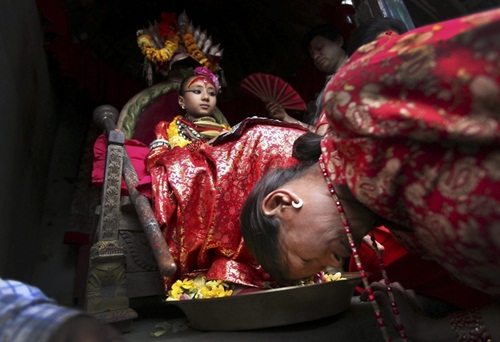
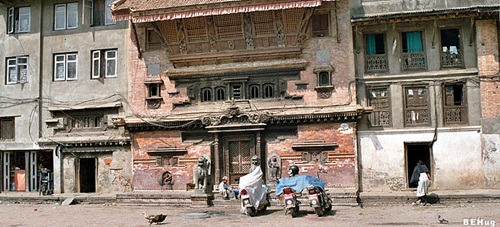
There are 10 Kumaris in Nepal but I have seen the ones from Kathmadu and Patan only. The Kumari from Kathmandu is considered the Royal Kumari and follows a bit different rules than the rest of the Kumaris. The Royal Kumari resides in Kumari Ghar in Kathmadu Durbar Square while the rest of the Kumaries live at home with their parents and family, and go to school as any other normal girl. They have certain ritual duties that they have to perform regularly, but otherwise live a pretty normal life.

Kumari Ghar

How Kumari is chosen?

Young Buddhist girls from, Kathmandu’s Newar community, Shakya or Bajracharya are chosen as “living goddesses”.  Normally it is a privilege to have your daughter contest in this selection process.

These are some features a young girl should have to consider to be chosen as Kumari .

  • Virgin with an unblemished body
  • Body of the Banyan tree
  • Eyebrows like the cow
  • Black straight hair
  • White teeth without any gaps
  • Dark eyes
  • Mona Lisa like smile
  • Sonorous crystal clear voice
  • Long slender arms
  • Delicate and soft hands and feet
  • Thighs like those of a deer
  • Neck like a conch-shell
  • Tongue – small and moist
  • Sexual organs small and well-recessed.

Above all, she should possess 32 lachchins (characteristics). She must have a sense of courage and should not fear a masked man or an animal sacrifice and she must never have lost a drop of blood. Her horoscope must match that of the king (it was so in the past, may be the President’s horoscope is considered now).

During the eighth day of Dashain, called Kal-ratri, the selection process of Kumari begins. The would be Kumari is left in a room with 108 decapitated buffalos laid out in a sea of blood with men wearing horrid masks dancing among them. This is to test the fearlessness of the girl. If the child gets scared and cries, she will be disqualified and the next girl has to go though the process until they find a girl who can smile in that surrounding and enjoy the dance of the masks men.

The Kumari Festival

Every September, during the Indra Jatra festival, the living goddess in all her bejewelled splendor is borne in a palanquin in a religious procession through parts of Kathmandu. It is a grand festivel attended by people in the thousands, who come to see the living goddess and seek her blessings. In keeping with an old tradition, the Kumari also used to bless the King but now she bless the president and prime minister of the country.

Controversy regarding Kumari

Critics say that the tradition violates the child’s human rights and leaves her unprepared for life after retirement.

Here is a documentary by ABC Australia on Kumari.

I’ll let you decide what you want to believe in but for people of Nepal, Kumari is still a Goddess who they respect and bow to. Kumari is the faith of Nepal and they still believe that she is an incarnations of the Hindu goddess of power.

Today, in the name of modernity, some members of the human rights groups along with the government are proposing that the Kumari tradition be abolished for good. Personally, I think Nepal should learn how to make its culture rich and safe instead of abolishing it, because it is centuries long tradition and this need to be kept alive for the future generation so they can learn and know more about it. Seeing the European countries spending millions to preserve their history and culture, it will be sad to see this tradition stopped.