Tag Archives: spirituality

Swayambhunath: Kathmandu, Nepal

Going regularly to a temple is big part of Nepali culture. You will often see people of all age going to a temple early in the mornings. While in Nepal, we tried to go to different temples as well. For us it was more of going to see the place than for religion but if we were to get blessed while we were there then even better :). One of the temples we visited was Swayambhunath, also know was Monkey Temple by tourist in Kathmandu.

One day we were invited for lunch to our aunt’s house, which is near to Swayambhunath, so we decided to visit the temple before we went for lunch. Swayambhunath is an ancient religious complex atop a hill in the Kathmandu Valley, west of Kathmandu city. Even though Swayambhunath is a Buddhist stupa, yet it is equally popular with the Hindu pilgrims as well.

Swayambhu (21)

Legend has it that Kathmandu Valley was once an enormous lake, out of which grew a lotus. The valley came to be known as Swayambhu, meaning “Self-Created.” The name comes from an eternal self-existent flame (svyaṃbhu) over which a stupa was later built.

Swayambhunath is also known as the Monkey Temple as there are holy monkeys living in the north-west parts of the temple. They are holy because Manjushree, the bodhisattva of wisdom and learning was raising the hill which the Swayambhunath Temple stands on. He was supposed to leave his hair short but he made it grow long and so head lice grew on them. It is said that the head lice transformed into these monkeys.

Swayambhu (15)

The Bodhisattva Manjusri had a vision of the lotus at Swayambhu and traveled there to worship it. Seeing that the valley could be a good place for settlement and to make the site more accessible to human pilgrims, Manjusri cut a gorge at Chovar. The water drained out of the lake, leaving the valley in which Kathmandu now lies. The lotus was transformed into a hill and the flower became the Swayambhunath stupa.

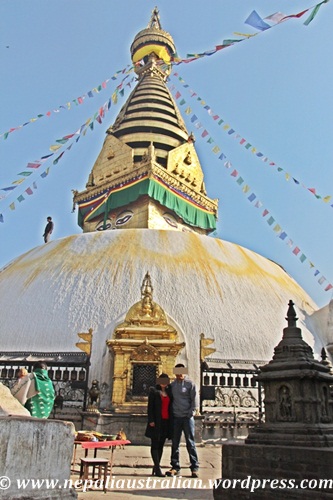
As we were driving to the hill where Swayambhunath stupa is, we could really see how beautiful the temple is.  Around the bend of some roads, the temple comes into full view, and we can see the large Buddha’s eyes, sitting below a golden roof at the peak, keeping watch over the valley.

These large pair of eyes, which represent Wisdom and Compassion, on each of the four sides of the main stupa. Above each pair of eyes is another eye, the third eye. It is said that when Buddha preaches, cosmic rays emanate from the third eye which act as messages to heavenly beings, so that those interested can come down to earth to listen to the Buddha. The hellish beings and beings below the human realm cannot come to earth to listen to the Buddha’s teaching, however, the cosmic rays relieve their suffering when Buddha preaches.

Swayambhu (26)

The dome at the base represents the entire world. When a person awakes (represented by eyes of wisdom and compassion) from the bonds of the world, the person reaches the state of enlightenment. The thirteen pinnacles on the top symbolize that sentient beings have to go through the thirteen stages of spiritual realizations to reach enlightenment or Buddhahood.

Swayambhu (1) Swayambhu (28)

When we reached the gate leading to the steps, there were many monkeys all over the place. Some people were feeding monkeys which were running everywhere. I am scared of monkeys as a monkey had snatched a bag from my hand when I was kid so I went and hid behind my husband and brother when I saw them running towards us. I have to say they are pretty well behaved as they don’t bother you unless you annoy them.
Swayambhu (22)

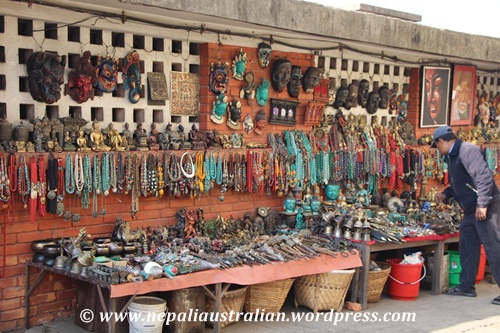
On the side of the gates, there were ladies selling Puja items like candle, flowers and souvenirs.

Swayambhu (31)

There are 365 steps and it is believed that there’s a step for each day of the year, starting at the gate and ending at the stupa. We started to climb the stairs and more monkeys emerged. I stayed close to AS and I was fine. We took a few photos as we climbed up and as we went higher the view got even better. There were many beggars sitting on either sides of the stairs as well and some of them I felt really sorry for as they had small children with them.

Swayambhu (12) Swayambhu (13) Swayambhu (11) Swayambhu (2)

Swayambhu (6) Swayambhu (5)

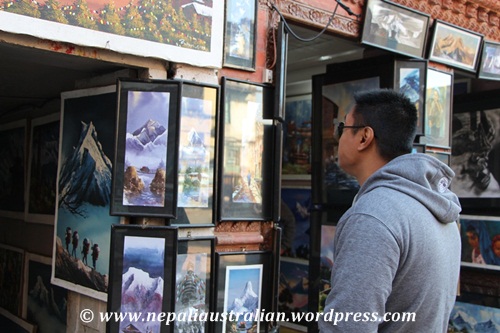
As we reached the top, we could see more monkeys everywhere. There were also stalls selling the usual touristy items. There were many interesting, well-done acrylic paintings of the Himalayas, Nepali hand puppets and other handicrafts.

Swayambhu (7) Swayambhu (30)

Swayambhu (20)

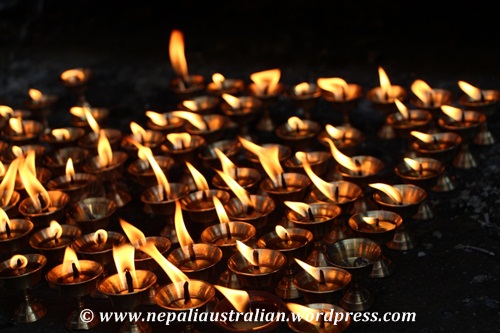
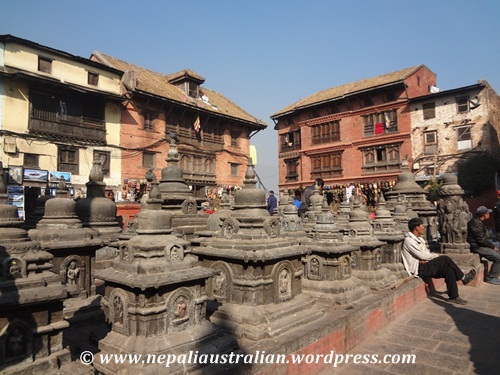
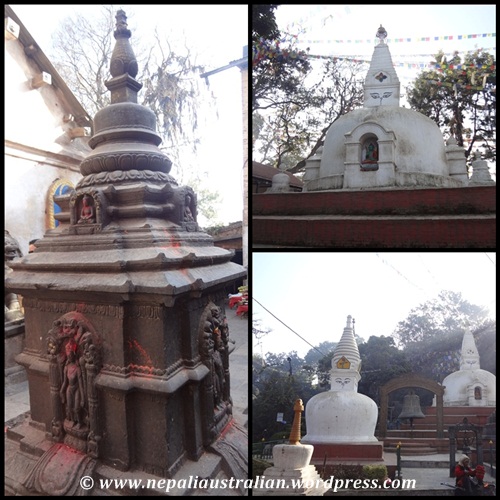
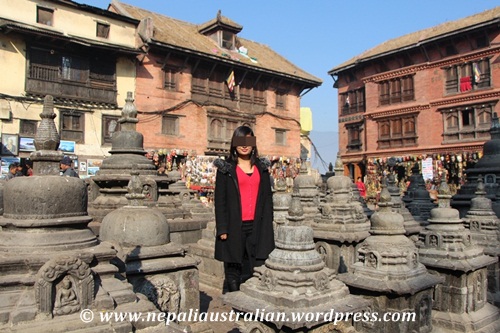
There were also lots of people worshipping in the temple with diyo and candles. I could see prayer flags around the stupa and lots of diyo lit in front of the temple next to stupa. The Swayambhunath complex consists of a stupa, a variety of shrines and temples, some dating back to the Licchavi period as well as a Tibetan monastery, a museum and a library.

Swayambhu (19)

Swayambhu (14)

Swayambhu (29) Swayambhu (25) Swayambhu (3)

 As we walked around the temple, we rotated the prayer wheels. A prayer wheel is a cylindrical “wheel” on a spindle made from metal, wood, stone, leather or coarse cotton. Traditionally, the mantra Om Mani Padme Hum is written in Sanskrit on the outside of the wheel. According to the lineage texts on prayer wheels, prayer wheels are used to accumulate wisdom and merit (good karma) and to purify negativities (bad karma).

Swayambhu (32)

Swayambhu (23)

At one end of the temple area, there is a viewpoint from where you can see the entire Kathmandu. I remember coming there when we were young and we used to try to find our house from there but these days due to population and pollution, you can’t see very far. I felt really sad to see how Kathmandu has changed in the last decade and definitely not for the better in terms of the environment.

Swayambhu (24)

Swayambhu (17)

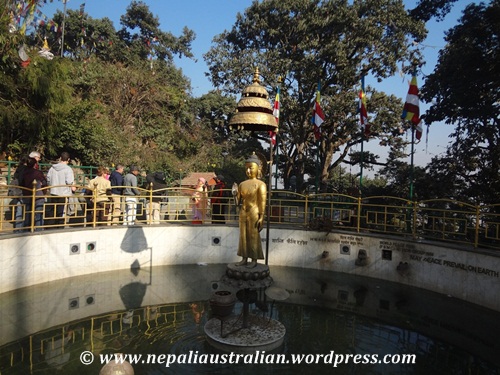
After looking around for a few more minutes, we decided to back down to the car. As you come down, there is a golden statue of Buddha surrounded by water. People were throwing coins into a bucket there and it is believed if your coin enters the bucket, it will bring good luck. My brother and SIL were trying their luck so AS asked me to throw some coins as well. It reminded me of the Trevi fountain when we were in Italy. There were lots of coins lying around the statue there as well but I am sure, the amount of money thrown here is nowhere near the amount in the Trevi fountain.
Swayambhu (9)

After our visit to the temple, we were really hungry so we went to our aunt’s house for lunch 🙂

Swayambhu (10)

Swayambhu (18) Swayambhu (8)

Swayambhu (27)

Asthami : Dashain

Hindus all over Nepal is celebrating Maha Ashtami today, the eighth day of Dashain, by worshipping Goddess Durga.

From ritualistic aspects,  Maha Ashtami holds very important value. On this day, the fiercest embodiment of the Goddess is worshipped. Goddess Durga is believed to bestow peace, longevity and perpetual happiness on her devotees.

People also read the Durga Saptashati scriptures today. The Durga Saptashati is divine recitals consisting of 700 slokas , or verses, divided into three parts – the first relating to Maha Kali, the second to Maha Lakshmi, and the third to Maha Saraswati.

Undertaking Durgasaptashati Patha  is supposed to destroy fear and the devotee is blessed with a benevolent mind. Chanting sacred hymns of Durgasatshati is also believed to eliminate poverty and free the devotee of all the sorrows.

The Goddess Durga is described as Sarvaswarupa (the one which incorporates every kind of form), Sarveshwari (the one who observes the function of all) and is possessed of all the divine powers and attributes. Goddess Durga can destroy all the illnesses and physical maladies of her devotee. 

Goddess Durga has 108 divine names and merely remembering or chanting the holy names can remove all the sufferings and bless the devotee with wealth and prosperity. 

The divine principle of Goddess Durga is supposed to manifest in nine rupas (forms) during the auspicious period of Dashain (the auspicious period of nine divine nights) and these divine forms are deified as Navdurga (nine divine manifestations of Durga) which are ascribed these divine names:

1. Shailputri, 2. Brahmacharini, 3. Chandraghanta, 4. Kushmanda, 5. Skandamata, 6. Katyayani, 7. Kalaratri, 8. Mahagauri, 9. Siddhidatri. 


Devotees throng the various shrines of the goddess in Kathmandu Valley from early morning today to offer prayers and to sacrifice animals like goats and ducks at different temples of Bhagwati including Bhadrakali, Kalikasthan, Guheswori, Mahankaal, Taleju Bhagwati, Daskshinkali, Sankata Shova Bhagwati and Naxal Bhagwati. Blood, symbolic for its fertility, is offered to the Goddesses.

Today, sacrifices and special offerings are made at Dashainghars and Kots as well. The old palace in Basantapur Hanuman Dhoka, is active throughout the night with worships and sacrifices in almost every courtyard. In Dasain Ghar at midnight , a total of 54 buffaloes and 54 goats are sacrificed in observance of the rites. After the offering of the blood, the meat is taken home and cooked as “prasad”, or food blessed by divinity. This food is offered, in tiny leaf plates, to the household Gods, and then distributed amongst the family. Eating this food is thought to be auspicious. Appropriately enough, the night of this day is called Kal Ratri (Black Night). 

While the puja is being carried out great feasts are held in the homes of common people.

People who do not sacrifice animals offer sacrifices of various vegetables and fruits in place of animals.

Some Hindus will also be fasting this day.

In Newari culture, we eat Kuchi Bhwey to mark this day. We were invited for the feast at my cousin house.

It consists of 9 Newari dishes which are

Kuchi bhwey

Holi / Phagu Purnima

Holi is one of the many festivals celebrated by Hindus in Nepal. It is also known as Phagu Purnima which is a festival of colours.

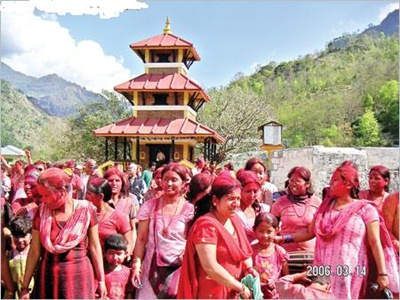
Holi is celebrated in two days in Nepal, today as Phagu Purnima (except in Terai)  and tomorrow in Terai region as Holi.

Chir of Holi

People install  Holi pole, “Chir’, a bamboo pole, fringed with strips of cloth representing good luck charms indicating the arrival of the Holi festival. This Chir pole is erected a week before the Holi festival is celebrated at all the three heritage squares of Nepal namely Kathmandu Durbar Square, Bhakatpur Durbar Square and Patan Durbar Square. Once the erecting is done, people throw red vermillion powder in the air as the symbol to mark the beginning of  Holi, a time for fun and frolic. It is said to symbolize the tree on which lord Krishna hung the milkmaids’ garments while they were bathing. At the end of the festivities the Chir is taken to a bonfire.

Here are some of the legends behind Holi (source: internet)

There is a popular legend behind the installation of Chir. The story is again about the mischievous nature of Lord Krishna who loved to play pranks with the milkmaids or gopis. Playful as he was, it is said that once he seduced all the local girls with his dashing good looks. He then danced with them all and when they were fully engrossed in him, then he thought they were ripe for a tease. He doused them in coloured water and stole all their clothes while they were bathing in the water of river Yamuna. Naughty Krishna then hung their clothes on a tree to bug them. Chir symbolizes that very tree.

Holika gets burnt in the fire

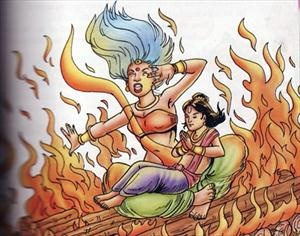
Another myth following Holi, reveals that a fiend named Holika together with her brother, an atheist king by the name of Hiranyakasyapu conspired to kill his son Pralhad because Pralhad was an ardent devotee of Lord Vishnu. But their attempts always failed for Lord Vishnu protects those who love him. Finally, Holika who having received a blessing from Lord Bramha to be immune to fire, jumped in a bonfire with Pralhadin her lap. But Brahma’s blessing could only be used for

Colours for Holi

good purposes and so Holika was consumed by the fire where as Pralhad was saved by the grace of the Gods. Thus, Holi is said to be celebrated to rejoice Holika’s extermination and the traditional bonfires are believed to commemorate her death.

Yet another legend says that there was an Ogress known as Putna. Lord Krishna’s devil uncle Kansa seeked the help of Putna to kill infant Krishna by feeding him poisonous milk.Putna disguised herself as a simple and pious woman and treacherously fed baby Krishna with her poisoned breast. Lord Krishna, however, sucked her blood which revealed the monster behind that pious woman and laid her to death.

On the night before Holi, there is a practice to burn an effigy of Putna – the Ogress who nearly killed Lord Krishna. The tradition is symbolic of victory of divinity over demonic forces. It also shows the end of winter and darkness – as typified by Putna.

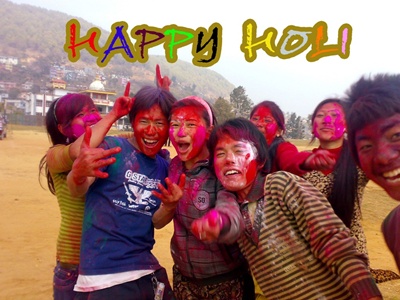
I used to love Holi while growing up. It used to be a few days off from school and we loved playing will lola (water filled balloons) and abeer (colours). It was time of fun and frolic. People spent the day smearing coloured powder all over each other’s faces, throwing coloured water at each other, having parties, and dancing.

Lola

The only drawback of Holi in Kathmandu is for young girls and women who get lola thrown at them everywhere they go. I remember being bombarded by hundreds of balloons from someone’s roof top on the way to school or on the way back. It was days before the real Holi and it used to piss me off. Can you imagine, you are going somewhere and you are drenched with water from these balloons? Also as you know clean water is not available easily in Nepal so I am not even sure, what kind of water they used. I used to fight with these people who spoiled the real meaning of Holi.

If you are in Nepal, hope you are having a great time.

Sydney is celebrating Holi at the end of the month so hoping to go and have some fun then.

Happy Holi everyone !!!

Happy Holi