Monthly Archives: November 2012

Kukur Puja: Tihar

Today is second day of Tihar which is Kukur Puja as well as Laxmi Puja. Some years due to the placement of moon and other planets in the universe, some of the pujas fall on the same day.

I will write about Laxmi Puja tonight after I perform my Laxmi Puja at home.

Kukur Puja

The second day of Tihar is called “Kukur Puja” or “Khicha Puja” (“worship of the dogs”) by the Newars.

A dog is considered as man’s best friend and for Hindus, a dog is also considered as the steed of God “Bhairab” as well as Yama’s (God of death) gate keeper. The Hindu epic Mahabharata talks about the close relationship dogs have enjoyed with mankind. According to it, a dog is said to have accompanied Dharmaraj Yudhisthir on his journey to heaven alive. Dogs howling is considered a bad omen as it means that, they saw “Yama coming to take someone away.

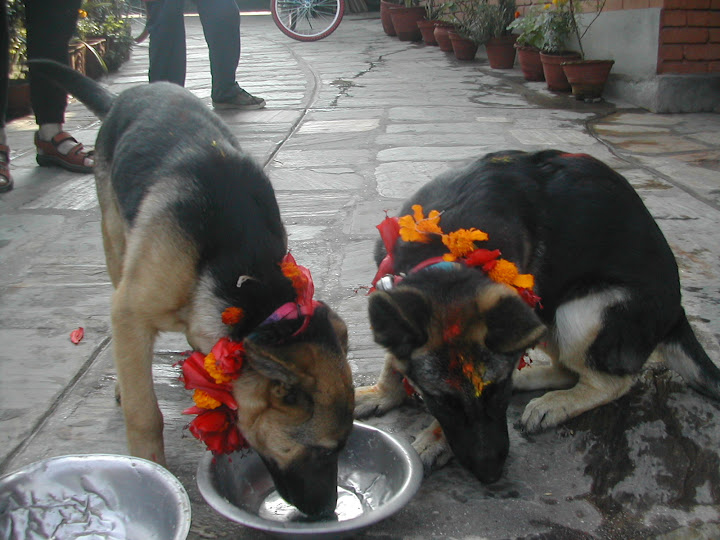
The dog is revered as a faithful and loyal animal which has been in the company of humans since ages. Around the year, dogs help humans by guarding their houses. So on the second day of Tihar, dogs are worshipped by putting tika on their forehead and a garland around their neck. They are offered a delicious meal consisting of meat and other dishes.

People perform the puja on their own dogs if they have one at home; otherwise they perform the puja on stray dogs. On this day you can see many stray dogs with red tika and a flower gland in Nepal.

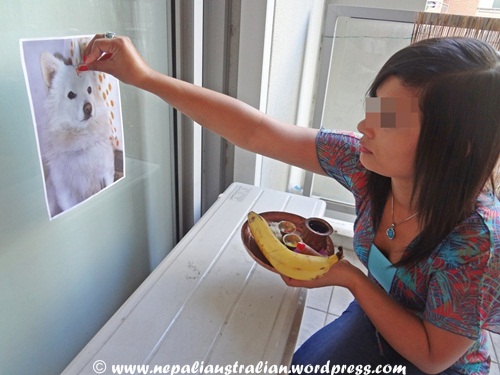
We don’t have a dog here but my parents have a dog called “Chhotu”.

So I performed my Kukur Puja with his photo. I really am grateful to him that he is there to protect and warn my parents against thieves and the likes.


I miss him so much.I hope we will have our own dog one day to do this puja. 🙂

Happy Tihar!!!

Tihar

Today we start the second biggest festival, after Dashain, for Hindu from Nepal.

This festival is celebrated in five days starting from the thirteenth day of the waning moon in October.

 The five days are called

  • Kaag / Kag (crow) Puja
  • Kukur (dog) Puja
  • Laxmi Puja and Gai (cow) Puja
  • Goru Puja,Gobhardan Puja , Mha Puja and Nepal Sambat
  • Bhai Tika

We also refer to Tihar as ‘Panchak Yama’ which literally means ‘The five days of the Lord of the underworld’. We also worship ‘Yamaraj’ in different forms in these five days.

In other words this festival is meant for life and death.The five-day festival is considered to be of great importance as it shows reverence to not just the humans and the Gods, but also to the animals like crow, cow and dog, who maintain an intense relationship with the humans. It is also a time for cooking great meals at home, brothers and sisters shopping for gifts, flying kites, decorating homes and streets, playing cards with friends, resting and relaxing.

Tihar is also called The Festival of Lights, as many diyo or candles or decorative lights are lit both inside and outside the houses to make them bright at night. All the houses are cleaned and decorated with the belief that Goddess Laxmi will enter the house that is clean so people light candles, oil lamps and other lights and thus during the night the entire village or city looks like millions of sparkling gems.

There is a story, which tells why this revelry is celebrated so widely. Once there was a king who was living his last days. His astrologer had told him that a serpent would come and take his life away. The king did not want to die so he asked the astrologer if there was any way to escape death. The king was advised to sleep with lit oil lamps all around his bed and decorate the palace with oil lamps on the day of Laxmi puja so that Goddess Laxmi would talk to the serpent not to take his life. It did happen; the serpent was convinced by Goddess Laxmi. The serpent took the king to Yama Raj and told him that it was not yet the king’s time to come to the underworld. So Yama Raj opened his ledger and in it the kings remaining age was written zero, but the serpent cleverly put seven before zero. Thus the king lived for seventy more years. So form then onwards Tihar is widely celebrated worshipping the lord of the underworld and Goddess Laxmi.

Another mytological reasons behind the celebration  is that Lord Ram return to Ayodhya  after 14 years of exile. He killed Ravan on Nawani of Dashain thus we celebrate Dashain and his home-coming is celebrated in Tihar with lights and flowers.

Tihar is also celebrated by playing Langurburja. It is a game similar to the British dice game “Crown and Anchor”. I remember taking money from dad and running to play a game with my friends. The game is played with 6 dice and a mat. The mat has similar symbols, as the dice, and they are spades, hearts, diamonds, clubs, crown and flag. The player can choose one or more symbols to bet his money on. If he gets at least one die with the same symbol which he bet on, he wins. If he gets two then he wins 2:1, the more he gets on the throw the more money he wins. As a kid we used to play for 25 paisa (equivalent to less than a cent in AUD now) a game. It was more for fun than for the money. I am sure they now play with more money than that.

Adults mostly play cards instead of Langurburja.

It also incorporates the Newar’s New Year, which is called Nepal Sambat.

Last weekend, I went shopping in preparation of the festival and bought lots of sweets, fruits and food.  I couldn’t find all the things I will need for Tihar and I was a bit disappointed in Nepali/Indian grocery in Sydney who are charging arms and legs for things we use for Tihar. Just an example, we need jajanka for Tihar which normally would cost around Rs 10 in Nepal but are selling for $2 (Rs180) each in Sydney!

Kaag Puja / Kag Puja

The first day of Tihar is Kaag / Kag (crow) puja which falls on 12 November this year.

Crow is supposed to be a henchman for Lord Yamaraj. Hindus believe crows to be messengers of good or bad news. With its croaking, it conveys messages like visitor coming to the house etc. It is also believed to be a messenger of Yama, the God of death

To avert grief and death in the family, Hindus worship crows during Kaag / Kag Tihar offering it sweets and various dishes. On this day crows are offered food on a plate made out of leaves in the morning before anyone in the house takes in food. In Nepal a crow is not killed cause as a legend says that one crow had happened to drink the water of life. Thus you can see crows everywhere sitting without the fear of human beings. Once you leave offerings on the balcony, a crow will come and eat the food.

Where there are no crows, any winged animal of the heavens (bird) will enjoy the feast.

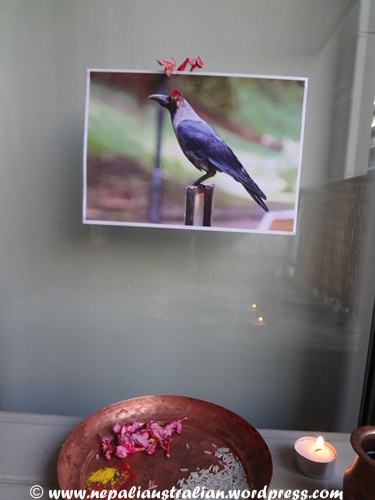
In Australia, I haven’t seen many crows around so I printed a photo of a crow and performed the Puja this morning. I had a shower and then prepared puja. Here are some photos of Kaag / Kag puja from this morning 🙂

Happy Tihar everyone!!!

I will write about other days like Kukur Puja, Gai Puja and Laxmi Puja, Goru Puja , Govardhan Puja , Mha Puja and Nepal Sambat and Bhai Tika as the festival progresses.

Tuscany and Florence: Italy

Tuscany is a region in Italy having an area of about 23,000 square kilometres (8,900 sq mi) and a population of about 3.8 million inhabitants. The regional capital is Florence. Tuscany is known for its landscapes, traditions, history, artistic legacy and its permanent influence on high culture. It is regarded as the birthplace of the Italian Renaissance and has been home to many figures influential in the history of art and science.

Driving from Rome to Tuscany was beautiful. There were lots of farm and greenery. We stopped over in Autogril to have some food. Then we drove all the way to Florence.
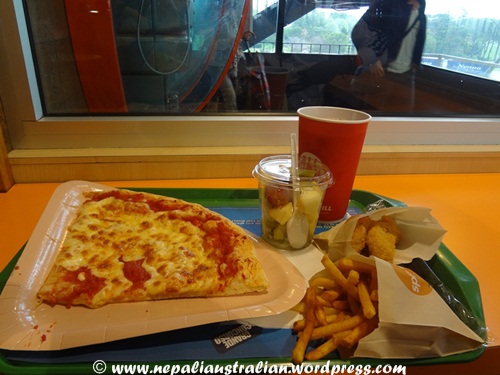
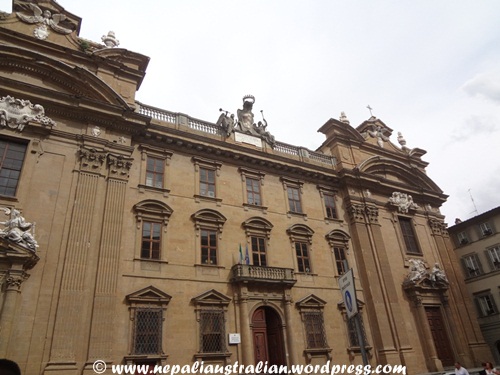
Once we were dropped off in Florence, we walked with our guide to  Piazza Santa Croce.

Piazza Santa Croce

Piazza Santa Croce is one of the main squares of the centre of Florence, Italy. The Basilica of Santa Croce, the largest Franciscan church in the world, overlooks the piazza. The basilica’s most notable features are its sixteen chapels, many of them decorated with frescoes by Giotto and his pupils, and its tombs and cenotaphs. It is the burial place of some illustrious Italians, such as Michelangelo Buonarroti, Niccolò Machiavelli, Enrico Fermi, Galileo Galilei, Ugo Foscolo, Guglielmo Marconi, Luigi Cherubini, Leon Battista Alberti, Vittorio Alfieri, Gioacchino Rossini, Lorenzo Ghiberti, Lorenzo Bartolini, Pier Antonio Micheli, Bartolomeo Cristofori, and Giovanni Gentile. For this reason it also known as the Temple of the Italian Glories (Tempio dell’Itale Glorie). In front of the Basilica there is famous marble statue made by Enrico Pazzi decidated to Dante Alighieri, and formerly places in the middle of the piazza.
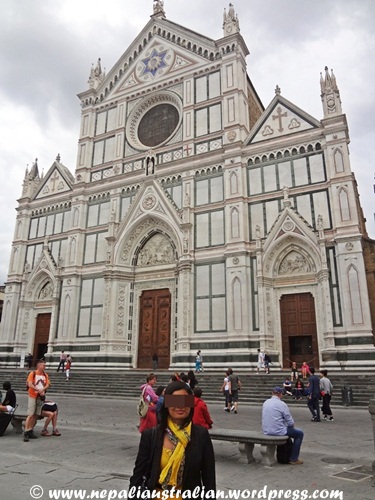
From Piazza we were taken to a leather shop near Piazza Santa Croce where they tried to sell some leather stuffs but to be honest I didn’t like the place as there were pushy salesman trying too hard. So me and my husband got out of the place and enjoyed the outside until everyone was out.

From there we were taken to the tour of Florence with the local guide.

Basilica di Santa Maria del Fiore

It is known as Basilica of Saint Mary of the Flower in english. The Cathedral is gothic in style, and it features a dome that was to become the model and standard for domes which were built in many other major European cities over the next several centuries.  In this era, the dome was a feat of architectural genius by its designer and engineer, Filippo Brunelleschi.  The exterior is covered with marble panels, which are in shades of green, pink, and white , very appropriate Saint Mary of the Flower.
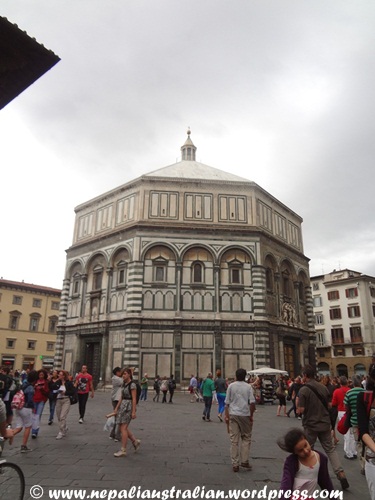
This cathedral is breathtaking on the outside. You could spend hours walking around it marvelling at the intricate work. The interior is also very nice and a lot brighter than I had expected. It’s marble and empty and echoing. Quiet and reflective, as a church should be. But looking up at the fresco will really take one’s breath away. Its definitely a good way to spend some time out of your day in Florence as it seems that relaxing and enjoying yourself is something that you can do in Florence very easily.

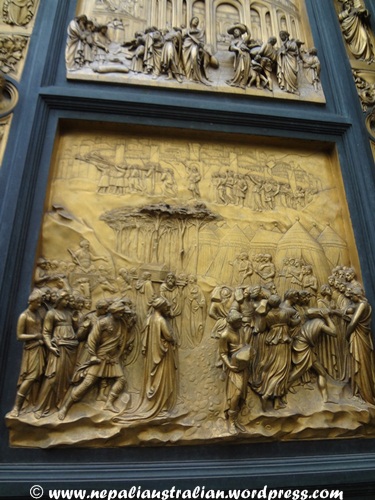
Be sure to see the bronze doors on the Baptistry – known as “The Gates of Paradise” by Ghiberti.  The original doors are in the Duomo Museum and were replaced with replicas due to water damage in a huge flood in the 1960’s, vandalism, and other harmful elements.  These doors took over 27 years to complete, and the ten panels depict the Old Testament.  And, this is hard to imagine, but the doors are the first time perspective was used in an artwork.

It is possible to climb to the top of the dome, but this is not for the faint of heart as it requires a reasonable degree of fitness to manage the spiral staircases, the ladders, and the countless number of steps to reach the top.

For us the last stop was Piazza della Signoria with our guide before we got free time to shop and eat.

Porcellino

Porcellino (Italian “piglet”) is the local Florentine nickname for the bronze fountain of a boar. The fountain figure was sculpted and cast by Baroque master Pietro Tacca (1577 –1640) shortly before 1634.
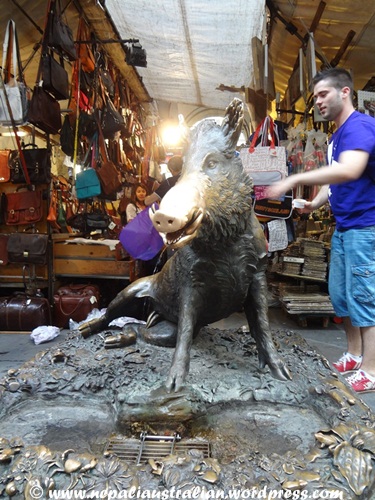
Visitors to Porcellino put a coin into the boar’s gaping jaws, with the intent to let it fall through the underlying grating for good luck, and they rub the boar’s snout to ensure a return to Firenze which has kept the snout in a state of polished sheen while the rest of the boar’s body has patinated to a dull brownish-green.

We also rubbed the snout so hope we will be going to Italy again 🙂

Piazza della Signoria

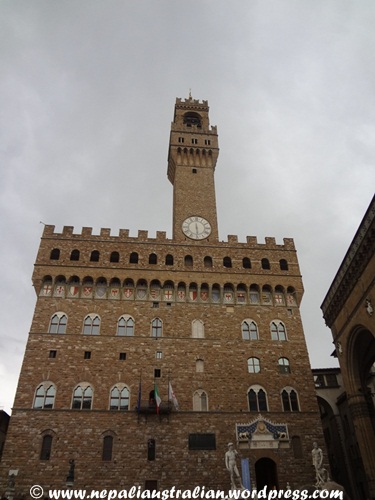
Piazza della Signoria is an L-shaped square in front of the Palazzo Vecchio in Florence, Italy. Florence’s most famous square started to take shape in the mid- to late-13th century when the Guelphs defeated the Ghibellines for control of the city. The piazza’s L shape and the lack of uniformity of its surrounding buildings is the result of the Guelphs leveling many of their rivals’ palazzi. The piazza gets its name from the towering Palazzo Vecchio, whose original name is the Palazzo della Signoria.

Numerous statues designed by some of the most famous Florentine artists decorate the square and the adjacent Loggia dei Lanzi, which serves as an outdoor sculpture gallery. Almost all of the statues located on the square are copies; the originals have been moved indoors, including to the Palazzo Vecchio and the Bargello, for preservation.

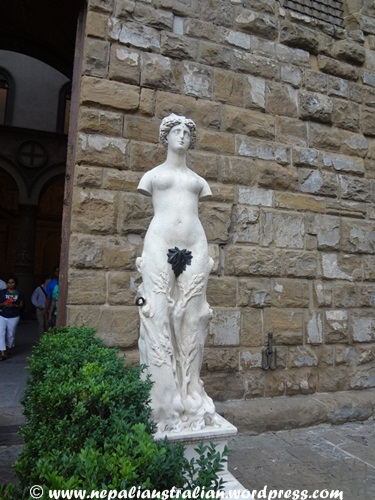
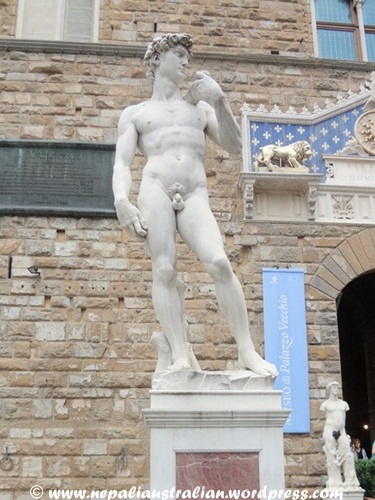
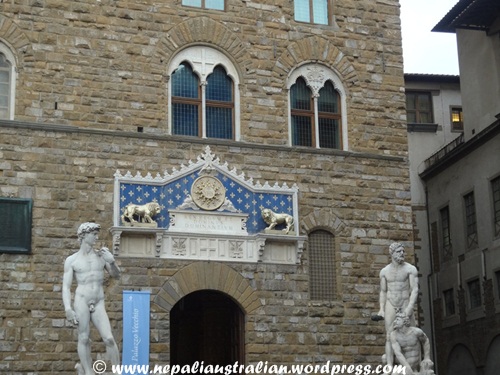
The most famous of the piazza’s sculptures is a copy of Michelangelo’s David (the original is in the Accademia), which stands watch outside the Palazzo Vecchio. Other must-see sculptures on the square include Baccio Bandinelli’s Heracles and Cacus, two statues by Giambologna – the equestrian statue of Grand Duke Cosimo I and Rape of a Sabine – and Cellini’s Perseus and Medusa.  At the center of the piazza is the Neptune Fountain designed by Ammanati.

Palazzo Vecchio

Florence’s City Hall, the Palazzo Vecchio, is one of the most important secular buildings in Florence and one of the city’s top attractions. Palazzo Vecchio was constructed in the late 13th/early 14th century in order to house the government offices for the newly formed Florentine Republic. The architect of the Palazzo Vecchio was Arnolfo di Cambio, the architect of Florence’s Duomo.

Today, the Palazzo Vecchio still contains the office of Florence’s Mayor and the City Council. But most of building is now a museum.

Entrance

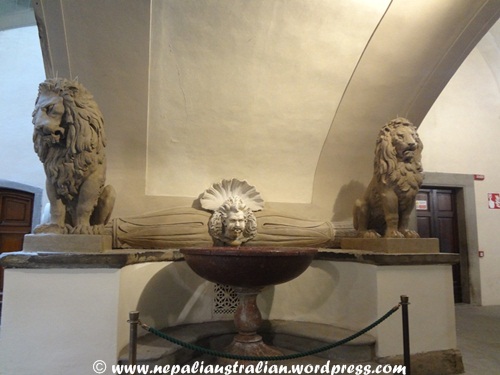
The entrance to the Palazzo Vecchio is flanked by a copy of Michelangelo’s David (the original is in the Accademia) and the statue of Hercules and Cacus by Baccio Bandinelli. Above the door is a gorgeous frontispiece set in a blue background and flanked by two gilded lions.

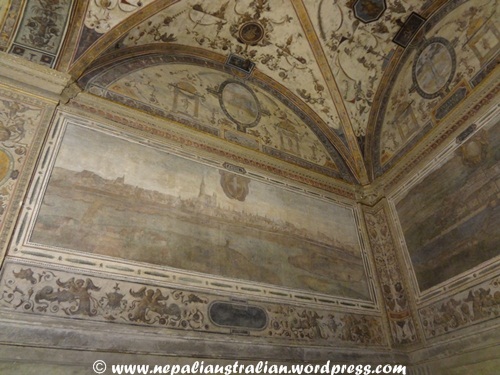
Cortile di Michelozzo: The artist Michelozzo designed the harmonious inner courtyard, which contains arcading set off by gilded columns, a copy of a fountain by Andrea del Verrocchio (the original is inside the palace), and walls painted with several city scenes.

Second Floor

Salone dei Cinquecento: The massive “Room of the Five Hundred” once held the Council of the Five Hundred, a governing body created by Savonarola during his short stint in power. The long room is largely decorated with works by Giorgio Vasari, who orchestrated the redesign of the room in the mid-16th century. It contains an ornate, coffered and painted ceiling, which tells the story of the life of Cosimo I de’ Medici, and, on the walls, gigantic depictions of battle scenes of Florence’s victories over rivals Siena and Pisa.

Leonardo da Vinci and Michelangelo were initially commissioned to produce works for this room, but those frescoes have been “lost.” It is believed that Leonardo’s “Battle of Anghiari” frescos still exist beneath one wall of the room. Michelangelo’s “Battle of Cascina” drawing, which had also been commissioned for this room, was never realized on the walls of the Salone dei Cinquecento, as the master artist was called to Rome to work on the Sistine Chapel before he could begin work in the Palazzo Vecchio. But his statue “Genius of Victory” located in a niche at the southern end of the room is worth a look.
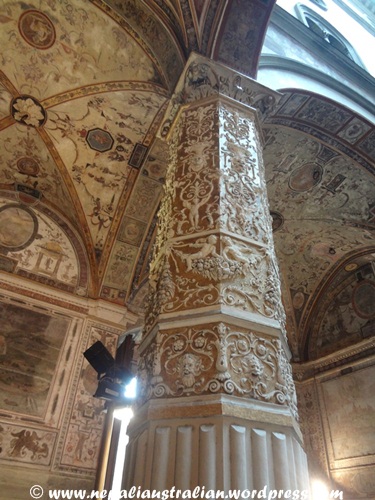
The Studiolo: Vasari designed this sumptuous study for Francesco I de’ Medici, at the time the Grand Duke of Tuscany. The Studiolo is decorated from floor to ceiling with Mannerist paintings by Vasari, Alessandro Allori, Jacopo Coppi, Giovanni Battista Naldini, Santi di Tito, and at least a dozen others.

Third Floor

Loggia del Saturno: This large room contains an ornate ceiling painted by Giovanni Stradano but is most renowned for its sweeping views over the Arno Valley.

The Sala dell’Udienza and the Sala dei Gigli: These two rooms contain some of the Palazzo Vecchio’s oldest elements of interior decoration, including a coffered ceiling by Giuliano da Maiano (in the former) and frescoes of St. Zenobius by Domenico Ghirlandaio in the latter. The stunning Sala dei Gigli (Lily Room) is so called because of the patterned gold-on-blue fleur-de-lys – the symbol of Florence – on the room’s walls. Another treasure in the Sala dei Gigli is Donatello’s statue of Judith and Holofernes.
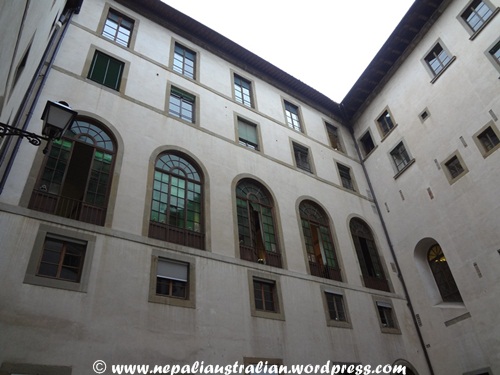
Several other rooms in the Palazzo Vecchio can be visited, including the Quartiere degli Elementi, which was also designed by Vasari; the Sala delle Carte Geographiche, which contains maps and globes; and the Quartiere del Mezzanino (mezzanine), which houses the Charles Loeser collection of paintings from the Middle Ages and Renaissance periods. 

After the tour we stopped to do some shopping and were taken back to the hotel.

Please click here for more photos.
Chicken choila / chhoela / Choila

I learned this recipe from my BIL (K didi’s husband). He is one of the best cooks around us and he loves cooking. I am sure it is true when they say that when you cook with love, it tastes better. He does put lots of time and effort in his cooking as well.

Ingredients

  • 500gm boneless chicken
  • Few stems spring onion
  • 2 small green chilies
  • 1 red onion finely sliced
  • coriander leaves
  • 5 cloves of fresh garlic
  • 2 inch on fresh ginger
  • 1 teaspoon turmeric powder
  • 2 teaspoons chili flakes
  • 1 teaspoon chili powder
  • 5 tablespoons vegetable oil
  • 1 teaspoon fenugreek seeds (Methi )
  • salt to taste

Steps

  • Cut chicken breast into thin layers.
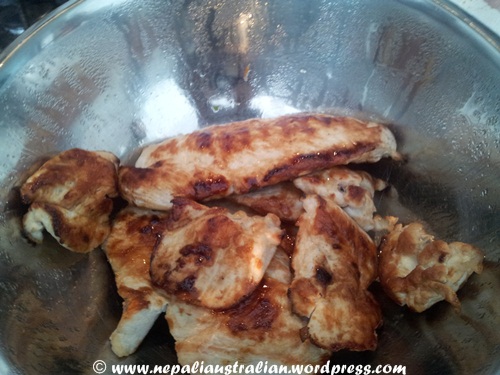
  • Heat the non-stick frying pan and sauté the chicken until cooked.
  • Cook on both side and make sure, the chicken doesn’t get burnt.
  • Once both sides are golden brown, repeat the process with all the chicken.

  • When you are doing this in batches, make sure you cover the cooked chicken in a container so it doesn’t become dry. This will also make the chhoela juicy and tender.
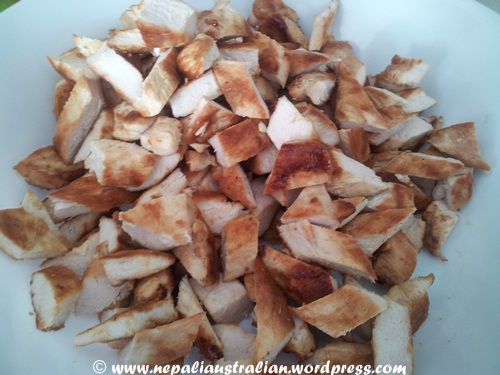
  • Once all the meat is cooked let it cool down for few minutes, slice the chicken into small diagonally into inch size pieces so it looks better for the presentation. Put all the meat in a big bowl.

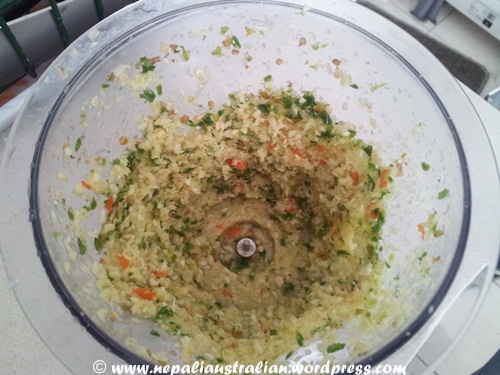
  • Make a paste in the blender using fresh garlic, fresh ginger, fresh chilli and fresh coriander. If you don’t have fresh ginger and garlic, you can used readymade paste but fresh always tastes better.

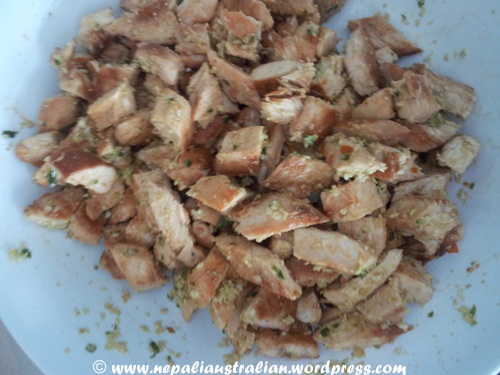
  • Then add this paste along with sliced onions, chili powder, cumin powder, coriander powder, chili flakes, turmeric powder and salt into a bowl with the chicken. Mix it well.

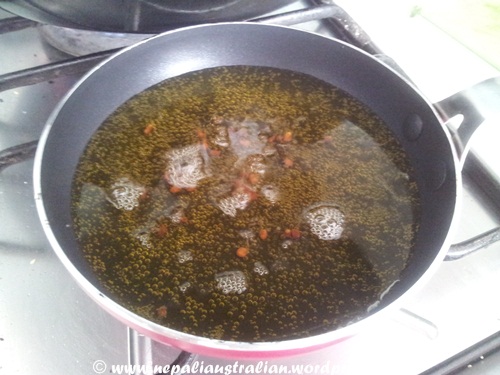
  • Now heat up the pan, add oil and fenugreek seeds and fry it till it turns dark brown. Make sure it doesn’t burn and turn black otherwise it will have a bitter taste.

  • Pour the oil over the chicken and mix it properly.
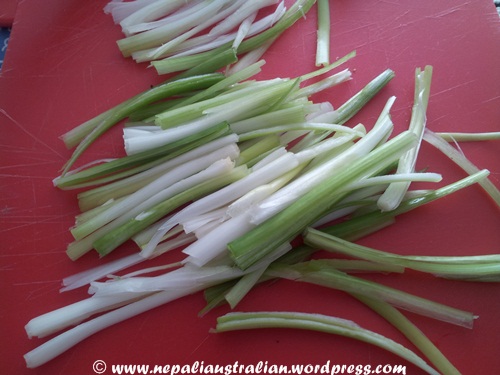
  • Cut the stem of the green onion into about 2 inch long sizes. Slice it into thin slices and add it to the chicken.

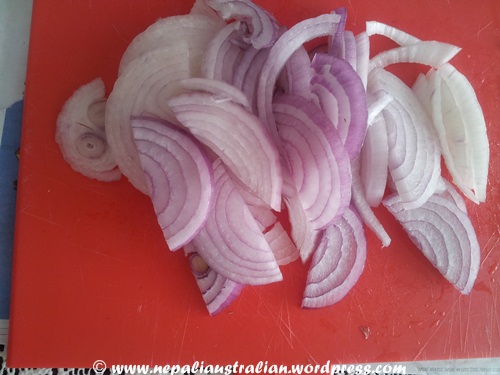
  • Add finely sliced red onion to the chicken

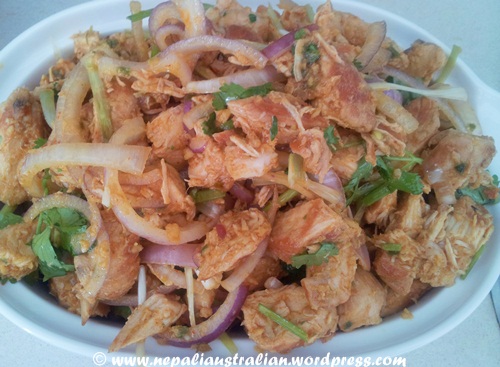
  • Garnish with fresh coriander and Chicken chhoela is ready to be served!

You may also like :

*Chicken chili *Goat curry *Momo

Bhuhari is going to Nepal

Bhuhari means daughter in law in Nepali.

As per our plan, I have booked my flight to go to Kathmandu, Nepal for mid of December.  I know I have been back form my Europe trip not long ago and l haven’t finished blogging about places we visited in Europe but it has been more than a year since we went to Nepal so, it is a perfect time to go again. We will be using our Christmas and New Year break with our annual leave to accommodate this holiday.

We will be going via Bangkok and will be stopping over for 4 days to do some sightseeing , some shopping and meeting AS’s family . We had been to Thailand before but I will be really nice to go again and meet AS’s new niece. She is so cute.

While in Nepali, my nephew will have his Pasni ceremony as well so we have a celebration and a holiday with our family. My brother, sister in law and nephew will be travelling there before us.

I always like to book my holiday in advance so I can look forward to the day and that keeps me going. I am always very eager to go to Nepal and I am this time as well but I have some fear of all the changes I will face.

This time, going to Nepal will be very different for me than ever before. This will be first time for me to go to my home town as a Bhuhari. It may sound strange in western society but life after marriage for Nepali women is very different than here. Lots of things do change which I haven’t really felt because I am in Australia but that will affect me while I am in Nepal.

Every time, I go to Kathmandu, my parents would come to pick me up at the airport but I am not sure what will happen this time. Because I am meant to go to AS’s house (my new home) from the airport. I am thinking to tell my parents not to come to the airport to receive me as I don’t want them to go home without me but instead am planning to go and visit there on the same day in the evening.

I will have to divide my time between two houses this time and I have no idea how I can manage that easily.

Going to Nepal always meant waking up late, not exercising , being spoilt my parents with yummy food , going out and meeting my friends and relatives, a short break to somewhere with my parents and lots of relaxation.

But I am not too sure I can keep this attitude in my new home.  I think it will be very rude to wake up at 8 am and go to kitchen where my MIL will be preparing breakfast for everyone. We have help but still she likes to do lot of things herself. Don’t get me wrong, as I have mentioned before as well, my MIL is very understanding and caring lady but still I can’t be spoilt the way my mum makes me when I am with her.

I am not too sure how I need to plan my days as there are lots of pending invitation we need to attend this time form AS families’ side. As it is a culture in Nepal to invite newlyweds for dinner after their wedding, we got lot of those invitations after our wedding last year. But as we had only 4 days after the wedding, we declined them and told everyone that we will be visiting them next time when we come back to Kathmandu. That means most of our evenings we’ll be dining out either at AS’s relatives’ house or mine’s.

Even in terms of clothing, I don’t know what I will be expected to wear. Like I mentioned in my post before, married women in Nepal dress differently after their wedding. So I am sure I can’t dress however I want. I don’t really mind wearing Sari and Kurta while I am there but it will be mid-winter so I am not too sure how easy it is going to be. Even a year after the wedding I will be a newlywed buhari so I need to learn all the right manners :).

I am sure with all the confusion and anxiety I am still going to have a great time with my two beautiful families, just thinking about it makes me bit anxious sometimes though. There is still a long time till I land in Kathmandu but I can’t wait to write about my experience and Nepal  from Kathmandu  🙂