Category Archives: Nepali Festivals

Teej


Teej is a four-day-long festival in Nepal and each day has its own significance.

  • First day is called ‘Dar Khane Din’, the day to make merry.
  • The Second day is a ‘fasting day’.
  • The third day is purification day
  •  The fourth day is ‘Rishi Panchami’

Dar Khane Din

The first day of Teej is called the “Dar Khane Din”. On this day, women don their finest attire and gather in one place to enjoy the day. Most women wear red saris or dark pink saris with lots of pote , chura and gold jewelleries. Some even apply henna on their hands. They sing, dance and enjoy a grand feast. The fun often goes on till midnight, after which the 24-hour fast begins.

In Sydney, all of us make one dish each and gather in one house. We enjoy music, dance and then have dinner. Even though most of us don’t fast, it is one of the days when we can wear a sari with jewellery and have fun with friends. I really enjoy this day.

The photos  are from last year’s Dar Khane din.

Fasting Day

The second day of Teej is the fasting day. Most of the women don’t eat anything and don’t even drink any water for a whole day while others take liquids and fruit and pray for the long life for their husband.

This is a very important day as this is the day when women fast and dedicated whole day in  pujas and prayers. The holy Pashupatinath temple is the most visited Hindu temple in Nepal during this day and there are be thousands of women in red saris to offer prayers to Lord Shiva.

They gather and offer puja to Lord Shiva and Goddess Parvati with flowers, sweets and coins. Lighting of an oil lamp is very important part of the puja ceremony. It is said that the oil lamp should be kept lit all night to forestall evil.

They also have a good time singing and dancing around the temple. Here are some videos.

In Sydney, we go to Minto Hindu temple and offer our puja. I was really surprised to see so many women in the temple like in Nepal wearing red saris and performing puja.  I don’t fast so after puja I will eat but my friends who fast will continue the fast for the whole day.

Third day

Women get up at dawn and bathe and perform puja once again to the diyo (oil lamp) and the Goddess Parvati.  The most important part of this puja is a banana and holy basil (Tulsi patta) leaf. Only after this puja, women take solid food. This third day of Teej is Ganesh Chaturthi. Women eat Karkalo ko Tarkari with chokho (pure) food made with pure ghee.

Rishi Panchami

The fourth day of the Teej Festival is called Rishi Panchami.

On this day, the seven sages of the Hindu pantheon are worshiped by women in a belief that it will cleanse all sins of the previous year. Womenfolk take a holy bath with red mud found on the roots of the sacred Datiwan bush, along with its leaves. After three hours of rigorous cleansing, they come out purified and absolved from all sins. This act of purification is the final ritual of Teej, after which women are considered absolved from all sins.

Happy Teej everyone!!!

Kushe Aushi (Father’s Day)

Today is Kushe Aushi in Nepal which is Nepali Father’s day.  Kush is a type of holy grass. There is a tradition to bring Kush home on this day of Aunshi (no moon day). Hence, this day is called Kushe Aushi.

 As I have mentioned in many of my posts before, Nepal has a different calendar than the Gregorian calendar. So in Nepal people also celebrate Father’s day on a different day than the western calendar. In Australia, Father’s Day is celebrated on the first Sunday of September every year but in Nepali calendar, it changes every year according to the positions of sun, moon and the planets. It falls on the last day of the dark fortnight of August or early September. This year, it happens to be today, 17 August 2012. It is commonly known as Buwa ko Mukh Herne in Nepal which translates into looking at father’s face.

As I mentioned in my previous post regarding Mother’s day, this day is very similar to Mother’s day and we cook yummy food for dad. Mostly mum will be do the cooking in reality but we give that to dad  :). Like Mother’s day Mum makes Sagun and we give that to dad.

Both my parents don’t have their dad anymore so every father’s day they prepare sida daan for a priest. Sida is a holy mixture of rice grains and other pure food materials and a collection of clothes.. They have a shower first thing in the morning and go to the priest’s house to give sida to the priest. During Kuse Aunse Hindus from all over Nepal, whose fathers have passed away descend on Gokarneswar Madadev Temple to worship and take holy dips, and present offerings. They also do Sraddha or pinda daan to their deceased father and some do Shradha at home or at the near river or at any holy place nearby.

Kuse Aunse , Father's Day

Mythology has placed the Gokarna shrine from prehistoric times when Lord Shiva hid himself in the Pashupatinath forest, disguised as a one-horned golden deer, from the gods and mankind. While he spent his days frolicking, the world suffered so Lord Vishnu, the preserver, Lord Brahma, the creator and Lord Indra, the king of Gods, took matters into their hands and searched for him. Finally a goddess revealed Shiva’s disguise. So when they finally caught the deer by the horn , it burst into fragments and Shiva revealed himself. He asked the other three gods to establish his horn in their three worlds. So, Vishnu installed his section in his abode in Vaikuntha, Indra in his realm in heaven and Brahma enshrined it at the sacred site of Gokarneshwor. The following day the gods and goddesses descended and bathed in Bagmati river, paid homage to Shiva and established the present day tradition of ancestor worship at Gokarna.

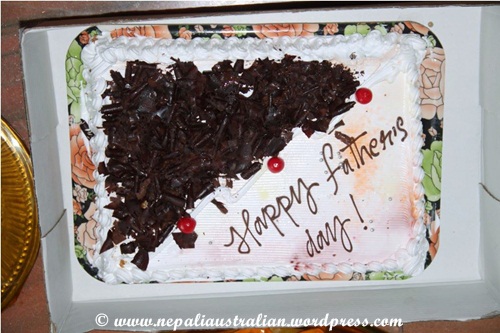
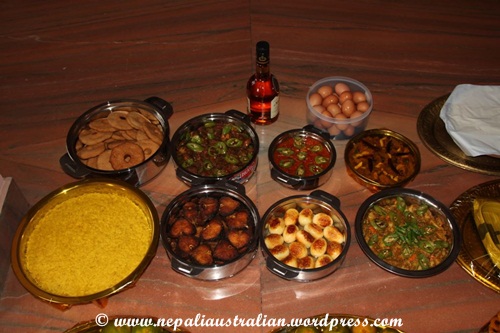
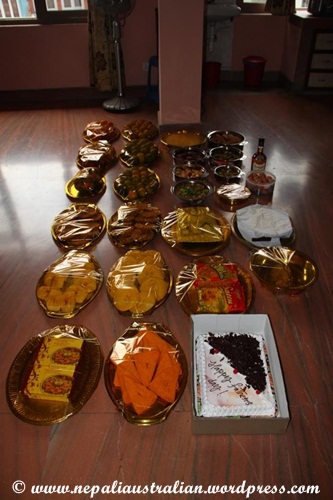
As I have describe in my previous post, in Nepal the first year of marriage is considered to be very important. So during every festival, there are things you are meant to do. This affects how you celebrate Dashain, Tihar, Father’s Day, Mother’s day and more. Last year, I had my first Father’s day after my wedding and my MIL made sure it was a special one for my dad. Here are some photos from the day.

Kuse Aunse , Father's Day

Kuse Aunse , Father's DayKuse Aunse , Father's DayKuse Aunse , Father's DayKuse Aunse , Father's DayThis year I have sent some gifts for my dad already and he will get them today. After work I am going to Skype with him. It is always so nice to see him happy.

So if you haven’t called you dad to wish him, do give him a call and make him smile. And to all the proud dads out there, Happy Father’s Day.

Here is one of the Father-daughter song form Nepali movie. Hope you will like it.

Aama ko Mukh herne / Mata Tirtha Aunshi (Nepali Mother’s day)

As I have mentioned in many of my posts before,Nepal has a different calendar than the Gregorian calendar. So in Nepal people also celebrate Mother’s day on a different day than the western calendar. In Australia, Mother’s Day is the second Sunday of May every year but in Nepali calendar, it changes every year according to the positions of sun, moon and the planets. It falls on the last day of the dark fortnight of April or early May. This year, it happens to be on today,9 May 2013. It is commonly known as Aama ko Mukh here in Nepal. Aama ko Mukh here translates into seeing mother’s face.

When I was still in Nepal, I used to make a nice breakfast and buy my mum a small present which was the only thing that I could afford with my pocket money. My dad used to buy lots of sweets as well so that there were lots of delicacies for her to eat. Mum used to make Sagun (egg, bara) for my grandma(both dad’s mum and her mum) and we used to use the same for her as well.

In Nepal, if the children have left home/ married, they will come with presents and delicacies to spend time with their mother. The entire day is filled with festivities around the country.

Children whose mothers have already passed away visit the place called ‘Mata-Tirtha’ which is situated at about 15 km to the west of Kathmandu or some other holy place elsewhere in Nepal to make offerings to the souls of their departed mothers. Mata means mother; tirtha means a holy place. Thus, this name suggests the holy place for them to visit for making offerings to the deceased mothers once a year.

A religious festival is held at ‘Mata-Tirtha’ on the Mother’s day for a whole day. There is a legendary natural pond at ‘Mata-Tirtha’ where Nepali people pay homage to their deceased mothers. Thousands of people take a quick bath in the water flowing from the nearby stone spouts, and then they go to the holy pond to make offerings to their deceased mothers. They believe that the souls of their mothers come to this natural pond to accept their offerings on this day. Thereafter, they worship Shiva Linga located next to the holy pond.

A legend behind this day goes as follows. Shepherds used to quench their thirst with the cold water from the natural pond at the current day ‘Mata-Tirtha’ when they went to graze their cattle in a nearby forest. One day, one of the shepherds whose mother was already died happened to go to drink water from this pond she saw the image of her dead mother in the clear water of the pond. She was so excited by this that she went to every house in that village to tell them about how she had seen her mother’s image in the pond. Since then Nepali people have believed that they can see the image of their deceased mothers in the water of this holy spring. So, Nepali people from different parts of the country visit this pond on this day hoping to see the image of their departed mother. Thus, this place came to be a holy place for those who have lost their mothers. Also those who cannot go to Mata-Tirtha shower at home or take a quick dip in the water of a holy river early in the morning then offer a platter of sweets, fruits and money to a priest in the memory of their departed mother.

My MIL sent these gifts to my dad last Father’s day on my behalf

As I have describe in my previous post , in Nepal the first year of marriage is considered to be very important. So during every festival, there are things you are meant to do. This affects how you celebrate Dashain, Tihar, Father’s Day, Mother’s day and more. Last year, I had my first Father’s day after the wedding and my MIL made sure it was a special one for my dad. This year, it is my first Mother’s Day after the wedding so it will be really special for my mum. My MIL is doing everything that she can to make sure this day is memorable for my mum. I know a few details about what is going to happen but I will wait for things to happen today and will update in details about my special Mother’s day. Just so excited to Skype with my mum later and receive photos from Nepal afterwards.

So if you haven’t called you mum to wish her, do give her a call and make her smile. And to all the proud moms out there, Happy Mother’s day.

Welcoming Nepali New Year 2069

As most of you already know Nepal follows a different calendar than the Gregorian calendar so Nepali New Year falls on mid April instead of 1st of January. Bikram Sambat or Nepali Calendar or Nepali patro is approximately 56 years and 8½ months ahead of the Gregorian calendar. Unlike Gregorian months, the lengths of Nepali months are not predetermined, and change from year to year, varying from 29 days to 32 days. This year starting today is 1st of Baishak, 2069.

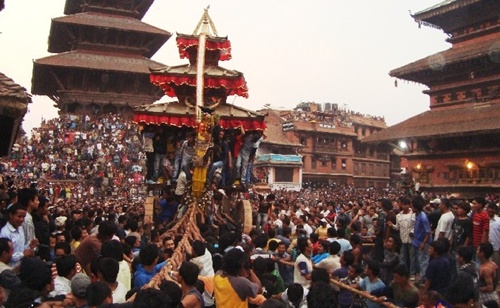
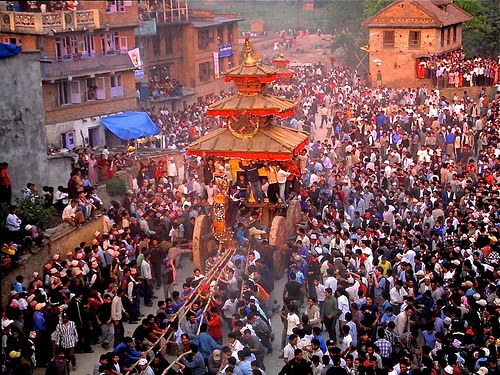
There are lots of celebrations for Nepali New year in Nepal but the most important one is a nine day long Bisket Jatra is held in Bhaktapur, which is 15 km east of Kathmandu. It is considered one of the liveliest cultural festivals in the world.

There is a legend that every man who married a Bhaktapur Princess died the first night. So, one brave prince after marrying the princess, stayed awake on the first night. He saw two serpents come out of the two nostrils of the princess when she was asleep. The prince quickly took out his sword and chopped off the serpents’ head . The next morning, the serpents were displayed on a pole in Bhaktapur and this continues till today in the form of Bisket Jatra Festival.

So on the first day of Bisket Jatra, a symbolic 25 ft Yoshin-Pole is erected in Taumadhi Tole of Bhaktapur.

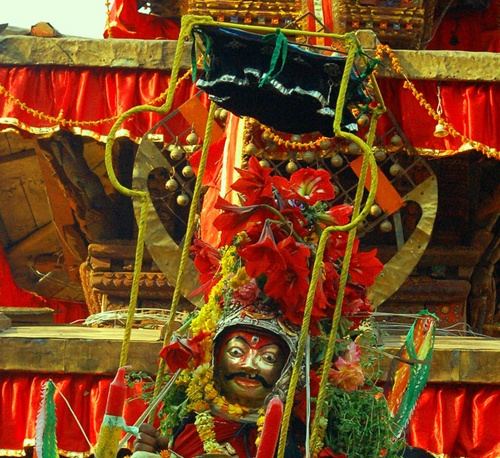
Two days after the erection of the pole, the idols of Lord Bhairab and his female counterpart Bhadrakali are enshrined in two large chariots and pulled through crowds of cheering onlookers. When the chariot reaches a sloping open square, there is a tug-of-war between the inhabitants of the upper and lower parts of the town. The winners of the tug-of-war are considered blessed with good fortune for the coming year.

On the last day of the festival the Bhairav Chariot is parked in Gahi Tole. At midnight the smaller Bhadrakali Chariot is repeatedly rammed against the Bhairav Chariot in a not very subtle display of their explosive copulation.

Variations on the Bisket Jatra theme can also be seen in the villages of Thimi and Bode. In the former there’s a parade of images of the gods, with villagers throwing red powder over them. In the latter, there’s a tongue-piercing ceremony, with one villager spending the day with an iron spike piercing his tongue.

Apart from this, there are lots of dance parties organised in Kathmandu this year to welcome the new year. In Sydney, tomorrow (14 April) we are going to celebrate new year with the Nepali band Nepathya. They are performing live in Sydney’s Town Hall. I’ll update about the event later.

Till then, Happy Nepali New Year 2069 everyone. Have Fun…

Ghoda Jatra

As always, no month passes in Nepal without a festival and today it is Ghoda Jatra (Festival of horses).

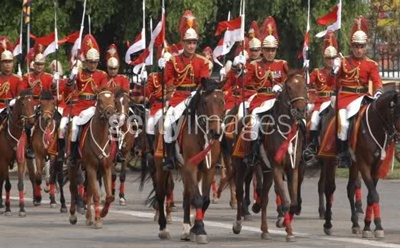
On this day there is a grand parade in Tundikhel, a large open ground in the middle of the city. It is believed that this festival began after the Kathmandu people buried a demon under the soil of Tundikhel show grounds. They say that he may rise again and cause terror in the world if he is not trampled on by horses each year. So every spring, this victory over evil is celebrated by organizing processions and grand display of show jumping, motorcycling feats, parachuting, aerobatics, bicycle races and gymnastics. The president, prime minister, ministers and other official along with, the Living Goddess Kumari, and thousands of people from all over the country observe this Jatra.

After this great function of horse ridding in Kathmandu, there is the Khat Jatra of the eight sister goddesses. The Newars of Kathmandu city observe this day as a family get together or ‘Pachare’. The chariot of Goddesses Lutidevi, Swetakali, Kankeshwori and Bhadrakali is brought to Ason, and the family get together of eight sister goddesses also takes place, as legend says.

At Bal Kumari area, in Patan during Ghode Jatra festival, a horse is intoxicated with spirit and an equally drunk person in a traditional Newari attire rides it and the townspeople chase the intoxicated animal through the streets amidst much cheering and clapping. This race is thought to have been commenced in the olden times by a certain king of Patan to give a better show in comparison to Tundikhel’s parade, as in those days no one from Patan could attend the show in Kathmandu as it was a rival kingdom, a time when Kathmandu valley was divided into three kingdoms of Kathmandu, Patan and Bhaktapur.