Category Archives: Nepal

Learn Nepal Bhasa

Nepal Bhasa is the native language of the Newar people. I cherished learning this language from my grandmother during my childhood. However, after she passed away, speaking Newari became painful, as it constantly reminded me of her absence.

However, after moving to Australia, my proficiency in Nepal Bhasa has waned over the years due to a lack of practice. AS, despite being a Newar, never learned the language and expressed a desire to do so. Motivated by this, I’ve decided to compile some Newari language resources here for anyone interested.

If you spot any mistakes, please don’t hesitate to correct me. I greatly value your feedback and suggestions to improve this page.

Chapter 1

English Nepali Nepal Bhasa
Hello Namastē (नमस्ते)/Namaskāra (नमस्कार Jwa-ja-la paa(ज्वजलपा)
What Kē (के) Chuu (छु)
This Yō (यो) Thwa (थ्व)
That Tyō (त्यो) Wa (वो)
Yes Hō (हो) Khah (ख)
No Hō’ina (होइन) Ma-khu (मखु)
When Kahilē (कहिले) Ga-ba-le (गबले)
Where Kahā (कहा) Ga-na (गन)
Which Kuna (कुन) Gu-gu(गुगु)
Who Ko (को) Su (सु)
Why Kina (किन) Chayaa (छ्या)
Whose Kasakō (कसको) Su-yuu (सुयु)
Whom Kasalāi (कसलाई) Sui-ta (सुइ त)
How (in what way) Kasarī (कसरी) Gay-na (गेनां)
How (to what degree) Kati (कति) Gu-li (गु लि)
Best Wishes Hārdika śubhakāmanā(हार्दिक भकामना) Bhin-tu-naa (भिन्तुना)
Welcome Swāgata cha (स्वागत छ) La-sa-ku-sa (लशकुश)
Thank you Dhanyavāda (धन्यवाद) Su-bhaay (सुभाय्)

Please click here for previous chapters.

Aama ko Mukh herne / Mata Tirtha Aunshi (Nepali Mother’s day)

As I have mentioned in many of my posts before,Nepal has a different calendar than the Gregorian calendar. So in Nepal people also celebrate Mother’s day on a different day than the western calendar. In Australia, Mother’s Day is the second Sunday of May every year but in Nepali calendar, it changes every year according to the positions of sun, moon and the planets. It falls on the last day of the dark fortnight of April or early May. This year, it happens to be on today,9 May 2013. It is commonly known as Aama ko Mukh here in Nepal. Aama ko Mukh here translates into seeing mother’s face.

When I was still in Nepal, I used to make a nice breakfast and buy my mum a small present which was the only thing that I could afford with my pocket money. My dad used to buy lots of sweets as well so that there were lots of delicacies for her to eat. Mum used to make Sagun (egg, bara) for my grandma(both dad’s mum and her mum) and we used to use the same for her as well.

In Nepal, if the children have left home/ married, they will come with presents and delicacies to spend time with their mother. The entire day is filled with festivities around the country.

Children whose mothers have already passed away visit the place called ‘Mata-Tirtha’ which is situated at about 15 km to the west of Kathmandu or some other holy place elsewhere in Nepal to make offerings to the souls of their departed mothers. Mata means mother; tirtha means a holy place. Thus, this name suggests the holy place for them to visit for making offerings to the deceased mothers once a year.

A religious festival is held at ‘Mata-Tirtha’ on the Mother’s day for a whole day. There is a legendary natural pond at ‘Mata-Tirtha’ where Nepali people pay homage to their deceased mothers. Thousands of people take a quick bath in the water flowing from the nearby stone spouts, and then they go to the holy pond to make offerings to their deceased mothers. They believe that the souls of their mothers come to this natural pond to accept their offerings on this day. Thereafter, they worship Shiva Linga located next to the holy pond.

A legend behind this day goes as follows. Shepherds used to quench their thirst with the cold water from the natural pond at the current day ‘Mata-Tirtha’ when they went to graze their cattle in a nearby forest. One day, one of the shepherds whose mother was already died happened to go to drink water from this pond she saw the image of her dead mother in the clear water of the pond. She was so excited by this that she went to every house in that village to tell them about how she had seen her mother’s image in the pond. Since then Nepali people have believed that they can see the image of their deceased mothers in the water of this holy spring. So, Nepali people from different parts of the country visit this pond on this day hoping to see the image of their departed mother. Thus, this place came to be a holy place for those who have lost their mothers. Also those who cannot go to Mata-Tirtha shower at home or take a quick dip in the water of a holy river early in the morning then offer a platter of sweets, fruits and money to a priest in the memory of their departed mother.

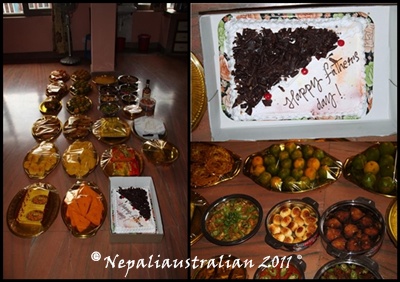
My MIL sent these gifts to my dad last Father’s day on my behalf

As I have describe in my previous post , in Nepal the first year of marriage is considered to be very important. So during every festival, there are things you are meant to do. This affects how you celebrate Dashain, Tihar, Father’s Day, Mother’s day and more. Last year, I had my first Father’s day after the wedding and my MIL made sure it was a special one for my dad. This year, it is my first Mother’s Day after the wedding so it will be really special for my mum. My MIL is doing everything that she can to make sure this day is memorable for my mum. I know a few details about what is going to happen but I will wait for things to happen today and will update in details about my special Mother’s day. Just so excited to Skype with my mum later and receive photos from Nepal afterwards.

So if you haven’t called you mum to wish her, do give her a call and make her smile. And to all the proud moms out there, Happy Mother’s day.

Aloo Chop

Aloo means potatoes in Nepali and this is a simple Nepali vegetarian dish.

Ingredients

  • 5 medium-sized potatoes
  • 2 onions, finely chopped
  • 2 cups gram flour (besan)
  • 3-4 green chillies finely chopped
  • 1 teaspoon of ginger paste
  • 2 teaspoons of  garlic paste
  • 1 lemon (squeezed)
  • 1 teaspoon mustard seeds
  • 1 teaspoon turmeric powder
  • 1/2 teaspoon red chilli powder
  • 1 teaspoon cumin seeds
  • A pinch of  baking soda
  • Salt to taste
  • Oil for deep frying

Method:

  • Boil the potatoes (use pressure cooker if you have one) and make a mash after peeling off the skin.
  • Add chopped onion, chillies, ginger, garlic, lime and salt and mix well. Make sure the mixture is a bit lumpy and not too smooth like a paste.
  • Heat two spoon oil and add the mustard seeds and curry leaves. When the mustard crackles, remove from heat and add to the potato mixture and mix well.

  • In one bowl, make a batter from gram flour and baking soda.
  • Add salt to taste, cumin seeds, red chilli powder and turmeric powder.
  • The batter should not be runny and should remain a bit thick.
  • Divide the potato mixture into equal sized portions, in the size of small egg.  and make a flat disc shape.

  • Dip each disc in the batter and deep fry till golden brown in colour.
  • Serve hot with achar/ketchup

You may also like :

*Momo *Aloo ko achar *Chicken chili

Nepathya rocked Sydney for Nepali New Year

As I mentioned in my last blog, I was planning to celebrate Nepali New Year 2069 with a concert by a Nepali band, Nepathya in Sydney Town Hall.

I don’t want to admit it but may be I am getting older since my wedding, I haven’t been partying and clubbing as I used to. One of the main reasons was that the few times I went out I felt so out-of-place and I couldn’t stand the loud and wild crowd around me. It is a big contrast to the life I used to have before my wedding when I used to go to dance parties at least a few times a month. Anyway, when I heard that Nepathya was coming to Sydney, I told AS and my friends that we have to go and have some fun.

For all who don’t know Nepathya, it is a popular band from Nepal who are known for blending folk melodies into new, youth-friendly pop and rock tune. The band members are Amrit Gurung (Vocals), Suraj Thapa (Keyboards), Subin Shakya (Bass), Nikhil Tuladhar (Drums), Niraj Gurung (Guitar), and Hari Maharjan (Guitar). They were really popular when I was in Nepal in the 90s and are equally popular today as well. Some of their popular songs include Resham, Tal ko Pani , Chekyo Chekyo, Jomsomai Bazaar Ma, Yo Mann ta Mero Nepali Ho etc.

So on Saturday, all of us were ready with our tickets and reached Sydney Town Hall by 6 pm. Just judging by the crowd outside the venue, I knew that it was going to be a very big concert. Sydney Town Hall is an international venue and Lady Gaga had her ‘Monster Ball’ concert there last year. It is the first time that any Nepali events was conducted in an international arena.  I later came to know that more than 2000 tickets were printed for the event and it was all sold out leaving lots of people who came thinking to buy tickets at the door disappointed. No wonder the place felt very crowded as during lady Gaga concert, there were only 800 in the audience.

We waited outside for the venue to be opened as it said in the ticket, the concert will start at 6 pm sharp but to our disappointment, we had to wait another 30 minutes before the door was open. Most of the people were already there so there was a long queue to get in. As I had been to this venue before, I was not worried about being last in the line as I thought we would be standing for the concert so no need to be the first inside. But I was surprised to see the sitting arrangements. There were chairs everywhere. When we got inside, the show had already started with local artists performing some songs. As we had gone in a group, it was really hard to find place in one row with 10 empty seats. Also it was already dark inside so we had to split with friends and try to get a sit wherever we could. Some of my friends were in the middle of the hall while me and rest of my friends were at back of the room. The worst part of this sitting arrangement is that people were walking in and out all the time and as we sat in behind the corridor, my view was constantly blocked. On top of that, as there were not so many empty seats left, people were putting their friends on their laps which blocked my view permanently. I was really disappointed thinking that I couldn’t enjoy the concert.

I would have preferred numbered sitting, if the organisers were planning to have chairs, so people who went in a group could sit together, if they bought tickets together like in any international event. Anyway, there were more dances by local artist on the stage and we were frantically searching for another area to enjoy Nepathya. Unfortunately, everywhere we looked it was full and there were lots of people who couldn’t find a seat and were just wandering around or standing next to their friends. At 8 pm, they promised, Nepathya would come on stage but due to some technical difficulties, they played videos of Nepathya’s songs on the big screen for a while instead. By this time I almost gave up hope  to enjoy this concert as the guys in front of us kept standing and blocking the view even after we have told them not to stand there. Not only couldn’t I see the stage now, I could hardly see the big screen as well. On top of that, as the town hall does not have sound absorbers as it was not built for a concert, the sound bouncing off the walls was really irritating.

I felt really luck when my friends who were sitting in the middle of the venue came and told us that there are a few empty seats around them. I was overjoyed and went to join them with the rest of my friends and it was the perfect timing as Nepathya just came on stage.
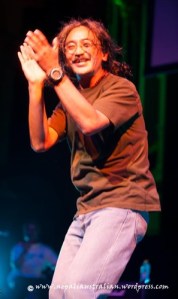
Once Nepathya took the stage, everyone around us started to stand and we did as well but it wasn’t a problem since from that side of the venue, I could still see the stage. Rest of the evening went smoothly and I really enjoyed the whole show.

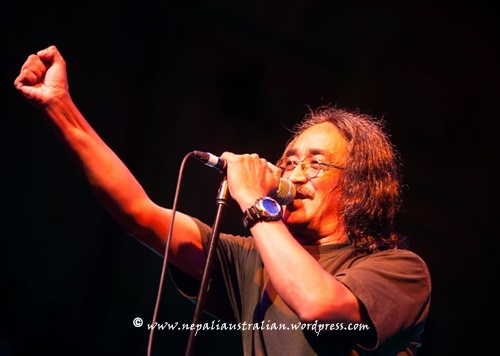
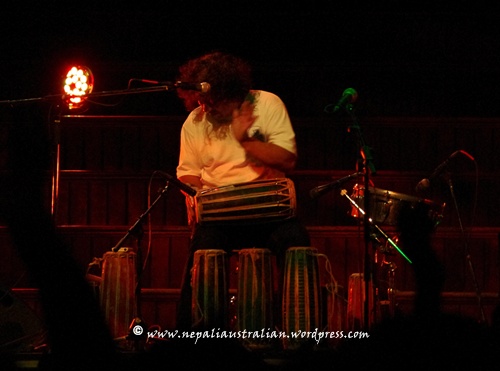
Amrit Gurung was such a great performer and kept everyone captivated for more than 2 hours straight. When he sang ‘Yo mann ta mero Nepali ho’ (This heart o’ mine is still Nepali), there was not a single person in the hall who wasn’t singing along. He sang a few songs that I haven’t heard before (must be new) but still the melody was so good that I enjoyed them all. When he sang ‘Resham’, the crowd were dancing and the audience got really loud and crazy. Overall, Amrit Gurug proved why they have been in this business for so long and still successful. The connection they made with the audience was undeniable. The guys who played  the maadal (Nepali drum) and guitar did a great job as well.

Making it clear to the crowd just how much he loves Nepal, Amrit Gurung at one stage draped a Nepali flag, that was given by the audience, around his shoulders. He delivered a few really heart touching words for people living abroad as well. One of the ones I really liked was

Mero desh lai padhe lekhako hoina safa hreedhya bhayako manche Ko jarurat cha. Matribhumi ko pukar sunidine bhitri kanbhayako maanish chahiyeko cha tashaile saknu huncha bhene Nepal farkinush haiiiiiiiiiiiiiiiiiiiiiiiiiiiiiii” –Amrit Gurung

 (Translation: My country doesn’t need scholars but it needs people who have a clean heart, one who can hear the country’s pleadings, so if you can, please come back to Nepal.)

I also got to know that he was involved with a lot of charities in Nepal where they look after poor and needy families. What an awesome human being. Going to a concert like these always draws me back toward Nepal and good people like him make me feel good about this world. I am still hopeful that things will get better in Nepal one day (hopefully soon) and we should always support people who are thinking of the betterment of Nepal in every way.
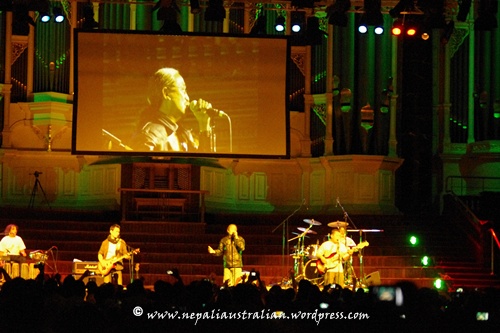
The organisers did a great job organising this event in such a big scale and was even proudly saying that it was a historical moment in Sydney for Nepalese people but I will definitely hope that they will be more organised in the future so that everyone one can enjoy the show without getting stressed out. Just one suggestion to the organisers for future events, if you are going to have seating arrangements, please number it .It makes everyone’s life easier.

Welcoming Nepali New Year 2069

As most of you already know Nepal follows a different calendar than the Gregorian calendar so Nepali New Year falls on mid April instead of 1st of January. Bikram Sambat or Nepali Calendar or Nepali patro is approximately 56 years and 8½ months ahead of the Gregorian calendar. Unlike Gregorian months, the lengths of Nepali months are not predetermined, and change from year to year, varying from 29 days to 32 days. This year starting today is 1st of Baishak, 2069.

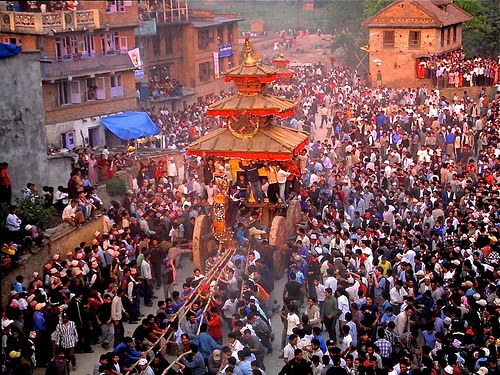
There are lots of celebrations for Nepali New year in Nepal but the most important one is a nine day long Bisket Jatra is held in Bhaktapur, which is 15 km east of Kathmandu. It is considered one of the liveliest cultural festivals in the world.

There is a legend that every man who married a Bhaktapur Princess died the first night. So, one brave prince after marrying the princess, stayed awake on the first night. He saw two serpents come out of the two nostrils of the princess when she was asleep. The prince quickly took out his sword and chopped off the serpents’ head . The next morning, the serpents were displayed on a pole in Bhaktapur and this continues till today in the form of Bisket Jatra Festival.

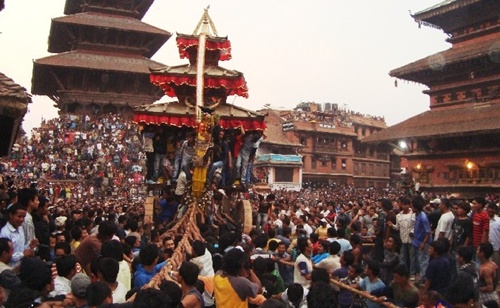
So on the first day of Bisket Jatra, a symbolic 25 ft Yoshin-Pole is erected in Taumadhi Tole of Bhaktapur.

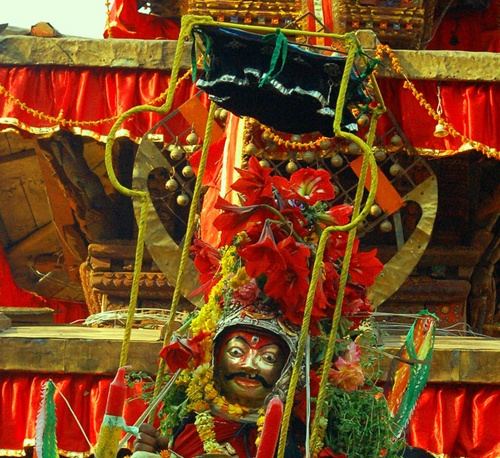
Two days after the erection of the pole, the idols of Lord Bhairab and his female counterpart Bhadrakali are enshrined in two large chariots and pulled through crowds of cheering onlookers. When the chariot reaches a sloping open square, there is a tug-of-war between the inhabitants of the upper and lower parts of the town. The winners of the tug-of-war are considered blessed with good fortune for the coming year.

On the last day of the festival the Bhairav Chariot is parked in Gahi Tole. At midnight the smaller Bhadrakali Chariot is repeatedly rammed against the Bhairav Chariot in a not very subtle display of their explosive copulation.

Variations on the Bisket Jatra theme can also be seen in the villages of Thimi and Bode. In the former there’s a parade of images of the gods, with villagers throwing red powder over them. In the latter, there’s a tongue-piercing ceremony, with one villager spending the day with an iron spike piercing his tongue.

Apart from this, there are lots of dance parties organised in Kathmandu this year to welcome the new year. In Sydney, tomorrow (14 April) we are going to celebrate new year with the Nepali band Nepathya. They are performing live in Sydney’s Town Hall. I’ll update about the event later.

Till then, Happy Nepali New Year 2069 everyone. Have Fun…