Vijaya Dashami : Dashain

The tenth day of Dashain is called ‘Dashami’. It is also known as Vijaya Dashami and it was the day Goddess Durga was victorious over the demons. It was also the day Lord Rama won the war with the demon king, Ravana, supposedly through the Durga’s blessing. The day is, hence, symbolic of good triumphing over evil. It is on this day that the jamara is finally utilized; the elders put tika (a mixture of rice, yogurt and vermilion) and Jamara on the forehead of younger relatives to bless them with abundance in the upcoming years.  The red Tika also symbolizes the blood that ties the family together.

Elders give “Dakshina”, a small amount of money, to younger relatives at this time. People visit elders in their home to receive blessings. The importance of Dashain also lies in the fact that on this day family members from far off and distant relatives come for a visit as well as to receive tika from the head of the family.

This continues to be observed for five days till the full moon during which period families and relatives visit each other to exchange gifts and greetings. This ritual of taking tika from all the elder relatives (even distant relatives) helps in the renewal of the community ties. This is one reason why the festival is celebrated with so much of vigor and enthusiasm.

Before the collapse of the monarchy system in Nepal, thousands of people ranging from the ministers, diplomats to the general public used to gather in the old royal palace to take the tika and blessing from the king, who is considered to be the incarnation of Lord Vishnu. However after the collapse of the monarchy system the president of the country who is considered the head of the state has been continuing the tradition by offering the tika to the general public and ministers.

A lot of feasting takes place in the meantime and everyone makes merry. Dramas of Goddess Durga fighting demons are also frequently staged.

The last day of the festival which lies on the full moon day is called ‘Kojagrata’ Purnima. The literal meaning of Kojagrata is ‘one who is awake’. On this day Goddess Laxmi who is believed to be the goddess of wealth is worshiped as it believed that goddess Laxmi descends on earth and showers whoever is awake all night with wealth and prosperity. As a result, many spend the night playing cards and doing other activities. The festival concludes when the remaining jamara and the holy vessel are disposed of by bringing them to the river.

This morning, I woke up, performed puja at home with Jamara and then went to my brother’s place where all my family gathered to celebrate Dashain. It was fun filled affair with lots of food, playing cards and having Tika ceremony.

P.S. I am so happy to share that my Jamara grew really well this year. It became longer than last year.  🙂 Here are some photos.

Nawami: Dashain

Today is Nawami (Ninth) day, a day before the Vijaya Dashami. Sacrifices continue throughout Nawami in Nepal. Today god Vishwas Karma, the God of creativity is worshiped. All artisans, craftsmen, tradesmen worship their tools, equipment and vehicles like cars, bikes, trucks etc. for protection against accidents during the year. Animals are also sacrificed to cars, trucks etc. to get the blessing from goddess Durga for protection for vehicles and their occupants against accidents during the year.

The Taleju temple at Hanuman Dhoka is opened for the public only once a year on this day. Thousands of people go and pay their respect to the goddess. Temples of the goddess are filled with people from dawn till dusk. There are local processions – local bands play music and a feast is organized – in the Taleju Bhawani Temple in Hanuman Dhoka Palace premises.

Today also the official military sacrifices are held in the ‘Kot’ courtyard at Hanuman Dhoka. The government allows foreigners to witness this function so hundreds of tourists and diplomats eagerly gather here.

Animals, mostly buffaloes are slaughtered by the hundreds to honour Durga the goddess of victory to seek her blessing. Military bands play war tunes, guns boom and officers with beautifully decorated medals in full uniform are present there. When the function ends the courtyard is filled ankle deep with blood from the sacrifices.

Kumari, the living goddess, also blesses the public on this day from her residence at Kumari Bahal.

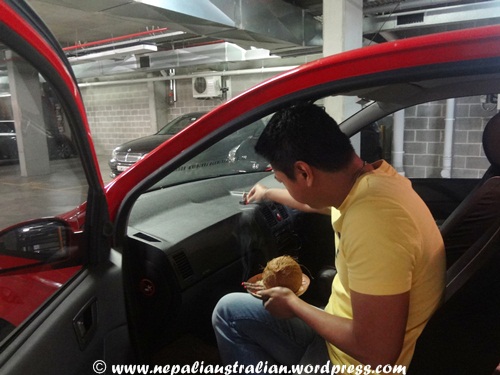
This morning we performed car puja as well. I am sure in Nepal, it is performed in a bigger scale but if you are not in Nepal and want to perform the puja, I am sharing how I did it here.

How to perform car puja:

  • Make sure the vehicle is clean.

  • Take your shoe off before puja.
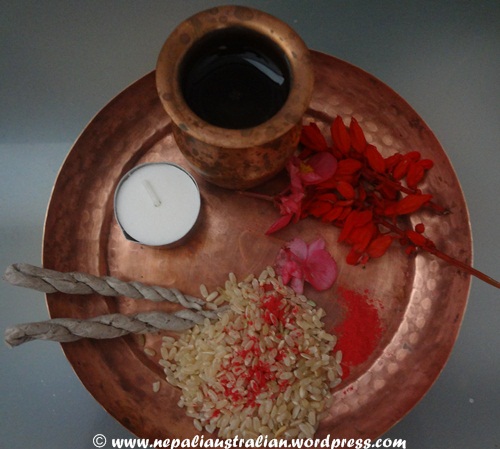
  • Prepare puja thali with sindoor, rice, flower, dhuup, batti, fruits and any other puja saman you have.

  • Also prepare an ankura (vessel) with water. If you don’t have a ankura then use a glass/tumbler.
  • Start the puja by sprinkling water in front of the car and its four wheels.

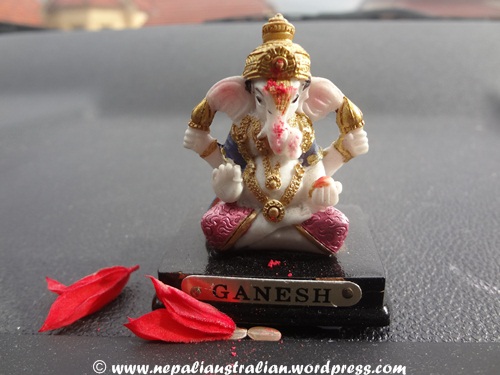
  • If you have any idol of a god inside the car, perform the puja inside first by putting sindoor, tika and flower on the idol.

  • I have an idol of Lord Ganesh inside our car.

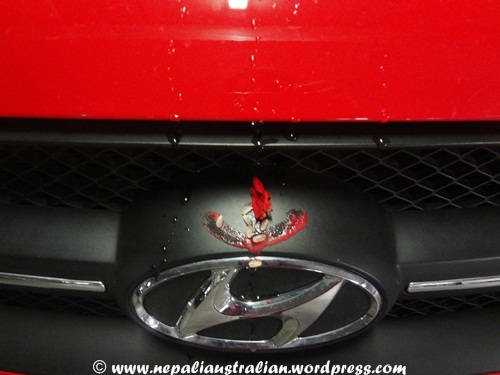
  • In front of the car use sindoor to make a half moon by using the third finger of right hand and put tika and flower. Also do the same on all four wheels of the car.

  • Now light the batti (I used tea light candle) and dhuup and show it to the God inside the car, the front of the car and move to all the wheels by circling  them around three times in a clockwise direction.

  • Normally animals are sacrificed during the Puja and the vehicles are given their fill of blood but we used a hard shelled coconut instead.
  • Crack the coconut in front of the car on the floor

  • Sprinkle the coconut water in front of the car as well as all wheels.

  • The coconut is kept as prasad (holy food offering given to God during pujas) and eaten later.

  • In Nepal they also put mala (flower garland) in front of the car.
  • The puja is finished.

Asthami : Dashain

Hindus all over Nepal is celebrating Maha Ashtami today, the eighth day of Dashain, by worshipping Goddess Durga.

From ritualistic aspects,  Maha Ashtami holds very important value. On this day, the fiercest embodiment of the Goddess is worshipped. Goddess Durga is believed to bestow peace, longevity and perpetual happiness on her devotees.

People also read the Durga Saptashati scriptures today. The Durga Saptashati is divine recitals consisting of 700 slokas , or verses, divided into three parts – the first relating to Maha Kali, the second to Maha Lakshmi, and the third to Maha Saraswati.

Undertaking Durgasaptashati Patha  is supposed to destroy fear and the devotee is blessed with a benevolent mind. Chanting sacred hymns of Durgasatshati is also believed to eliminate poverty and free the devotee of all the sorrows.

The Goddess Durga is described as Sarvaswarupa (the one which incorporates every kind of form), Sarveshwari (the one who observes the function of all) and is possessed of all the divine powers and attributes. Goddess Durga can destroy all the illnesses and physical maladies of her devotee. 

Goddess Durga has 108 divine names and merely remembering or chanting the holy names can remove all the sufferings and bless the devotee with wealth and prosperity. 

The divine principle of Goddess Durga is supposed to manifest in nine rupas (forms) during the auspicious period of Dashain (the auspicious period of nine divine nights) and these divine forms are deified as Navdurga (nine divine manifestations of Durga) which are ascribed these divine names:

1. Shailputri, 2. Brahmacharini, 3. Chandraghanta, 4. Kushmanda, 5. Skandamata, 6. Katyayani, 7. Kalaratri, 8. Mahagauri, 9. Siddhidatri. 


Devotees throng the various shrines of the goddess in Kathmandu Valley from early morning today to offer prayers and to sacrifice animals like goats and ducks at different temples of Bhagwati including Bhadrakali, Kalikasthan, Guheswori, Mahankaal, Taleju Bhagwati, Daskshinkali, Sankata Shova Bhagwati and Naxal Bhagwati. Blood, symbolic for its fertility, is offered to the Goddesses.

Today, sacrifices and special offerings are made at Dashainghars and Kots as well. The old palace in Basantapur Hanuman Dhoka, is active throughout the night with worships and sacrifices in almost every courtyard. In Dasain Ghar at midnight , a total of 54 buffaloes and 54 goats are sacrificed in observance of the rites. After the offering of the blood, the meat is taken home and cooked as “prasad”, or food blessed by divinity. This food is offered, in tiny leaf plates, to the household Gods, and then distributed amongst the family. Eating this food is thought to be auspicious. Appropriately enough, the night of this day is called Kal Ratri (Black Night). 

While the puja is being carried out great feasts are held in the homes of common people.

People who do not sacrifice animals offer sacrifices of various vegetables and fruits in place of animals.

Some Hindus will also be fasting this day.

In Newari culture, we eat Kuchi Bhwey to mark this day. We were invited for the feast at my cousin house.

It consists of 9 Newari dishes which are

Kuchi bhwey

Fulpati: Dashain

After Ghatasthapana, the next major excitement arrives with Fulpati, also known as Saptami, which is the seventh day of the festival. Today is Fulpati. Phool(Ful) means flower and pati means leaves and plants in Nepali. FulPati literally means flowers, leaves and plants.

On this day, in the past when the Nepal was ruled by a king, the jamara to be used by the royal family was brought from Gorkha Palace, their ancestral house. The Fulpati (jamara and the other items that are necessary for tika) is brought after a three day walk from Gorkha district which is about a hundred and sixty nine kilometres away from the valley of Kathmandu. A parade is held at Tundikhel ground in Kathmandu.


However, since 2008 when the monarchy was abolished, the two-century old tradition was changed so that the holy offering of Fulpati goes to the residence of the Prime Minister. The Prime Minister has taken over the king’s social and religious roles after the fall of the royal government. The Fulpati is brought from Gorkha to Dhading district from where six Brahmins carried it to Jamal. From Jamal, the Fulpati filled with holy water, banana stalks, jamara and sugarcane tied with red cloth to be offered to Goddess Durga, is carried by Bhramans on a decorated palanquin under a gold tipped and embroidered umbrella to the Dashain Ghar in Hanuman Dhoka. The Gurujyuko Platoon, the Nepal army, Nepal police, and high-ranking officials of Armed Police and civil service, band music, and panchebaja bands also join the Fulpati parade. While the sacred items are being placed in Hanuman Dhoka palace, there is a majestic display of the Nepalese Army along with a celebratory firing of weapons that continues for ten to fifteen minutes honouring Fulpati. Army parade in Tundikhel is watched by the President, Prime Minister and other high level dignitaries in conventional formal dress.

All government as well as private offices close down from today encouraging people to go back to their respective ancestral homes and receive blessings from Durga Bhawani as well as their elders.

According to historian Prakash Darnal, the Fulpati celebration was started during the rule of Late King Prithivi Narayan Shah, after he united the small kingdoms into one Nepal.

Though Dashain begins with Ghatasthapana, the festival gets special flavour from the day of Fulpati.

As there is not much happening in Sydney for Fulpathi, we just gather in my house and had Samay Baji. This is a newari style Bhoj that we have in Nepal during Dashain. I will write details about the Samay Baji in my next post. This it what it looks like.

The festival will continue with Maha Asthami on Monday, Nawami on Tuesday and Dashami on Wednesday.

What would you do if a STRANGER follows you trying to make conversation?

Normally I go for 30 – 40 minutes’ walk during my lunch break. I think I have to stop that soon as it is getting very hot here but I really enjoy it as it gives me some fresh air. Otherwise I would be sitting on my desk all day long. Mostly I go to walk in the park near my office or sometimes I go to shopping center  I always take my phone with me and listen to music with my earphones plugged in.

Anyway on one of these walks last week, a car stopped near me on the road. I didn’t give it much attention and kept walking. But a middle aged guy some 40+ came out of the car and started talking to me. He first complimented me saying I look beautiful. I just ignored him and kept walking but he started walking next to me.

I became a bit weary of his persistence and kept walking. But then he started asking my name and where I work. He kept talking even as I walk on. He was making me uncomfortable and I didn’t want to start a conversation so I kept ignoring him but he kept walking beside me. I was close to my office but I didn’t want to go in as I didn’t want him to know where I worked so I decided to walk a block. But he still kept walking with me.

I was really scared at that point because I didn’t know what to do. Recently there has been lots of news about girls and women being assaulted and abducted so my mind was racing thinking what I should do next. Luckily after almost 10 minutes he understood that I was not going to talk to him and he left me alone. It was really creepy.

I do get occasional compliments in malls or even on the street from complete strangers , not only from men but also from women about my dress or shoe. I smile back at them and thank them and go my own way but this was my first experience where I was really scared.

I am just glad that it was over because I didn’t know what I would have done next if he had kept on following me.

Have you ever been standing in the line at the supermarket, riding the bus home or sitting at the doctor’s office when a stranger tries to strike up a conversation with you? How do you deal with it?

I really don’t want to be rude but sometimes it is really uncomfortable and in times like this, it is very scary to talk to complete strangers especially if they are men.