Piazza di Trevi, Spanish Steps and Dinner: Rome, Italy

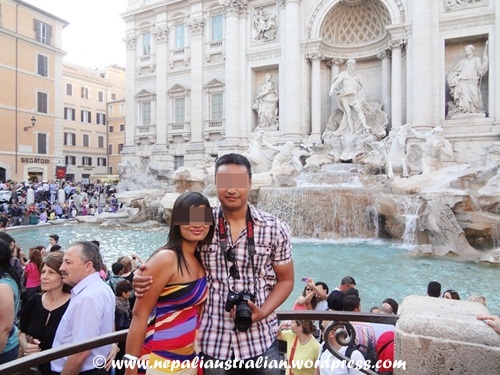
On our first day in Rome, we went to the Trevi Fountain and Spanish Steps and then ended in Italian restaurant.

The Trevi Fountain

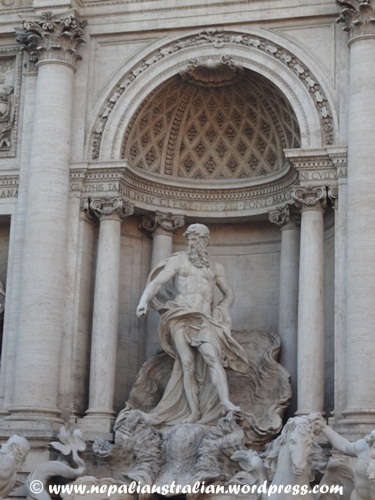
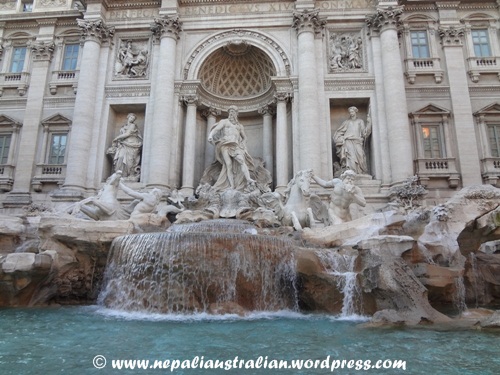
The Trevi Fountain is a fountain in the Trevi district in Rome, Italy. Standing 26 metres (85.3 feet) high and 20 metres (65.6 feet) wide, it is the largest Baroque fountain in the city and one of the most famous fountains in the world.

The fountain gets its name from the fact that it sits at the junction of three roads or in Italian “tre vie”. Traditionally Romans built rather elaborate fountains at the terminal point of their aqueducts.

Supplied by water from the Acqua Vergine aqueduct and a triumph of the baroque style, it was based on the design of Nicolo Salvi and was completed in 1762. The design centres on the triumphant figure of Neptunus Rex, standing on a shell chariot drawn by winged steeds and led by a pair of tritons. Two allegorical figures in the side niches represent good health and fertility.

The legend has it that if you throw a coin into this fountain it guarantees your return to Rome. An estimated 3,000 euros are thrown into the fountain each day. The money has been used to subsidize a supermarket for Rome’s needy; however, there are regular attempts to steal coins from the fountain.

The Trevi Fountain is beautiful, but it can also be overwhelmingly crowded, so keep an eye out while you take pictures and hold on tight to your bags. We were told by our guide again and again to beware of pickpocket so we were very careful when we were in the crowd.

Spanish Steps

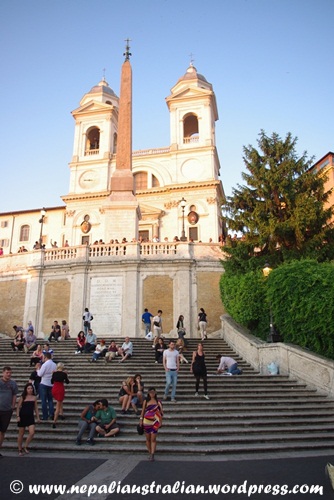
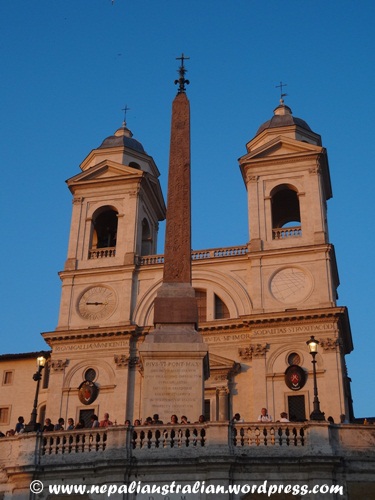
The Spanish Steps are a set of steps in Rome, Italy, climbing a steep slope between the Piazza di Spagna at the base and Piazza Trinità dei Monti, dominated by the Trinità dei Monti church at the top. The monumental stairway of 138 steps was built with French diplomat Étienne Gueffier’s bequeathed funds of 20,000 scudi, in 1723–1725, linking the Bourbon Spanish Embassy, and the Trinità dei Monti church that was under the patronage of the Bourbon kings of France, both located above — to the Holy See in Palazzo Monaldeschi located below.

The Spanish Steps are the longest and widest staircase in Europe.

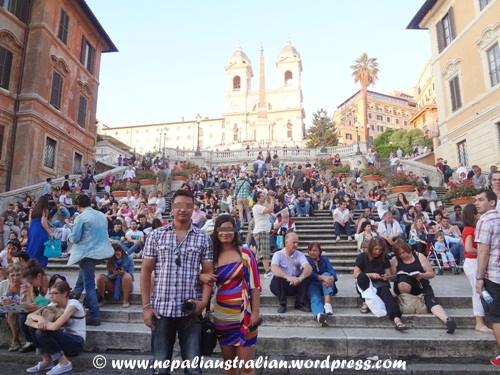
We stopped there on the way to the restaurant for our dinner. There were lots and lots of people everywhere; basically it is a set of steps with the church on the top and fountain at the bottom. But it had the vibe like the Times Square in New York with lots of people on the steps or around the fountains taking pictures, having their lunch or just reading a book.

We climbed the stairs and went to the top of the stair and it was amazing to see so many people from the top.

The streets nearby are full of up-market designer shops likes of Gucci, Max Mara, Salvatore Ferragamo, Giorgio Armani and Louis Vuitton as well as bars and restaurants and are enjoyable to stroll around in.

If you are tired and want to rest for a while it is a good place to stop while you are in Rome but for us we had around an hour there and it was time for us to meet our guide to go for our dinner.

Disappointing Italian dinner

After our mini tour of Rome, we went to an Italian restaurant for dinner. I have to say this was one of the places where I was disappointed with the food as well as the restaurant itself.

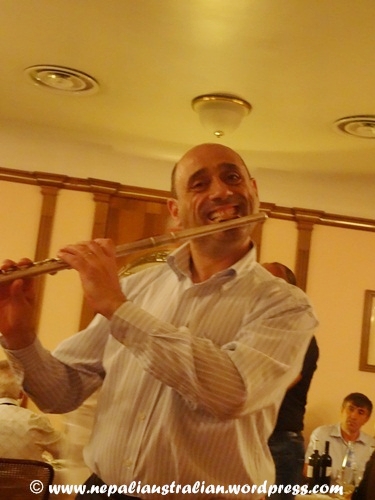
We went to this restaurant and they served us a four course meal.  They started with salad and Bruschetta, followed by Pasta. Then the main was Chicken or Beef and dessert was ice cream with fruits.  Even with so much food, it was just an average experience. There were two musicians playing music during the whole time and a waiter was giving red roses to all the ladies. I found the food bland and the place too crowded.

Inspite of the dinner, overall we had a great day.

Please click here for more photos.

The Man Who Sued God

I was looking to watch a movie last night and I saw one of my friends Facebook’s status: “OMG (Oh My God) is a great movie.”

So I googled and found out that it is a Bollywood movie and it looked interesting so I convinced my husband to get this movie from our local Asian grocery shop and we watched it together.

It is a film about our relationship with God, how instead of being God-loving, we have become God-fearing. How religion has become a business run by god-men  ( referred to as ‘salesmen’) who aren’t in fact very spiritual at all. While I was watching this movie, it came to me that I have watched a very similar movie before and then I remembered that it was “The man who sued God.”

The Man who sued the god (2001) is an Australian movie that I watched a long time ago and I really liked it. But over time I had completely forgotten about it.

The story was very similar in both movies but one aimed at the Hindu religion and other at the Christian religion but both conveyed the same message. My husband loved OMG and I did as well expect a few instances where it was hard for me to understand Bollywood humour and the subtitle didn’t help at those times.

So if you are into Bollywood movies then do watch OMG (Oh My God) but I am sure you will also love The Man who sued the god.

The story in a nutshell is:

Billy Connolly plays Steve Myers, a lawyer who became a fisherman from frustration. When his one piece of property, his boat, is struck by lightning and destroyed he is denied insurance money because it was ‘an act of God’. He re-registers as a lawyer and sues the insurance company and the church under the guise of God, defending himself.

Billy Connolly is excellent, his wit and charm is on display throughout the film and it is very, very, funny, most of the time. The story itself is very intriguing; it successfully provokes your thoughts and captures your imagination with interesting questions.

I don’t want to spoil your fun so please watch either or even both of the movies and tell me what you think.

ou may also like:

*I’m Addicted to Game of Thrones *The Hunger game **Life in a day

Mismatched

It was only yesterday that I was laughing my head off with a colleague of mine. I saw her in the kitchen in the morning and I saw something odd about her. After observing her for a while I realised that she was wearing her ballet flat shoe rather than her normal high heels. So I asked her if her leg was ok because I usually wear my flats only if my leg is aching or I have to walk a long distance.

She told me the reason and I couldn’t stop laughing.

Like me, she is crazy about her shoes. I am sure she owns more pairs of shoes than I do but we always argue about it. Anyway, back to the story. Every morning she leaves home wearing her flat shoe but carries her high heels in her bag. So as usual, today she did the same. Went to the cupboard, took a pair of black shoe, put them in her bag and left home.

When she reached office and she was exchanging her flat for high heels, she realised that she had brought mismatched black shoes. The worst thing was that they both looked completely different, one plain black and the other one with strips. And to top it off, they were both for the left feet. So the whole of yesterday, she was running around office in her flats.

She admitted that she made the mistake because she had too many pairs of shoes. But like me there is always something nice in the market and it is hard to pass a shoe shop without looking at them and buying a few pairs now and then.

When we were kids, our teachers told us not to laugh at someone else’s mistakes. I learnt my lesson this morning. I was running a bit late for work so after getting ready, I picked up my earrings and ran for the lift. I put on my earrings in the lift without even looking at it properly. But while driving, I saw myself in the rear-view mirror and guess what; I was wearing mismatched earrings. It was not so bad as both of them were pearl but one has diamonds around it and the other doesn’t.  Have a look.

Well I guess, I will say it is the latest fashion to wear mismatched earnings if someone asks me 🙂

Do share your crazy mismatch story.

Dashain

Dashain is the 15 day Hindu festival celebrated in Nepal. It is the longest Hindu festival and it falls around September – October, starting from the bright lunar fortnight and ending on the day of full moon. Dashain is also popularly referred to as Bada Dasain, Dashera, Vijaya Dashami etc.

This year Dashain starts today, 16 October which is Ghatasthapana (Literally pot establishing). Ghatasthapana is the first day of Dashain and it is the day in which Jamara is planted on a pot or Kalash. The other important days for the festivals are Day 7 called Fulpati (21 October), Day 8 called Maha Asthami (22 October), Day 9 called Maha Nawami (23 October) and Day 10 called Dashami (24 October). The festival ends the 15th day with Purnima, full moon.

Every year Nepalis, remember the message “Good always wins over the evil”, with the celebration of the great festival of Bada Dashain.

Legend behind Dashain

King Ram Chandra, whose wife Sita was kidnapped by King Rawan, with the help of hanuman and its military, conquered Rawan on the tenth day, after regular worship of Durga Bhawani for 9 days. The 10th day is the victory day. We put tika on our forehead as prasad of the victory.

Another legend goes like this.

Demons, or Asuras, became very powerful and ambitious and continually tried to defeat the Devas, or Gods, and capture Heaven. One Asura, Mahishasur, in the form of a bull, grew very powerful and created havoc on the earth. Asuras started defeating the Devas and chasing them away from the heaven. The world was crushed under Mahishasura’s cruelty; the Devas put their energy together and form Shakti, a single mass of incandescent energy, to kill Mahishasur.

A very powerful band of lightning emerged from the mouths of Brahma, Vishnu and Shiva and a young, beautiful female virgin with ten hands appeared. All the Gods gave their powers and special weapons to her. This Shakti blended to form the goddess Durga. Riding on a lion, Durga Bhawanu fought Mahishasur. The battle raged for nine days and nights. Finally on the tenth day of Ashvin shukla paksha, Mahishasur was defeated and killed by Durga. This is the day of celebration.

Day 1: Ghatasthapana

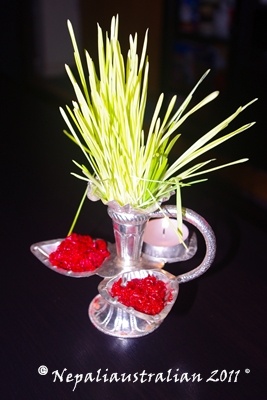
Ghatasthapana marks the beginning of Dashain. It literally means installing a pot which symbolizes Goddess Shakti. In this day, Jamara is planted establishing the holy Kalash vessel, which represents the goddess Durga. Goddess Shakti is believed to reside in the Kalash vessel during the Dashain.

Today, everyone in Nepal will plant Jamara to mark the start of Dashain. Normally, Jamara is planted in Puja ghar (prayer room). Jamara pot is kept away from direct sunlight, and holy water is offered to it every day, so that by the tenth day of the festival the seed will have grown to five or six inches long yellow grass. This sacred grass is known as Jamara.

Today, before coming to work, I planted my Jamara as well :). It is the second time I have planted Jamara and I am hoping like last year, it will be a good one so I can use this for puja and tika .
How to plant Jamara

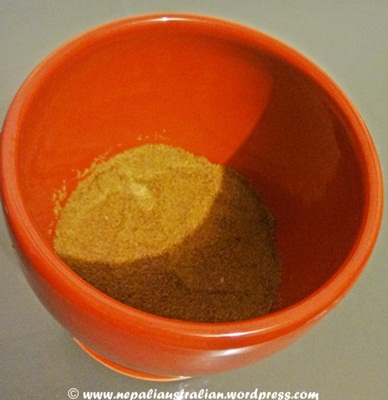
  • Soak barley seeds overnight. I used a Jamara mix (barley, corn, wheat) from Nepali grocery shop.
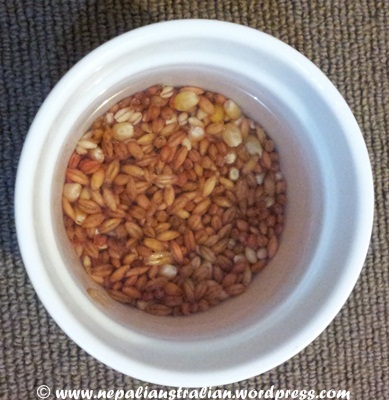
  • Get a deep bowl or container with a flat bottom. I am using a clay flower pot this year. Fill it with a layer of sand about 2 inches thick.

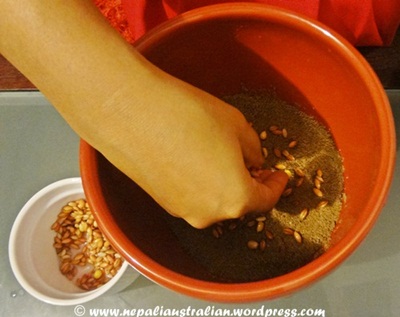
  • Sprinkle a layer of soaked Jamara mix into the container.

  • Make sure it is only one layer of the seeds so they have enough room to sprout.
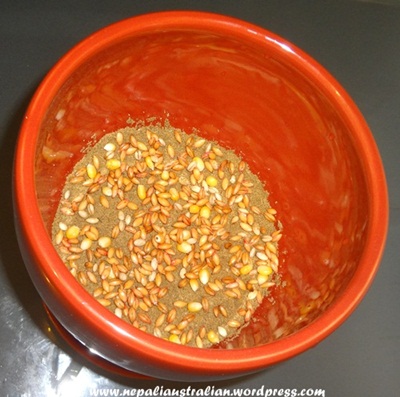
  • Cover the seeds with a thin layer of sand.

  •  Sprinkle some water in the container. The sand should be moist, but not soggy.

  • Cover the container and put it in a dark corner, away from the sun.

  • Check the container daily to make sure that the sand is moist.

  • Your Jamara should be is ready for Tika.

Click here to see how Jamara looks like from my last year’s post.

If you are in Nepal, you will see lots of signs of Dashani which will remind you that the festival season is on.

Lots of kites in the sky

Flying kites has been a very important part of celebrating Dashain in the country as it is considered to be one way of reminding god not to send rain anymore. When I was a kid, we used to gather on the rooftop of the house and take turns flying kites. My brothers and his friends would be there and I would be there trying to learn how to fly kite. They used to teach me but most of the time I dropped the kite too low when I was taking control and one of them would jump in and take over  before someone could cut it in the sky, with so many kites fighting already.

When you cut someone else’s kite, you shout ‘Changa Chet‘ literally meaning Kite, cut! If we had a big group of friends we even used to take metal plates or metal buckets with metal spoons and bang them to make a loud noise to celebrate the Changa Chet. I know it might sound weird but it was lots of fun.

Ohoo, how I miss my childhood Dashain.

Kites are not only for kids but adults get into the spirit and have some fun too.

Everyone playing cards

Gambling is illegal in the Nepal but it is usually permitted in public places during this festival. While children are busy flying kites during Dashain, the older members of the family pass their time by getting together and playing cards with each other for money and fun all day long.

As a kid, I remember playing cards using 1 shuka (a quarter /25 paisa) and trying to win more money. It was so much fun to team up with the cousins and play it as a group. That is the only time we didn’t get scolding from our elder for playing cards.

 Everyone busy shopping for new clothes

I would never have thought as a kid I would ever own 100s of dresses or shoes in my lifetime. As a kid, Dashain was especially exciting as I got to buy new clothes along with a new pair of shoes which I could wear during the festivals. All of my friends used to gather during Dashain and show off our new dress and shoes 🙂

Buying and wearing new clothes is an important part of the festival. As many people are living in the villages below the poverty line and for them it is often the case that new clothes come only with Dashain. Almost all the shops in the country have festival offers and discounts. This makes shopping even more attractive to people. Clothes have the highest sales during the festival.

To get into the Spirit of Dashain, we went shopping last weekend and I bought two dresses and a pair of shoes. My husband bought a jacket and a few t-shirts :). I am wearing my new dress today so Dashain has already made an impact in our lives.

Swings everywhere

During Dashain, bamboo swings are constructed a week before Ghatasthapana in many parts of the country as a way of celebration. These bamboo swings are called ‘ping’ in Nepali. These kinds of swings present the best of local culture, tradition, community spirit and fun.

These swings are constructed with the help of community members using traditional methods which make the use of ropes made from tough grass, bamboo poles and wood etc. Theses swings are dismantled only after the festival of Tihar which is 2 weeks after Dashain.

The heights of some swings exceed twenty feet and one can swing really high. One can see people of all ages enjoying the swing. It is especially famous with the children.

I used to love these swings. It goes so high that the adrenaline kicks in. I used be a bit scared to get on at first but once you are on it, it is a great feeling. I am sure these kinds of swings won’t be allowed in western countries as it will be consider a health hazard as it doesn’t have any safety harness 🙂

Dashain Fairs everywhere

Different kinds of fairs are also organized during the festival. Usually small fairs are organized in the villages with the Ferris wheels for children and other items of entertainment for the adults. However, in the city it is the commercial fairs and celebration events that are usually organized.

My memories of Dashain fairs are of Bhrikuti Mandap Dashain Mela. My parents used to take my brother and me there and we were allowed to buy treats. They had concerts, dance shows, magic shows, family games, Band competitions, games, food, and a lot more. They also had stalls with goats, chickens, ducks etc. and great for people who want to buy animals to sacrifice for Nawami.

Also these days they organise lots of musical concerts during these festivities.

In Sydney, during Dashain there are lots of musical concerts with Nepali artists visiting down under to celebrate the festivals. Dashain festival and dance parties are also organised here to make merry and have a get together.

Animals slaughtered

This is probably the worst part of Dashain for me that thousands of animals such as buffaloes, ducks, goats, etc. are slaughtered during Dashain every year.

It is considered an important ritual since it is believed that the goddesses are appeased by such sacrifices. Almost all the temples, especially the temples of Goddess Durga and Kali  around the country are offered with thousands of sacrifices.

Asthami and Nawami are the days when the sacrifices reach their peak. While thousands of animals are sacrificed to appease the goddesses, people also slaughter animals for the purpose of feasts. Since a large number of feasts and gatherings are organized throughout the fifteen days of the festival, the demand for meat goes up considerably. Hence to meet the demands the slaughtering of animals becomes considerably high during the festival.

However, for the past few years the animal rights activists in the country have been continuously opposing these acts of slaughtering of animals in such a manner. They have been requesting people to stop such inhuman acts of killing the innocent animals and instead have suggested them to offer fruits and vegetables to the Goddesses since they believe that it is mentioned nowhere in the Hindu religious books that such sacrifices appease the gods and goddesses.

I do know that we need meat from animals but I still think it doesn’t need to be cruel killing of animals for the meat. I am sure there can be less violent way of killing animals for their meat.

As I am not into killing animals and also I can’t do that in Australia so I will be using coconut instead to mark Nawami. I will keep you posted about Dashain for the next 15 days.

A relaxed mind, a peaceful soul, a joyful spirit, a healthy body; be a heart full of love, may you have all these every day. Happy Dashain everyone!!!
Helensburgh Hindu temple

I am sure you get the vibe from my blog that I am not a very religious person but I do enjoy going to the temple occasionally. My husband always reminds me how religious my mum is and he finds it a bit surprising that I am not like my mum in the religion department. I always tell him, “If I have a clean heart and make sure that I am not hurting anyone in my day to day life, God will consider me as a good citizen and will be happy with me. There is no need to really visit a temple all the time or pray for hours :)”.

There are not that many Hindu temples in Sydney and most of them are not close to where I live so planning is required to visit one.

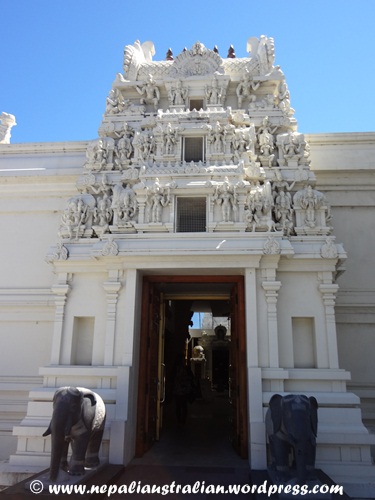
From time to time I feel like I should go to the temple and pay my respect so I drag my husband along for some prayer. Last weekend we managed to go to a temple in Helensburgh called Sri Venkateswara Temple. It is around 45 minutes’ drive from my apartment or an hour from Sydney city center (55km). The temple is built on top of a hilly area 400 feet above sea level. It has four ‘praharam’ (encircling corridors). Sri Venkateswara Temple was built in 1978 by the Indian people in Australia as a South Indian-style Hindu temple.

So far there is no Nepali temple in Sydney but they are planning to build a version of Nepal’s famous Pashupathi in Sydney.

At the temple devotees are supposed to leave their footwear outside and wash their hands and feet before they enter the temple. The temple area inside has small shrines for each of the Gods. There are priests performing rituals at each of the shrines at a pre-determined time.

There is a temple counter inside which provides visitors with more information about temple rituals and prayers.  They also sell puja for $15 which goes towards maintenance of the temple. You get a plate of puja which has Sindoor, flowers, dhup and fruits. Also, you can buy diyo (oil lamp) if you want to light just the diyo.

The temple has deities like Lord Venkateswara, Goddess Mahalakshmi ,Lord Chandramouleeswarar, Goddess Thripurasundari , Lord Ganesh, Lord Subrahmanya , Lord Navagraha, Goddess Durgambika , Lord Rama , Goddess Andal , Lord Krishna, Lord Brahma , Lord Hanuman, Lord Garuda  , Lord Sudharsana , Lord Viswakshena , Lord Dhakshinamurthy and Lord Chandikesa.

I have seen lots of South Indian weddings being performed inside the temple in my previous visits.

I know it doesn’t sound so right but I love to go to this temple because they serve a great Indian food in their canteen during weekends. I always have Masala Dosa (made by stuffing a lightly cooked filling of potatoes, fried onions and spices in a fermented crepe or pancake made from rice batter and black lentils) and Vada (a donut  shaped dish made from lentils and gram flour or potato) . They are so cheap but so yummy. They do sell other South Indian vegetarian dishes as well but those two are my favourite especially with masala tea (spiced Indian style milk tea).

The temple opens 8am – 7pm, week-ends and public holidays; 8.00am to 12.00pm and 4.00pm to 7.00pm on weekdays.