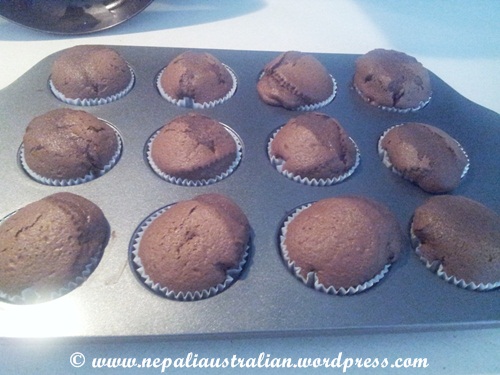
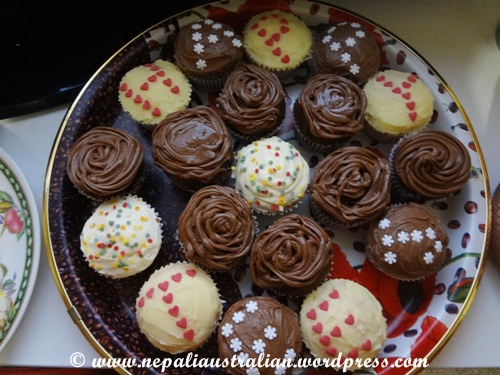
Chocolate cupcakes

Ingredients (make 12 cupcakes)

  • 80g unsalted butter, softened
  • 1/2 cup caster sugar
  • 2 eggs
  • 1 tsp vanilla extract
  • ¾ cups plain flour
  • ¾ cup cocoa powder
  • 2 tsps baking powder
  • ½ cup milk

Icing

  • 50g unsalted butter
  • 1 cup icing sugar
  • 1 cup cocoa powder
  • 2 tbsp milk
  • Sprinkles or lollies to decorate

Steps

  • Preheat oven with fan to 180°C or without fan for 200°C.
  • Place cupcake papers in two 12-hole cupcake trays.

  • In an electric mixer, beat butter for 2 minutes until pale in colour and creamy. Add sugar one third at a time and cocoa beating well between each addition. Add the eggs one at a time, beating for about a minute between each addition. Add the vanilla essence and beat until combined.

  • Sift flour and baking powder and add half to butter mixture with half the milk, mix until well combined. Repeat with remaining flour and milk.

  • Divide batter evenly between 12 patty cases.

  • Bake for 15-20 minutes, Cupcakes are baked if they spring back when lightly touched in the centre. Allow cupcakes to cool in pan for 5 minutes before transferring.

Icing Steps

  • In an electric mixer, beat Cream butter until pale and smooth. Add the milk and half the sifted icing sugar and cocoa powder. Beat until well combined. Add the remaining icing sugar and beat until mixture is light and fluffy. The mixture should be a spreadable paste; if it is too dry, add some more milk, if too wet add more icing sugar.

  • When cakes are cold, spread generously with icing and dip into sprinkles or decorate with small lollies.

Rose cupcake icing

I also decided to do a rose swirl with the icing. As it was my first attempt, it was not very good but here are the steps.

  • Start from the middle and pipe a small amount of buttercream into the centre.

  •  Slowly work your way around going anti-clockwise until you reach the outer edge of your cupcake. Remember to apply even pressure to your pipping bag, this insures an even swirl all the way around.

Here is the YouTube video if you want to try.

I made them for Teej along with Vanilla cupcakes.

Aastha Pokharel representing Nepal on Asia’s Next Top Model

I am sure you all know the show called America’s Next Top Model. We have our own version here in Australia called Australia’s Next Top Model. They are doing a new Pan-Asian version of it called Asia’s Next Top Model and I am so glad to see Nepal being represented in this contest.  🙂

The new Pan-Asian television series gives young Asian women, with modelling aspirations, an opportunity to prove that they can make it in the high-stress, high-stakes world of international modelling. Coming from various backgrounds across Asia, the series follows the top model hopefuls as they live and compete against each other for the coveted prizes.

Hosted by Nadya Hutagalung, the show charts the transformation of aspiring models into successful top models. With fashion director Daniel Boey, fashion photographer Todd Anthony Tyler and model mentor Joey Mead King guiding and mentoring the top model hopefuls, these young women will see themselves competing in a highly-accelerated modelling boot camp to top model fame.

The winner of the first season will be offered a contract with one of the top modelling agencies in Asia and/or Europe.

Aastha Pokharel is representing Nepal and she should do a great job as she has lots of experiences as a model in Nepal.

Here are some details of Aastha Pokharel

  • From: Kathmandu, Nepal
  • Education: Bachelor in Nursing
  • DOB: 10/24/1991
  • Sex: Female
  • Height: 5’9″
  • Weight: 53 kgs
  • Waist:   25.5″

Asia’s Next Top Model will be broadcasted across Asia from late 2012. With 13 episodes of fresh new Asian modelling talent, you would be exposed to the calibre of work and passion that builds and sustains this industry.

Wishing Aastha all the best on her journey. Please support Aastha Pokharel and her journey on Asia’s Next Top Model.

You may also like :

*Aastha journey’s in Asia’s Next Top Model *Prabal Gurung : A Fashion designer from Nepal *Varsha Thapa: First international fashion model from Nepal

Guest Post : Forward

Thank you Nelle for sharing her life with this wonderful post. You can check her blog on nellewrites. She is truly talented and amazing writer and I am eagerly waiting for the day when her book will be published.

Also I will like to congratulate her for upcoming award for her volunteerism at Planned Parenthood. You are a good example of how commitment and hard work pay off.

My appreciation and gratitude to Nepaliaustralian for her invite to write a guest post for her fascinating blog.  She takes us on such wonderful journeys and mini-tours with each new post, through two places and more what seem so exotic.

Fiction writing flows easy from my soul.  My own blog exists as a relief valve replete with short stories.  On occasion, my writing ventures into the personal, shared glimpses at the last dozen years.  I cannot take you all on a tour of wondrous places, so the logical writing for this guest post flays open part of my life and exposes a path fraught with experiences I care not to repeat.

Sometime just short of fifty-eight years ago, a physician declared me male at birth.  Gender assumptions ruled, through childhood, adolescence, and decades of adulthood.  One big caveat occurred in 1960, year America elected John F Kennedy president.  My gender exploration as a six year old earned a declarative statement from my father.  “You’re sick.”

So I believed, through the 1960s, 1970s, 1980s, and three quarters of the 1990s. What ensued I’ll truncate and spare much detail.  Married, parent, businessowner, these descriptive terms of my life collided with jumbled works within beginning in the late 1990s.  Gender pressure ratcheted to an unholy level.  It worked over my ability to function, a steady slide into oblivion, to the detriment of all around me.

The worst of it fell within a thirty-month window, 2001 through 2003.  I crossed gender lines nine years ago, and in 2008, faced an expected indictment that led to a two-year sentence and twenty-one months served in a federal prison camp, from June 2009 to my release in March 2011.

The dysfunction would not define my life.  Eight years ago, I pulled myself together, driven by some inner will to overcome and rebuild.  It required fighting through severe depression.  It meant re-commitment to personal and work ethics.  Over the ensuing four and a half years as a state employee, I rebuilt integrity lost in those thirty months, manifested in my commitment to each claimant and in distinguished service to my employer.

People fall into horrid circumstance.  Sometimes we act in irrational ways or shut down when faced with unimaginable pressure.  If one stumbles as I did, don’t accept it.  Strive for better.

Don’t stay down.  Don’t accept failure.  Learn from the adversity.  Get back up and dust off.  Learn from weaknesses and overcome them.  Commit to the truth no matter if it carries adverse consequences.  Commit to make amends, to rebuild and move forward.  And after, consider precious rebuilt integrity.

I’m a student, again.  I’m a Planned Parenthood volunteer, less than two weeks from receiving an unexpected state award honouring my volunteerism.  I’m a writer, new, four years into the creative path after a lifetime of business writing.  My first novel, now in its eighth edit nears an end.  I anticipate at least two more edits before the agent process begins.

Regrets?  Many.  Guilt?  Much.  Stronger?  🙂

Please click here if you are interested to write a guest post for me.

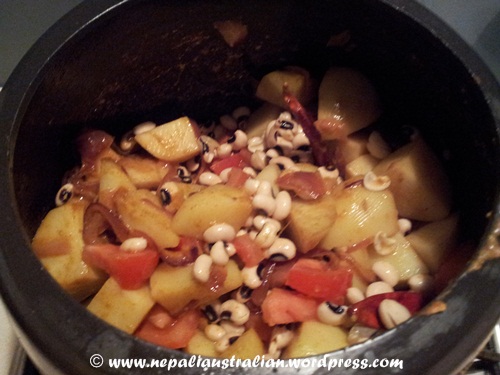
Aloo Tama bodi (Potato with Bamboo Shoot and black eye beans)

This is one of the popular dishes in Nepali/ Newari cuisine. In Newari style Bhoj (feast) you will always find this dish.

Aloo Tama is a classic Nepali soup prepared with black eyed beans, potatoes, bamboo shoots and spices. Tama is a non-fermented bamboo shoot product. Aloo tama is well-loved comfort food cooked almost in every household throughout Nepal. The enduring popularity of this dish is that, it is extremely tasty and very appetizing mainly for its slightly sour and pungent taste. There are different way to cook this and today I am sharing my style using pressure cooker.

Ingredients

  • 1 cup bamboo shoots (preferably sour one)
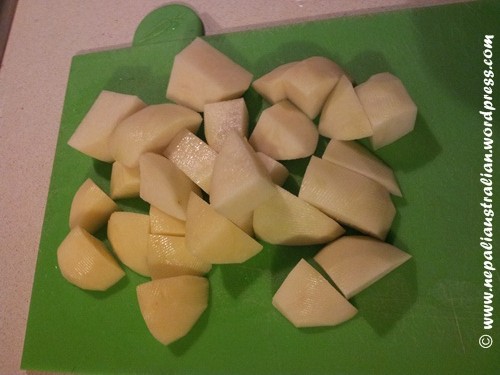
  • 4 medium potatoes, peeled, and cut into ½ inch cubes
  • 1 cup black-eyed peas (soaked overnight)
  • 1 teaspoon dry cumin seeds (jira)
  • 1 medium onion, finely chopped
  • 3 red dry chilies
  • 1 teaspoon cumin powder
  • 1 teaspoon chili powder
  • 1 teaspoon garlic, minced
  • 1 teaspoon ginger, minced
  • ½ teaspoon turmeric
  • 2 medium chopped tomatoes
  • 2 tablespoons oil
  • Salt to taste
  • Lemon juice to taste

Steps

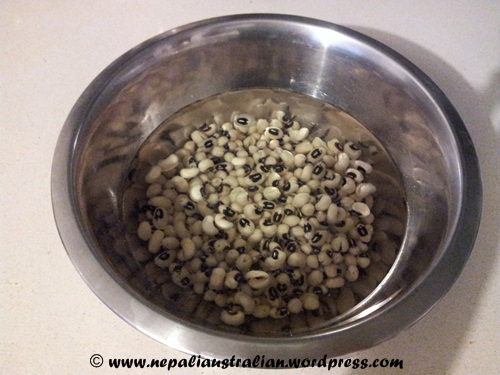
  • First of all let the black eyed beans shock in water for overnight. If you forget to soak it overnight, you can soak in hot water for few hours and it will be fine.

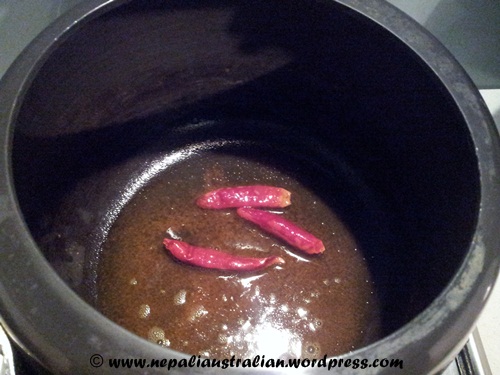
  • Heat oil in a pan. I used pressure cooker.
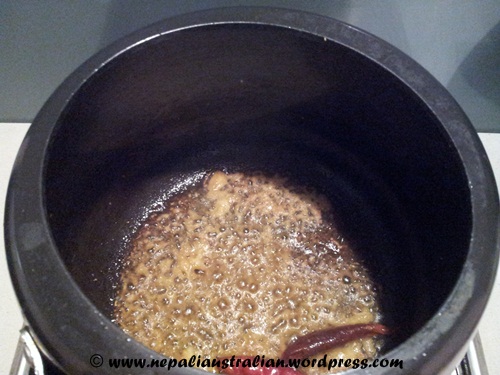
  • Add turmeric, dry cumin seeds and red chilli and fry until it is dark.

  • Then add garlic and ginger.

  • Add chopped onion and cook few minutes on low heat.

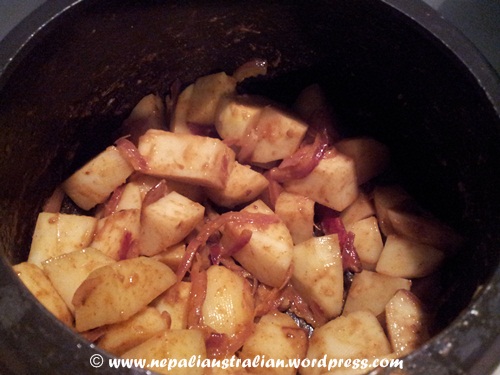
  • Add potatoes to the onion and sauté for at least 5 minutes in medium heat.

  • Add little water so that it doesn’t stick on the pan.
  • Add soaked beans, tomatoes and fry for few minutes.

  • Add 2 cup of water, salt, chilli powder and cover the pressure cooker and press for 6-10 whistle or until potatoes is cooked.
  • Take off the pressure cooker and let it cool down.

  • Now add bamboo shoots and 1 cup water ,cover it and let it simmer for another 10 minute or until desired consistency is reached.

  •  Taste and add lemon juice as required to make it bit sour.
  • Sever with roti or rice.

You may also like :

*Aloo dum *Aloo ko achar *Aloo chop

Sistine Chapel : Vatican

Before I had visited Vatican I knew about Sistine Chapel but it had never interested me. But I was in awe of the whole place when I got there. I think the biggest credit goes to our guide who was so good at explaining all the details about the chapel that I wanted to share the information with all of you. I am sure many of you know a lot about this famous chapel already but I still am sharing what I learned.

As you know I am not a Christian but still the history behind the chapel is so interesting that anyone will fall in love with this architectural beauty and its frescos by Renaissance artists including Michelangelo, Sandro Botticelli, Pietro Perugino, Pinturicchio and others.

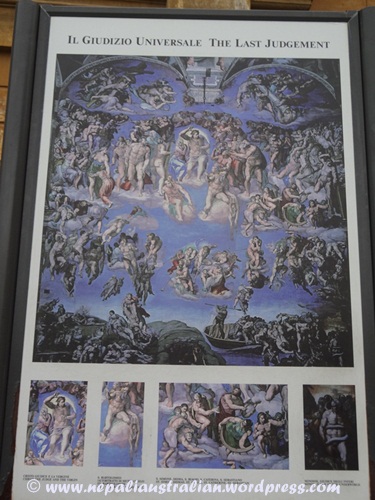
When we entered the Sistine Chapel, no photography was allowed but these are photos I took in the garden where the guide explained the detail about the chapel. Rest of the photos are from the internet.(I have no idea how they managed to take these photos.)

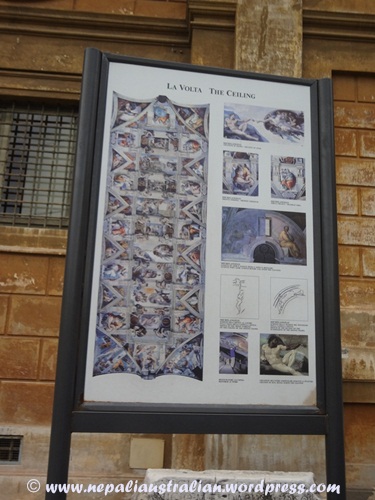
There are 1,100 sq. m of paintings in the chapel, and its beauty is astounding. Even though there were so many people inside the chapel, I was lost looking at the amazing pace while our guide was talking into our headphones.

From time to time I heard a guard in the Sistine Chapel enforcing the No Talking rule and hundreds of tourists instantly complied but just for a few seconds.  Then the buzz began again but I was just lost in one of history’s monumental artistic achievements.

The Sistine Chapel ceiling, painted by Michelangelo, was exhibited to the public for the first time on November 1st 1512. It was quite shocking at the time as it appears to depict an image of God – forbidden by the Church.

Michelangelo considered himself more of a sculptor than a painter, which is one reason he was reluctant to accept the commission of Pope Julius II to come to Rome and paint the ceiling of this building.  It had originally been built in the 1470s at the behest of Pope Sixtus IV.

The building had undergone some renovations due to structural flaws; Michelangelo started in on the new ceiling in 1508.  There were problems:  For one thing, he had relatively little experience with fresco.  That technique involves applying paint to wet plaster, so the artist and his assistants had to estimate how much plaster they thought they could paint before the surface dried.

Another issue was even more basic:  How do you work on a large horizontal surface that is 60 feet above the floor?  The easiest approach would have been to build scaffolding towers, but the pope and cardinals wanted the floor to be clear so they could continue holding their meetings in the chapel.

Michelangelo figured out a way to bolt the scaffolding into the side walls; he and his assistants climbed up to their perch and did that marvelous work while leaning backward.  The first half of the ceiling — the eastern side — was completed in 1510.

The scenes are all from the Old Testament and relate to rebirth and new beginnings (God creating the World, God creating Adam and Eve, Garden of Eden and Noah’s Ark) and therefore indirectly relate to how the della Rovere family helped achieve its own rebirth of the church.

Look at the interesting view of the ceiling below, the combination of large scenes combined with smaller scenes and the painted illusion of sculpture and a cornice is incredible.  Everything you see below is painted and creates both a striking illusion and a powerful narrative.

The stories were painted in backwards chronological order. You can see how much his style was changed and simplified from the first scene showing Noah and the Flood.  In that early painting the scene is crowded with figures.  His work becomes much more effective when he simplifies his style.

He uses the human figure to represent the entire story, leaving out many of the symbols, landscape and backgrounds that other artists were using.  His studies in human anatomy are evident and this key work shaped the direction of the Renaissance.


When that scaffolding was taken down, Michelangelo was dissatisfied with the result.  There were too many figures in the panels, he felt; from the floor they appeared small.  When you visit the Sistine Chapel, you’ll notice that the figures in the other end, starting with the iconic “Creation of Adam”, are larger.

There are also paintings on the walls, including some by eminent artists like Boticelli and Ghirlandaio, who was Michelangelo’s teacher.  By far the most impressive wall painting, though, is the massive “Last Judgment” behind the altar on the west end, which took Michelangelo several more years to complete.

I found this amazing 360 degree view of the Sistine Chapel online. Check out this interactive video.

http://www.vatican.va/various/cappelle/sistina_vr/index.html

Here are some interesting facts about the Sistine chapel

Sistine Chapel Fact #1:

Did you know that the Sistine Chapel was built by a Pope named Pope Sixtus the Vl, hence the name Sistine Chapel?

Sistine Chapel Fact #2:

Did you know that Michelangelo was only 32 years old when he began painting the ceiling of the Sistine Chapel and completed it in only 4 years?

Sistine Chapel Fact #3:

Did you know that the Sistine Chapel was built to house the Cardinals while they deliberated on who should become the next Pope?

Sistine Chapel Fact #4:

Did you know that the famous chimney that releases black smoke telling us the Pope has died and white smoke telling us we have a new Pope is set up in the Sistine Chapel? You can see the marks where it sits towards the back right of the chapel?

Sistine Chapel Fact #5:

Did you know that no artist in history suffered as much as Michelangelo suffered in the 4 years it took him to complete the ceiling of the Sistine Chapel? He suffered with his knees, back and neck and he still managed to live to be 89 years old.

Sistine Chapel Fact #6:

Did you know that Michelangelo painted the Last Judgement (the front wall of the Sistine Chapel) 28 years after he finished the Sistine ceiling?

Sistine Chapel Fact #7:

Did you know that Michelangelo’s enemy, Rapheal, was originally asked to paint the Ceiling of the Sistine Chapel but refused. He suggested Michelangelo knowing he was a sculpture and not a painter.

Sistine Chapel Fact #8:

Did you know that the Sistine Chapel was completely cleaned between the years 1980 to 199. It was paid for by the camera company Fuji Film. Fuji Film now own all copyright to the paintings, and that is why there is no photography allowed in the Sistine Chapel.

Sistine Chapel Fact #9:

Did you know that Pope Julius ll (the Pope that commissioned Michelangelo to paint the ceiling of the Sistine Chapel) sold Indulgences in order to pay Michelangelo for his work? Selling Indulgences meant that people could pay money to get time off Purgatory.

Sistine Chapel Fact #10:

 Did you know that there are 3 Botticelli paintings in the Sistine Chapel, painted 24 years before Michelangelo began the Ceiling?

Please click here more photos.