Tag Archives: Mandap

Our Story : “Swayamvar” ceremony- Part 41

This is a continuation of my previous posts. Please read the previous posts here.

Swayamvar ceremony is the main event for the whole wedding and it literally means ‘Choosing the Groom by the Bride’. In the past, the bride had the right to choose one among many suitors. Nowadays, in the majority of marriages, Swayamvar is just a ceremony followed by Janti in Newari / Nepali wedding. For us the Swayamvar ceremony and Janti ceremony took place in two different days.

The Sahit sent during the Supari ceremony has an auspicious time written for the Swayamvar ceremony. For us the date and time was 24 June at 9.00pm. Therefore, it was going to be an evening ceremony.

Swayambar (2)

For this ceremony, I wore a red Dupata (silk with sliver work) sari, Dupata shawl around my arms and Ghumto (net red shawl similar to a veil) to cover my head. I went to the beauty parlour for hair and make-up.

Swayambar (3)

Before 9.00pm, all my family and I arrived at the venue. Due to the monsoon season, it was raining heavily. Everyone told me that the rain was a good sign for weddings. Anyway, all of us were waiting for the groom and his family to arrive for the ceremony. When they arrived, I was asked to go to the room upstairs so the groom and family could be welcomed and when everything was ready, I was to enter the room where the mandap was set.

Wedding Ceremony

In this mean time, my dad and uncles welcomed the groom and his family. They put Tika on the groom’s forehead, garland around his neck and escorted him to the mandap room. Once everything was settled, my cousin asked me to come down. I had my veil to cover my face and I was looking down as I walked towards the mandap.

Swayambar (4)

When I saw AS , I was so happy. He was wearing a Daura-Suruwal, Nepali national costume in light grey colour with dark blue coat and Nepali Dhaka topi. I was asked to sit next to him and the ceremony began.

Swayambar (5)

There were two priests, one from my family and one from his. They both told us to do lots of things, like doing Puja and saying mantras in Sanskrit and we were meant to repeat it after them. Vedic hymns and prayers invoked the blessings of all Hindu gods and the support of every element under the sun that will have a role in the conjugal life of the couple. The five basic elements of earth, air, fire, water and sky are highlighted time and again.

Swayambar (7)

The Swayamvar ceremony continued with me circling AS thrice holding the Supari (from the Supari ceremony), Dubo ko mala (garland made out holy grass) and Ful ko mala (flower garland). Once I was done, I stood in front of him.

Wedding Ceremony

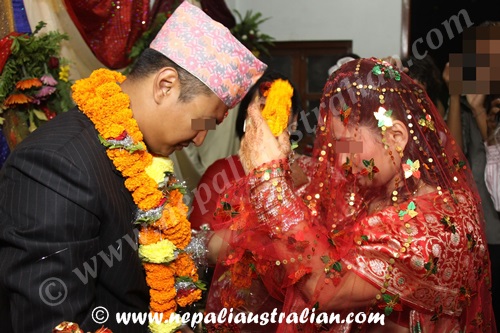
We exchanged Dubo ko mala and Ful ko mala.
Wedding Ceremony Wedding Ceremony

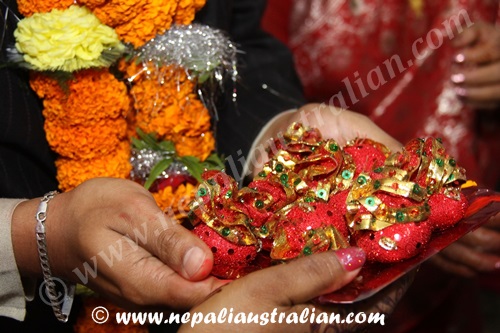
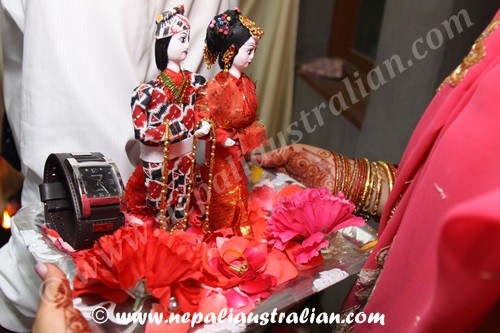
Then my aunt bought the tray with two traditionally dressed dolls (Bride and Groom) and all the jeweleries nicely displayed.
Wedding Ceremony Wedding Ceremony

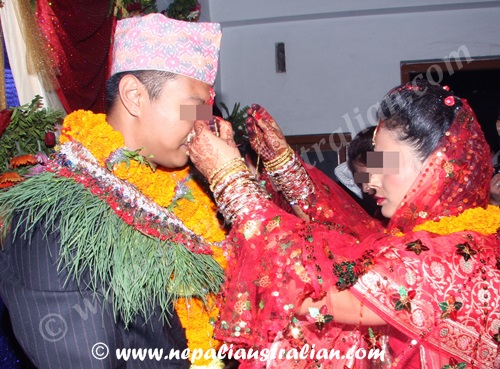
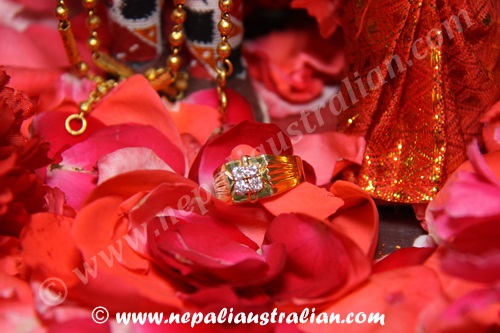
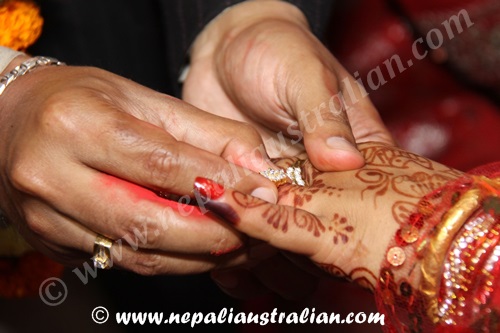
Now AS put the diamond necklace and Tilahari around my neck and golden bangles on my hands. Then we exchanged rings. It was followed by me putting a gold chain around his neck and watch on his wrist.
Wedding Ceremony Wedding Ceremony Swayambar (16) Swayambar (17) Swayambar (18)

Then priest asked me to sit down for the most important Sindoor ceremony. My aunt put golden and red clothe around my face covering my eyes, holding it from the back. Then the priest instructed AS to take a pinch of Sindoor in between his ring finger and thumb. He had to put that first to his forehead and then put on my forehead. Wedding CeremonyHe had to then move it into my hair partition still touching the forehead.

Swayambar (20)

This step was repeated two more times and now I was officially married to be his wife. Wedding CeremonyI touched AS’s feet for his blessing as his wife, and he handed me the Supari.

Wedding Ceremony Wedding Ceremony Wedding Ceremony Wedding Ceremony

Under the Hindu (Newar) tradition the sindoor and tilahari are the signs of a married woman. Finally, the priests pronounced that AS and I are husband and wife. He explained that as his wife, it is his duty to protect me and to make me happy.

Swayambar (24)

Now the priest asked us to share yogurt from the plate. AS ate a spoonful and then hand it to me. I had one spoon too. It was a bit hard to eat when everyone is watching. After this, we bowed to all elder relatives to get their blessing.

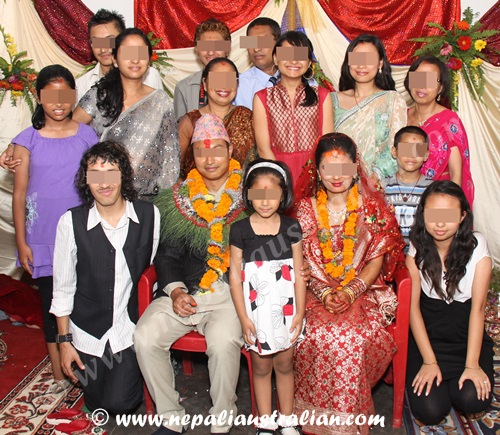
Family photos followed the ceremony and yes a Bhoj (party) as well. Once the ceremony was over, everyone was relaxed and started enjoying the food and company.

Swayambar (25) Wedding Ceremony

AS and his family left after the ceremony and we went home as well. I was so tired after such a long day but I was a married woman that day. It felt good.

Wedding Ceremony

More on the wedding in the next post.

Take care,

M from nepaliaustralian

XOXO

P.S: Do not forget to vote your favorite blog . NEPALIAUSTRALIAN’s Blog Award 2014

Go to Part 42

Happy Tihar!!!

Today we start the second biggest festival, after Dashain, for Hindu from Nepal.

Tihar

This festival is celebrated in five days starting from the thirteenth day of the waning moon in October.

 The five days are called

Mha Puja (10)

Hope all of you are enjoying with lots of yummy food like Selroti, Lal mohan, Besan ko ladoo and other sweets.

Sel roti (4)

With gleam of Diyos
And the Echo of the Chants
May Happiness and Contentment Fill Your life
Wishing you and your family
Happy and Prosperous Tihar!!

Take care everyone,

M from nepaliaustralian

XOXO

P.S: Do not forget to nominate  your favorite blog .

Nominations open for NEPALIAUSTRALIAN’s Blog Award 2014

Celebrating Tihar

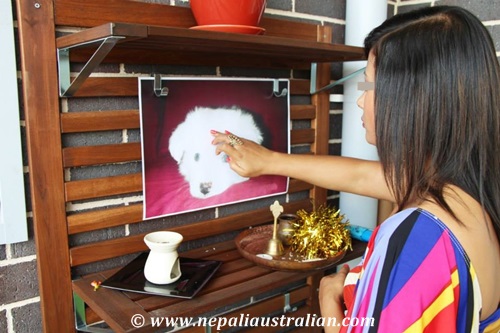
Like every year, we celebrated Tihar this year as well. For the details of the festival, please click here. I am sharing some of the photos from the festival.

Kaag / Kag (crow) Puja

Kaag puja (2)Kaag puja (1)

Kukur (dog) Puja

kukur puja (2) kukur puja (1)

Laxmi Puja and Gai (cow) Puja

laxmi puja (9)laxmi puja (7) laxmi puja (1) laxmi puja (3) laxmi puja (4) laxmi puja (5) laxmi puja (6) laxmi puja (8)

Mha Puja and Nepal Sambat

mha puja (2) mha puja (5)mha puja (4) mha puja (3) mha puja (6) mha puja (7) mha puja (1)

Bhai Tika

IMG_3217 IMG_3237 IMG_3259 IMG_3265 IMG_3269 IMG_3361 IMG_3390

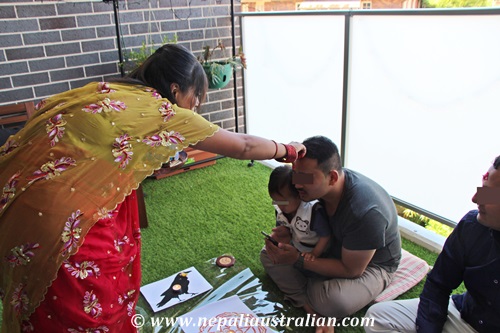
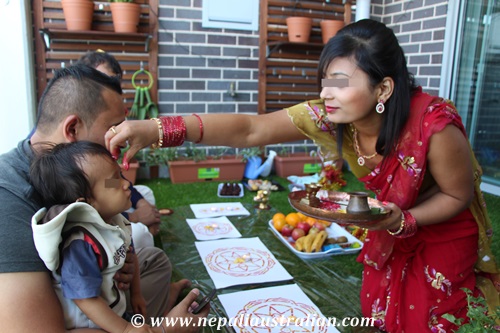
This year, I have one more person to put tika on and that is my little nephew. It was so much fun and amazingly he even managed to sit still on his father’s lap in front of the mandap for the whole puja.

IMG_3246

Hope all of you had great time celebrating the festival.

tihar

P.S: Do not forget to nominate  your favorite blog .

Nominations open for NEPALIAUSTRALIAN’s Blog Award 2013

You may also like :

* * *

Goru Puja, Govardhan Puja, Mha Puja and Nepal Sambat

Today is Goru Puja, Govardhan Puja, Mha Puja and Nepal Sambat.

Goru Puja

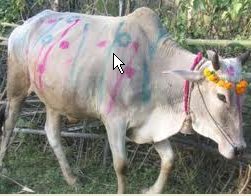
Nepal is mostly an agricultural country so oxen are considered important animals as they help in ploughing the fields. That is why on this day they are worshiped with tika, garland and offered nice food.

Govardhan Puja

Govardhan Puja is performed by making a hill called govardhan parbat using Cow dung. Cow dung has big importance in Hindu culture. In the olden days it was used for everything from light at night (Methane) to polish mud floors of traditional houses. Even now no Puja is complete without cow dung in Nepali Hindu culture.

It is believed that once there was a drought in a village in Vridavan. The villagers were very worried and they wanted to perform a big Puja in honour of Lord Indra, the God of rain. But Lord Krishna convinced them that, they should not pray to Lord Indra since it was the Mount Govardhan that brought the rain and not Lord Indra. This made Lord Indra very angry and in his wrath he sent forth a big thunderstorm to flood the village. Lord Krishan lifted the Mount Govardhan as an umbrella above the village to protect the villagers and their cattle from the rain and flood.

Mha Puja

In this day, after sunset Newar community perform Mha Puja.

“Mha” means body in the Newari language so on this day the Newa people worship their body and their inner self in the evening. They believe that the soul never dies and our body is only a vehicle and so we need to understand and respect our body as it is the chosen vehicle for this incarnation. This Puja is believed to bring prosperity and physical well-being.

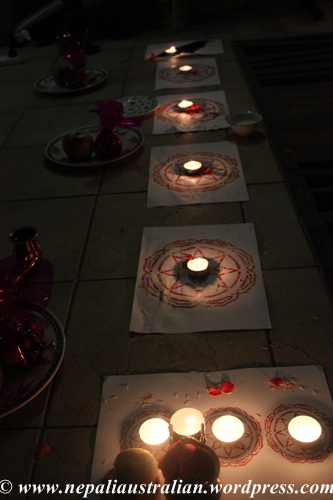
Members of the family, first males followed by females, sit cross-legged in a row. The elder group of females plays the role of facilitators for each member. A mandap, decorated with different colours and various grains, fruits and flowers, is drawn for each member of the family.

In between the grains and fruits lies a mini mandap of oil, which represents the human soul. The human soul is placed between various grains and fruits so that a person will prosper throughout the year since each object represents a particular God and it is believed that each deity will bless the person. An oil lamp with velvet cloth wick equal in length to one’s own face is lit on top of the mandap facing all four cardinal directions so that a person will be renowned in all the places of this earth.

Apart from worshipping oneself, all the household entities like brooms, water pots, utensils and machines are also worshipped in the same way.

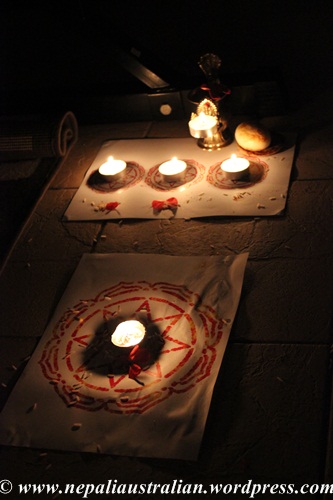
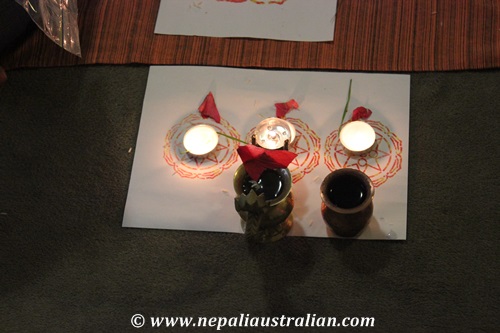
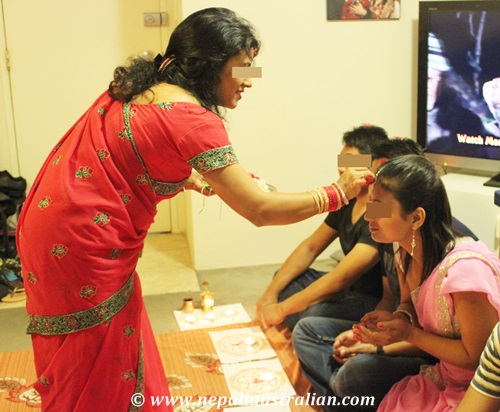
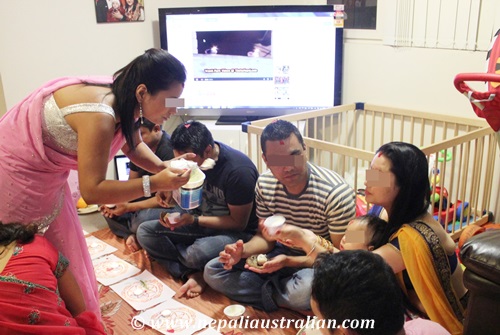
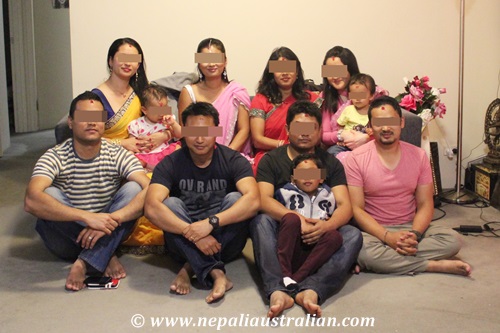
I performed Mha Puja with my brother and his family this year. This year my cousins are in Nepal so there were only 4 of us unlike 9 last year. For the Puja, first the floor was purified by sprinkling water on it then we made mandaps in front of a row of seats on the floor where we were sitting. Our mandap was designed by AS and I had printed them out on A4 paper but in Nepal they are made by hand on the floor using oil, rice flour, vermilion, puffed rice and sometimes beans.

The number of the mandaps needed is three plus the number of people doing the puja. We need three smaller mandaps at the top of the row for the Family Deity (Kuladevata), Yamaraj and Janmaraj, one mandap for each of the member performing Mha Puja. Then at the end of the row, we had a crow drawn symbolising Yama the God of death.

Normally the puja is done by the eldest member of the family but this year I did the process as my elder cousin is not in Sydney.

Process of doing Mha Puja (according to my knowledge):

  • First I gave Nasala, a few drops of water, in the palm of the right hand of everyone to sprinkle some into the mouth and rest over the body for purification.
  • I worshipped the Family Deity and Yama’s mandap with water, rice, flowers, and vermilion powder.
  • I gave water, rice, flowers, and vermilion powder to each individual to worship their own mandaps. The mandap is used as a medium to present the various offerings to the self.
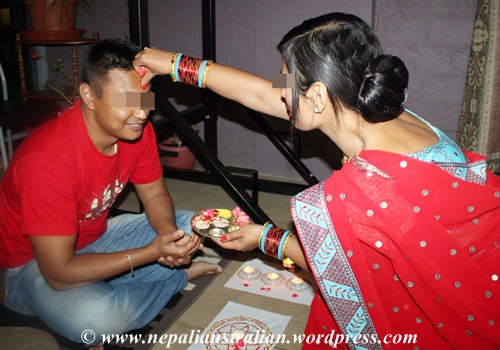
  • Then I put tika on everyone’s forehead and gave them flower to put on their head.

  • Normally in Nepal, they use Itaa (hand woven long strands made using white cloth soaked in mustard oil) but here we used tea light candle instead. I gave each person the candle and everyone took the candle from my hand, lighted them and put them on their mandap. This light is believed to brighten the inner self and keep evil at bay.
  • I used rice and flower to shower each individual and worshipped the god within.
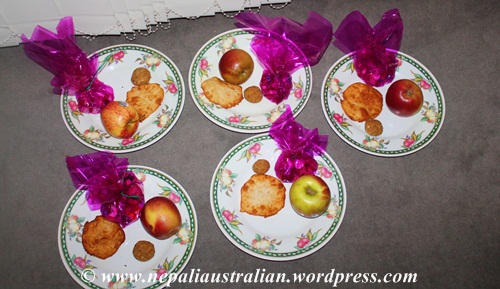
  • Then I gave every a plate with roti, sweets, fruits and masala.

  • Then,I gave Sagun to everyone. For Sagun, you put a plate of egg, bara (lentil cake), meat (chicken), a piece of garlicand fish in the right hand and yougurt in your left hand.

  • Once everyone finished eating the sagun, we used kucho (broom) to sweep the mandaps from top of the row to the bottom touching each mandap to conclude Mha puja.

Nepal Sambat

This day is also New Year’s day for Newar community and is called Nepal Sambat. Nepal Sambat is the national lunar calendar of Nepal. The era started on 20 October 879 AD and was in widespread use for all daily purposes until the beginning of the 20th century. It appeared on coins, stone and copper plate inscriptions, royal decrees, chronicles, Hindu and Buddhist manuscripts, legal documents and correspondence.

The customs of celebrating Nepal Sambat started from October 880 AD. According to a popular legend, there used to be a learned person in Bhaktapur who ordered porters to get sand from Lakhu Tirtha, a river in Kathmandu because he knew that it would turn into a heap of gold the next day. A person named Shankhadhar Sakhwaa came to know about it, and he enticed the porters to leave the sand in his place.

The next day, the sand turned into gold and with that gold he paid off the debt of all the people in the Kathmandu Valley. So from that day, people started celebrating it as their New Year to commemorate their happiness.

Even today, people are very enthusiastic to welcome the New Year. Every year, the day starts with a rally and the greeting of “Nhu Daya Bhintuna!” which means “Happy New Year”. Different programmes and functions are also organised in the Kathmandu Valley every year on this day.

The months of the year in Nepal Sambat are

Nepal Sambat month Corresponding Gregorian month
Kachha lā November
Thin lā December
Pohe lā January
Sil lā February
Chil lā March
Chau lā April
Bachha lā May
Tachha lā June
Dil lā July
Goon lā August
Yen lā September
Kau lā October

 It is Nepal Sambat 1133 this year. Nhu Daya Bhintuna everyone!!!

Also from this day, boys in groups go door to door singing special songs called Deusi similar to the Bhailo sung during Laxmi Puja. You can write just about any Deusi song as long as each line ends with the word `Deusi’ or `Deosuray’. A group of males get together, carry what-ever musical instruments they have or can play, and sing Deusi door to door blessing the home and family in return for money and/or refreshments. Teenagers perform various Deusi songs to collect money for their picnic.

It is considered auspicious to have these groups come to your front door. The house owner will offer them some rotis, fruits and money and they sing Deusi songs blessing the household with good fortune.

A Sample of Deusi Song. Includes a similar meaning in English

Bhana Mera Bhaiho Deusuray. (Say it my brothers, Say it. Deusuray)

Sormelai Kana Deusuray. (Say it louder and say it in tune. Deusuray)

Rato Batoo Deusuray. (Red mud trail. Deusuray)

Chiploa Batoo Desuray. (Slippery trail. Deusuray)

Laddai Paddai Deusuray. (Slipping and Sliding. Deusuray)

Akeya Hami Deusuray. (Finally we made it to your home! Deusuray)

…. …. Deusuray

…. …. Deusuray

…. …. Deusuray

Yo Garma Laxmi Deusuray. (In this home Lord Laxmi. Deusuray)

Sadthai Aaun Deusuray. (May always come. Deusuray)

Hamilai Denus Deusuray. (Give us what you have money or meal)

Bidtha Garnus Deusuray. (Please give us now, say good bye to us, so we can go sing for the next house!)

 Happy Tihar!!!

Gai Puja and Laxmi Puja : Tihar

As I mentioned in my previous post, today is  Gai Puja and Laxmi Puja as well.

In the morning of this day, the cow, the mother of the universe, is worshiped. According to Hinduism, the human infant is fed breast milk by its human mother for three years. After weaning, the cow acts as the surrogate mother providing milk for the rest of the human life – through childhood, adult age and old age. Cows are the mothers of the universe, the sacred animal. Hindus consider a cow as sacred and used its milk, dung and even urine for purification purpose. Those performing Cow puja place her manure in different parts of the home, drink a drop or two of the cow’s urine, as a part of a purification process. Also dip a blade of grass into the urine and lightly sprinkle it on each other’s body to become closer to the mother of the universe – cow.

People in villages who have a cow worship their cow but most of the people in Kathmandu don’t have a cow so they either go to a priest’s house or to a temple to worship the cow.

Cow is worshiped by putting tika on their forehead and a garland around their neck. They are offered a delicious meal and fruits.

 A cow also symbolises wealth and a form of goddess Laxmi.

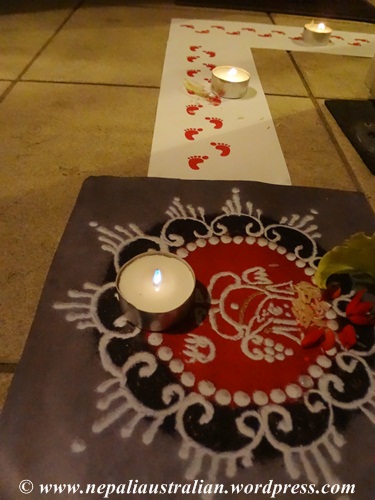
In the afternoon, the whole house is cleaned in preparation for welcoming the goddess of wealth, Laxmi. Most of the houses have their front door decorated with a mandap and have a trail of red mud leading to their Puja room (worship room in the house) .

Laxmi Puja is performed using flowers, incense, oil lamps, color-powders, bell and money (both notes and coins). Laxmi puja is performed at dusk using red mud, and puja is often done by a female in the family.

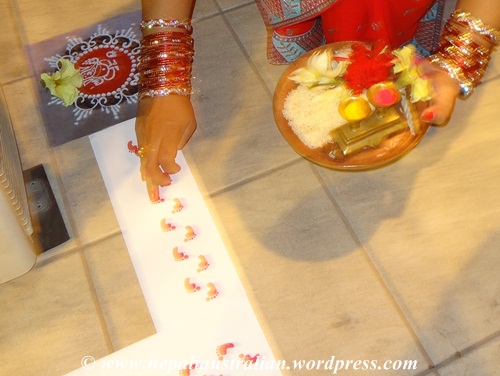
When I was young, I used to help mum do this. It was one of my favourite holiday activities. First, red mud is used to make a trail leading to the Puja room. Once it is dry, a mixture of flour and water is used to make a symbolic footprint of Goddess Laxmi on the floor entering the home. Once the flour footprints have dried, vermillion mixed with oil is put on them along with some flowers. This results in a trail of small red footprints from the main door of the house to the Puja room symbolising that Goddess Laxmi has entered the house.

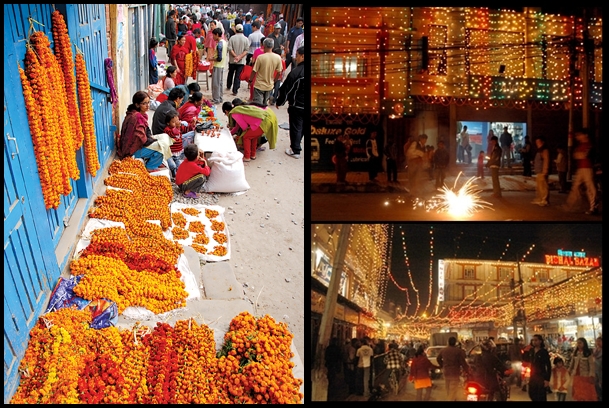
The entire house is decorated with flower garlands and lit oil lamps in every doors and windows.

Also people use firecrackers to celebrate the festival.

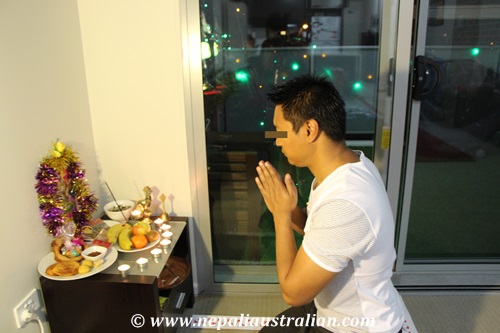
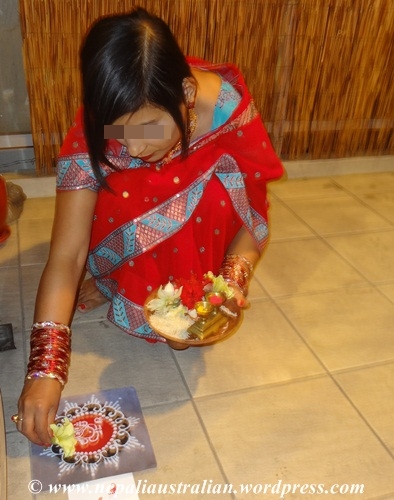
In Australia, we can’t do all this so I printed out small footsteps on paper and used that as an alternative to lead the Goddess Laxmi to our Puja area. Also at the start of the footsteps, I had a mandap of Lord Ganesh.

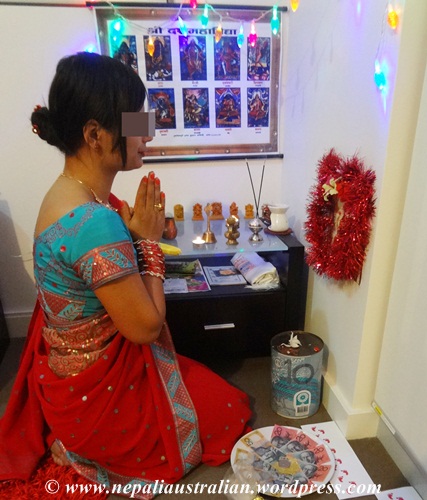
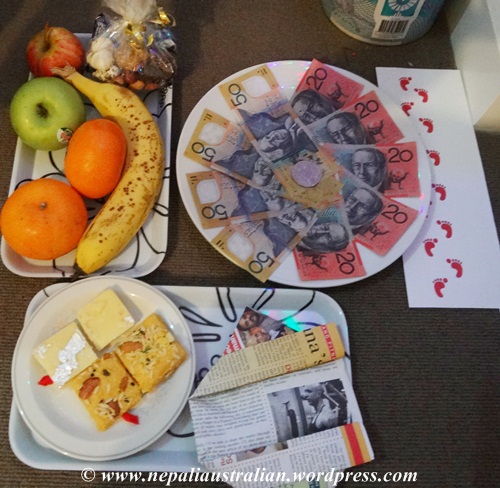
I set up a photo of goddess Laxmi with some notes and our piggy bank in the Puja area.

Then I performed Puja using tika, flower, garland, fruits, roti and masala.

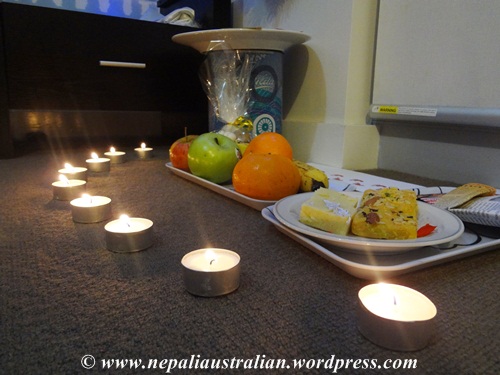
I had candles lit in the puja area as well as twinkle lights to simulate the ambience of Tihar.

Laxmi puja is not only for households but is also performed by businesses. Business-Laxmi-Puja is done exactly the same way as is done in home. Usually the company’s cashier performs the puja during which time the entire office including office compounds are lit with various lights including electrical, candle lights, and oil lamps and usually the staffs are invited to participate in the puja procession.

From this day on for the next 3 days, there will be women in groups coming door to door singing special songs called Bhailani. It is considered auspicious to have these groups come to your front door. The house owner will offer them some rotis, fruits and money and they sing Bhailo blessing the household with good fortune.

Hapyy Tihar!!!