Tag Archives: tika

Bhai Tika

The fifth day of Tihar is Bhai Puja.

Bhai” mean brother in Nepali. This festival is mainly for brothers and sisters.

It is believed that this tradition was started by Yama (the God of death) and his sister Yamuna because of their affection for each other.

In this day, sisters apply sacred Tika on their brother’s forehead and pray to Lord Yama for her brother’s long life and prosperity.

Yamaleswor temple

Some of the ethnic groups in Nepal use the Pancha Rangi Tika (Five coloured Tika)  for  Bhai Tika. First a base, rice flour is applied vertically  on the forehead then yellow, green, red, blue and white colour Tika are put on top of this line in a row. But in the Newa culture, we just use rice, vermilion and yogurt, mix them and use that as a Tika.

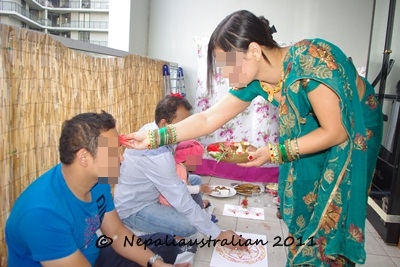
For this occasion, I had invited my brothers and their families to my apartment and we did the Bhai Tika on my balcony.

This is how I did my Bhai Tika.

Mandap Puja

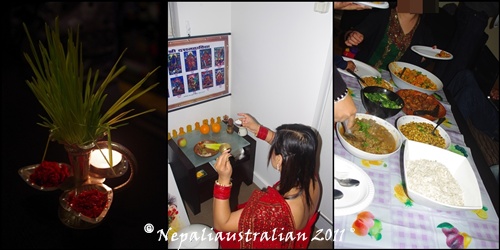
Before the Bhai Tika, just like in Mha Puja, the floor was purified by sprinkling water on it, then we made Mandaps in front of a row of seats on the floor where my brothers were sitting. I used a copy of the same Mandap which was designed by AS but this time I printed them in A3 paper. In Nepal the Mandaps are made by hand on the floor using oil, rice flour, vermilion, puffed rice and sometimes beans. The number of the Mandaps needed is three plus the number of people doing the Puja. So I had two big Mandaps, for my brothers. in a row and three smaller Mandaps at the top of the row for the House God (Kuladevata), Yamaraj and Janmaraj, and one crow drawn at the end of the row symbolising Lord Yama.

Beside the three Mandaps at one end, I also had a Sukunda with a candle on it.

Bhai Tika

Then I put all the sweets and Rotis that I had made or bought as well as some fruits around the Mandap along with the Masala and Sagun.

The Rotis I made at home this year were

  • Besana ko ladoo
  • Puri
  • Nimki
  • Lal Mohan
  • Strawberry cup cake
  • Chocolate cup cake

(I will post recipes in my next post)

I also bought Soan Papdi.

Then I had trays with fruits like mangoes, peaches, plums, rockmelons, oranges, apples and pears.

Masala and Tshirt

I made Masala at home this year with dry coconuts, dry dates, raisins, almonds, pistachio nuts, apricots, dry figs, cashews, cloves, cardamoms, beetle nuts, hard shelled walnuts, palm sugar cubes and lots of Chocolates. I used clear cello wrap and colourful bows to make it look beautiful.

For Sagun, I boiled the eggs, took the shell out and fried them in a pan. I made Bara (lentil cakes, for which I will share recipe later), fried some chicken, fish and cut fresh garlic.

Jajanka

I made Mala out of tinsel and bought Jajanka in a Nepali grocery store. Jajanka is made of many rounds of a white cotton thread forming a circle of about two feet in diameter and tied with a small piece of colourful cloth in order to have no ends. Jajanka symbolizes the integration of the beginning with the end. It is about creation, maintenance and fullness of life. Normally the Mala is supposed to be of Makhmali ful/Supadi ful (Globe Amaranth) as it never dries and always looks fresh.

I also bought  T-shirts for both of them.

Bhai tika process

  •  First I gave Nasala, a few drops of water, in the palm of the right hand of my brothers to throw some into the mouth and rest over the body for purification.
  • I worshipped the House-God and Yama’s Mandap with water, rice, flowers, and vermilion powder.
  • I gave water, rice, flowers, and vermilion powder to my brothers first to worship the Mandap of the House God and then the crow, then to worship their own Mandaps. The Mandap is used as a medium to present the various offerings to the self.
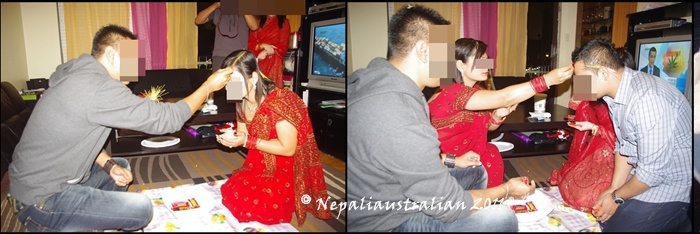
  • Then I put Tika made of vermillion, rice and yogurt on my brothers forehead and gave them flowers to put on their head as a blessing form God. This was followed by Mala and Jajanka around their neck.

    Putting TIka

  • Normally in Nepal, they use Ita (special long threads made using white cloth soaked in mustard oil) but here we used tea light candles instead. I gave both my brothers the candles. They  took the candle from my hand, lit them and put them on their Mandap. This light is believed to brighten the inner self and keep evil at bay.
  • Then I took some water in an Ankhura (a small pitcher for Puja) filled with oil and water and Dubo in my hand and circled around my brothers three times.

    Making circle with oil and water

  • Then I gave them some rice and flower in their hand. Then I gave trays of Rotis, fruits, Masala, sweets and clothes to them and they had to hold them and keep them from touching the ground. Then I toke some rice and flower in my hand and showered each of them and worshipped the god within them. Only after that could they put the trays down.
  • Then my brothers put Tika on my forehead, touched my feet for my blessings and gave me the gifts they had brought for me. 
  • I gave them the Sagun . For Sagun, you put a plate of egg, Bara, meat and fish in the right hand and yogurt or alcohol in the left hand
  • Once everyone finished eating the Sagun, we used Kucho (broom) from top end of the row of Mandaps to the bottom of the row, touching each Mandpa to erase them and conclude our Bhai Tika.
This slideshow requires JavaScript.

Goru Puja , Govardhan Puja , Mha Puja and Nepal Sambat

The third day of Tihar is Goru Puja, Govardhan Puja, Mha Puja and Nepal Sambat.

Nepal is mostly an agricultural country so oxen are considered important animals as they help in ploughing the fields. That is why on this day they are worshiped with tika, garland and offered nice food.

Also this day small hillocks made out of cow dung is worshiped. It is believed that once there was a drought in a village in Vridavan. The villagers were very worried and they wanted to perform a big Puja in honour of Lord Indra, the God of rain. But Lord Krishna convinced them that, they should not pray to Lord Indra since it was the Mount Govardhan that brought the rain and not Lord Indra. This made Lord Indra very angry and in his wrath he sent forth a big thunderstorm to flood the village. Lord Krishan lifted the Mount Govardhan as an umbrella above the village to protect the villagers and their cattle from the rain and flood.

This is also the day Mha puja is performed by the Newa people.

Mha” means body in the Newa language so on this day the Newa people worship their inner self in the evening. They believe that the soul never dies and our body is only a vehicle and so we need to understand and respect our body as it is the chosen vehicle for this incarnation. This Puja is believed to bring prosperity and physical well-being.

I performed Mha Puja with my brother , his family and with my cousins on my brother’s balcony. First the floor was purified by sprinkling water on it, then we made mandaps in front of a row of seats on the floor where we were sitting. Our mandap was designed by AS and I had printed them out in A4 paper but in Nepal they are made by hand on the floor using oil, rice flour, vermilion, puffed rice and sometimes beans. The number of the mandaps needed is three plus the number of people doing the puja. We need three smaller mandaps at the top of the row for the House God (Kuladevata) , Yamaraj and Janmaraj, one mandap for each of the member performing Mha Puja. Then at the end of the row, we had a crow drawn symbolising Yama the God of death.

Normally the puja is done by the eldest member of the family but this year I did the process as my elder cousin is not in Sydney.

Process of doing Mha Puja:

  • First I gave Nasala, a few drops of water, in the palm of the right hand of everyone to throw some into the mouth and rest over the body for purification.
  • I worshipped the House-God and Yama’s mandap with water, rice, flowers, and vermilion powder.
  • I gave water, rice, flowers, and vermilion powder to each individual to worship their own mandaps. The mandap is used as a medium to present the various offerings to the self.
  • Then I put tika on everyone’s forehead and gave them flower to put on their head.
  • Normally in Nepal, they use Ita (special long threads made using white cloth soaked in mustard oil) but here we used tea light candle instead. I gave each person the candle and everyone took the candle from my hand, lighted them and put them on their mandap. This light is believed to brighten the inner self and keeps evil at bay.
  • I used rice and flower in my hand to shower each individual and worshipped the god within.
  • I gave Sagun to everyone. For Sagun , you put plate of egg , bara (lentil cake), meat,piece if ginger and fish in the right hand and yougurt in your left hand. 
  • Once everyone finished eating the sagun, we used kucho (broom) from top to bottom touching each mandap to conclude Mha puja.


This day is also New years day for Newar community which is called Nepal Sambat .  It is Nepal Sambat 1132 this year. Happy New Year!!!

Also from this day, boys in groups go door to door singing special songs called Deusi similar to the Bhailo sung during Laxmi Puja. It is considered auspicious to have these groups come to your front door. The house owner will offer them some rotis, fruits and money and they sing Deusi songs blessing the household with good fortune.

 Happy Tihar!!!

Gai Puja and Laxmi Puja

The third day of Tihar is Gai Puja and Laxmi Puja.

In the morning of this day, the cow is worshiped. Hindus consider a cow as sacred and used its milk, dung and even urine for purification purpose. Cows are worshipped with tika and garland with a nice meal. People in villages who have a cow worship their cow but most of the people in Kathmandu don’t have a cow so they either go to a priest’s house or to a temple to worship the cow.

 A cow also symbolises wealth and a form of goddess Laxmi.

In the afternoon, the whole house is cleaned in preparation for welcoming the goddess of wealth, Laxmi. Most of the houses have their front door decorated with a mandap and have a trail of red mud leading to their Puja room(worship room in the house) .

When I was young, I used to help mum do this. It was one of my favourite holiday activities. First red mud is used to make a trail leading to the Puja room. Once it is dry , a mixture of flour and water is used to make a symbolic footprint of Goddess Laxmi on the floor entering the home. Once the flour footprints have dried, vermillion mixed with oil is put on them along with some flowers. This results in a trail of small red footprints from the main door of the house to the Puja room symbolising that Goddess Laxmi has entered the house.

In Australia we can’t do this so I printed out small footsteps in a piece of paper and use that as an alternative to lead the Goddess Laxmi to our Puja area. We also put our piggy bank in the Puja area.

Laxmi Puja is also done by businesses to have a prosperous year ahead. They put tika on Goddess Laxmi’s idol as well as their cash register and deposit safes.

From this day on for the next 3 days, there will be women in groups coming door to door singing special songs called Bhailani. It is considered auspicious to have these groups come to your front door. The house owner will offer them some Rotis, fruits and money and they sing Bhailo blessing the household with good for fortune.

Hapyy Tihar!!!

Happy “Dashami”

The tenth day of Dashain is called  ‘Dashami’. On this day we take Tika and Jamara from our elders and receive their blessing.  The red Tika also symbolizes the blood that ties the family together. Elders will give “Dakshina”, or a small amount of money, to younger relatives at this time.

This year Tika was on Thursday so after work, I performed Puja at home. Then we went to my cousin K’s place for tika. We had a Nepali bhoj and lots of fun.

Here are some pics from the day.


L-R Jamara, Me performing Puja, yummy food


L-R AS putting tika on me, Me putting tika on my brother

Engagement ceremony

After AS told me he loves me (Our unconventional love story), everything went in fast pace. We continued to Skype and phone and by the time he was going to be in Nepal, we both were sure this is what we wanted. Even it wasn’t long, it felt like we been together for life time. I think as we were friends for so long, it helps us to bridge the distance we had.

The next step for both of us was to tell our parents as we want them to stop looking for match for us. We were planning to do that around the same time so we know straight away how things are going to work out or not. Both of us are from same culture, same ethnic background and same cast so it seems done deal. But until we really make that step we were worried. We didn’t have any other plan if our parents said NO for any reason.

With the grace of God, both our family took the news very well and they wanted to meet each other officially. They were happy that we made a good couple. So the date was fixed for meeting where they were going to officially ask my hand for marriage called “Kochi” ( Newari word for fix).This is a tradition in Newari / Nepali wedding.

That was one of the scary days for us as things were happening too fast. We know it was going great but still scared if something will come into picture and ruin everything. But after our family meeting in one of the restaurant in Kathmandu, everything went well.

As both of us were leaving Nepal again, both the family though it is wise to have engagement ceremony to announce that we are engaged to be married soon. For AS and me it was great relief that things were going as we wanted.

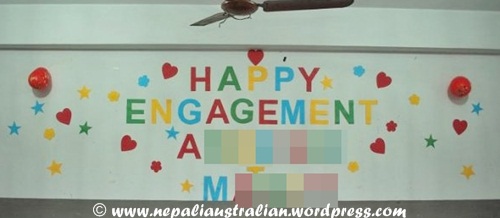
Both families agreed that ceremony should be small and for only close family and friends. But I forgot in Nepal, small is not really small and it turned out to be ceremony for almost 150 people. Initially, we were planning to have the ceremony at my house, but with 150 people, it was not possible so a date and venue was arranged.

I was dressed in red sari with golden work. Had my hair and make up done Nepali bridal way. AS was dressed in dark blue suit and I swear he looked so handsome. My mother in law, following traditional way, has brought trays of sweets, fruits and gifts for me.

The ceremony started with welcoming everyone to this big new family. It followed by elder putting Tika (a mixture of rice, yogurt and vermillion) on our forehead. At the end , we had so much Tika on our forehead; it kept sliding to our nose.

Then in front of our families and friends, we exchanged rings and we were officially “ENGAGED”.

After that we cut cake, had photo time with everyone. It was followed by snacks and main meal. And of course there was much-loved dancing.

It was really a great days for both of us. We never expect it to be so easy and quick but we didn’t mind.

This ceremony was followed by