Monthly Archives: October 2012

Dashain

Dashain is the 15 day Hindu festival celebrated in Nepal. It is the longest Hindu festival and it falls around September – October, starting from the bright lunar fortnight and ending on the day of full moon. Dashain is also popularly referred to as Bada Dasain, Dashera, Vijaya Dashami etc.

This year Dashain starts today, 16 October which is Ghatasthapana (Literally pot establishing). Ghatasthapana is the first day of Dashain and it is the day in which Jamara is planted on a pot or Kalash. The other important days for the festivals are Day 7 called Fulpati (21 October), Day 8 called Maha Asthami (22 October), Day 9 called Maha Nawami (23 October) and Day 10 called Dashami (24 October). The festival ends the 15th day with Purnima, full moon.

Every year Nepalis, remember the message “Good always wins over the evil”, with the celebration of the great festival of Bada Dashain.

Legend behind Dashain

King Ram Chandra, whose wife Sita was kidnapped by King Rawan, with the help of hanuman and its military, conquered Rawan on the tenth day, after regular worship of Durga Bhawani for 9 days. The 10th day is the victory day. We put tika on our forehead as prasad of the victory.

Another legend goes like this.

Demons, or Asuras, became very powerful and ambitious and continually tried to defeat the Devas, or Gods, and capture Heaven. One Asura, Mahishasur, in the form of a bull, grew very powerful and created havoc on the earth. Asuras started defeating the Devas and chasing them away from the heaven. The world was crushed under Mahishasura’s cruelty; the Devas put their energy together and form Shakti, a single mass of incandescent energy, to kill Mahishasur.

A very powerful band of lightning emerged from the mouths of Brahma, Vishnu and Shiva and a young, beautiful female virgin with ten hands appeared. All the Gods gave their powers and special weapons to her. This Shakti blended to form the goddess Durga. Riding on a lion, Durga Bhawanu fought Mahishasur. The battle raged for nine days and nights. Finally on the tenth day of Ashvin shukla paksha, Mahishasur was defeated and killed by Durga. This is the day of celebration.

Day 1: Ghatasthapana

Ghatasthapana marks the beginning of Dashain. It literally means installing a pot which symbolizes Goddess Shakti. In this day, Jamara is planted establishing the holy Kalash vessel, which represents the goddess Durga. Goddess Shakti is believed to reside in the Kalash vessel during the Dashain.

Today, everyone in Nepal will plant Jamara to mark the start of Dashain. Normally, Jamara is planted in Puja ghar (prayer room). Jamara pot is kept away from direct sunlight, and holy water is offered to it every day, so that by the tenth day of the festival the seed will have grown to five or six inches long yellow grass. This sacred grass is known as Jamara.

Today, before coming to work, I planted my Jamara as well :). It is the second time I have planted Jamara and I am hoping like last year, it will be a good one so I can use this for puja and tika .
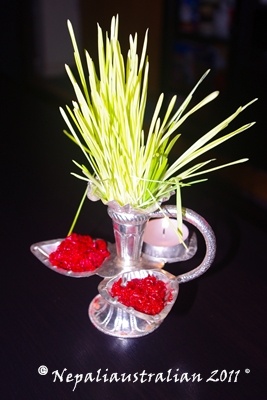
How to plant Jamara

  • Soak barley seeds overnight. I used a Jamara mix (barley, corn, wheat) from Nepali grocery shop.

  • Get a deep bowl or container with a flat bottom. I am using a clay flower pot this year. Fill it with a layer of sand about 2 inches thick.
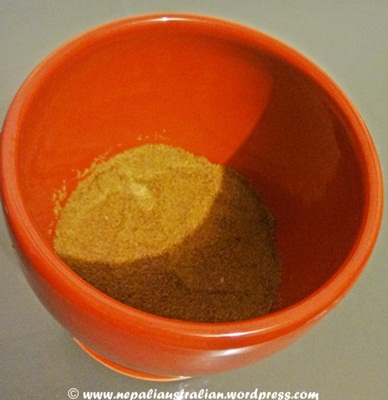
  • Sprinkle a layer of soaked Jamara mix into the container.
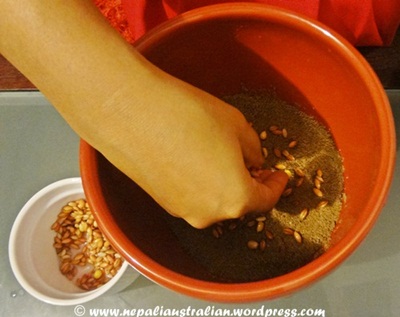
  • Make sure it is only one layer of the seeds so they have enough room to sprout.
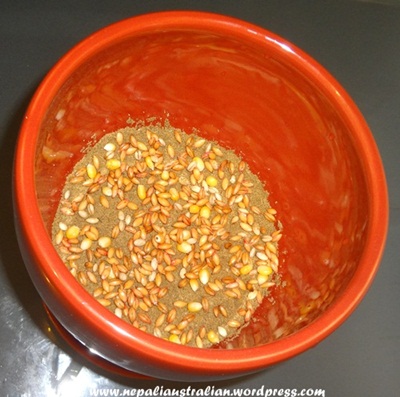
  • Cover the seeds with a thin layer of sand.

  •  Sprinkle some water in the container. The sand should be moist, but not soggy.

  • Cover the container and put it in a dark corner, away from the sun.

  • Check the container daily to make sure that the sand is moist.

  • Your Jamara should be is ready for Tika.

Click here to see how Jamara looks like from my last year’s post.

If you are in Nepal, you will see lots of signs of Dashani which will remind you that the festival season is on.

Lots of kites in the sky

Flying kites has been a very important part of celebrating Dashain in the country as it is considered to be one way of reminding god not to send rain anymore. When I was a kid, we used to gather on the rooftop of the house and take turns flying kites. My brothers and his friends would be there and I would be there trying to learn how to fly kite. They used to teach me but most of the time I dropped the kite too low when I was taking control and one of them would jump in and take over  before someone could cut it in the sky, with so many kites fighting already.

When you cut someone else’s kite, you shout ‘Changa Chet‘ literally meaning Kite, cut! If we had a big group of friends we even used to take metal plates or metal buckets with metal spoons and bang them to make a loud noise to celebrate the Changa Chet. I know it might sound weird but it was lots of fun.

Ohoo, how I miss my childhood Dashain.

Kites are not only for kids but adults get into the spirit and have some fun too.

Everyone playing cards

Gambling is illegal in the Nepal but it is usually permitted in public places during this festival. While children are busy flying kites during Dashain, the older members of the family pass their time by getting together and playing cards with each other for money and fun all day long.

As a kid, I remember playing cards using 1 shuka (a quarter /25 paisa) and trying to win more money. It was so much fun to team up with the cousins and play it as a group. That is the only time we didn’t get scolding from our elder for playing cards.

 Everyone busy shopping for new clothes

I would never have thought as a kid I would ever own 100s of dresses or shoes in my lifetime. As a kid, Dashain was especially exciting as I got to buy new clothes along with a new pair of shoes which I could wear during the festivals. All of my friends used to gather during Dashain and show off our new dress and shoes 🙂

Buying and wearing new clothes is an important part of the festival. As many people are living in the villages below the poverty line and for them it is often the case that new clothes come only with Dashain. Almost all the shops in the country have festival offers and discounts. This makes shopping even more attractive to people. Clothes have the highest sales during the festival.

To get into the Spirit of Dashain, we went shopping last weekend and I bought two dresses and a pair of shoes. My husband bought a jacket and a few t-shirts :). I am wearing my new dress today so Dashain has already made an impact in our lives.

Swings everywhere

During Dashain, bamboo swings are constructed a week before Ghatasthapana in many parts of the country as a way of celebration. These bamboo swings are called ‘ping’ in Nepali. These kinds of swings present the best of local culture, tradition, community spirit and fun.

These swings are constructed with the help of community members using traditional methods which make the use of ropes made from tough grass, bamboo poles and wood etc. Theses swings are dismantled only after the festival of Tihar which is 2 weeks after Dashain.

The heights of some swings exceed twenty feet and one can swing really high. One can see people of all ages enjoying the swing. It is especially famous with the children.

I used to love these swings. It goes so high that the adrenaline kicks in. I used be a bit scared to get on at first but once you are on it, it is a great feeling. I am sure these kinds of swings won’t be allowed in western countries as it will be consider a health hazard as it doesn’t have any safety harness 🙂

Dashain Fairs everywhere

Different kinds of fairs are also organized during the festival. Usually small fairs are organized in the villages with the Ferris wheels for children and other items of entertainment for the adults. However, in the city it is the commercial fairs and celebration events that are usually organized.

My memories of Dashain fairs are of Bhrikuti Mandap Dashain Mela. My parents used to take my brother and me there and we were allowed to buy treats. They had concerts, dance shows, magic shows, family games, Band competitions, games, food, and a lot more. They also had stalls with goats, chickens, ducks etc. and great for people who want to buy animals to sacrifice for Nawami.

Also these days they organise lots of musical concerts during these festivities.

In Sydney, during Dashain there are lots of musical concerts with Nepali artists visiting down under to celebrate the festivals. Dashain festival and dance parties are also organised here to make merry and have a get together.

Animals slaughtered

This is probably the worst part of Dashain for me that thousands of animals such as buffaloes, ducks, goats, etc. are slaughtered during Dashain every year.

It is considered an important ritual since it is believed that the goddesses are appeased by such sacrifices. Almost all the temples, especially the temples of Goddess Durga and Kali  around the country are offered with thousands of sacrifices.

Asthami and Nawami are the days when the sacrifices reach their peak. While thousands of animals are sacrificed to appease the goddesses, people also slaughter animals for the purpose of feasts. Since a large number of feasts and gatherings are organized throughout the fifteen days of the festival, the demand for meat goes up considerably. Hence to meet the demands the slaughtering of animals becomes considerably high during the festival.

However, for the past few years the animal rights activists in the country have been continuously opposing these acts of slaughtering of animals in such a manner. They have been requesting people to stop such inhuman acts of killing the innocent animals and instead have suggested them to offer fruits and vegetables to the Goddesses since they believe that it is mentioned nowhere in the Hindu religious books that such sacrifices appease the gods and goddesses.

I do know that we need meat from animals but I still think it doesn’t need to be cruel killing of animals for the meat. I am sure there can be less violent way of killing animals for their meat.

As I am not into killing animals and also I can’t do that in Australia so I will be using coconut instead to mark Nawami. I will keep you posted about Dashain for the next 15 days.

A relaxed mind, a peaceful soul, a joyful spirit, a healthy body; be a heart full of love, may you have all these every day. Happy Dashain everyone!!!

Helensburgh Hindu temple

I am sure you get the vibe from my blog that I am not a very religious person but I do enjoy going to the temple occasionally. My husband always reminds me how religious my mum is and he finds it a bit surprising that I am not like my mum in the religion department. I always tell him, “If I have a clean heart and make sure that I am not hurting anyone in my day to day life, God will consider me as a good citizen and will be happy with me. There is no need to really visit a temple all the time or pray for hours :)”.

There are not that many Hindu temples in Sydney and most of them are not close to where I live so planning is required to visit one.

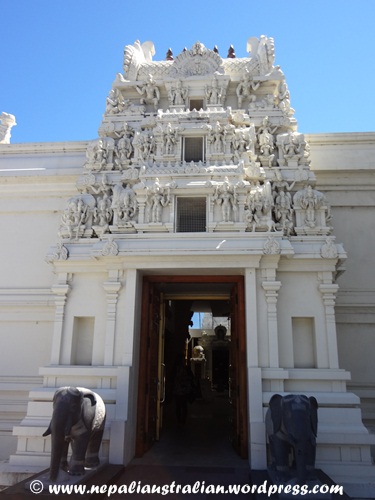
From time to time I feel like I should go to the temple and pay my respect so I drag my husband along for some prayer. Last weekend we managed to go to a temple in Helensburgh called Sri Venkateswara Temple. It is around 45 minutes’ drive from my apartment or an hour from Sydney city center (55km). The temple is built on top of a hilly area 400 feet above sea level. It has four ‘praharam’ (encircling corridors). Sri Venkateswara Temple was built in 1978 by the Indian people in Australia as a South Indian-style Hindu temple.

So far there is no Nepali temple in Sydney but they are planning to build a version of Nepal’s famous Pashupathi in Sydney.

At the temple devotees are supposed to leave their footwear outside and wash their hands and feet before they enter the temple. The temple area inside has small shrines for each of the Gods. There are priests performing rituals at each of the shrines at a pre-determined time.

There is a temple counter inside which provides visitors with more information about temple rituals and prayers.  They also sell puja for $15 which goes towards maintenance of the temple. You get a plate of puja which has Sindoor, flowers, dhup and fruits. Also, you can buy diyo (oil lamp) if you want to light just the diyo.

The temple has deities like Lord Venkateswara, Goddess Mahalakshmi ,Lord Chandramouleeswarar, Goddess Thripurasundari , Lord Ganesh, Lord Subrahmanya , Lord Navagraha, Goddess Durgambika , Lord Rama , Goddess Andal , Lord Krishna, Lord Brahma , Lord Hanuman, Lord Garuda  , Lord Sudharsana , Lord Viswakshena , Lord Dhakshinamurthy and Lord Chandikesa.

I have seen lots of South Indian weddings being performed inside the temple in my previous visits.

I know it doesn’t sound so right but I love to go to this temple because they serve a great Indian food in their canteen during weekends. I always have Masala Dosa (made by stuffing a lightly cooked filling of potatoes, fried onions and spices in a fermented crepe or pancake made from rice batter and black lentils) and Vada (a donut  shaped dish made from lentils and gram flour or potato) . They are so cheap but so yummy. They do sell other South Indian vegetarian dishes as well but those two are my favourite especially with masala tea (spiced Indian style milk tea).

The temple opens 8am – 7pm, week-ends and public holidays; 8.00am to 12.00pm and 4.00pm to 7.00pm on weekdays.

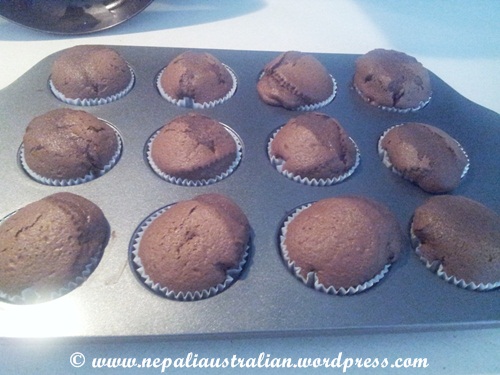
Chocolate cupcakes

Ingredients (make 12 cupcakes)

  • 80g unsalted butter, softened
  • 1/2 cup caster sugar
  • 2 eggs
  • 1 tsp vanilla extract
  • ¾ cups plain flour
  • ¾ cup cocoa powder
  • 2 tsps baking powder
  • ½ cup milk

Icing

  • 50g unsalted butter
  • 1 cup icing sugar
  • 1 cup cocoa powder
  • 2 tbsp milk
  • Sprinkles or lollies to decorate

Steps

  • Preheat oven with fan to 180°C or without fan for 200°C.
  • Place cupcake papers in two 12-hole cupcake trays.

  • In an electric mixer, beat butter for 2 minutes until pale in colour and creamy. Add sugar one third at a time and cocoa beating well between each addition. Add the eggs one at a time, beating for about a minute between each addition. Add the vanilla essence and beat until combined.

  • Sift flour and baking powder and add half to butter mixture with half the milk, mix until well combined. Repeat with remaining flour and milk.

  • Divide batter evenly between 12 patty cases.

  • Bake for 15-20 minutes, Cupcakes are baked if they spring back when lightly touched in the centre. Allow cupcakes to cool in pan for 5 minutes before transferring.

Icing Steps

  • In an electric mixer, beat Cream butter until pale and smooth. Add the milk and half the sifted icing sugar and cocoa powder. Beat until well combined. Add the remaining icing sugar and beat until mixture is light and fluffy. The mixture should be a spreadable paste; if it is too dry, add some more milk, if too wet add more icing sugar.

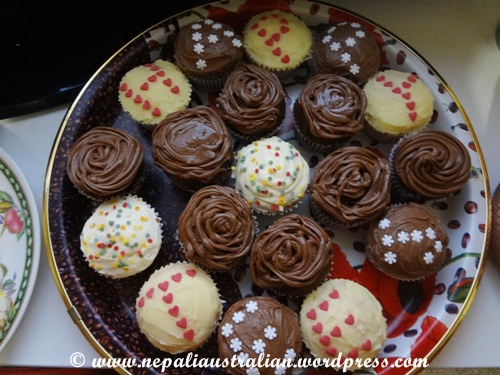
  • When cakes are cold, spread generously with icing and dip into sprinkles or decorate with small lollies.

Rose cupcake icing

I also decided to do a rose swirl with the icing. As it was my first attempt, it was not very good but here are the steps.

  • Start from the middle and pipe a small amount of buttercream into the centre.

  •  Slowly work your way around going anti-clockwise until you reach the outer edge of your cupcake. Remember to apply even pressure to your pipping bag, this insures an even swirl all the way around.

Here is the YouTube video if you want to try.

I made them for Teej along with Vanilla cupcakes.

Aastha Pokharel representing Nepal on Asia’s Next Top Model

I am sure you all know the show called America’s Next Top Model. We have our own version here in Australia called Australia’s Next Top Model. They are doing a new Pan-Asian version of it called Asia’s Next Top Model and I am so glad to see Nepal being represented in this contest.  🙂

The new Pan-Asian television series gives young Asian women, with modelling aspirations, an opportunity to prove that they can make it in the high-stress, high-stakes world of international modelling. Coming from various backgrounds across Asia, the series follows the top model hopefuls as they live and compete against each other for the coveted prizes.

Hosted by Nadya Hutagalung, the show charts the transformation of aspiring models into successful top models. With fashion director Daniel Boey, fashion photographer Todd Anthony Tyler and model mentor Joey Mead King guiding and mentoring the top model hopefuls, these young women will see themselves competing in a highly-accelerated modelling boot camp to top model fame.

The winner of the first season will be offered a contract with one of the top modelling agencies in Asia and/or Europe.

Aastha Pokharel is representing Nepal and she should do a great job as she has lots of experiences as a model in Nepal.

Here are some details of Aastha Pokharel

  • From: Kathmandu, Nepal
  • Education: Bachelor in Nursing
  • DOB: 10/24/1991
  • Sex: Female
  • Height: 5’9″
  • Weight: 53 kgs
  • Waist:   25.5″

Asia’s Next Top Model will be broadcasted across Asia from late 2012. With 13 episodes of fresh new Asian modelling talent, you would be exposed to the calibre of work and passion that builds and sustains this industry.

Wishing Aastha all the best on her journey. Please support Aastha Pokharel and her journey on Asia’s Next Top Model.

You may also like :

*Aastha journey’s in Asia’s Next Top Model *Prabal Gurung : A Fashion designer from Nepal *Varsha Thapa: First international fashion model from Nepal

Guest Post : Forward

Thank you Nelle for sharing her life with this wonderful post. You can check her blog on nellewrites. She is truly talented and amazing writer and I am eagerly waiting for the day when her book will be published.

Also I will like to congratulate her for upcoming award for her volunteerism at Planned Parenthood. You are a good example of how commitment and hard work pay off.

My appreciation and gratitude to Nepaliaustralian for her invite to write a guest post for her fascinating blog.  She takes us on such wonderful journeys and mini-tours with each new post, through two places and more what seem so exotic.

Fiction writing flows easy from my soul.  My own blog exists as a relief valve replete with short stories.  On occasion, my writing ventures into the personal, shared glimpses at the last dozen years.  I cannot take you all on a tour of wondrous places, so the logical writing for this guest post flays open part of my life and exposes a path fraught with experiences I care not to repeat.

Sometime just short of fifty-eight years ago, a physician declared me male at birth.  Gender assumptions ruled, through childhood, adolescence, and decades of adulthood.  One big caveat occurred in 1960, year America elected John F Kennedy president.  My gender exploration as a six year old earned a declarative statement from my father.  “You’re sick.”

So I believed, through the 1960s, 1970s, 1980s, and three quarters of the 1990s. What ensued I’ll truncate and spare much detail.  Married, parent, businessowner, these descriptive terms of my life collided with jumbled works within beginning in the late 1990s.  Gender pressure ratcheted to an unholy level.  It worked over my ability to function, a steady slide into oblivion, to the detriment of all around me.

The worst of it fell within a thirty-month window, 2001 through 2003.  I crossed gender lines nine years ago, and in 2008, faced an expected indictment that led to a two-year sentence and twenty-one months served in a federal prison camp, from June 2009 to my release in March 2011.

The dysfunction would not define my life.  Eight years ago, I pulled myself together, driven by some inner will to overcome and rebuild.  It required fighting through severe depression.  It meant re-commitment to personal and work ethics.  Over the ensuing four and a half years as a state employee, I rebuilt integrity lost in those thirty months, manifested in my commitment to each claimant and in distinguished service to my employer.

People fall into horrid circumstance.  Sometimes we act in irrational ways or shut down when faced with unimaginable pressure.  If one stumbles as I did, don’t accept it.  Strive for better.

Don’t stay down.  Don’t accept failure.  Learn from the adversity.  Get back up and dust off.  Learn from weaknesses and overcome them.  Commit to the truth no matter if it carries adverse consequences.  Commit to make amends, to rebuild and move forward.  And after, consider precious rebuilt integrity.

I’m a student, again.  I’m a Planned Parenthood volunteer, less than two weeks from receiving an unexpected state award honouring my volunteerism.  I’m a writer, new, four years into the creative path after a lifetime of business writing.  My first novel, now in its eighth edit nears an end.  I anticipate at least two more edits before the agent process begins.

Regrets?  Many.  Guilt?  Much.  Stronger?  🙂

Please click here if you are interested to write a guest post for me.