Category Archives: Newari Culture

Kumari – The living Goddess

I had this post sitting in my draft box for a while but the article I read in the dailymail online inspired me to finish and post it. Please click here if you want to read it too.
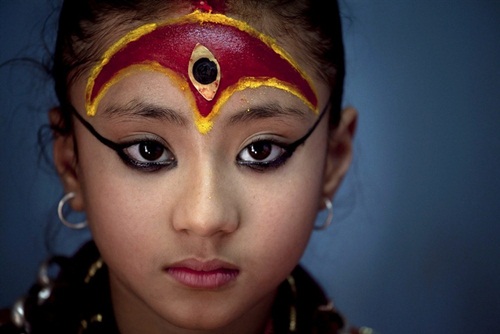
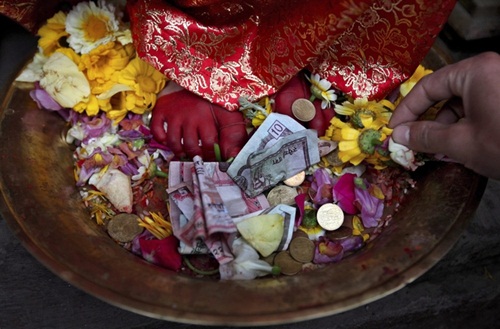
The word kumari literally means virgin in Nepali. Kumari is the only living Goddess in the world worshipped by Hindus and Buddhists in Nepal. The Living Goddesses are young pre-pubescent girls that are considered to be incarnations of the Hindu goddess of power, Kali and Goddess Taleju.

History behind Kumari

For over 300 years now, it is believed that the spirit of the goddess Taleju has been residing in a succession of pre-pubescent virgin girls in this way, and the future of the country has balanced precariously on their pleasure. With a frown they have held back the rains; a single tear from their eye has resulted in floods. An ancient ruler ofNepalis even said to have died after the reigning Kumari fell asleep during an audience with him.
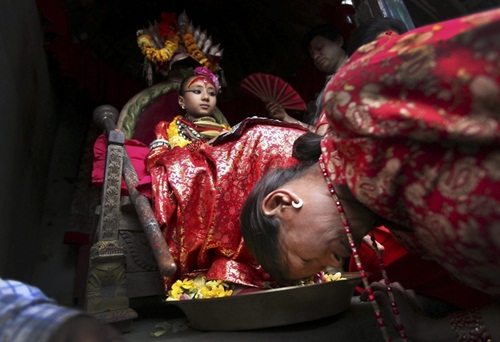
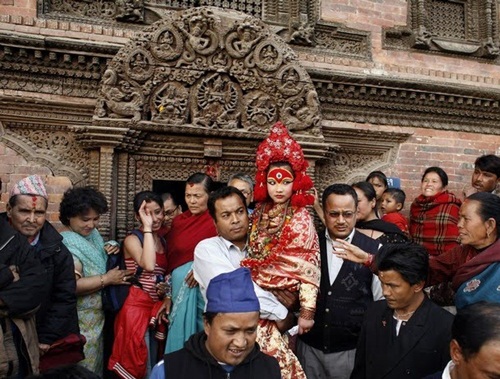
There are 10 Kumaris in Nepal but I have seen the ones from Kathmadu and Patan only. The Kumari from Kathmandu is considered the Royal Kumari and follows a bit different rules than the rest of the Kumaris. The Royal Kumari resides in Kumari Ghar in Kathmadu Durbar Square while the rest of the Kumaries live at home with their parents and family, and go to school as any other normal girl. They have certain ritual duties that they have to perform regularly, but otherwise live a pretty normal life.
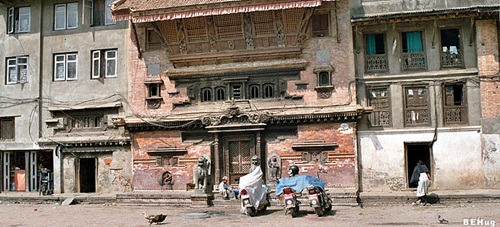
Kumari Ghar

How Kumari is chosen?

Young Buddhist girls from, Kathmandu’s Newar community, Shakya or Bajracharya are chosen as “living goddesses”.  Normally it is a privilege to have your daughter contest in this selection process.
These are some features a young girl should have to consider to be chosen as Kumari .

  • Virgin with an unblemished body
  • Body of the Banyan tree
  • Eyebrows like the cow
  • Black straight hair
  • White teeth without any gaps
  • Dark eyes
  • Mona Lisa like smile
  • Sonorous crystal clear voice
  • Long slender arms
  • Delicate and soft hands and feet
  • Thighs like those of a deer
  • Neck like a conch-shell
  • Tongue – small and moist
  • Sexual organs small and well-recessed.

Above all, she should possess 32 lachchins (characteristics). She must have a sense of courage and should not fear a masked man or an animal sacrifice and she must never have lost a drop of blood. Her horoscope must match that of the king (it was so in the past, may be the President’s horoscope is considered now).
During the eighth day of Dashain, called Kal-ratri, the selection process of Kumari begins. The would be Kumari is left in a room with 108 decapitated buffalos laid out in a sea of blood with men wearing horrid masks dancing among them. This is to test the fearlessness of the girl. If the child gets scared and cries, she will be disqualified and the next girl has to go though the process until they find a girl who can smile in that surrounding and enjoy the dance of the masks men.

The Kumari Festival

Every September, during the Indra Jatra festival, the living goddess in all her bejewelled splendor is borne in a palanquin in a religious procession through parts of Kathmandu. It is a grand festivel attended by people in the thousands, who come to see the living goddess and seek her blessings. In keeping with an old tradition, the Kumari also used to bless the King but now she bless the president and prime minister of the country.

Controversy regarding Kumari

Critics say that the tradition violates the child’s human rights and leaves her unprepared for life after retirement.

Here is a documentary by ABC Australia on Kumari.

I’ll let you decide what you want to believe in but for people of Nepal, Kumari is still a Goddess who they respect and bow to. Kumari is the faith of Nepal and they still believe that she is an incarnations of the Hindu goddess of power.
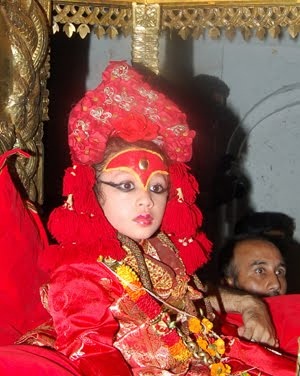
Today, in the name of modernity, some members of the human rights groups along with the government are proposing that the Kumari tradition be abolished for good. Personally, I think Nepal should learn how to make its culture rich and safe instead of abolishing it, because it is centuries long tradition and this need to be kept alive for the future generation so they can learn and know more about it. Seeing the European countries spending millions to preserve their history and culture, it will be sad to see this tradition stopped.

Maghe Sankranti

I think many of you know already that from my previous posts that Nepal follows a different calendar than the Gregorian calendar. So the months are different and the start and end of the months do not match with the Gregorian calendar. Also Nepali people have lots of festivals according to their own calendar. 

On Sunday, 15 January, it was 1st of Magh  2068. This day is called Maghe Sankranti. It is the end of winter and start of warmer days in Nepal which is also believed to bring an end to the ill-omened month of Poush when all religious ceremonies are forbidden. 

Normally people go to holy rivers around the country  like Devghat, Dolalghat, Sankhamul Ghat to take a holy dip in the morning and offer auspicious food like laddoos (sesame seeds candy ball), chaku (molasses), ghee (clarified butter), sweet potatoes, yam, khichari (mixture of rice and lentils) and green leaf spinach to the gods. Then in the afternoon and evening there will be a bhoj (get together) to eat all these food they have prepared. 

Chaku (Molasses) is a viscous by-product of the processing of sugar cane, grapes or sugar beets into sugar. 

Laddoos (sesame seeds candy ball) is made with black or white sesame seed and chaku . They are sweet like candy and very tasty. 

In Newari culture, this day is also known as ‘Ghyo-Chaku Salu’ which means the day to eat chaku (molasses) and ghee (clarified butter). 

Days leading to this festival, you will see vendors in the street selling lots of sweet potatoes and yam as well as molasses  and black and white sesame candy balls all across the country. I love the white ones 🙂 

When I was in Nepal, I remember going to my grand ma’s house with my brother and she would put mustard oil on our head and bless us. Then we would be given khichari with melted Ghee and Chaku with sweet potatoes and yam. I really miss those days. 

Happy Maghe Sankranti!!!

Bahra

As I mentioned in my previous post Ihi’, every Newar girl have to perform the ritual called ‘Ihi’ and after ‘Ihi’, they have to perform the ritual called ‘Bhara’.

Bahra’ is also known as ‘’Bahra tyagu” in Newari and Surya Darshan or Gufa rakhne in Nepali. In this ceremony, the girl is married to the sun.

In some culture, this ceremony is done when the girl has her first menstruation and in other cultures, it occurs after they get an auspicious date from a priest .

It is believed that the girl is protected by the sun from bad people and the evils after this ceremony.

For this ceremony, a girl will stay in a room of her house for 12 days without seeing sunlight and not meeting any male person. ( I still don’t know the reason for this so please share if you know).

In the room at one corner, a cloth is put as Bahra Khayak (ghost) and worshipped by the girl as she is believed to be in possessed by evil. Before she eats anything, one portion needs to be separated for Khayak. If the ritual is not followed, it is believed, the Khayak will scare the girl at night. 

My Bahra ceremony

The hardest part of the ritual is not to eat salt during the first 6 days. I was only 13 years old when I had my Bahra and I remember crying for salt everyday as food doesn’t taste good without salt. As this culture is different among different families, I am writing about how members of my own family go through this tradition.

After the sixth day, close female relatives like maternal uncles (mama), dad’s sisters (fufu) and other relative will come and meet the girl with food like popcorn and Rotis and fruits. Also from the sixth day, there will be powder called ‘Koaa’ which is used by all the women to make them look beautiful. You have to follow a special direction to use this and it is meant to clean the skin. It is used especially by the Bahra girl to look good when she come out of hiding on the 12th day.

Step to use Koaa.

  • Wash your hands, legs and face with water first.
  • Mix the ‘Koaa’ with water and make a paste. Then put the paste all over your face, legs and hands
  • Leave it for a few minutes to dry.
  • Now rub oil on your hands and remove the paste from your face, legs and hands.

    Alha during Bahra

In these 12 days the girl will be entertained by her female friends and relatives. While I was in my room we had ludo, snake and ladder and dolls to play with. As my family was ok for me to hear male voice we had radio so we used to play it loud and dance.

Some days went really quick as I had many visitors around and then there were days which were so long, I couldn’t wait to go out.

On 12th day there will be a big celebration of the ending of this ceremony.

Surya darshan during Bahra

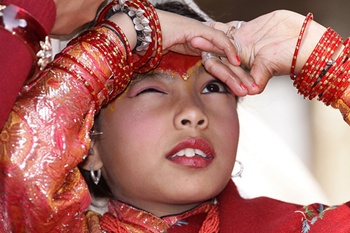
In the morning, the girl purifies herself  by taking a bath. Then she is dressed in bridal sari and make up. She will then be covered my shawl and take to the open space where Puja is performed. There will be Ganesh Puja first and then Surya Puja followed by Surya Darshan. It will be the first time the girl will see the sun in 12 days. Also Sindoor is put on the girl’s forehead as a symbol of marriage to the sun and a yellow string is put around her head.

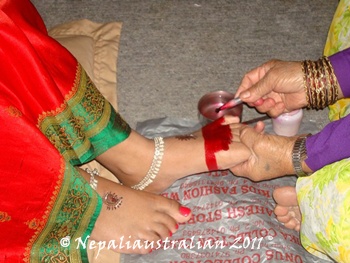
Like in Ihi, there will be a special person who cuts toe nails for the girl and then paints the feet with red colour called ‘Alah’. Also, ‘Thaa bu’, a plate which has eggs, yogurt, wine, fruits, Roti, meat, fish and much more for the girlsto eat is served like in the real wedding.

Then she will be given Sagun and gifts by family and relatives. Also after this Puja, the girl will go with her relatives to a nearby temple and do more Puja.

In the evening of that day there will be a big bhoj (party) and lots of relatives and friends are invited.

After this ceremony the girl becomes an adolescent.

Ihi

According to Newari tradition, girls are married three times in their lives.

First one is called ‘Ihi’ then ‘Bara Tayegu’ and then the real human marriage.

I am writing about the first marriage in Newar girl’s life which is called ‘Ihi’. “Ihi’ is also known as Bel Bibaha in Nepali. It is performed before a girl turns 13 years old. It is a compulsory ceremony every girl has to go through in most Newar community.

I too had the ceremony held for me but I can’t remember a lot about that day. I was quite small, I think 7 or so years old when the ‘Ihi’ was held for me.

In ‘Ihi’ ceremony, the girl is married to Lord Vishnu with the bel fruit (wood apple) as a witness. This ceremony is performed to save the girl from evil and malicious spirits but the most important reason is to protect the girl from unpleasant humiliation of widowhood.  As I mention in my post Widows in Nepal, it is really hard for the women in Nepal when they become widows. They had to take part in ‘Sati’ process in the old days, so in order to save their daughters from ‘becoming Sati’, Newars started a tradition in which they married their daughters to Lord Vishnu first. So even if her human husband dies in the course of her life, she doesn’t need to take part in ‘Sati’ ritual since her first husband, Lord Vishnu is still alive.

Some also believed this tradition allowed women to be more independent of their husbands. They can divorce or become widows without losing reputation.

Ihi is performed in mass over two days. It is normally organised by priests in their own house or backyard or someone can choose to host it in their house.

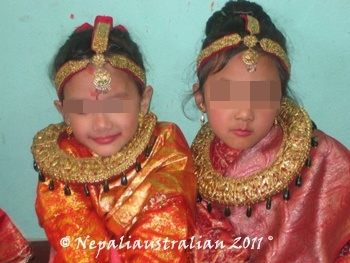
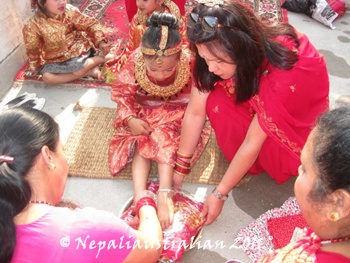
The first day is called Dusala Kriya. On this day, young girls have to bathe with pure water and are dressed like a bride in ankle length skirt, blouse and shawl. These days, you will see them as mini versions of traditional Nepali brides. Then all the girls will gather in the priest’s house. They sit on the floor in a long line with their mothers. Then the Puja begins where these girls go through sequences of ritual actions of purification. They have to worship images of Suvarna Kumara, the golden Bachelor which is an aspect of Lord Vishnu. It normally takes 5-6 hours for this ceremony to be over.

The second day is the most important day of the ritual  ‘Kanyadan’ (giving away of the daughter by the father) is performed on this day. For this day as well, the young girls are dressed as brides and taken for the Puja. On this day, they wear some special ornaments as well.

There will be a special person who cut toe nails for all the girls  and then paint the feet with red colour called ‘Alah’. Also at the end of the day, ‘Thaa bu’ , a plate which had eggs, yogurt, wine, fruits, Roti, meat, fish and much more for the girls to eat is served like in the real wedding.

There will be more Puja performed and the day will end by the father doing a ‘Kanyadan’ and giving away his daughter to Lord Vishnu in marriage with the Bel fruit as a witness.

‘Ihi’ is one of the many tradition the Newar community in Nepal follow and is unique to them.

Dhau baji

As I have previously mentioned in  I see babies everywhere  my friend SK is pregnant and she is expecting a baby girl on December 13. 

Last weekend we went to visit her for ceremony called Dhau-baji in Newari or Dahi-Chiura in Nepali. 

We were planning a baby shower but as her parents are here it became a Dhau-baji ceremony. 

SK and her Dhau baji

Dhau-baji feeding is a Newari culture, similar to baby shower in the western world. A girl’s family comes to feed Dhau-baji (yogurt and flattened/beaten rice) on the ninth month of pregnancy.  They bring Sagun and lots of food along with gifts for the mother as well as the unborn baby. 

As her parents are staying with her now, they just went and bought lots of food. They prepared Puja, made Sagun and the ceremony began. 

First both my friend SK and her husband got their tika, made out of vermillion, rice and yogurt. Then they were given Sagun consisting of boiled egg, bara, a piece of chicken and fish with yogurt. It was followed by a plate of fruits and flattened rice with yogurt. 

Then they had some gifts for both the new parents to be. 

I along with my friends, SS and SD were bit unaware of the traditional ceremony so we ended up buying cupcakes, flowers and gifts for the baby. I am glad SK loved it.

I think it is so important to have your parents and in-laws around when you are pregnant and having a baby. I would love to follow our Newari tradition but sometime we are not aware of what needs to be done as per the tradition. If it was only us, SK would have got a baby shower but as her mum was here, it turned into Dhau-baji

two yummy mummies to be

Ohoo, can’t wait for December, 2 new babies on the way. 

SD is my another friend who is also pregnant but we still haven’t planned her Dhau-baji / baby shower as she is still waiting for her mum to get her visa to come to Australia. I really wish she gets that good news soon as SD is stressing about it a lot and it is not good for her baby. It will also be better for her mum to be here when we have the ceremony for her. 

Finger crossed!!!