Category Archives: Nepal

Different looks of Nepali people

Newar girl

When people realise that I am from Nepal, they always tell me I don’t look anything like the last Nepali they met. I am from the Newar ethnic group but  I have Aryan features so even people from Nepal tell me that I don’t look like a Newar as I have bigger eyes than Newar people normally have.  This is because Newars are a community of mostly Tibeto-Burman and some Indo-Aryan ethnicities and my family seems to lean towards the Indo-Aryan side of the community in our features.

The other day I met a friend of my friend (Gurung) who was from Italy and she told me that I looked just like one of her Italian cousins. She was surprised that I and my friend (Gurung) look so different even though we both are from the same country. There are times when I meet Indian people and they think I look like an Indian.
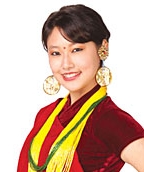
Gurung girl

The main reason for Nepalese people having such a diverse features is due to the geography and the climatic in Nepal.

Don’t worry if you get confused after reading this post because even Nepali people sometimes can’t say for sure if someone is from Nepal or some other countries as our features match people from so many other countries. I also can’t tell for sure as well.

Brahmin man

Here is one of the funny incident. A friend of mine  was traveling in a train when a group of Nepali guys came and sat on the seat in front of her. She is from the Rai ethnic group so she looks more Asian. The guys did not think that she was a Nepali so they start talking in Nepali about anything and everything. And there were some things you normally won’t say in front of women. Anyway, my friend was very uncomfortable in hearing this but she tried to pretend that she didn’t understand the language. She couldn’t wait to get off the train.
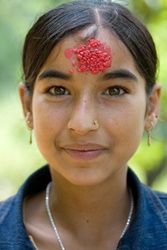
Chherti girl

At next stop, her cousin caught the same train and saw her sitting there. So she came and joined her and started speaking in Nepali. Then the guys realised that she was Nepali. They were very embarrassed by their activity so they changed the carriage. It happened a lot to my friends when people mistake them to be from India, Sri Lanka, China, Indonesian, Brazil, Korea, Italy etc.

When me and AS were on our holiday in Vietnam, a few people came and talked to us in different languages because they thought we were either Thai, Vietnamese or Pilipino so I am not surprised if you are confused by the Nepali look.
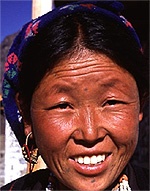
Thakali women

Nepal is a country of four castes and thirty six sub castes and they are a mix of Aryan and Mongolian people. Aryan normally have fair or dark skin, long pointed nose, big eyes, broad chest and shoulders while Mongolians are normally white or fair skin with small eyes and medium built. Brahmin and Chhetri looks Aryan where as Rai, Gurungs, Tamang, Magar looks Mongolians. I find Newar are a mix of both.

Of course it is just a guideline as there are so many inter-caste marriages, it is getting even harder to tell people’s ethnicity apart just by their looks.

 Still confused? I thought so  🙂

Value of Electricity

It is getting really hot in Sydney these days. It was 34-37 C the day before. After a very hot day I went home thinking it will be a cool evening with the AC on and I can relax but to my annoyance the electricity went off. 

I couldn’t believe how much our lives depend on having electricity here. The lift in the building stopped working so we could hear fire exit doors opening and closing all the time. The building in front of us had people stuck in the lift so there were two fire trucks and police car to rescue them. 

People couldn’t go inside the car park as the roller doors are electric so there were long queues of cars waiting in the street. 

Inside our apartment, AS and I didn’t know what to do. Our internet didn’t work, no TV, the laptop battery was on 35%, no light so nothing to do. Luckily we have a gas stove which was the only thing working. But still we didn’t cook anything as it was too dark so we ordered takeaway. I remember my cousin K, mentioning power outage in June for hours when I was in Nepal, and as they have electric stove, they had to go out and eat. 

I have been in Nepal when they had 18 hours of load shedding. Luckily my house has an inverter so we had some light during those times. But I can’t imagine how everyone in Nepal live everyday more than 9 months a year without electricity. It is good that my parents are not dependent on the fridge as they cook fresh meal everyday. Also they buy their milk every morning and meat on the day, they are cooking. They always buy fresh fruits and veggies every other day so they can have fresh supply of most essential things. I can’t imagine people here living without a fridge and a microwave. We wouldn’t know what to do.

 Most of the houses in Nepal don’t have air conditioning and lift so you are not stuck when load shedding happens.

Sometimes I forget how much better facilities we have than people in Nepal. I was complaining that power was out for a few hours but then I remembered for people living in Nepal that is a part and parcel of their life. I see Facebook and Twitter updates from my friends and family in Nepal like

 “ No power cut for last 24 hours 🙂 🙂 🙂 “

 “ Load shedding is reduced to 10 hours a day :)”.

 “ Felt so lucky to wait only 15 minutes in line for petrol’.

No water for last two days 😦

Nepal bandh again today, walking to work” (Nepal closed/no vehicles on road due to strikes)

 I promise from now on I will appreciate how good I have it here and stop complaining about small things that I don’t have.

Widows in Nepal

I want to start this post by saying; whatever I am going to write in this post is solely my opinion and understanding and hold no disrespect for any culture or tradition. 

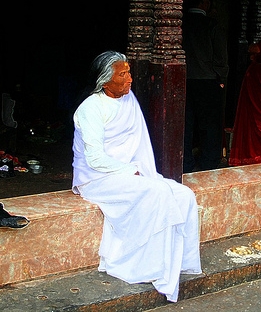
In Nepal, if a Hindu woman loses her husband, she has to wear a white sari for a whole year. She also has to give up all signs of marriage like pote, glass chura and sindoor. 

After one year, she is allowed to wear clothes with colours other than red or shades of red or other bright colours and she still can’t wear pote, glass chura and sindoor. They are also forbidden from remarrying. It is believed if a widow marries another man; her deceased husband’s soul goes to hell. I know it sounds ridiculous but that is what the widows are led to believe. 

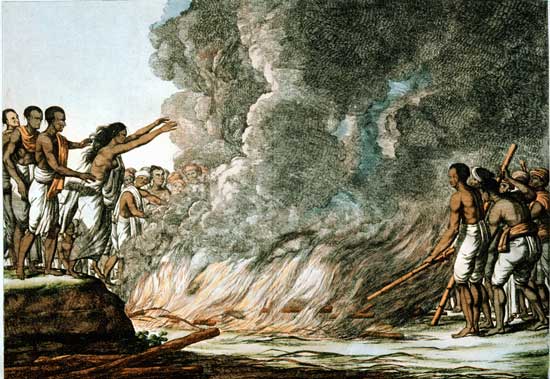
In ancient times, there used to be ‘Sati’ practice in which if a married man died, the widow is coerced to join her husband in his funeral pyre. My grandma used to tell me the stories about how she knew people who she lost due to this practice. This was outlawed only around 70 years ago. 

I don’t know why the husband is never made to undergo such cruel customs on the death of his wife. And men can remarry if they want. 

My paternal grandmother was widowed when she was quite young. Her youngest child was only 2 years old at that time. I know she suffered a lot as a widow in a conservative Nepali society. She was not invited for many religious ceremonies and considered an outcast for lots of Pujas. My grandma is a survivor and she managed to ignore all the brutal treatment from the society and brought up all 7 kids all by herself. She made sure that all the kids went to school and were well-educated despite the fact that she was uneducated and alone. All the kids grew up to be successful in their lives and all the credit goes to my grandma. 

I never saw my grandma wearing any bright colour saris even after 50 years of the death of my grandfather nor did she wear any glass chura. She used to have a few golden bangles and that was it. She told me lot of stories where she felt like an outcast from the society after her husband passed away. 

I know an aunt who lost a husband in a freak accident after just 3 years of marriage. At that time she had a year old baby boy and she was only 26 years old. I really thought it was cruel that she couldn’t enjoy her life just because her husband had passed away. Her MIL blamed her for her son’s death and made her life into hell. I am sure she missed her husband terribly and on top of that she had to deal with the cold behaviour from relatives and the society. I strongly believed that she should have been allowed to remarry and live the rest of her life happily but I was just a kid and my opinion would have brought an outburst among my relatives. 

Recently, I read news that the Nepali government are giving RS 50,000 (AUD 600) to the couple if a man married a widow. I find this wrong in so many levels. A widow is a woman and not some broken furniture which you pay the removalist to discard. No one should be given monetary incentive to marry; it should be purely out of love. I also read lots of news later that people were marrying only for the money and it was not helping the problem of widows in Nepal. 

I know there are so many human rights organisations that are fighting for this cause and I salute them but this problem is not going anywhere until we are able to educate people and make them understand that death is a natural process so no woman should suffer her whole life just because her husband died. 

I know things are changing slowly but still the majority of Nepalese people do not accept widows as a normal woman. I want them to think what they will do if the window is their own daughter or sister. I am sure they want them to be treated as equal to any normal woman and allowed to remarry if they wish to and live their life happily.

How to make Newari “Wo” / Bara with Mugh beans

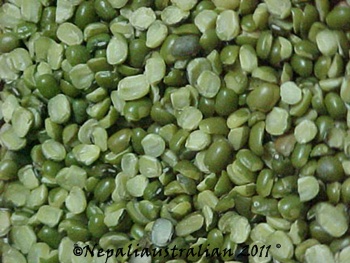
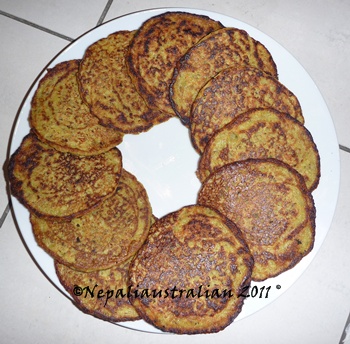
Wo is a Newari word which is mashed lentils cake and it  is prepared from the black lentils or green lentils (Mugh beans). Wo  is called Bara in Nepali. There are different kinds of Wo depending on what is put in it and how it is cooked but I am making vegetarian one today.

This recipe was given to me by my MIL.

Ingredients

  • ½ kg Mugh beans (Split or whole)
  • Vegetable oil
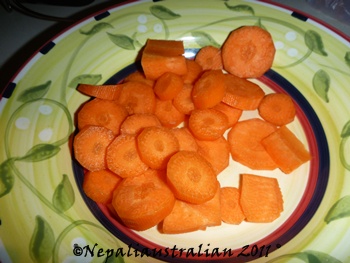
  • 2 carrots
  • 2 small onions
  • salt according to taste
  • 2 teaspoon ginger paste
  • 2 teaspoon garlic paste
  • water

Steps 

  • In a big container, pour Mugh beans and add at least 1000ml of water. As these beans increase in size after soaking, it is a good idea to add lots of water in a deep, large container.
  • Leave them overnight to soak if possible otherwise soak for at least 5-6 hours.
  • After 5-6 hours, they will absorbed water and will be swollen and soft.
  • Wash the beans and take some of the green bean coats out. The green coating is very healthy so no need to take a lot out.
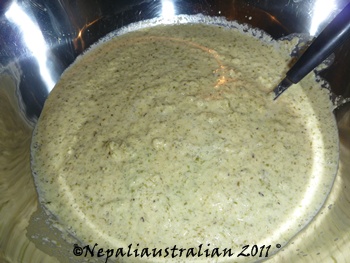
  • Put the beans in the mixer with salt, ginger and garlic and grind until it becomes a thick paste.
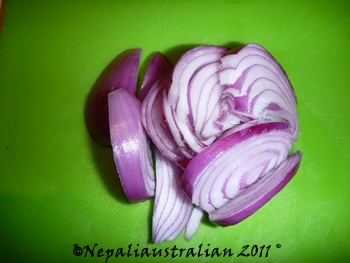
  • Grind carrots and onion separately.
  • Now mix the bean paste and the carrot onion mixture..
  • In a flat frying pan, add one tea-spoon of oil and let it heat.
  • Put two table spoons of the mix and make a circle around 4-5 inches using  the spoon.
  • Cook on low heat and when the Wo is crispy and brown on one side turn it over.
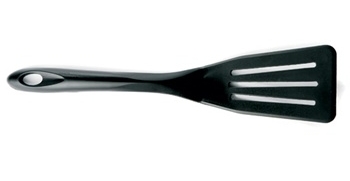
  • It is best to use slotted(as shown in picture) as it is easier than other spoons.

    Slotted turner

  • Pour one spoon oil again and cook this side till it is crispy and golden brown.
  • Your “Wo” is ready. This is best served hot.  You may also like :

    *Aloo chop *Chatamari *Gundruk Aloo Bhatmas Curry

Bhai Tika

The fifth day of Tihar is Bhai Puja.

Bhai” mean brother in Nepali. This festival is mainly for brothers and sisters.

It is believed that this tradition was started by Yama (the God of death) and his sister Yamuna because of their affection for each other.

In this day, sisters apply sacred Tika on their brother’s forehead and pray to Lord Yama for her brother’s long life and prosperity.

Yamaleswor temple

Some of the ethnic groups in Nepal use the Pancha Rangi Tika (Five coloured Tika)  for  Bhai Tika. First a base, rice flour is applied vertically  on the forehead then yellow, green, red, blue and white colour Tika are put on top of this line in a row. But in the Newa culture, we just use rice, vermilion and yogurt, mix them and use that as a Tika.

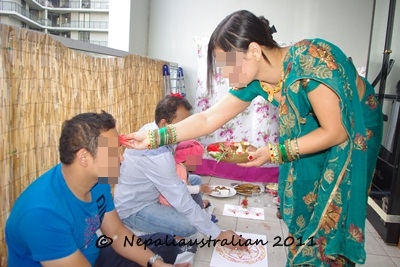
For this occasion, I had invited my brothers and their families to my apartment and we did the Bhai Tika on my balcony.

This is how I did my Bhai Tika.

Mandap Puja

Before the Bhai Tika, just like in Mha Puja, the floor was purified by sprinkling water on it, then we made Mandaps in front of a row of seats on the floor where my brothers were sitting. I used a copy of the same Mandap which was designed by AS but this time I printed them in A3 paper. In Nepal the Mandaps are made by hand on the floor using oil, rice flour, vermilion, puffed rice and sometimes beans. The number of the Mandaps needed is three plus the number of people doing the Puja. So I had two big Mandaps, for my brothers. in a row and three smaller Mandaps at the top of the row for the House God (Kuladevata), Yamaraj and Janmaraj, and one crow drawn at the end of the row symbolising Lord Yama.

Beside the three Mandaps at one end, I also had a Sukunda with a candle on it.

Bhai Tika

Then I put all the sweets and Rotis that I had made or bought as well as some fruits around the Mandap along with the Masala and Sagun.

The Rotis I made at home this year were

  • Besana ko ladoo
  • Puri
  • Nimki
  • Lal Mohan
  • Strawberry cup cake
  • Chocolate cup cake

(I will post recipes in my next post)

I also bought Soan Papdi.

Then I had trays with fruits like mangoes, peaches, plums, rockmelons, oranges, apples and pears.

Masala and Tshirt

I made Masala at home this year with dry coconuts, dry dates, raisins, almonds, pistachio nuts, apricots, dry figs, cashews, cloves, cardamoms, beetle nuts, hard shelled walnuts, palm sugar cubes and lots of Chocolates. I used clear cello wrap and colourful bows to make it look beautiful.

For Sagun, I boiled the eggs, took the shell out and fried them in a pan. I made Bara (lentil cakes, for which I will share recipe later), fried some chicken, fish and cut fresh garlic.

Jajanka

I made Mala out of tinsel and bought Jajanka in a Nepali grocery store. Jajanka is made of many rounds of a white cotton thread forming a circle of about two feet in diameter and tied with a small piece of colourful cloth in order to have no ends. Jajanka symbolizes the integration of the beginning with the end. It is about creation, maintenance and fullness of life. Normally the Mala is supposed to be of Makhmali ful/Supadi ful (Globe Amaranth) as it never dries and always looks fresh.

I also bought  T-shirts for both of them.

Bhai tika process

  •  First I gave Nasala, a few drops of water, in the palm of the right hand of my brothers to throw some into the mouth and rest over the body for purification.
  • I worshipped the House-God and Yama’s Mandap with water, rice, flowers, and vermilion powder.
  • I gave water, rice, flowers, and vermilion powder to my brothers first to worship the Mandap of the House God and then the crow, then to worship their own Mandaps. The Mandap is used as a medium to present the various offerings to the self.
  • Then I put Tika made of vermillion, rice and yogurt on my brothers forehead and gave them flowers to put on their head as a blessing form God. This was followed by Mala and Jajanka around their neck.

    Putting TIka

  • Normally in Nepal, they use Ita (special long threads made using white cloth soaked in mustard oil) but here we used tea light candles instead. I gave both my brothers the candles. They  took the candle from my hand, lit them and put them on their Mandap. This light is believed to brighten the inner self and keep evil at bay.
  • Then I took some water in an Ankhura (a small pitcher for Puja) filled with oil and water and Dubo in my hand and circled around my brothers three times.

    Making circle with oil and water

  • Then I gave them some rice and flower in their hand. Then I gave trays of Rotis, fruits, Masala, sweets and clothes to them and they had to hold them and keep them from touching the ground. Then I toke some rice and flower in my hand and showered each of them and worshipped the god within them. Only after that could they put the trays down.
  • Then my brothers put Tika on my forehead, touched my feet for my blessings and gave me the gifts they had brought for me. 
  • I gave them the Sagun . For Sagun, you put a plate of egg, Bara, meat and fish in the right hand and yogurt or alcohol in the left hand
  • Once everyone finished eating the Sagun, we used Kucho (broom) from top end of the row of Mandaps to the bottom of the row, touching each Mandpa to erase them and conclude our Bhai Tika.

This slideshow requires JavaScript.