Tag Archives: nepali australian

Let’s make this world one big happy family

This article was published in +977 (a Nepalese Lifestyle Magazine in Australia) in  June 2014 issue.   

plus977 

Nepal is a country of “Char jaat and chhattis barna” and our ancestors were very proud about it. They even made a song about this fact and we learned about the great history of Nepal in our school years.

People were happy and understanding when you had friends from different castes and they seemed to advocate equality and brotherhood between castes. But falling in love outside the caste was a different story. Every parent of single girls and boys feared their child might marry outside their own caste. That was a century ago.

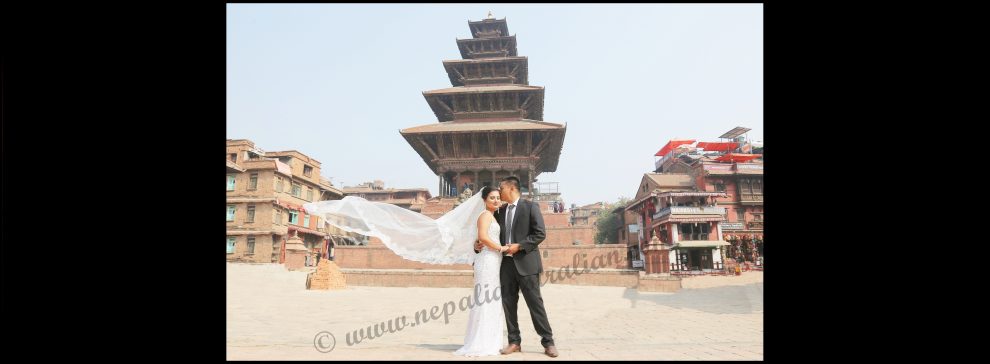
These days, the fear has moved from inter-caste marriage to international marriage. Now almost every home in Nepal seems to have someone living and/or studying abroad so the parents’ fear has shifted from inter-caste marriage to intercultural/international marriage. More and more people from Nepal are abroad and more individuals have crossed racial, ethnic, and religious boundaries to marry someone. I bet you know someone in your close circle who has married a non-Nepalese. Marrying inter-caste is very common in Nepal and acceptable in most families these days but most parents are finding it difficult to accept someone from a different county, culture, religion and background.

The thing is these intercultural relationships and marriages are meant to happen. What do you expect when you send your kid aboard to mix with international society, learn their culture, meet new people but then never think about them falling in love with anyone other than people from Nepal? Even typing these words right now I can see straight away how ridiculous it sounds. Similarities and connections with another person isn’t limited to someone of your own culture as love sees no boundaries and connections can be made with individuals from all backgrounds and experiences.

I find it funny when a guy/girl returns to Nepal with a foreigner friend; the parents show them off as a trophy. Saying, “Mero chora/chori ko ta American sathi cha.” But if the same person was introduced as their boyfriend or girlfriend, they change their tone completely.

I know so many friends who had a hard time making their parents understand that their love is real and they are serious about their relationship. Some parents have even gone to the extent of bribing them or using emotional blackmails as a tool to separate them form their love.

Australia has the highest rate of intercultural marriage in the world, and it is increasing. According to the Australian Bureau of Statistics, the number of mixed marriages has grown from 39% in 1974 to 60% in recent years. I am sure the numbers in Nepal are increasing as well.

I do understand the few genuine reasons why parents are opposed to intercultural relationship. The first one is the society. In this instance, they always think about what people will say and think, without thinking about their child first. Their social status seems to be more valuable than the love for their children.

Then there are the communication issues, whether that is between them and their son/daughter in law or the future grand kids. Parents think these barriers mean that they will have a hard time understanding each other’s feelings.

If they are religious people, they are worried what religion and culture their future grand kids will follow. In addition, many people in Nepal are Hindu and they are against eating beef while most of the westerners live on beef.

However, these are the issues which could be easily overcome with communication and understanding. Therefore, parents first must take the first step of acceptance if they want good relation with their kids and their partners.

One of the biggest misconceptions parents in Nepal seem to have is that if you marry a foreigner, they will divorce in the future. I am serious that most of the older generation have this in mind and tell you about it openly. I know it is not true but looking at few examples, they put everyone in the same pigeonhole.

To all the parents, please think twice before you go against the marriage of your kid. They are still the same kid you used to worry about when they got sick or didn’t come home on time. Then how can you be OK when they are heart broken and hurt by your action.

The world is changing, let’s embrace it. As our world becomes more accepting of differences, individuals will continue to find attraction and love with others from outside of their own culture. Let’s look beyond the differences that confuse or frustrate us, and look for the value we can find in these relationships. Let us educate our children in recognizing human beings as human beings in spite of their race, colour, or ethnicity. I will just be very happy for my kids one day to marry someone honest, loving and respectful.

Would you prefer your son/daughter to marry someone nice, honest, hardworking and friendly but from a different culture or someone stubborn, lazy and annoying but from your own culture? I am sure everyone has the same answer so why are we so bothered by where this nice, honest, hardworking friendly person comes from. Believe me, nobody’s status declines because of intercultural or inter country marriage.

While every romantic relationship can bring its own set of challenges, intercultural relationships can bring unique challenges and during this stage, support of family and friends is very important to the couple.

To everyone who sees their future in international/intercultural marriage, don’t expect things to be easy but also don’t give up. The best way to overcome this issue is by learning each other’s culture, religion and traditions so you can understand your partner and in laws better. Ask questions and try to understand why your partner has a certain perspective or why s/he does things a different way. Learn to accept and understand the differences without changing your own beliefs or behaviors, this way you would be able to pass this knowledge down to your kids. Just to be clear this is something a couple have to do regardless of whether they are in an intercultural marriage or from the same culture because each of us has our own perspective in life. For couples from intercultural background, they will just have a little more work to do to understand the differences.

Let’s make this world a big happy family and let’s all live in harmony.

Please click here for all my published posts.

Take care,

M from nepaliaustralian

XOXO

Kwati: Nepali mixed bean soup

This is a guest post I wrote for , Chai- A cup of life, amazing blog I have been following for a while. Thank you so much for the opportunity and sharing the post here.

I would like to introduce you to M who writes her blog called ‘Nepali Australian‘. M is a Nepalese born Australian living in Sydney, an IT Business Analyst who loves blogging, travelling and fashion! We have been following each others blogs for some time now and I love reading about her thoughts, the Nepalese way of life and of course her life in Sydney. Her writings have been published in magazines, newspapers and she has even held her own Nepali Australian ‘Blog Awards 2013′, (which Chai a Cup of Life received an award for- thank you!) Today she is sharing a traditional Nepalese dish called ‘Kwati’. Here it is: 

It is really cold in Sydney these days. It is supposed to be autumn but it feels like winter already so I am always looking to cook warm meals for dinner. In Nepal, they have food for every season and Kwatiis especially made during rainy and cold season and is a very popular Nepali soup. Kwati is a traditional Nepalese dish which is a thick stew of several kinds of beans. It is high in protein so it is considered good to be given to sick people to gain strength.

kwati (10)

This soup is  made during the festival JanaiPurnimain Nepal. Kwati is normally a mix of 9 beans namely, black eye peas, cow peas, black lentils, chickpeas, adzuki, soybeans, mung dal, green peas and favas. But we can use any beans and pluses you have to make this soup. Luckily for me, I found a pre-mixedkwati pack in a Nepali grocery store.

Some people like to sprout it before making it into a soup but I just soaked it overnight and made the soup without sprouting.

Ingredients

  • 200 gm Kwati Mix
  • 1 medium onion sliced
  • 2medium tomatoes diced
  • 1 tablespoon of ginger garlic paste
  • 1 teaspoon of turmeric powder
  • 1 tablespoon of red chilli powder
  • 1 tablespoon of garam masala powder
  • 2 tablespoons of oil
  • 3 cups of vegetable /chicken stock
  • A few bay leaves
  • Salt to taste
  • 2 teaspoons of ghee
  • 1 teaspoon jwanu (Lovage)

kwati (5)

Steps

  • Wash and soak the Kwati mix overnight and drain the water.

kwati (11)

  • In a pressure cooker, heat oil and season with turmeric powder and bay leaf. Add the chopped onion and fry until it turns golden brown.
  • Add ginger garlic paste, salt, red chilli powder, garam masala powder and fry for a minute or two.

kwati (2)

  • Add chopped tomatoes and cook until the tomatoes are soft. Make them into a paste.
  •  Add the soaked Kwati mix to the pressure cooker, mix well and add vegetable /chicken stock and cook until 5-7 whistles or until you can smell the beans.

kwati (3)

  •  Let it cool in the pressure cooker before you open the lid. As there are different types of beans, test the big ones like broad beans to check if it is cooked properly. The beans must be tender on touch. If it is not cooked enough then press again.

kwati (4)

  • In a pan, heat the ghee.

kwati (7)

  • Once ghee is hot, add jwanu(lovage)and fry for 30 seconds until it is dark brown in colour.

kwati (8)

  • Pour this into the pressure cooker with kwati and mix well.

kwati (6)

  • You could add more water/vegetable /chicken stock depending upon how thick you want the soup.

kwati (9)

P.S : If you are not into vegetable soup, you could add cooked/boiled  meat into the soup as well. Enjoy a tasty and healthy soup!!

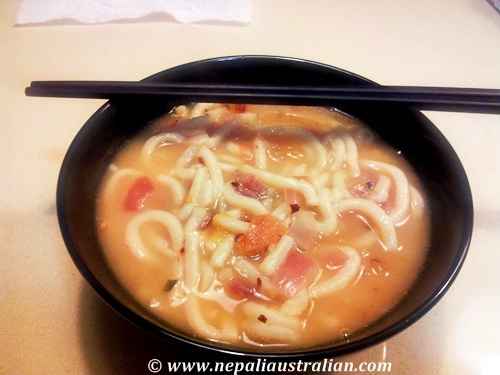
Easy Tom Yum Soup noodle (Sour Spicy Soup)

This is probably one of the easiest ways to have Tom Yum Soup noodle.

Ingredients

  • 400 gm udon noodle(ready to fry)
  • 2 – 3 cups chicken/Vegetable stock
  • 10 shrimps
  • 1 Onion diced
  • 1 tomato diced
  • 1 lemon (depends on how sour you like it)
  • 2 chillies sliced
  • 1 handful of sliced Lemongrass
  • 2 teaspoons fish sauce
  • 1 teaspoon Sugar

Easy Tom Yum Soup noodle (1)

Procedure

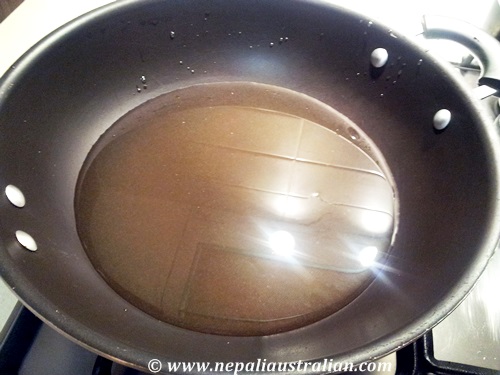
  • Boil chicken stock in medium sauce pot.

Easy Tom Yum Soup noodle (2)

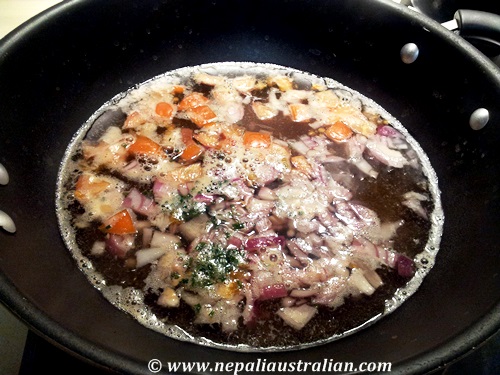
  • When the stock is boiling, add the sliced lemongrass, onion and tomatoes.

Easy Tom Yum Soup noodle (3)

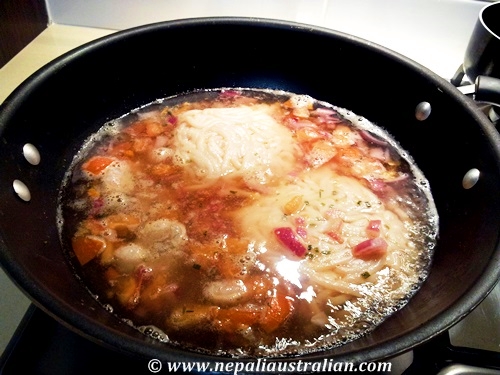
  • Boil for about 5 minutes and then add the udon noodle

Easy Tom Yum Soup noodle (4)

  • Boil for another 5 minutes and add the shrimp
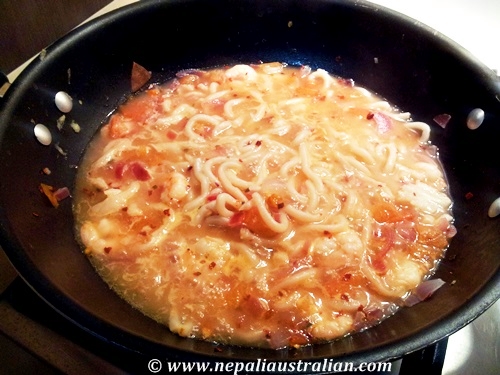
  • Boil for 2 minutes and add fish sauce, chilli and sugar, boil the soup for another 5 minutes

Easy Tom Yum Soup noodle (5)

  • Take the pot off the heat and squeeze lemon juice and check if you want to add more lemon if you like it more sour.

Easy Tom Yum Soup noodle (6)

  • The dinner is ready.

Learn Nepal Bhasa / Newari – Chapter 23


English Nepal Basa
May I step inside? Du-ne wa-ne jii laa?
Do I have to take off my shoes? Laa- kaa twah-te maah laa?
Yes/no Maah/mwah
What god is kept in there? A-na chhu dyah ta-yaa tah-gu du?
Can I take a picture? Tas-bir kaa-ye jii laa?
What’s that temple? Wa chuu de-gah?
We come to see the procession. Ji-pii jaa-traa swah-was-yaa-gu.
Will the procession pass this way? Jaa-traa tha-naa hai la?
Is there a restaurant around here? Tha-na ga-naa restaurant du la?
I will have a plate of momo. Ma-ma-chaa chha-guu plate ha-yaa di-saa.
Please bring it quickly. Yaa-ka-naa ha-yaa di-saa
Is it spicy? Paa-lu laa?
This is not what I ordered? Jin dha-yaa gu thaw ma-khu.
Please bring the bill. Bill bi-yaa di-saa

Please click here for previous chapters.

Learn Nepali : Nepali ingredients name

When I share recipe, I use lots of Nepali name so here is the list of Nepali ingredients commonly used in Nepali food.

Nepali name                                                                         English Name

Ajwain Tymolseeds
Aduwa Ginger
Amchoor Mango powder
Ata Wheat flour
Banda (Banda Govi) Cabbage
Bakula Fava Beans
Bhatmas Soybeans
Bhanta Eggplant, Brinjal,Aubergines
Besan Gram flour
Besar Turmeric
Bhuteko Channa Roasted gram
Bodi Black-eyed peas
Chana Chick peas
Chana dal Gram dal
Chyapi Chives
Dal Lentils
Dahi Curds, Yoghourt
Dhania (leaves) Coriander leaves, Cilantro, Chinese Parsley
Dhania (masala) Coriander seeds
Farsi Pumpkin
Hing Asafoetida
Ilaichi Cardamom (black)
Jau Oats
Jeera Cummin
Jwanu Lovage
Kankro Cucumber
Kari Pata Curry leaves
Kesar Saffron
Kathal Raw jack fruit
Kalonji Onion seeds
Kodo Millet
Kurilo Asparagus
Kuskus Poppy seeds
Lwang Cloves
Lasun Garlic
Makai Corn
Marich Black Pepper
Mas Black Lentils
Masoor dal Red gram
Maida Flour
Moong dal Green gram
Methi Fenugreek
Methi sag Fenugreek leaves
Makai Corn
Moong Whole green gram
Mula Daikon Radish
Palungo Spinach
Paneer Paneer (or cottage cheese)
Parwal Pointed gourd
Phapar Buckwheat
Pindaula Taro or Eddos
Pitho Flour (All Purpose)
Pyaj Onions
Pyaj (Hariyo) Scallion
Ram Toriya Okra (Lady’s Finger)
Rawa Semolina, Cream of wheat
Rayo/Tori Mustard
Roti Flat Bread
Sabudana Dry ginger
Sakhar Brown Sugar
Salgam Turnip
Simi Green Beans
Saunf (sag) Dill leaves
Saunf (masala) Fennel
Sukamel Cardamom (green)
Tama Bamboo Soda
Tej Paat Bay Leaf
Til Sesame seeds
Til ko Tel Gingelly oil
Turai Sponge gourd
Tarul Yam
Urrad Dhal Black gram