Tag Archives: Sindoor

Bahra

As I mentioned in my previous post Ihi’, every Newar girl have to perform the ritual called ‘Ihi’ and after ‘Ihi’, they have to perform the ritual called ‘Bhara’.

Bahra’ is also known as ‘’Bahra tyagu” in Newari and Surya Darshan or Gufa rakhne in Nepali. In this ceremony, the girl is married to the sun.

In some culture, this ceremony is done when the girl has her first menstruation and in other cultures, it occurs after they get an auspicious date from a priest .

It is believed that the girl is protected by the sun from bad people and the evils after this ceremony.

For this ceremony, a girl will stay in a room of her house for 12 days without seeing sunlight and not meeting any male person. ( I still don’t know the reason for this so please share if you know).

In the room at one corner, a cloth is put as Bahra Khayak (ghost) and worshipped by the girl as she is believed to be in possessed by evil. Before she eats anything, one portion needs to be separated for Khayak. If the ritual is not followed, it is believed, the Khayak will scare the girl at night. 

My Bahra ceremony

The hardest part of the ritual is not to eat salt during the first 6 days. I was only 13 years old when I had my Bahra and I remember crying for salt everyday as food doesn’t taste good without salt. As this culture is different among different families, I am writing about how members of my own family go through this tradition.

After the sixth day, close female relatives like maternal uncles (mama), dad’s sisters (fufu) and other relative will come and meet the girl with food like popcorn and Rotis and fruits. Also from the sixth day, there will be powder called ‘Koaa’ which is used by all the women to make them look beautiful. You have to follow a special direction to use this and it is meant to clean the skin. It is used especially by the Bahra girl to look good when she come out of hiding on the 12th day.

Step to use Koaa.

  • Wash your hands, legs and face with water first.
  • Mix the ‘Koaa’ with water and make a paste. Then put the paste all over your face, legs and hands
  • Leave it for a few minutes to dry.
  • Now rub oil on your hands and remove the paste from your face, legs and hands.

    Alha during Bahra
In these 12 days the girl will be entertained by her female friends and relatives. While I was in my room we had ludo, snake and ladder and dolls to play with. As my family was ok for me to hear male voice we had radio so we used to play it loud and dance.

Some days went really quick as I had many visitors around and then there were days which were so long, I couldn’t wait to go out.

On 12th day there will be a big celebration of the ending of this ceremony.
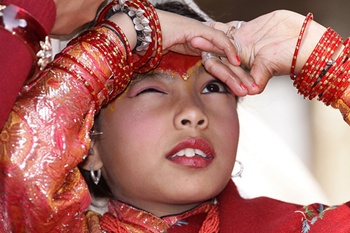
Surya darshan during Bahra

In the morning, the girl purifies herself  by taking a bath. Then she is dressed in bridal sari and make up. She will then be covered my shawl and take to the open space where Puja is performed. There will be Ganesh Puja first and then Surya Puja followed by Surya Darshan. It will be the first time the girl will see the sun in 12 days. Also Sindoor is put on the girl’s forehead as a symbol of marriage to the sun and a yellow string is put around her head.

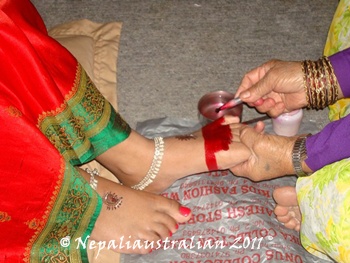
Like in Ihi, there will be a special person who cuts toe nails for the girl and then paints the feet with red colour called ‘Alah’. Also, ‘Thaa bu’, a plate which has eggs, yogurt, wine, fruits, Roti, meat, fish and much more for the girlsto eat is served like in the real wedding.

Then she will be given Sagun and gifts by family and relatives. Also after this Puja, the girl will go with her relatives to a nearby temple and do more Puja.

In the evening of that day there will be a big bhoj (party) and lots of relatives and friends are invited.

After this ceremony the girl becomes an adolescent.

Widows in Nepal

I want to start this post by saying; whatever I am going to write in this post is solely my opinion and understanding and hold no disrespect for any culture or tradition. 

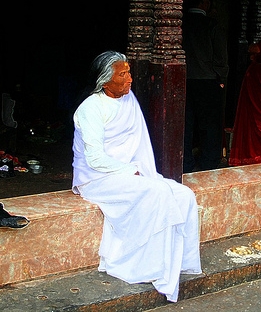
In Nepal, if a Hindu woman loses her husband, she has to wear a white sari for a whole year. She also has to give up all signs of marriage like pote, glass chura and sindoor. 

After one year, she is allowed to wear clothes with colours other than red or shades of red or other bright colours and she still can’t wear pote, glass chura and sindoor. They are also forbidden from remarrying. It is believed if a widow marries another man; her deceased husband’s soul goes to hell. I know it sounds ridiculous but that is what the widows are led to believe. 

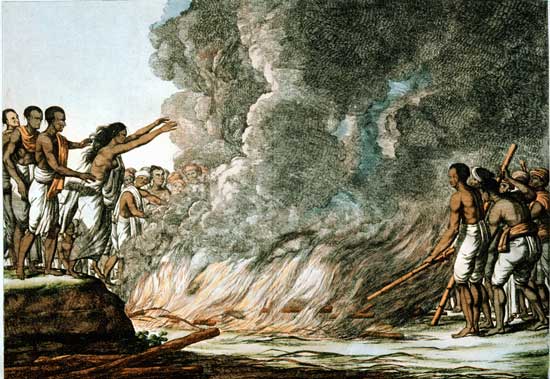
In ancient times, there used to be ‘Sati’ practice in which if a married man died, the widow is coerced to join her husband in his funeral pyre. My grandma used to tell me the stories about how she knew people who she lost due to this practice. This was outlawed only around 70 years ago. 

I don’t know why the husband is never made to undergo such cruel customs on the death of his wife. And men can remarry if they want. 

My paternal grandmother was widowed when she was quite young. Her youngest child was only 2 years old at that time. I know she suffered a lot as a widow in a conservative Nepali society. She was not invited for many religious ceremonies and considered an outcast for lots of Pujas. My grandma is a survivor and she managed to ignore all the brutal treatment from the society and brought up all 7 kids all by herself. She made sure that all the kids went to school and were well-educated despite the fact that she was uneducated and alone. All the kids grew up to be successful in their lives and all the credit goes to my grandma. 

I never saw my grandma wearing any bright colour saris even after 50 years of the death of my grandfather nor did she wear any glass chura. She used to have a few golden bangles and that was it. She told me lot of stories where she felt like an outcast from the society after her husband passed away. 

I know an aunt who lost a husband in a freak accident after just 3 years of marriage. At that time she had a year old baby boy and she was only 26 years old. I really thought it was cruel that she couldn’t enjoy her life just because her husband had passed away. Her MIL blamed her for her son’s death and made her life into hell. I am sure she missed her husband terribly and on top of that she had to deal with the cold behaviour from relatives and the society. I strongly believed that she should have been allowed to remarry and live the rest of her life happily but I was just a kid and my opinion would have brought an outburst among my relatives. 

Recently, I read news that the Nepali government are giving RS 50,000 (AUD 600) to the couple if a man married a widow. I find this wrong in so many levels. A widow is a woman and not some broken furniture which you pay the removalist to discard. No one should be given monetary incentive to marry; it should be purely out of love. I also read lots of news later that people were marrying only for the money and it was not helping the problem of widows in Nepal. 

I know there are so many human rights organisations that are fighting for this cause and I salute them but this problem is not going anywhere until we are able to educate people and make them understand that death is a natural process so no woman should suffer her whole life just because her husband died. 

I know things are changing slowly but still the majority of Nepalese people do not accept widows as a normal woman. I want them to think what they will do if the window is their own daughter or sister. I am sure they want them to be treated as equal to any normal woman and allowed to remarry if they wish to and live their life happily.

Reliving our Big day

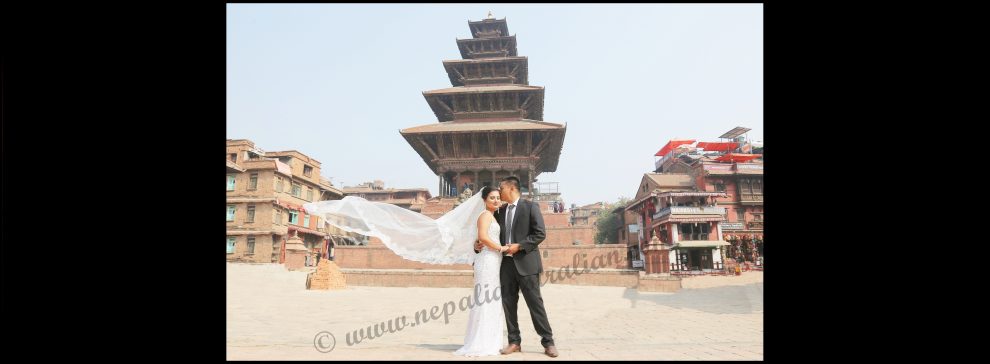
It is 95 days since our wedding. I know it is funny I am counting days and I hope to count them in years as time pass by. We had big wedding (Big, Loud, Crowded, Nepali wedding) and I enjoyed every minute of it. It involved lots of culture, tradition and people I never knew. So I decided I should write about my experience before it goes fuzzy in my head. We had Nepali Newari wedding. I am going to write about our engagement and will continue with all the steps of our wedding. The steps were as follows:

  •  Engagement ceremony –  The day we were officially engaged.
  • Mehendi” ceremony – The day where all girls including Bride get henna tattoo on their hand.
  • Supari” ceremony (from Groom to Bride) – The day when Groom’s family send lots of gifts like jewellery, Saris, cosmetics, shoes, bags, fruits, Nepali Roti , Masala and much more.
  • “Swayambar” ceremony -The day where all the marriage ritual happens and groom put Sindoor (Vermilion) on bride’s forehead and parting of her hair.
  • Bride side Reception – Reception from bride and her family for all their relatives and friends.
  • Janti -The day groom and his family come to bride’s home to take her to their home.
  • Groom side “Supari – The day where Bride is officially introduced to Groom’s family and they give bride jeweller or money.
  • Groom side Reception Reception form groom and her family for all their relatives and friends.
  • Mukh herne” ceremony – The day when Bride’s family come and meet Bride with lots of gifts like jewellery, Saris, cosmetic, shoes, bags fruits, Nepali Roti , Masala and much more
  • WanjalaThe newly married couple visit the temple (Kul Deuta)
  • “Jwain Bhitraune” ceremony – Days when Groom is invited to close relative of Bride for Sagun.