Category Archives: Nepali Culture

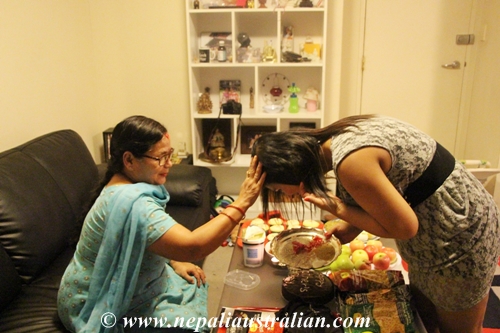
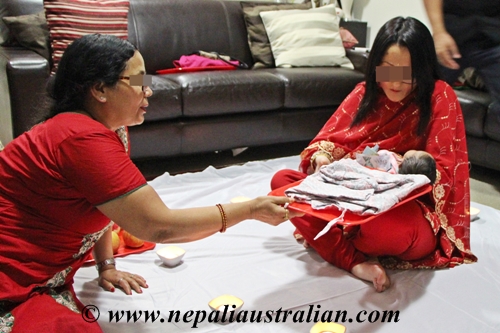
My extra special Aama ko Mukh herne (Nepali Mother’s day)

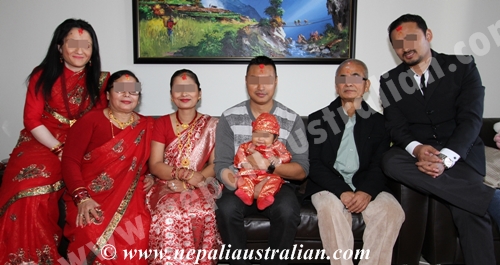
As I have mentioned in many of my posts before, Nepal has a different calendar than the Gregorian calendar. So in Nepal people also celebrate Mother’s day on a different day than the western calendar. In Australia, Mother’s Day is the second Sunday of May every year but in Nepali calendar, it depends on the moon. It falls on the last day of the dark fortnight of April or early May. This year, it happened to be on 18 April 2015. It is commonly known as Aama ko Mukh herne in Nepal which translates to “Looking at one’s mother’s face”.

This year Aama ko Mukh herne was extra special because my mum is here with me. The last time we were together for Aama ko Mukh herne was more than a decade ago so I was really excited.

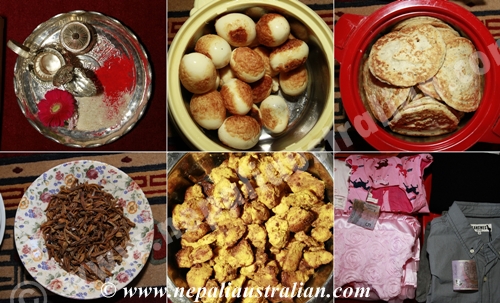
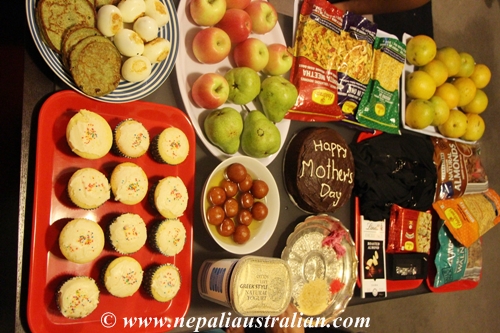
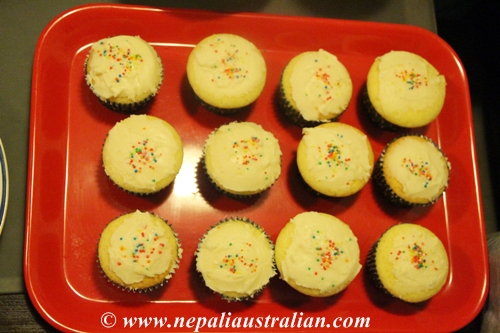
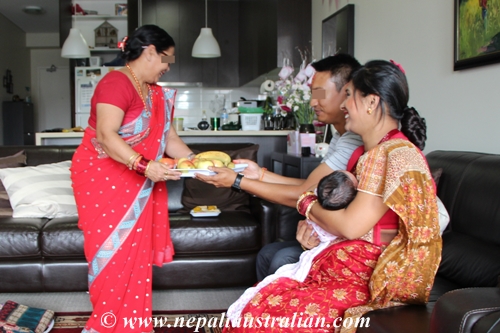
To make the day special for her I prepared Sagun, baked cupcakes and a cake. I also bought a dress, a nice watch, fruits, sweets and snacks.

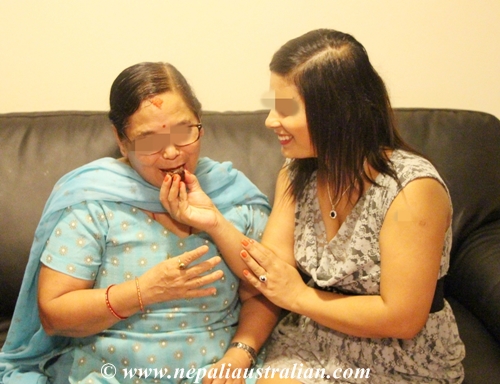
Aama ko Mukh herne (1) Aama ko Mukh herne (4) Aama ko Mukh herne (3) Aama ko Mukh herne (2)Aama ko Mukh herne (12)

It was amazing to do the Aama ko Mukh herne ritual in person as compared to on Skype Aama ko Mukh herne.

Aama ko Mukh herne (5)Aama ko Mukh herne (6)Aama ko Mukh herne (7)Aama ko Mukh herne (8)

Mummy was really happy and I am glad I was able to make her feel special.

Aama ko Mukh herne (10)Aama ko Mukh herne (11)

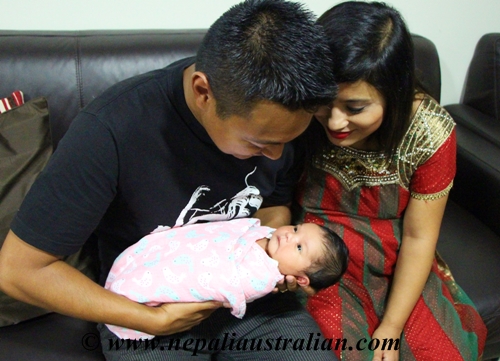
Also this is my first Aama ko Mukh herne as a mum and just looking at Chhori smiling in the morning made my day extra special.

Aama ko Mukh herne, Mata Tirtha, Nepali Mother’s day

So if you haven’t called your mum to wish her, do give her a call and make her smile. And to all the proud moms out there, Happy Aama ko Mukh herne.

Till  next post take care everyone,

from nepaliaustralian

XOXO

Superstitions Practices during Pregnancy in Nepali culture

As I come from a background where there are lots of superstitions and beliefs practiced till today. It is normal to hear dos and don’ts regarding pregnancy. I can see the logic behind some of the beliefs while about others I have no idea why they are followed.

In Nepal, they believe that when the baby is in the womb it picks up a lot from his/her surroundings and emotions and thoughts of the mother. Even though we may not realize his/her senses are active at that time, our actions have a great impact on babies even before they arrive on earth.

From the type of food to the mother’s daily actions, what to wear and what to do are some of the traditions that amazed me. Some of them I did considered following while others I couldn’t. Most of these superstitions don’t cost more money and doesn’t hurt anybody. It just may prove to be a little more inconvenient at times.

As educated as I am in the 21st century of advanced science, I am still scared sometimes not to follow the superstitions. At the back of my mind, I think that if something does happen to the baby, it will be my fault. I definitely do not follow the beliefs blindly but I do follow them as long as they sound reasonable enough and it are morally right.

Not announcing the pregnancy until after 3 months have passed

I wrote a whole post regarding this because I have my own idea why we shouldn’t announce the pregnancy very early. A higher percentage of miscarriages occur during the first trimester. Some people may feel it is just wiser to wait until after the period of instability is over. We did tell our immediate family members early and waited 3 months to tell the rest of the world, but at the end of the day it is a personal preference.

nepaliaustralian

Eating lots of almond, milk and saffron to have fair skin baby

I have talked about Asian people’s obsession with fair skin before in my blog. I thinking living in Australia for more than a decade now I have come to love my skin tone. Most people around always complement me about it and I am proud of my colour.

But in Nepal, they still believe that fair is beautiful. Everyone wants a fair baby regardless of the colour of parents’ skin. Most people will call a fair person beautiful disregarding any other quality.

So when I told people that I am having a baby, they asked me to drink lots of milk with saffron and almonds. Some of my friends and cousins swear by it.

I do drink plenty of milk for calcium and snack on almonds but don’t do saffron at all. But in my head, I can’t imagine my baby being too fair as both AS and I are brown and I am sure we are going to have a brown baby no matter what I eat or drink.

Not watching Horror/scary/action movie

I know lots of people have asked me not to watch scary movies/ TV during pregnancy. It’s advisable not to watch horror or action movies which involve a lot of blood during pregnancy because it is believed that it may indirectly effect the growing baby. Watching violent and horror stuff on television or reading such books can create fear or violence in your child.

I do see some logic behind this because when we watch such movies, our heart may pump heavily as we get excited and this could lead to pressure on our womb.

I generally don’t watch horror movies but I do watch lots of cops/ detective dramas so I am not sure what it is doing that to the baby. I think if you feel happy after watching a movie and not frightened then go for anything that you like.

Look at the photo/picture of great people or God

Lots of people believe that you should have a photo of a god/goddess or some famous person in your room while you are pregnant. It is also believed that keeping pictures of baby Lord Krishna and smiling faces around you in the room will also create a harmonious environment.

When my SIL was pregnant, my brother put up president Obama’s photo in their bedroom. I really don’t know what was going on in his head but if my nephew becomes a prime mister/president one day, then I will be sure that this theory works.

Also having photos of beautiful baby is supposed to make your baby beautiful as well.

Do not touch the baby in tummy during eclipse

It is believed that if one is expecting and there is an eclipse during that time both parents should be very careful and cautious. Parents should not do any activity like using a knife, scissors, pen as their child will have a mark or mole or cut on his body.  So during eclipse, one should not leave the house and should lie on the bed straight and stay indoors. Reading holy books during eclipse is beneficial for everyone specially couples expecting a baby.

Read holy/spiritual book

Parents who are more into spiritualism and read spiritual books during pregnancy believe that they notice their children will be coming from the same thought process because they read these books during pregnancy.

There is a myth people believe in for a long time in our holy book Gita.

Abhimanyu, who is the son of Arjuna & Subhadra (half-sister of lord Krishna). As an unborn child in his mother’s womb, Abhimanyu learned the knowledge of entering the deadly and virtually impenetrable Chakravyuha from Arjun. The epic explains that he overheard Arjun talking about this with his mother Subhadra from the womb. Arjun explains to Subhadra in detail, the technique of attacking and escaping from various vyoohs (an array of army formation) such as Makaravyoha, Kurmavyooha, and Sarpavyuha etc. After explaining all the vyoohs, he explains about the technique of cracking Chakravyuha. Arjun tells how to enter the Chakryavyuha. When he was about to explain how to exit from the Chakravyuha, he realizes that Subhadra is asleep and stops explaining about the Chakravyuha further. Thus the baby Abhimanyu in the womb did not get a chance to learn how to come out of it, which played a big role in his life.

Be around and in contact with positive and cheerful people.

I completely agree with this one because you don’t need extra stress during pregnancy apart from what you are already going through. If the mom to be is depressed and sad most of the time during pregnancy it will affect the child in the same manner.

I made sure that I only met people who had a positive attitude so I didn’t dwell on negative thoughts and kept myself happy during the journey.

Reciting, chanting or listening to devotional mantras

Good, peaceful thoughts and reciting, chanting or listening to devotional mantras plays a great role at the time one is expecting.  It is believed that if you listen to devotional mantras when the baby is in the tummy, he/she will have a calm personality.

Wearing loose clothing

You don’t want to show off your pregnancy in case you get an evil eye from someone. They even suggest wearing scarfs (kasto) so people won’t notice you are pregnant. Making sure you stay away from evil eyes and evil thought seems to be very important in Nepali culture.

For me it was not possible for me to wear covered clothing as most of my pregnancy was during spring and summer. I was happy to wear comfortable clothes that were not too tight but never went beyond that to make people think I was not pregnant.

Until around 5 months, I think it was not a problem anyway as it was not obvious but after that no matter what I wore, it was obvious.

I am sure there are a lot of other superstations and beliefs in Nepali/Newari culture I could add to this list. But I am going to stop here.

Please do share superstitions and practices during pregnancy in your culture. I am sure there are some interesting ones and some weird ones out there.

Till  next post take care everyone,

from nepaliaustralian

XOXO

Nwaran for Chhori

I know I am posting this late because Chhori is already a month now.

Nwaran  (19)

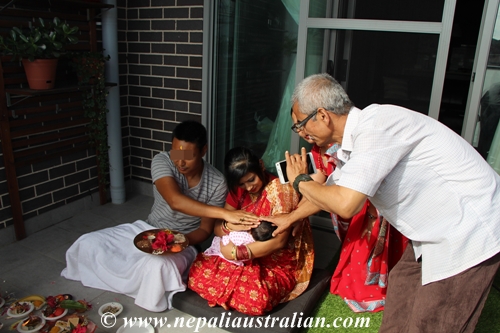
Nwaran was performed when she was 11 days old.

Nwaran  (20)

Nwaran ceremony is also known as Machabu Byakegu in Newari. This ceremony is performed to give a birth name to a child according to his/her lunar horoscope; this is usually not the name by which he/she will be known. This ceremony is normally small and celebrated amongst close family.

Typically, a priest is invited to perform the ceremony at home, and divines the child’s lunar horoscope from his birth details, as the mother is still recovering at home with the child. Until the mother and child are ‘purified’ (from past birth etc. in the religious sense), they should not visit the temple.

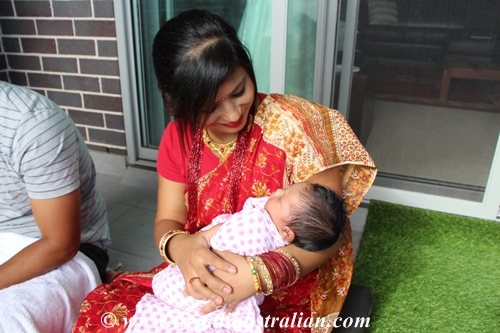
For the occasion, I wore a red sari which was specially brought from Nepal by my mum for the occasion. It was a cotton sari which is what new mums are supposed to wear for the occasion.

As soon as Chhori was born, we booked a priest for the ceremony and he gave us a list of things that are required for the day and everything was ready when he arrived at my place at 8.30 am on the day of the ceremony.

Nwaran  (1)

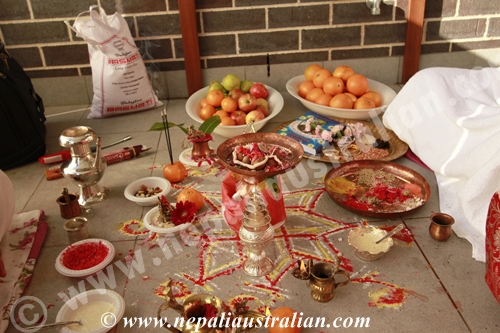
The main ceremony was conducted in the balcony of our apartment.  Before the priest arrived we had cleaned and mopped the place. So, when he arrived, he started making a Mandap on the balcony. Once it was ready he asked AS to come and join him for the Puja.

Nwaran  (2) Nwaran  (3)

He had all his books of mantras and it took more than an hour for the first phase of the Puja to finish. It involved lots of mantra reciting from the books and lots of different Pujas to God, with candles on the Mandap.

Nwaran  (4) Nwaran  (5)

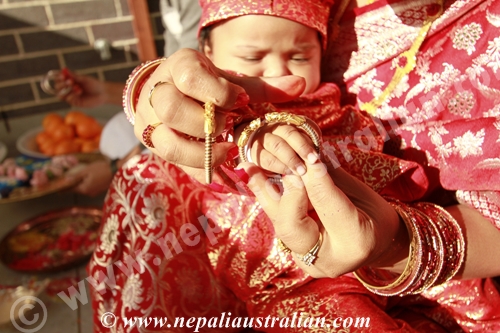
Then he asked me and Chhori to join the Puja. He chanted more mantras from the book. Then he asked me to perform Puja to the sun. Then he put tika on Chhori’s forehead and gave him a piece of paper which had details required to make her Jaata (lunar horoscope chart).

Nwaran  (6) Nwaran  (8) Nwaran  (7)

Then my SIL took Chhori for Surya Darshan, i.e. to let the sunray fall on her as a blessing. Then the priest put Tika on AS, me and rest of the family. He also put Janai (holy string) around our wrists.

Nwaran  (11)

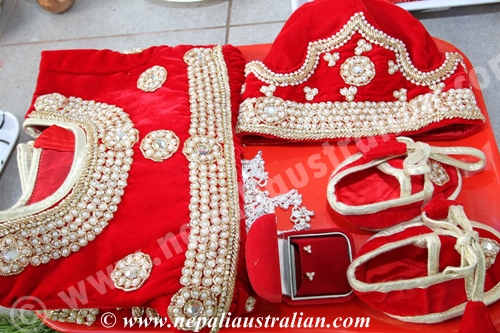
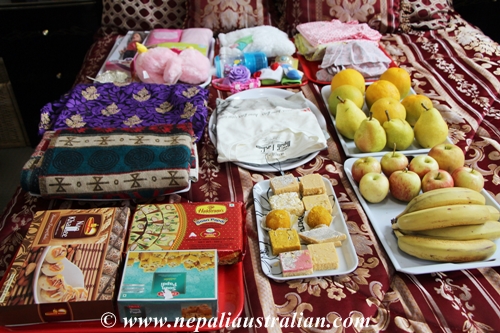
After the ceremony, the priest left and the family function started. My parents, with the help of my brother and SIL, had prepared lots of trays of gifts for us and Chhori. It included sari and other gifts for me, clothes for AS and lots of clothes, toys, and manchester for Chhori as well as trays of sweets and fruits.

Nwaran  (12) Nwaran  (13) Nwaran  (15)

The special thing required was special sliver bowl and spoon which my mum has got from Nepal.

Nwaran  (14)

My parents put tika for AS, me and Chhori and gave us blessing and gifts. It was really nice and special to have all my family here for the occasion.

Nwaran  (16) Nwaran  (17) Nwaran  (18)

Till  next post take care everyone,

from nepaliaustralian

XOXO

Chhaithi for Chhori

First of all thank you everyone for lovely message and sorry for not posting as frequently as before but as you can imagine I am too busy feeding, changing nappies and looking after Chhori that there is no time for anything else. If there is any spare time, I would love to sleep but sleeping for long periods of time seems like a distant dream right now.

As you all know there are lots of rituals in Hindu culture when one has a baby. Now with Chhori, we want to follow all the rituals as well even though we are not in Nepal. The first ritual we performed is called Chhaithi.

Chhaithi  (5)

Chhaithi ceremony is performed when the baby is six days old and takes place late in the evening.

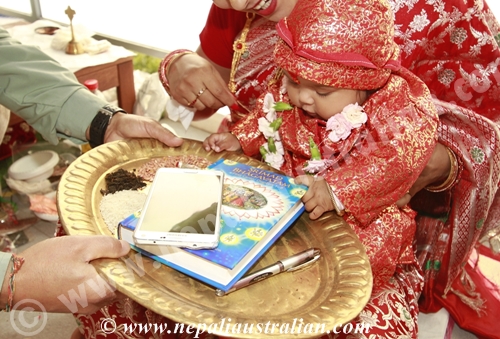
For Chhaithi, the fufu (baby’s dad’s sister, or the baby’s paternal aunt) will need to bring some koseli (gifts for the baby) which includes fruits and sweet along with a new pair of clothes for the baby. She will also bring a notebook and a pen.

In our case, as AS doesn’t have any sister here, the ceremony was performed by my SIL.

Chhaithi  (2)

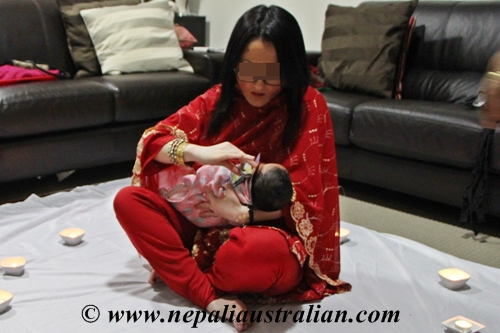
So to start the Chhaithi, my SIL sat with Chhori surrounded by 12 tea light candles (traditionally we use oil lamps) and one more candle was lighted for god.

Chhaithi  (3)

According to tradition, there is a belief that on the 6th day after the birth of the child,  Vidhaata (Goddess of destiny) would quietly enter the house around midnight to pen the destiny of the newborn. Traditionally the mother of the newborn lights a lamp and this lamp along with a pen and paper given by fufu are placed on a wooden plank for Vidhaata to write the future of the newborn.

Chhaithi  (4)

After my SIL finished performing the ritual, everyone else in the family performed the rituals by giving Chhori money and gifts. Then I gave my SIL gifts and she gave the baby back to me.

Chhaithi  (6)

After the ceremony when the Chhori went back to sleep, we placed the notebook and pen next to the bassinet along with one of the candles.

I prayed to the Goddess that she be given a bright future with a healthy life.

This concludes the first of many rituals my Chhori will have in her life.

Till  next post take care everyone,

from nepaliaustralian

XOXO

Dahi Chiura Ceremony

As I mentioned in my previous post, I had my baby shower but I was waiting for my parents to arrive from Nepal to do a traditional baby shower, also known as Dahi chiura ceremony in Nepali or Dhau-baji in Newari.

In this ceremony, the mother-to-be’s family comes to feed Dhau-baji (yogurt and flattened/beaten rice) and brings Sagun and lots of food along with gifts for the mother-to-be as well as the unborn baby.

My parents have arrived in Sydney now so I am extremely happy as I will have a helping hand to look after the little one for the first few months. I could not imagine how I would have managed if they were not here.

Last weekend, my parents along with the help of my brother and SIL organised the Dahi Chiura ceremony. It was a traditional ceremony with the ladies all wearing saris.

Dhai Chiura (14)

My mum made Yomari and sagun (bara, boiled eggs, chicken and fish) for the occasion and bought some sweets, fruits and cakes as well. They also bought clothes for me along with jewelleries as well as things for little one.

Dhai Chiura (5) Dhai Chiura (4) Dhai Chiura (3) Dhai Chiura (1)

It was a family affair with just me, AS, my parents, brother, SIL and my little nephew.

Dhai Chiura (15) Dhai Chiura (2)

For the ceremony, my mum followed the followings steps, if anyone wants to know. It might be different for different cultures but I believe the basic will remain the same.

Dhai Chiura (6) Dhai Chiura (7)

  • The ritual started with my mother worshipping Lord Ganesh in the Sukanda. She put tika made of vermillion, rice and yogurt and flowers on Lord Ganesh..
  • Then she put tika for me and AS.
  • Then she gave us the gifts of fruits, sweets, clothes, and jewelleries.
  • This was followed by Sagun and then the main event of dahi chiura, where everyone feeds me dahi chiura.
  • Everyone was given Sagun and sweet as well after this.
  • Thus the main event of dahi chiura is was conclude.
  • Cake is normally not a traditional inclusion for dahi chiura but we had one so I and AS cut the cake together

Dahi Chiura (12) Dahi Chiura (13) Dahi Chiura (16)

For many reasons, the dahi chiura ceremony is one of my favourite celebrations for our coming daughter.

Dahi Chiura (9) Dahi Chiura (10) Dahi Chiura (11)

In addition to normal family dahi chiura, the pregnant mother is often invited by her relatives to eat meals with them. I had invited many of my family and friends who were pregnant to my place and done the same ceremony so it is my turn to be invited to my close friends and family’s place for the dahi chiura ceremony as well.

It was really nice of all of them to get involved making me and the baby feel special. Here are some of the pics from various occasions of dahi chiura. I was spoiled with lots of blessings, yummy foods and lots of useful gifts .

Dahi Chiura (18)

I am so glad that we are keeping Nepali traditional alive living so far from home and I want to show all these photos to my daughter one day and explain the traditions and culture.

Hope you enjoyed the traditional way of Nepali/Newari baby shower.

Take care,

from nepaliaustralian

XOXO