Category Archives: Nepal

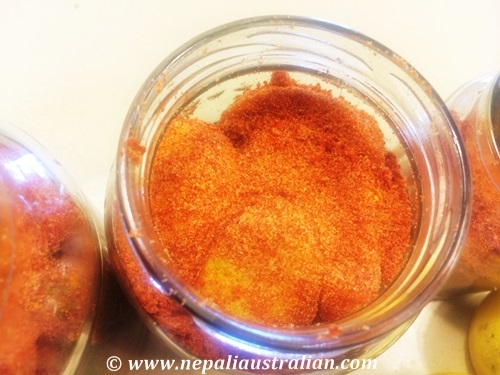
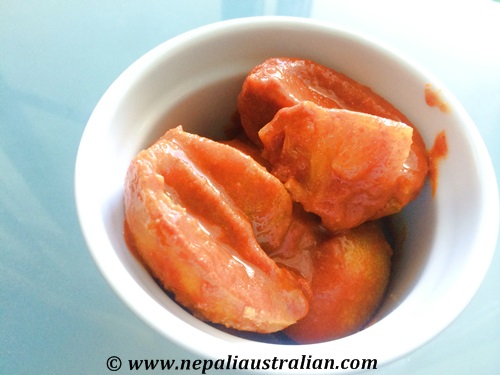
Preserved lemon achar (kagati ko achar)

Ingredients

  • 1 kg small lemon
  • 350 gms salt
  • 150 gms red chili powder
  • 20 gms turmeric powder
  • 150ml of oil

IMG_1361

Steps

  • Wash the lemons and use paper towel to pat dry.
  • Let it air dry for a few minutes after that to ensure there are no water particles.
  • In the meantime, wash a glass bottle/pickle jar and dry it well.
  • Cut each lemon into quarters.
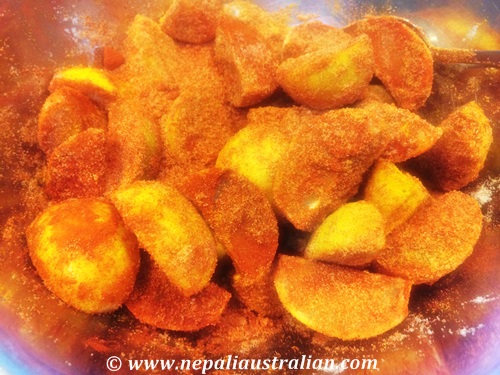
  • In a large bowl, add lemon, salt, chilli and turmeric powder.

IMG_1368

  • Mix well with hands to mix all the spices with the lemon to coat them with the spices.

IMG_1369

  • Transfer prepared pickle into the glass bottle/ jar using a spoon.

IMG_1373

  • Make sure you fill only ¾ of the jar. Close the lid tightly so no air can go inside. Use glad wrap on the lid if necessary to make it air tight.

IMG_1380

  • Leave for a week under direct sunlight to dry the lemon.

IMG_1388

  • Move the lemon around every day so the spice gets to all of the lemons and they all get the sun .
  • The lemon is ready to eat once the salt melts and coats the lemon wedges.
  • If you want to make the pickle last longer, add oil into the jar and keep in the sun for 2 more days.
  • Now the pickle will last for a few months.
  • Never use wet hands or spoon to handle pickle.

IMG_1890

  • Enjoy!!!

 Take care ,

M from nepaliaustralian

XOXO

Nirbuni for my nephew (second birthday)

I swear it feels like yesterday that I told you I had a new man in my life (my li’l nephew) and gosh it has been two years now. Even though he was born in 18 July, we celebrated his birthday on 26th of July which was determined by his birth chart and our own Nepali calendar.

Since his birth, he has given joy to everyone including his parents, us, my parents and my sister in law’s parents. When he was visiting last month to Nepal, he was the apple of the eye and was spoiled rotten by everyone.

Strangely, for reasons unknown and out of traditions handed down from generation to generation, the first birthday of a child is not celebrated by Newars. When a child is born, he will have chhaiti, nawaran then pasni. After pasni, the big celebration is second birthday, which is known as Nirbuni in Newari.

According to tradition, we make Yomari every even birthday (2, 4, 6, 8, 12) until a child turns 12. Yomari is a delicacy of the Newars. It consists of an external covering of rice-flour and an inner content of sweet substances such as chaku (Molasses).

yomari

During Nirbuni, a big puja is performed and the child is given a garland made out of two yomaris. The child is also given tika and sagun and prayed to ward off evil spirits from the child’s body. If we were in Nepal, relatives would come along with gifts and sweets for the kid. Therefore, this birthday was a big deal for us.

We started Saturday making yomari and sagun. With the help of our cousin it was done and then the puja started. My nephew was good during the puja as he sat on his dad’s lap while I perform the puja.

Nirbuni  (12)I am not expert on performing the puja but this is what I did.

  • First I gave Nasala, a few drops of water, in the palm of the right hand of my nephew to sprinkle some into his mouth and the rest over his body for purification.
  • Then I put tika on Lord Ganesh with water, rice, flowers, and vermilion powder as well as a plate of sagun in front of him.
  • Then I gave water, rice, flowers, and vermilion powder to my nephew to worship the Lord Ganesh and also to all the God and Goddess by throwing the rice towards the ceiling.
  • Then I placed tika on his forehead and put a flower on his head.

Nirbuni  (14)Nirbuni  (11)

  • Then I placed the Yomari mala followed by flower mala.

Nirbuni  (13)

  • After that I put bits of rice, radish, coins, cucumber in a small container and poured them on his head. This is believed to take all the evil spirits away from him. I did this three times.

Nirbuni  (8)

  • Then,I gave Sagun to him. For Sagun, you put a plate of egg, bara (lentil cake), meat (chicken), a piece of giner and fish in the right hand and yogurt in the left hand.

Nirbuni  (9)Nirbuni  (15)

  • Once the process is finished with my nephew, I gave tika to the rest of the family, followed by sagun.

My parents and my SIL’s parents were on skype watching the ceremony. They were happy to watch all the ceremony even though they are so far away.

I also took tray of fruits, biscuits and a three piece suit for him as a birthday gift.

Nirbuni  (10)

He looked really adorable in the suit.

Nirbuni  (5)Then there was a party in the evening. I did the decoration and was happy with the result. It was a fun party with lots of kids.

Nirbuni  (7)

The house was chaotic in a good way for the rest of the evening where kids ran, laughed , danced and played.

Nirbuni  (3) Nirbuni  (2)We had a nice cake for him and the food was catered so everyone enjoyed the day. It was such a fun day and the little man was very happy with all the attention and gifts.

Nirbuni  (1)

On Sunday, I baked cupcakes for him to take to his childcare to celebrate his birthday. The childcare request simple individual cupcakes so I baked them myself.

Nirbuni  (6) Nirbuni  (4)Overall, it was a great nirbuni celebration for my nephew.

Wishing little man all the happiness of this world.

Take care ,

M from nepaliaustralian

XOXO

Chana chatpat

Chana chatpat is a snack I used to love while growing up in Kathmandu. They were usually sold by street vendors and I used to love it. Now every time I go back, I feel like having it but am scared of getting sick so I decided to try to make my own home made Chana chatpat. I am happy with the result even though it might lack the touch of the street vendor.

I think it is healthy and definitely tasty snack perfect for anytime.

Ingredients

  • 1 cup puffed rice
  • ½ cup chickpeas, soaked (I used canned)
  • 1/2 cup aloo bujiya (bought a pack from Indian grocery store)
  • 1 medium sized onion, finely chopped
  • 1 medium sized tomato, finely chopped
  • 1 green chilli, finely chopped
  • 1 teaspoon chili powder
  • 1 tablespoon mustard oil
  • 1 table lemon juice
  • 2 tablespoon finely chopped coriander leaves
  • 2 teaspoons of chat masala (salt if chat masala not available)

chana chatpat (1)

 Method

  • Mix puffed rice, chopped onion, chickpeas, chopped tomatoes, chilli powder, green chilli, aloo bujiya , coriander leaves in a bowl.

chana chatpat (2)

  • Now add lemon juice and oil and mix it well.
  • The chana chatpat is ready.
  • I served mine in a paper cone like the street vendors in Kathmandu, you can just serve in a plate or bowl.

chana chatpat (3)

Note : It needs to be consumed immediately otherwise the puffed rice will go soft and it won’t be nice and crunchy as it is supposed to be.
Hope this will bring back your childhood memories as well 🙂

Take care,

M from nepaliaustralian

XOXO
 

Janku (Pasni for older people)

In Newari culture Janku (also known as Buda Janku or Pasni, different from pasni for baby  ) is a celebration when a person reaches a certain age. If it’s a couple, the date is determined by the age of the husband and the couple will celebrate the Janku together irrespective of the wife’s age at the time. If it is a single person, then it is according to their birth date.

There are five Jankus performed during the lifetime of the person if s/he happens to live to be 106 years old.

The first Janku is when a person is of 77 years, 7 months and 7 days where they are worshipped as an aspect of the sun. This is called BHIMRATHAROHAN where the grandsons carry the person’s chariot on their shoulders and visit temples of god and goddess.

The second Janku is at the age of 83 years, 4 months and 4 days where they are worshipped as an aspect of the moon. This is called CHANDRARATHAROHAN as it is believed that a person has seen 1000 full moons in their life and their prayers are directed towards the moon.

The third Janku is performed at the age of 88 years, 8 months and 8 days, which is called DEVRATHAROHAN and they are worshipped as an aspect of god. This time too the grandsons pull the chariot and visit temples. While entering to home the persons chariot is entered from the window of the house.

The forth Janku is at the age of 99 years, 9 months and 9 days, which is called DIVYARATHAROHAN.

The final one is at the age of 105 years, 8 months and 8 days old, called MAHADIVYARATHAROHAN.

Janku is celebrated at such defined ages for two reasons. “Newari texts mention that the particular ages for the ceremonies mark inauspicious times in a person’s life, times when even the smallest hurdle might pose a serious threat to one’s life. The various rituals are performed in order to please particular deities to help the person overcome those problems”.

Before the invention and availability of modern medicine the average life expectancy of the people was 60 to 65 years and reaching the age of 77 and beyond was like getting a new lease on life. The second reason for a Janku is that after their Janku ,they are considered as god or goddess and the title of Thakali is given the as they are one of the senior members of the community.

Few weeks ago, my Ma (maternal grandmother) celebrated her second Janku. I wish I was in Nepal for that as I missed the first one too but I am so glad to see that she has one great grandson with her.

My Ma has four kids, one of them being my mum and all of them are married. She has 10 grand kids and 6 great grand kids but unfortunately all of the grand kids live overseas so it was so rare for a great grand kid to be around during that time.

Luckily my brother, SIL and nephew were visiting Nepal and they were there to celebrate the big occasion.

During each Janku, the person is dressed like a bride or groom and takes seven steps before getting on the Rath (chariot). The sons and grandsons carry them on the chariot take them around town with family and relatives following the procession.

Women shower them with flowers and vermilion powder and when they reach their home they are given Sagun wishing them a long healthy life.

All the relatives and even distant ones visit them to receive their blessings and have a Bhoj (party) after the completion of all the rites and rituals.

Till next time, take care

M from nepaliaustralian

XOXO

Prabal Gurung Resort 2015

Inspired by a show of the British artist Matthew Stone’s work at The Hole gallery, Prabal Gurung ( my favourite designer), named his latest Resort collection: Unconditional Love. He said he approached his striking new Resort collection as if it were a “one-stop shop from morning to evening”. The idea, he explained, was prompted by all the traveling he’s been doing to trunk shows in places as far-flung as Singapore and Toronto.

I love everything from this collection, from tees and sweatshirts to floor-length gala dresses with prints or jacquards designed to evoke Stone’s brushstrokes. The prints and jacquards came in vivid shades of red or blue, sometimes mingled together, and they turned the clothes into moving canvases.

Here are some of my favourite from the collections..And looks at those choose, love love love.

View the rest of the collection .

Apart from his latest collection, he is definitely making waves around the world and doing a great job.

Take care,

M from nepaliaustralian

XOXO