Roti and fruit shops in Nepal

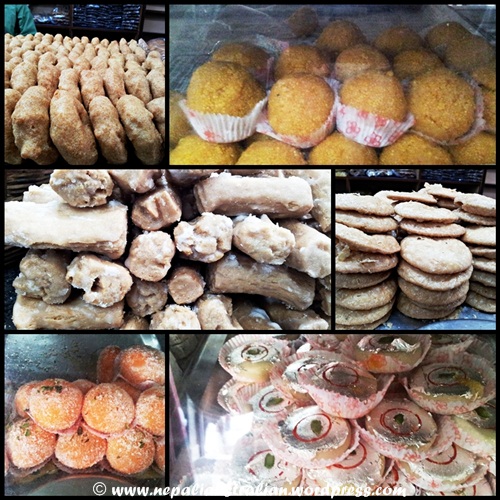
While I was shopping in Nepal for my nephew’s Pasni, I went to many Roti shops and fruit shops. I was so fascinated by the items on the shelves that I took the photos of so many varieties of rotis and fruits. You will notice that there are many varieties of rotis and I don’t even know the names. Also fruit shops are so different from the ones in Australia, I was just fascinated. Sharing the pics here 🙂fruits (1) fruits (2) fruits (3) fruits (4) Roti shop (1) Roti shop (2) Roti shop (3) Roti shop (4) Roti shop (5) Roti shop (6) Roti shop (7) Roti shop (8) Roti shop (9)

Visiting Grand Palace and Wat Phra Kaew (Temple of the Emerald Buddha): Thailand

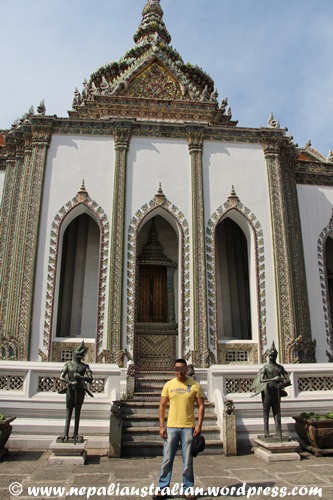
I have been to Thailand before but for one reason or another I didn’t get a chance to visit one of the famous tourist attractions of Bangkok which is the Grand Palace. (Read about my previous trip here and here). So on our visit there this time, we made sure to go and see the Grand Palace and Wat Phra Kaew, Temple of the Emerald Buddha.

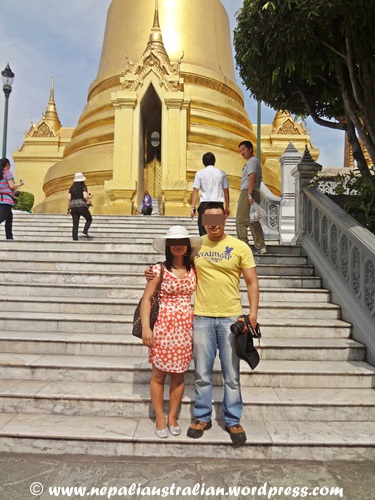
One morning we had our breakfast at the hotel and left to catch a boat to the palace. I had read on the internet that we need to dress appropriately to go to the palace. Men must wear long pants and shirts with sleeves — no tank tops and if you’re wearing sandals or flip-flops you must wear socks .Women must be modestly dressed too; no see-through clothes, bare shoulders, etc. So even though the day was very hot, AS was wearing his jeans and I was wearing a sleeved dress.

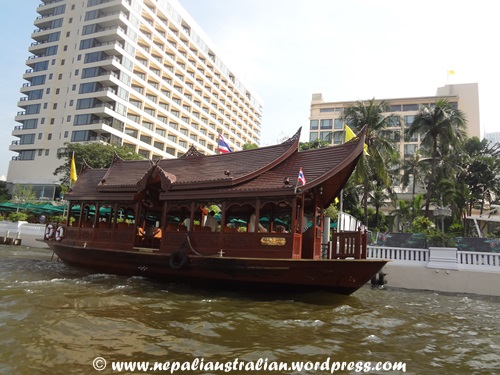
We caught a train from our hotel to the pier where we were to catch the Chaophraya Express Boat to the Chang Pier (Tha Chang). It was a quite easy to get there but it took us around an hour all up. Grand Palace and Wat Phra Kaew  (2) Grand Palace and Wat Phra Kaew  (3)

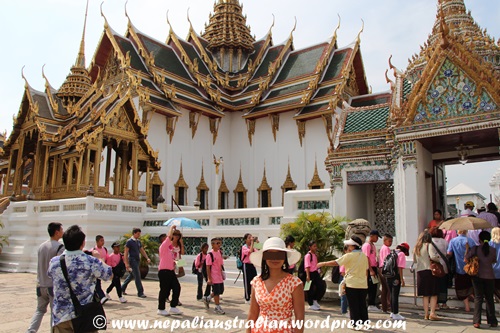
Once we got off at the Chang pier, we needed to go through the market around the pier and out onto the plaza flanked by old shop-houses. It is easy to get distracted while you pass by these shops selling food and souvenirs.  As soon as we were out in the main street, I could see the white walls of the palace. There were a lot of tourists, busloads of them from everywhere.

Grand Palace and Wat Phra Kaew  (4)

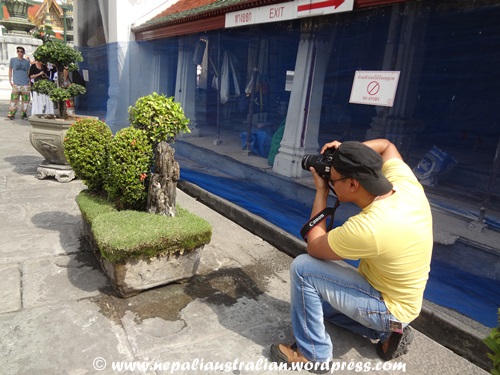
We found the main door and bought our tickets. We had always used guided tours before but this time we took a chance and planned to explore the palace on our own. And I am glad we did as we had lots of fun and got plenty of time to look around and take photos.

Grand Palace and Wat Phra Kaew  (5)

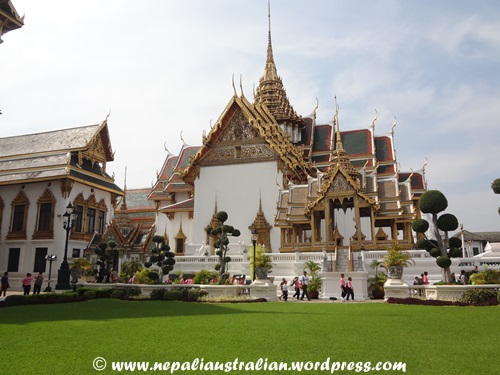
The Grand Palace of Bangkok has buildings with a beautiful architecture and intricate details. The Grand Palace complex was established in 1782 and it houses not only the royal residence and throne halls, but also a number of government offices as well.

Grand Palace and Wat Phra Kaew  (26) Grand Palace and Wat Phra Kaew  (27)

For almost 150 years, the Grand Palace was the home of the King and his court, as well as administrative seat of government. Thai Kings stopped living in the palace full time at the start of the twentieth century but the complex remains the seat of power and spiritual heart of the Thai kingdom.

Grand Palace and Wat Phra Kaew  (30)

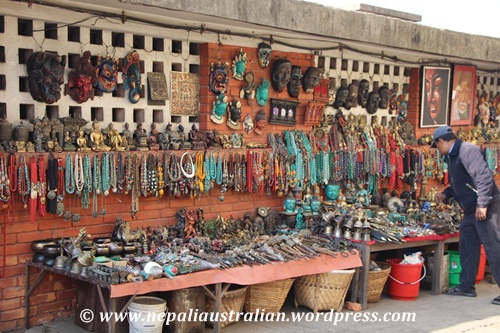
 As soon as we started our journey, we saw a Nepali handicraft shop. It was so nice to see that shop as I felt good that Nepali handicraft is so popular.

Grand Palace and Wat Phra Kaew  (6)

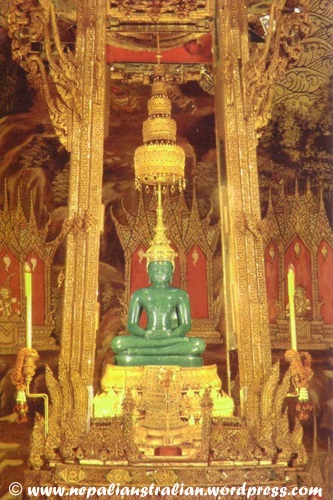
Within the palace complex, there are several impressive buildings including Wat Phra Kaew (Temple of the Emerald Buddha), which contains the small but very famous and greatly revered Emerald Buddha.

Grand Palace and Wat Phra Kaew  (17)

Wat Phra Kaew or the Temple of the Emerald Buddha is regarded as the most important Buddhist temple in Thailand. This highly revered Buddha image meticulously carved from a single block of jade. The Emerald Buddha is a Buddha image in the meditating position in the style of the Lanna school of the north, dating from the 15th century AD.

Grand Palace and Wat Phra Kaew  (18) Grand Palace and Wat Phra Kaew  (11)

You have to take your shoes off to go inside the Buddha temple and cameras were not allowed. There were lots of people sitting on the marble floor and praying but we just went in, looked around and got out as it was too very busy.

Grand Palace and Wat Phra Kaew  (7) Grand Palace and Wat Phra Kaew  (12) Grand Palace and Wat Phra Kaew  (19) Grand Palace and Wat Phra Kaew  (22)

We spent most of our time exploring the temple complexes surrounding Wat Phra Kaew. I was really impressed by a model of Angkor Wat. Every detail was covered and it looked really impressive.

Grand Palace and Wat Phra Kaew  (9) Grand Palace and Wat Phra Kaew  (10)

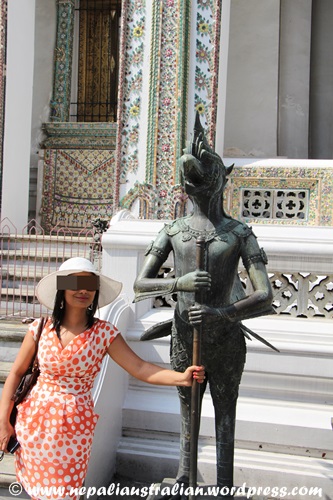
The rich blues and greens, earthy reds and shining gold tiles covering every imaginable surface are stunning and the big balcony with columns that has stone inscriptions, the murals inside which tells the Ramayana epic in its entirety were very impressive. Each gate of the Balcony were guarded by the five-metre tall ‘Yaksa Tavarnbal’ (Gate-keeping Giants), the characters taken from the same epic and looked awesome.

Grand Palace and Wat Phra Kaew  (23)

Grand Palace and Wat Phra Kaew  (1)

I loved the colours and patterns of the roof which are embellished with polished orange and green tiles, the golden colour everywhere and the pediments which were made of rich marble. The place was really clean despite of so many tourists visiting every day.

Grand Palace and Wat Phra Kaew  (14)

Grand Palace and Wat Phra Kaew  (13)Grand Palace and Wat Phra Kaew  (16)Grand Palace and Wat Phra Kaew  (21)Grand Palace and Wat Phra Kaew  (8)

On our way out we dropped into the weapons museum inside the Borom Phiman Mansion. It was an interesting collection of weapons and AS was more excited than me, naming the weapons and comparing it to one another.

Grand Palace and Wat Phra Kaew  (29)Grand Palace and Wat Phra Kaew  (24)

Grand Palace and Wat Phra Kaew  (15)

If you have time, you can spend the whole day there but as we had other plans for the evening, we caught a boat back to our hotel.

Grand Palace and Wat Phra Kaew  (25) Grand Palace and Wat Phra Kaew  (28)

Please click here for more photos.

Blueberry muffins

When I was in Nepal, I baked blueberry muffins in my new home. All the family members loved it so I am sharing the recipe here. It is really easy and simple.

Makka ku (7)

Ingredients

  • 2½ cups self-rising flour
  • 90g butter, chopped
  • 3/4 cup firmly packed brown sugar
  • 125g fresh blueberries (I used canned ones as I couldn’t find fresh ones in Nepal)
  • 1 cup milk
  • 2 eggs, lightly beaten

Steps

  • Preheat oven to 180°C or 160°C fan-forced.
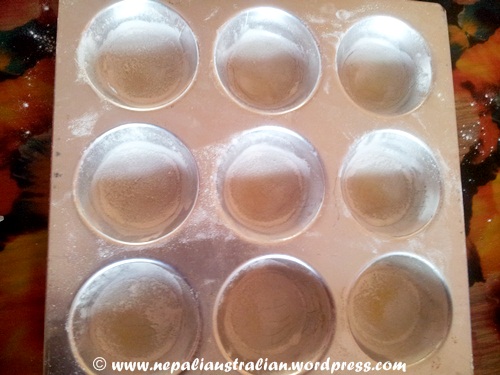
  • Lightly dust muffin tray with flour.

Blueberry muffin (4)

  • Sift flour into a bowl. Add sugar and butter and mix well with hand.
  • Make a well in the centre of flour mixture.

Blueberry muffin (1)

  • Add blueberries, milk and egg. Gently stir until just combined using wooden spoon

Blueberry muffin (2)

Blueberry muffin (3)

  • Spoon mixture into prepared holes.

Blueberry muffin

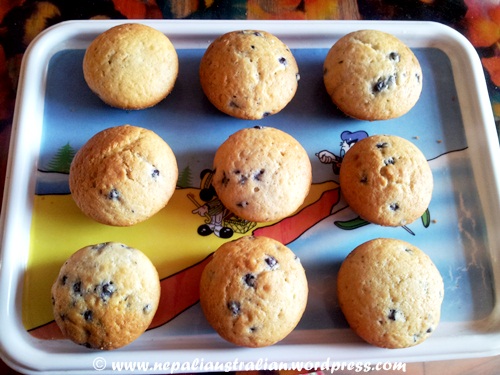
  • Bake for 25 minutes or until a skewer inserted in center of 1 muffin comes out clean.

Blueberry muffin (5)

  • Stand in pan for 5 minutes. Turn out onto a wire rack to cool.

Blueberry muffin (6)

  • Enjoy with tea or coffee.

Blueberry muffin (7)

From independent, confident strong women to dependent, needy wife

I am not sure when I crossed the bridge but I recently realised that I have turned from a strong, confident, independent woman into a very dependent, needy wife.

Before I got married, I used to do everything on my own. Most importantly I made my own decisions and went everywhere on my own. I travelled to the US on my own and I was just glad that I had so many friends there. I always went shopping on my own and made decisions on my own. I never felt the need for anyone to be there constantly for me and definitely not to make any decisions for me.

But these days, for even small decisions I need to ask AS for his opinion. Is it really normal or do I really need to pick up my act?

I call AS and ask things like,

“Do you want me to buy a red towel or a maroon one?”

“I really like this dress but should I buy it?”

“I am in the supermarket and I saw this new laundry powder, shall I buy it or buy our regular powder?”

“Do you want to eat lamb or chicken for dinner tonight?”

Some days I even ask him what should I eat for lunch as I can’t make a decision and I am already in front of food court or outside some restaurant.

Seriously, is this normal once you are married or I am becoming overly dependent on him?

It is not only me who has noticed this changed. When AS left from Kathmandu 2 weeks before me, I was on my own. In those 14 days I mentioned that I missed him to everyone. Really, I was telling my cousins and friends so often that they told me the same thing, I have become very dependent. I have really begun to rely on him in so many things that I can’t live even a week away from him.

For the last few years I have told myself that all these changes are because of love. I love him so much that I can’t imagine my life without him. And I thought it was normal to change and feel the way I do but today I feel like asking all of you.

Is this love or dependency?

Do you think I am on the right path?

Do I need to change and start becoming independent again?

Anyone there feels the same as way I do?

P.S: AS consults with me for all his decisions as well.

You may also like :

*Arranged marriage: My perspective *Ta, Timi, Tapai and Hajoor *With love, to my dear husband

Swayambhunath: Kathmandu, Nepal

Going regularly to a temple is big part of Nepali culture. You will often see people of all age going to a temple early in the mornings. While in Nepal, we tried to go to different temples as well. For us it was more of going to see the place than for religion but if we were to get blessed while we were there then even better :). One of the temples we visited was Swayambhunath, also know was Monkey Temple by tourist in Kathmandu.

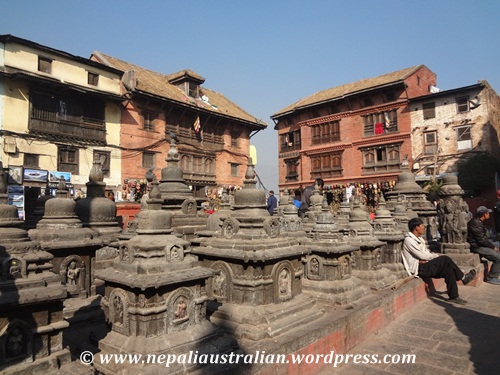
One day we were invited for lunch to our aunt’s house, which is near to Swayambhunath, so we decided to visit the temple before we went for lunch. Swayambhunath is an ancient religious complex atop a hill in the Kathmandu Valley, west of Kathmandu city. Even though Swayambhunath is a Buddhist stupa, yet it is equally popular with the Hindu pilgrims as well.

Swayambhu (21)

Legend has it that Kathmandu Valley was once an enormous lake, out of which grew a lotus. The valley came to be known as Swayambhu, meaning “Self-Created.” The name comes from an eternal self-existent flame (svyaṃbhu) over which a stupa was later built.

Swayambhunath is also known as the Monkey Temple as there are holy monkeys living in the north-west parts of the temple. They are holy because Manjushree, the bodhisattva of wisdom and learning was raising the hill which the Swayambhunath Temple stands on. He was supposed to leave his hair short but he made it grow long and so head lice grew on them. It is said that the head lice transformed into these monkeys.

Swayambhu (15)

The Bodhisattva Manjusri had a vision of the lotus at Swayambhu and traveled there to worship it. Seeing that the valley could be a good place for settlement and to make the site more accessible to human pilgrims, Manjusri cut a gorge at Chovar. The water drained out of the lake, leaving the valley in which Kathmandu now lies. The lotus was transformed into a hill and the flower became the Swayambhunath stupa.

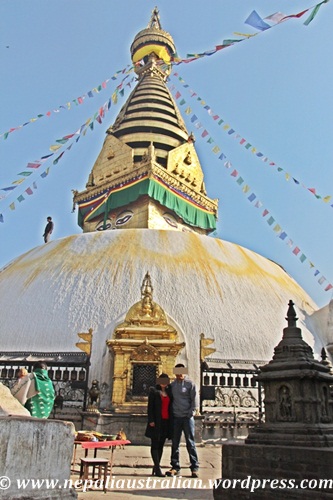
As we were driving to the hill where Swayambhunath stupa is, we could really see how beautiful the temple is.  Around the bend of some roads, the temple comes into full view, and we can see the large Buddha’s eyes, sitting below a golden roof at the peak, keeping watch over the valley.

These large pair of eyes, which represent Wisdom and Compassion, on each of the four sides of the main stupa. Above each pair of eyes is another eye, the third eye. It is said that when Buddha preaches, cosmic rays emanate from the third eye which act as messages to heavenly beings, so that those interested can come down to earth to listen to the Buddha. The hellish beings and beings below the human realm cannot come to earth to listen to the Buddha’s teaching, however, the cosmic rays relieve their suffering when Buddha preaches.

Swayambhu (26)

The dome at the base represents the entire world. When a person awakes (represented by eyes of wisdom and compassion) from the bonds of the world, the person reaches the state of enlightenment. The thirteen pinnacles on the top symbolize that sentient beings have to go through the thirteen stages of spiritual realizations to reach enlightenment or Buddhahood.

Swayambhu (1) Swayambhu (28)

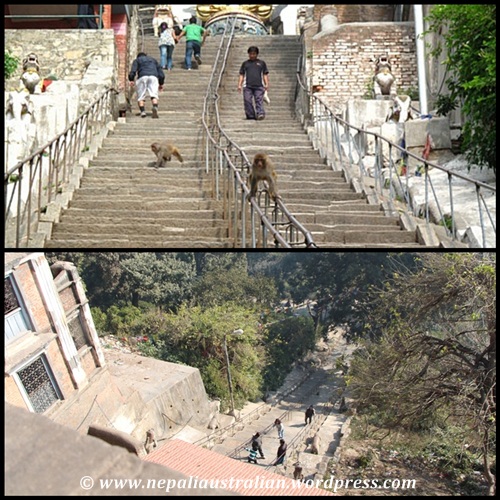
When we reached the gate leading to the steps, there were many monkeys all over the place. Some people were feeding monkeys which were running everywhere. I am scared of monkeys as a monkey had snatched a bag from my hand when I was kid so I went and hid behind my husband and brother when I saw them running towards us. I have to say they are pretty well behaved as they don’t bother you unless you annoy them.

Swayambhu (22)

On the side of the gates, there were ladies selling Puja items like candle, flowers and souvenirs.
Swayambhu (31)

There are 365 steps and it is believed that there’s a step for each day of the year, starting at the gate and ending at the stupa. We started to climb the stairs and more monkeys emerged. I stayed close to AS and I was fine. We took a few photos as we climbed up and as we went higher the view got even better. There were many beggars sitting on either sides of the stairs as well and some of them I felt really sorry for as they had small children with them.

Swayambhu (12) Swayambhu (13) Swayambhu (11) Swayambhu (2)

Swayambhu (6) Swayambhu (5)

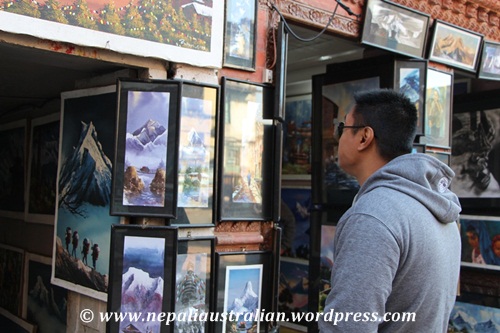
As we reached the top, we could see more monkeys everywhere. There were also stalls selling the usual touristy items. There were many interesting, well-done acrylic paintings of the Himalayas, Nepali hand puppets and other handicrafts.

Swayambhu (7) Swayambhu (30)

Swayambhu (20)

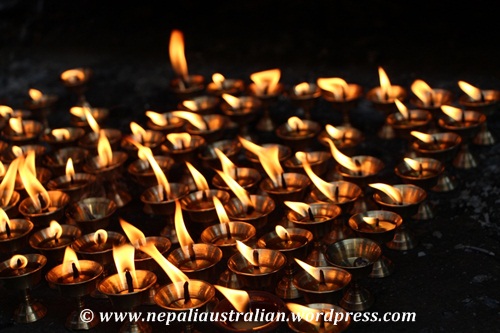
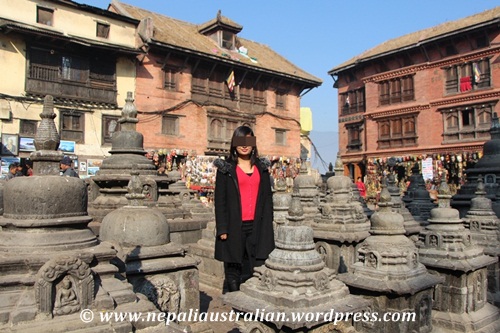
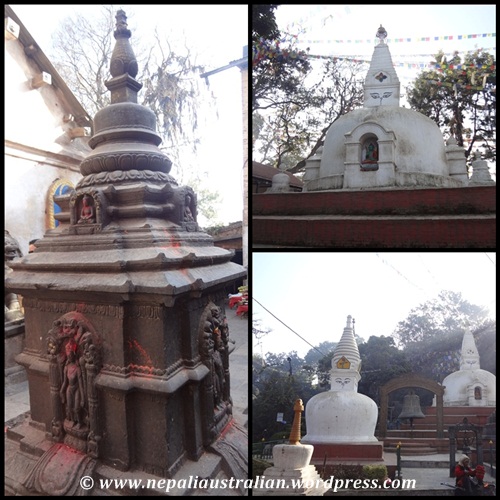
There were also lots of people worshipping in the temple with diyo and candles. I could see prayer flags around the stupa and lots of diyo lit in front of the temple next to stupa. The Swayambhunath complex consists of a stupa, a variety of shrines and temples, some dating back to the Licchavi period as well as a Tibetan monastery, a museum and a library.

Swayambhu (19)

Swayambhu (14)

Swayambhu (29) Swayambhu (25) Swayambhu (3)

 As we walked around the temple, we rotated the prayer wheels. A prayer wheel is a cylindrical “wheel” on a spindle made from metal, wood, stone, leather or coarse cotton. Traditionally, the mantra Om Mani Padme Hum is written in Sanskrit on the outside of the wheel. According to the lineage texts on prayer wheels, prayer wheels are used to accumulate wisdom and merit (good karma) and to purify negativities (bad karma).

Swayambhu (32)

Swayambhu (23)

At one end of the temple area, there is a viewpoint from where you can see the entire Kathmandu. I remember coming there when we were young and we used to try to find our house from there but these days due to population and pollution, you can’t see very far. I felt really sad to see how Kathmandu has changed in the last decade and definitely not for the better in terms of the environment.

Swayambhu (24)

Swayambhu (17)

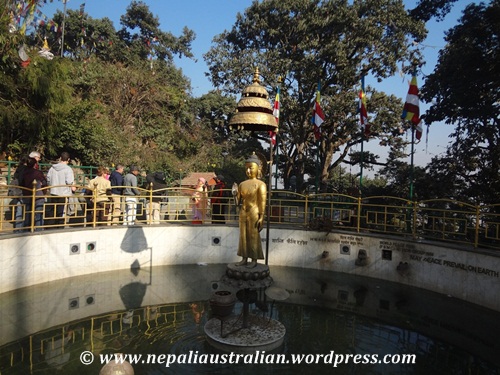
After looking around for a few more minutes, we decided to back down to the car. As you come down, there is a golden statue of Buddha surrounded by water. People were throwing coins into a bucket there and it is believed if your coin enters the bucket, it will bring good luck. My brother and SIL were trying their luck so AS asked me to throw some coins as well. It reminded me of the Trevi fountain when we were in Italy. There were lots of coins lying around the statue there as well but I am sure, the amount of money thrown here is nowhere near the amount in the Trevi fountain.

Swayambhu (9)

After our visit to the temple, we were really hungry so we went to our aunt’s house for lunch 🙂

Swayambhu (10)

Swayambhu (18) Swayambhu (8)

Swayambhu (27)