Tag Archives: Dashain

My long weekend in picture

Last weekend, we had a long weekend as it was Labour Day on Monday. There is so much happening in Sydney right now that we had busy weekend. I am so tired now but glad I managed to do so much. Here are some of the photos from the weekend.

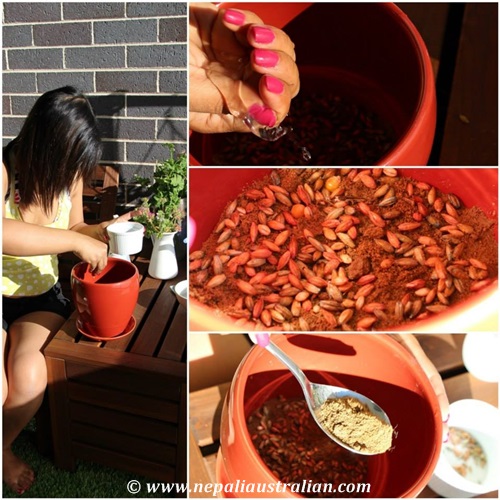
On Saturday, it was the start of Dashain, our biggest festival (for details click here). So in the morning I had to plant my Jamara to start the festival. To learn how to plant your own Jamara, please click here.

Jamara

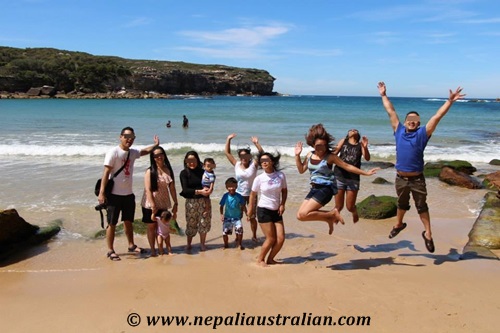
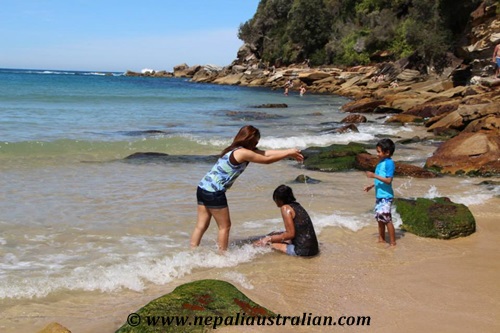
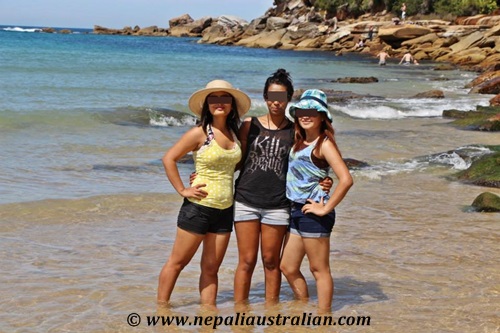
Around 10am, we headed to Wattamolla Beach to enjoy picnic with family and friends. Wattamolla Beach is located within the Royal National Park and have nice beach perfect to go with family. It was awesome sunny day and we had heaps of fun in water.

Wattamolla Beach  (4)Wattamolla Beach  (3)Wattamolla Beach  (1)Wattamolla Beach  (5)Wattamolla Beach  (7)Wattamolla Beach  (6)Wattamolla Beach  (8)

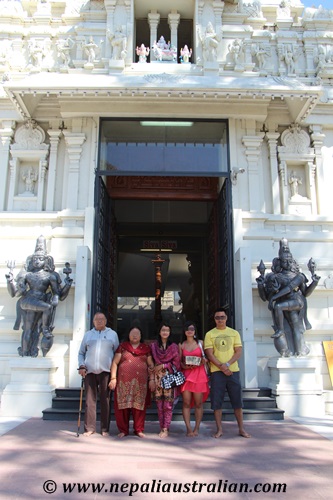
On Sunday, we went to Helensburgh temple (details here) as it is Dashain now and it seemed like a great idea.. We went there with some of our friends and his family. As always, we had breakfast there, yummy vegetarian South Indian dishes.

temple

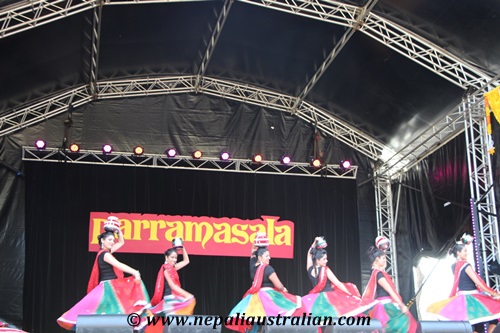
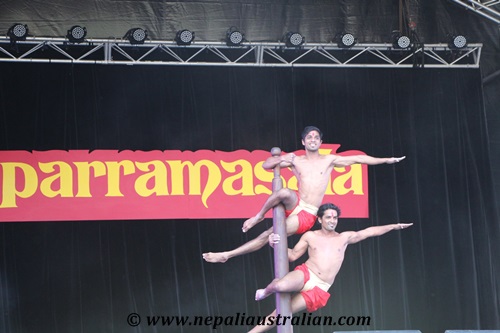
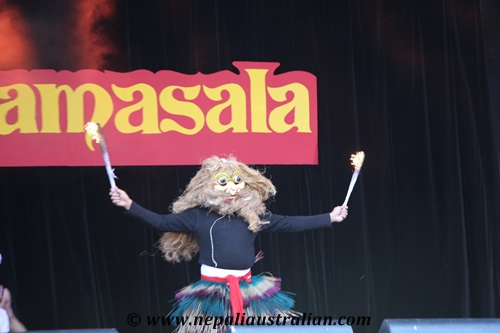
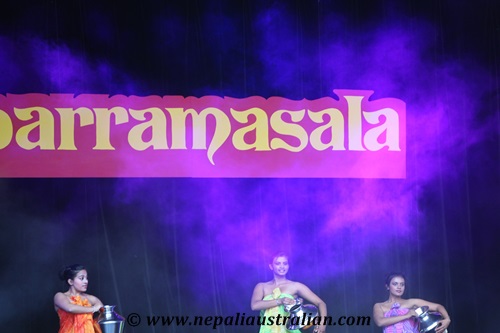
From there we drove for over an hour and was in Parramatta, enjoying Parramasala (details here). Like every year, it was fun with lots of food and music.

Parramasala (1)Parramasala (5)Parramasala (4)Parramasala (7) Parramasala (12) Parramasala (11) Parramasala (10) Parramasala (9) Parramasala (8)

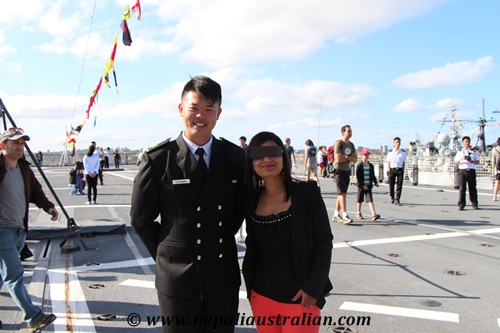
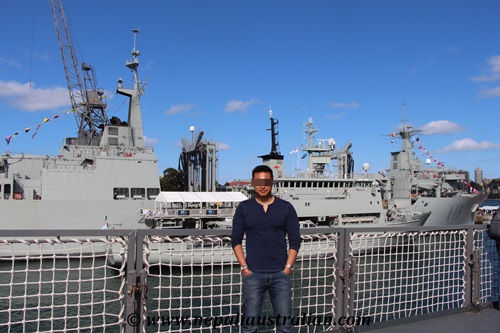
On Monday, we went and saw the war ship at International Fleet Review. The review is a celebration marking 100 years since the Royal Australian Navy fleet first entered Sydney Harbour. It was worth the visit as we got to see so many navy ship from many different countries.

International Fleet Review (1) International Fleet Review (20) International Fleet Review (18) International Fleet Review (17) International Fleet Review (16) International Fleet Review (14) International Fleet Review (13)

You may also like :

*Sculpture by the sea *Easter Long weekend trip *Snowy Mountains: Australia

Living in the west with values of the east

This article was published in DREAMS online magazine on 3rd October 2013.

dreams

When I was living in Nepal, I used to be annoyed and irritated by Nepali culture, tradition and values from time to time. Sometimes, I wished that I could run away from all that and live my life the way I wanted. And my wish was fulfilled when I left Nepal to come to Australia.

Having lived outside the country for more than decade now, I know how wrong my thoughts were. These days, I miss our culture, tradition, rituals and values that I used to ignore before. Not only do I miss it, I actually want to be a part of it and hope to pass it on to my kids and grand-kids one day, like my mother and grandmother did.

The festive season of Dashain and Tihar is here, and it is one of my favourite times of the year. This festive time has helped me connect with Nepal, Nepali culture and tradition. Before, I used to wish things could be as good in Australia as in Nepal, but that was just wishful thinking. So instead of being sad and depressed, this time I decided that we would celebrate the festivals with whatever we could.

With the motto, “If the mountain will not come to M, then M must go to the mountain”, we bring Nepali style Dashain and Tihar to Sydney. For the last few years, I have been having a lot of fun in Nepali festivals here.

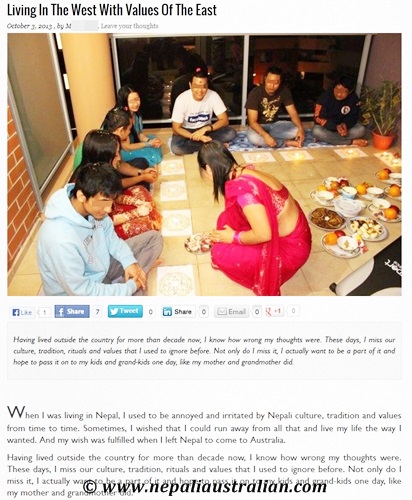
For Dashain, I plant Jamara during Ghatasthapana, and it is ready for Tika day. During Asthami, Nawami and Dashami, we plan a Newari bhoj to mark the days.

Last year we had Kuchi Bhwey, a Newari bhoj consisting of Baji/Chiura(beaten/flattened rice), Chicken curry, Spinach, Methi kerau (fenugreek and peas), Thulo kerau (big peas), Golbheda achar (tomato pickle), Butan(meat fry), Aloo tama(potatoes with bamboo shoots), and Methi(fenugreek) salad on Asthami.

On Nawami, we followed the tradition and performed a worship of our car. Later we had Samay Baji, a Newari dish consisting of Baji/Chiura(beaten/flattened rice) , Haku Mushya (black soyabean), Chhwela (smoked meat), Puka-la (spicy roasted meat), Aalu achar (cold potato salad ), Bhuti (boiled beans with spices), Khyen (boiled egg), Panchkwa (bamboo shoot, potato, beans mixed curry), Wo or Bara (shallow fried pancakes made of black lentil), Lava-palu (ginger and garlic), Achar (pickle), Wauncha (green vegetables) and Aayla (Newari liquor).

On Vijaya Dashmi, we normally take a day off from work so we can have fun with our loved ones. It is always fun to be blessed by elders with red Tika and Jamara. Following Tika, there are a few days where we get invited for tika, and this normally concludes the celebration of Dashain.

After a few weeks, we celebrate Tihar in full swing as well. I know people overseas normally celebrate only Bhai Tika but I didn’t want to miss out on the other days. So I perform Kag Tihar, Kukkur Tihar, Laxmi Puja and Mha Puja as well.

I haven’t seen many crows around in Sydney, so I decided to print a photo of a crow to perform my puja with. I know it sounds a bit silly, but it helps me to celebrate the festival. I did the same during Kukur Puja, printed the photo of a dog that my parents have in Nepal. If you ever feel like celebrating Tihar in full swing, you may want to follow my ideas.

I love Laxmi Puja as it make me feel happy and there is so much to do. We start the evening by lighting fairy lights and candles. Then I perform Laxmi Puja to the best to my knowledge. I normally print out the Mandap and Laxmi’s footsteps so I can perform the puja. Living overseas, we have to make do with whatever we can rather than missing out in the belief that we can’t do it.

Following Laxmi Puja, we performed Mha Puja with my brother, cousins, and friends. Mha Puja is such a great way to come together and have fun in our Newar culture. For this puja too we used printed mandaps, which made it easy for us to set up the puja. Like in Nepal, we have Shagun (a traditional plate typically consisting of a boiled egg, smoked fish, a “bara”, haku chhoila”  and “aila”, which ends with “dhau”) and bless our body for good health.

And finally, there is the Bhai Tika, which is always a big deal for me. I have two brothers on whom I perform the Puja, and I wanted to make sure it is a great celebration. I and my cousin even learned how to make Sel Roti, so our celebration is a lot like Nepal’s. I prepare for Bhai Tika weeks in advance, making masala (pack of dry fruits & nuts) and buying fruits, snacks and clothes. I prepare Shagun on the day and bake cakes for puja as well. I am always happy to see my brothers enjoying the day with me, and blessing me with happiness and gifts.

Not only celebrating Dashain and Tihar, but we try to do whatever we can to be in touch with Nepalese tradition and culture. Recently, my nephew had his 6th birthday, and it was celebrated with yomari (a newari delicacy made of external covering of rice-flour and an inner content of treacle) mala like in Nepal. One of my nephews was born here in Australia, so we did his chatti and nwaran (naming ceremony) according to Hindu rituals. We celebrate Teej every year wearing red and eating yummy Nepalese cuisine. And whenever possible, we go to Nepal to celebrate milestones like marriage and pasni. We had a traditional Newari wedding which went for over a week, and my nephew had his pasni in Nepal with our relatives and friends.

Even though I don’t have kids of my own right now, I know that they are affected by many thing in life, but their strongest main values are learned from their parents, society and surrounding environment. I know that even in Nepal, with globalisation we are losing some of our traditional values fast, while we adopt easily imitable aspects of western culture. Nepal has a unique blend of culture and customs, and people travel millions of miles to learn and observe these in Nepal. It will be a shame for our kids not to know their own customs, traditions, and rituals.

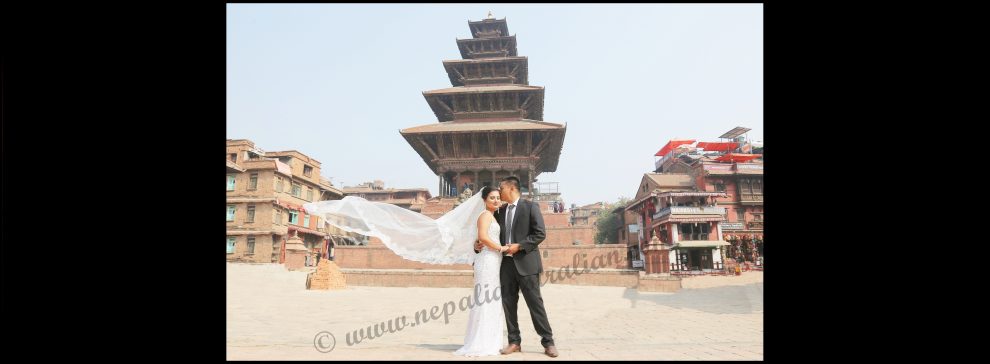
I hope my effort in bringing our eastern culture to the west will help my kids and their kids to learn more about Nepal, Nepali culture, traditions, rituals and values, so that they know their root and can be proud of it. I have been away from Nepal for a long time, but I still cherish the values that I have learned, and I hope one day, our next generation will do the same.

Happy Dashain and Tihar to all readers. No matter where you are, enjoy it in full swing!!!!

You may also like :
*Confessions of a Shoeholic *Recycling and reusing in Nepal *Slave of Smartphone and Instant messaging

Dashain ko Nakhatey

Dashian is almost finished now. Today is the last day of Dashain and the celebrations are over until mid-November when we celebrate Tihar.

After Tika, last five days of Dashain are celebrated by visiting relatives and getting tika and blessing from them. As far as I know, in Chhetri and Bhaun culture, they normally visit relative to get blessing on Dashami itself. They don’t need invitation for tika so they go to the  their elders’ house and get blessing. That day is a big day for them as they get to meet lots of relatives.

But in Newar culture, we cannot go to anyone’s house until we get an invitation. If a daughter is married, she won’t even go to her parents’ house until the invitation arrives. This invitation is called Nakhatey in Newari. Normally relatives consult each other so so that the Nakhateys don’t fall on the same day and everyone gets to attend all Nakhateys.

Going for the Nakhatey is a big part of Dashain for Newars in Nepal. I remember growing up going to houses of my relatives to get tika, blessings and daskchhina (money). It was a fun filled affair with lots of yummy food as well as money to collect.

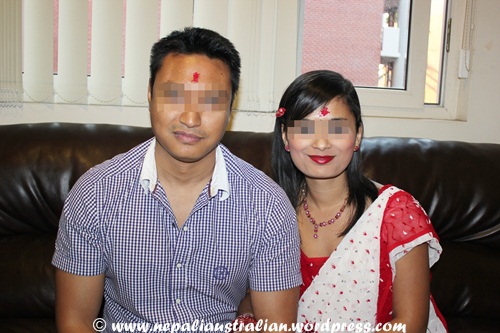
In Sydney as well, we had a few Nakhateys. We were invited to AS’s cousin’s house as he is the eldest of AS’s relatives in Sydney. We had tika and Nepali food. I wore my sari and got into a festive mood. We got tika from AS’s cousin and we also put tika to his younger cousins.

We also had tika from my Dai , his wife and we put tika to their daughter.

So my Dashain for this is over 🙂

Dashain Tika update

So here is the update on my Dashain from Sydney. Yesterday I took a day off from work and stayed home to celebrate Dashain.

I wore my red sari to be in a festive mood and performed the puja at home first.

Then we went to my brother’s place for the celebration.

As my brother’s MIL is in town, she put tika for all of us.  Also I got tika and blessings from all the other elder persons. It was really fun as there were so many of us there.

Then I and my husband put tika on all the younger ones.

It is the first Dashain for my nephew but he can’t put tika on yet as he hasn’t completed his Pasni ceremony. Still we bought him a Dashain gift and it was a cute Jumper from pumpkin patch. He looked so cute with his new jumper on 🙂

We had a great time as we played card and have some yummy food. 🙂

Here are some photos.

Hope everyone is having a great time this Dashain.

Vijaya Dashami : Dashain

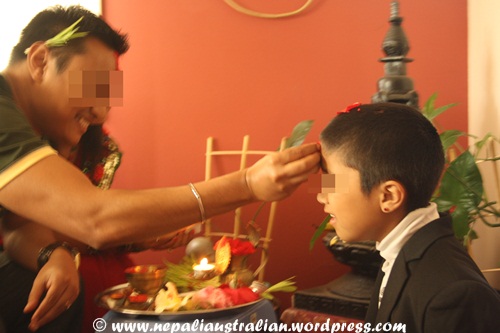
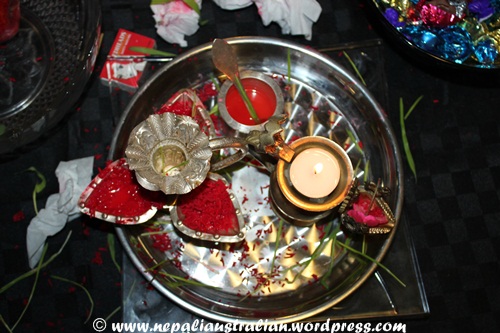
The tenth day of Dashain is called ‘Dashami’. It is also known as Vijaya Dashami and it was the day Goddess Durga was victorious over the demons. It was also the day Lord Rama won the war with the demon king, Ravana, supposedly through the Durga’s blessing. The day is, hence, symbolic of good triumphing over evil. It is on this day that the jamara is finally utilized; the elders put tika (a mixture of rice, yogurt and vermilion) and Jamara on the forehead of younger relatives to bless them with abundance in the upcoming years.  The red Tika also symbolizes the blood that ties the family together.

Elders give “Dakshina”, a small amount of money, to younger relatives at this time. People visit elders in their home to receive blessings. The importance of Dashain also lies in the fact that on this day family members from far off and distant relatives come for a visit as well as to receive tika from the head of the family.

This continues to be observed for five days till the full moon during which period families and relatives visit each other to exchange gifts and greetings. This ritual of taking tika from all the elder relatives (even distant relatives) helps in the renewal of the community ties. This is one reason why the festival is celebrated with so much of vigor and enthusiasm.

Before the collapse of the monarchy system in Nepal, thousands of people ranging from the ministers, diplomats to the general public used to gather in the old royal palace to take the tika and blessing from the king, who is considered to be the incarnation of Lord Vishnu. However after the collapse of the monarchy system the president of the country who is considered the head of the state has been continuing the tradition by offering the tika to the general public and ministers.

A lot of feasting takes place in the meantime and everyone makes merry. Dramas of Goddess Durga fighting demons are also frequently staged.

The last day of the festival which lies on the full moon day is called ‘Kojagrata’ Purnima. The literal meaning of Kojagrata is ‘one who is awake’. On this day Goddess Laxmi who is believed to be the goddess of wealth is worshiped as it believed that goddess Laxmi descends on earth and showers whoever is awake all night with wealth and prosperity. As a result, many spend the night playing cards and doing other activities. The festival concludes when the remaining jamara and the holy vessel are disposed of by bringing them to the river.

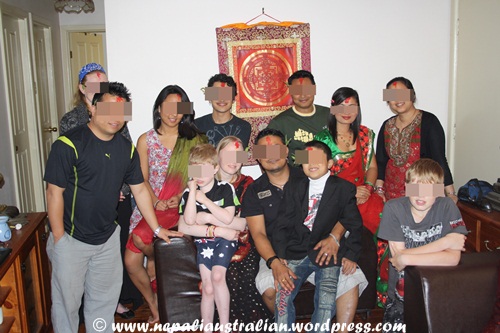
This morning, I woke up, performed puja at home with Jamara and then went to my brother’s place where all my family gathered to celebrate Dashain. It was fun filled affair with lots of food, playing cards and having Tika ceremony.

P.S. I am so happy to share that my Jamara grew really well this year. It became longer than last year.  🙂 Here are some photos.