Tag Archives: Nepaliaustralian

Our Story : Enjoying holiday – Part 21

This is a continuation of my previous posts. Please read the previous posts here.

We took a few more tours while we were in Bangkok and they were quite interesting.

Floating Market

I had heard a lot about the floating markets in Thailand so we planned to see it. Damnoen Saduak Floating Markets is a prime tourist attraction that not too far from Bangkok.

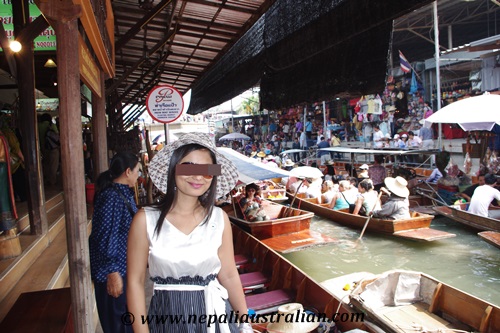
We were picked up from the hotel in a van and driven 100 km southwest of Bangkok to Damnoen Saduak. As soon as we were in the canal area I saw lots of floating boats some with tourists and some selling colourful souvenirs, fruits and other items.

The floating markets of Thailand is a great place to view colourful boats with vendors selling fruits, vegetables and other delicious goods. It’s a great place to also see a traditional way of buying and selling goods of the Thais.

The best things about these markets are the food stalls. There is no Thai dish you cannot find here. The hardest decision is narrowing down your choice to one or two. Squashed in amongst the food and tables lining the canals are handicrafts, plants and clothing stores too.
Thailand (19)

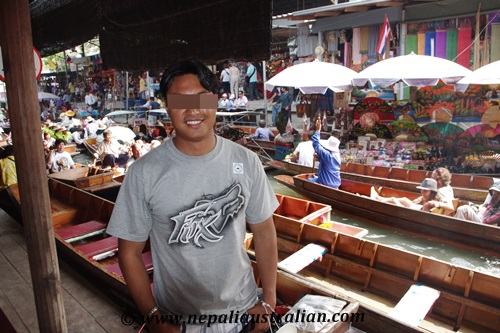
We were asked to hop into one of the boats and we had a guide who took us around the 32 km canal. Sitting on a wooden long tail boat, we ventured out to the floating market. It was fun passing through narrow canal lanes and underneath bridges. It was a really fun way of seeing the market.

Thailand (21)

Once we were back where we had started, we had some time to look around by ourselves. I ended up buying lots of souvenirs like a floating boat, a tuk tuk, a hat and a beaded earring.
Thailand (20)

River Kwai and The Jeath War Museum

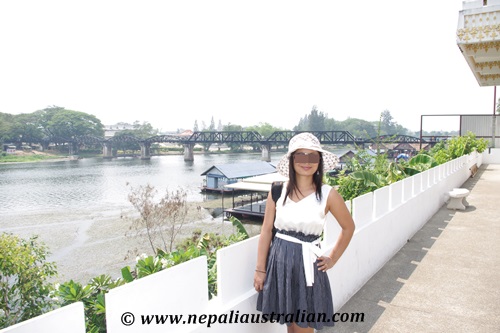
The next stop for us was in Kanchanaburi province where we went and visited the war museum and the river Kwai.
Thailand (4)

Once there we went to the war museum and there were lots of information about World War II.  Then we went to the bridge over the river Kwai which was built-in World War II.

Thailand (23)

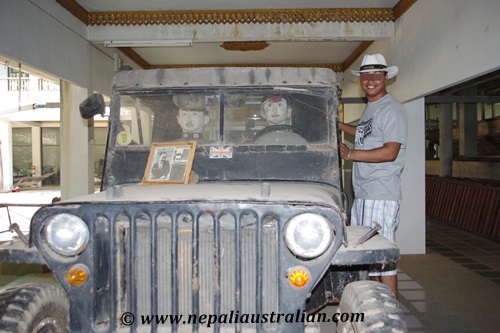
The JEATH War Museum is situated on the junction of the Rivers Khwae Yai and Khwae Noi, right on top of the old rail tracks. The name is an acronym recognising the primary nationalities of those involved in the construction of the Death Railway; Japanese, English, Australian, American, Thai and Holland. To the locals it is known simply as the Wat Tai War Museum.

Thailand (7) Thailand (2)

The museum is divided into several sections. While the main path through the exhibitions charts Thailand’s involvement in the Pacific War (from the first invasion through to the destruction of the bridge, and finally Japan’s retreat accompanied by the release of prisoners), other areas offer a range of different perspectives on the region.

Thailand (25) Thailand (22) Thailand (5)

One room focuses on the prehistoric evolution of the area, while another charts the annual winners of the Miss Thailand competition. There seem to be Buddhist shrines tucked away into every empty corner, and there isn’t an inch of wall space that hasn’t been written on. Some of it in Thai, other passages in French, English or German, and these verses range from military history through to religious philosophy. To read them all would have taken a day at least.

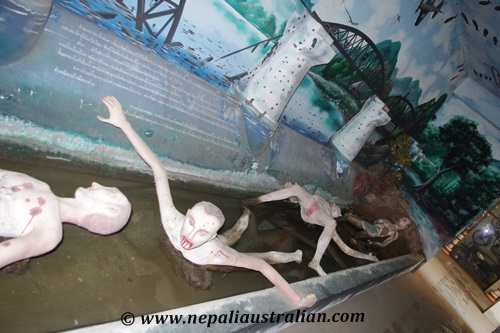
Perhaps the most striking feature of the museum however, are the wooden effigies used to depict the suffering of Allied POWs. Carved in a similar style to those that appear in Thailand’s numerous Buddhist Hell Gardens, these often crude figures show naked men engaged in hard labour, being tortured, or lying dead and bloody at the bottom of rivers.
Thailand (3) Thailand (1)

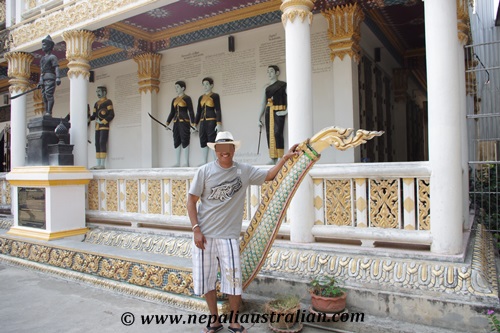
The intention is to shock… but also to bring home the very real pain and suffering which prisoners were subjected to. Towards the end of the museum, a courtyard is walled in with mounted figures of WWII’s military leaders: Churchill and De Gaulle; Mussolini and Hitler; Japanese Generals Tōjō and Yamashita; Joseph Stalin and General Douglas MacArthur. On an adjacent wall, written in both Thai and English, hangs a sign which reads, “War is sinful behaviour”.

Perhaps the most poignant feature at the JEATH War Museum however, is the broken wooden structure which protrudes from the riverbank beneath an observation platform. This is all that now remains of the former bridge, and is a stark reminder of the tragedy that befell here; in 1945 both the Royal Air Force and the US Army Air Force mounted bombing raids on the bridge, but after both attacks it was repaired using prisoner labour.

Thailand (6) Thailand (24)

Finally, on 24th June 1945, an RAF squadron was ordered to halt the Japanese movement into Burma at any cost. Fearing defeat, the Japanese filled the bridge with as many Allied prisoners as they could fit, in a hope to deter the bombers. It failed however, and when the bridge was finally put out of action, its destruction came at a cost of many Allied lives.

Kanchanaburi’s ‘Tiger Temple’

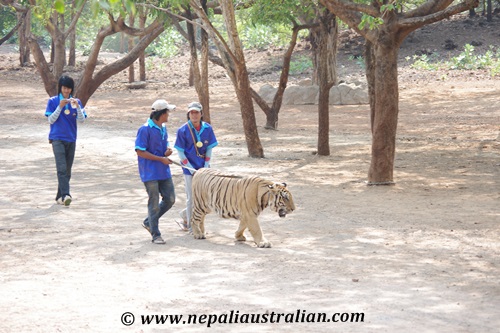
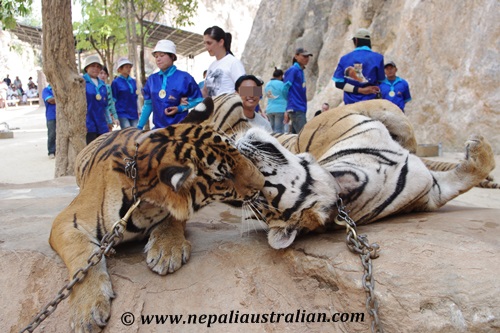
The last stop of the day was the Tiger Temple and it was the highlight of our trip. It is a Buddhist temple where there were many monks, lots of tigers and few other creatures.
Thailand (17)

Almost a decade ago, monks started to look after tiger cubs whose mothers had allegedly been killed by poachers. With the outbreak of tiger-euphoria, tourists reported enthusiastically how the monks of this remote temple devotedly cared for the animals. Initially there were just a few young tigers – joined by freely roaming deer and other small mammal species. Therefore, it all started as a neat little temple zoo with lovely deer, orphaned tiger cubs and monks as keepers.

Thailand (18)

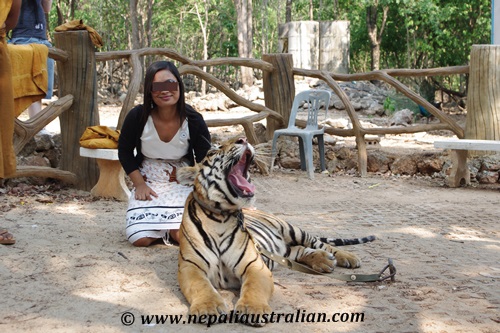
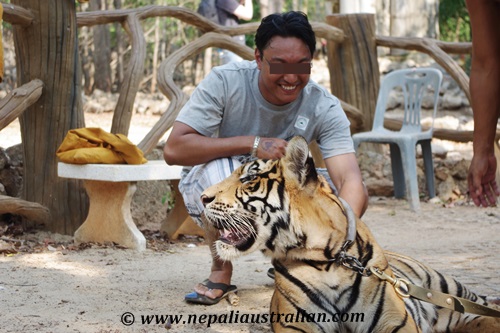
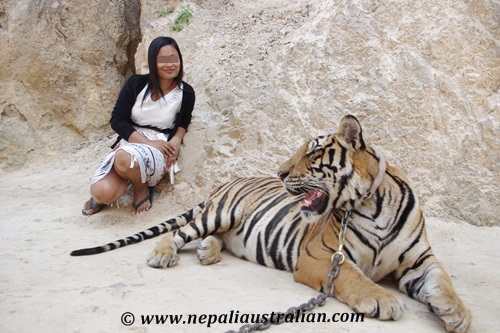
For around fifty dollars each, we were allowed to be up-close and personal with the tigers. This was 600 Bhat admissions and 1000 Bhat for photo with the tigers. It was a really unique experience and I was a bit scared but then it was all good as there was a guide with us all the time. I patted the tiger and he didn’t eat me 🙂

Thailand (8) Thailand (10) Thailand (14)

We also saw a cub on the way back and we were allowed to take pictures and pat it. It was a really nice experience.
Thailand (15) Thailand (16)

After coming back from the holiday, I did some research about the place and I found lots of negative things so I am still confused as to what to believe.
Thailand (12) Thailand (10) Thailand (11) Thailand (13)

Also if you are going there make sure you wear a covered dress as they will not allow you in otherwise as they have a dress code for both men and women.

By the time we got back to Bangkok both of us were tired and ready for bed.

For the next few days in Bangkok, we met AS’s cousin and went shopping. I was feeling sad already as I knew we were going to different places once the holiday was over.

More on that in the next post. Till then take care.

M from nepaliaustralian

XOXO

Go to Part 22

Peplum trend

This article was published in +977 (a Nepalese Lifestyle Magazine in Australia) in  June 2014 issue.    

fashion

If you over indulge a little during holiday season, don’t worry a lot but invest in peplum dress/top/skirt/jacket until you get back in shape sa it draws attention away from non-washboard abs.

Peplum is a clever little frill, a short overskirt or ruffle attached at the waistline of a jacket, blouse, skirt or dress that extends from your waist to hips making your body look perfect.

From 1800s, peplums were in fashion and it has made a big comeback since few seasons now. From catwalks to celebrities to normal people, everyone is embracing this new tread and you will know why as well if you own a piece.

As everything in fashion, you need to know some simple rules on wearing peplum in the most flattering way. The length, width and volume of the ruffle determine it all, and the drape and choice of fabric make a difference too while choosing what to buy. The key to getting this trend right is keeping it modern.

  • Choose soft materials peplum making sure it stays next to your skin and gives the illusion of a smaller waist.
  • Get a peplum that has slightly higher waist and it can hide a thicker middle.
  • A single colour outfit will also help lengthen your frame so avoid extreme colour-blocking or graphic print-blocking.
  • If you are wearing a peplum top, wear a streamlined pencil skirt or tapered pants.
  • Buy peplum slightly narrower at the front than the back, creating a scooping effect at the waist and hips.
  • Paired with the right belt (read skinny), peplum can be even more flattering.
  • If you are not tall, buy peplum with short width and less volume.
  • If you have straight body, pick a soft yet streamlined flared peplums to add curve to your body.

Please click here for all my published posts.

Take care,

M from nepaliaustralian

XOXO

Household tricks and tips (HTT)

I know we all have tips and tricks we use every day around the house which make our job easier. In this page, I want to collect all those tips and tricks. Please leave comments below with your handy tips so I can share them in my blog too.

#HTT : How to keep your shower cubical clean?

In Australia, most of the shower cubical is made out of glass. When you shower every day, it will leave behind soap scum which look really bad but you can’t clean it every day. So it is a painful job you need to do when you do it but in the meantime every time anyone uses the toilet, they will see the marks in the shower cubical.

Solution: Keep a window/glass squeegee in the shower. Yes, it is really handy. Every time, anyone has a shower, ask them to use it on the tiles and glass and you don’t have to worry about it at all.

As the tiles and glass panels will be soaked properly while someone has a shower, if you just use the window cleaner, squeegee, the surface won’t have any soap scum and will look clean. It takes only a minute and will keep your bath cubical shiny all the time.

#HTT : What to use as alternative for wet wipes?

We always need make up removal wet wipes around as it is so handy and can fix a mess but if you run out of it there is always a solution.

Solution: Use baby wipes instead. They are soft, most are fragrance and alcohol free and cheaper than wet wipes.

Both baby wipes and wet wipes contain the same active ingredients and have different additives like Aloe depending on the brand so I see no problem.

Dear readers, please leave comments below with your handy tips so I can share them in my blog too.

Take care,

M from nepaliaustralian

XOXO

Let’s make this world one big happy family

This article was published in +977 (a Nepalese Lifestyle Magazine in Australia) in  June 2014 issue.   

plus977 

Nepal is a country of “Char jaat and chhattis barna” and our ancestors were very proud about it. They even made a song about this fact and we learned about the great history of Nepal in our school years.

People were happy and understanding when you had friends from different castes and they seemed to advocate equality and brotherhood between castes. But falling in love outside the caste was a different story. Every parent of single girls and boys feared their child might marry outside their own caste. That was a century ago.

These days, the fear has moved from inter-caste marriage to international marriage. Now almost every home in Nepal seems to have someone living and/or studying abroad so the parents’ fear has shifted from inter-caste marriage to intercultural/international marriage. More and more people from Nepal are abroad and more individuals have crossed racial, ethnic, and religious boundaries to marry someone. I bet you know someone in your close circle who has married a non-Nepalese. Marrying inter-caste is very common in Nepal and acceptable in most families these days but most parents are finding it difficult to accept someone from a different county, culture, religion and background.

The thing is these intercultural relationships and marriages are meant to happen. What do you expect when you send your kid aboard to mix with international society, learn their culture, meet new people but then never think about them falling in love with anyone other than people from Nepal? Even typing these words right now I can see straight away how ridiculous it sounds. Similarities and connections with another person isn’t limited to someone of your own culture as love sees no boundaries and connections can be made with individuals from all backgrounds and experiences.

I find it funny when a guy/girl returns to Nepal with a foreigner friend; the parents show them off as a trophy. Saying, “Mero chora/chori ko ta American sathi cha.” But if the same person was introduced as their boyfriend or girlfriend, they change their tone completely.

I know so many friends who had a hard time making their parents understand that their love is real and they are serious about their relationship. Some parents have even gone to the extent of bribing them or using emotional blackmails as a tool to separate them form their love.

Australia has the highest rate of intercultural marriage in the world, and it is increasing. According to the Australian Bureau of Statistics, the number of mixed marriages has grown from 39% in 1974 to 60% in recent years. I am sure the numbers in Nepal are increasing as well.

I do understand the few genuine reasons why parents are opposed to intercultural relationship. The first one is the society. In this instance, they always think about what people will say and think, without thinking about their child first. Their social status seems to be more valuable than the love for their children.

Then there are the communication issues, whether that is between them and their son/daughter in law or the future grand kids. Parents think these barriers mean that they will have a hard time understanding each other’s feelings.

If they are religious people, they are worried what religion and culture their future grand kids will follow. In addition, many people in Nepal are Hindu and they are against eating beef while most of the westerners live on beef.

However, these are the issues which could be easily overcome with communication and understanding. Therefore, parents first must take the first step of acceptance if they want good relation with their kids and their partners.

One of the biggest misconceptions parents in Nepal seem to have is that if you marry a foreigner, they will divorce in the future. I am serious that most of the older generation have this in mind and tell you about it openly. I know it is not true but looking at few examples, they put everyone in the same pigeonhole.

To all the parents, please think twice before you go against the marriage of your kid. They are still the same kid you used to worry about when they got sick or didn’t come home on time. Then how can you be OK when they are heart broken and hurt by your action.

The world is changing, let’s embrace it. As our world becomes more accepting of differences, individuals will continue to find attraction and love with others from outside of their own culture. Let’s look beyond the differences that confuse or frustrate us, and look for the value we can find in these relationships. Let us educate our children in recognizing human beings as human beings in spite of their race, colour, or ethnicity. I will just be very happy for my kids one day to marry someone honest, loving and respectful.

Would you prefer your son/daughter to marry someone nice, honest, hardworking and friendly but from a different culture or someone stubborn, lazy and annoying but from your own culture? I am sure everyone has the same answer so why are we so bothered by where this nice, honest, hardworking friendly person comes from. Believe me, nobody’s status declines because of intercultural or inter country marriage.

While every romantic relationship can bring its own set of challenges, intercultural relationships can bring unique challenges and during this stage, support of family and friends is very important to the couple.

To everyone who sees their future in international/intercultural marriage, don’t expect things to be easy but also don’t give up. The best way to overcome this issue is by learning each other’s culture, religion and traditions so you can understand your partner and in laws better. Ask questions and try to understand why your partner has a certain perspective or why s/he does things a different way. Learn to accept and understand the differences without changing your own beliefs or behaviors, this way you would be able to pass this knowledge down to your kids. Just to be clear this is something a couple have to do regardless of whether they are in an intercultural marriage or from the same culture because each of us has our own perspective in life. For couples from intercultural background, they will just have a little more work to do to understand the differences.

Let’s make this world a big happy family and let’s all live in harmony.

Please click here for all my published posts.

Take care,

M from nepaliaustralian

XOXO

Kwati: Nepali mixed bean soup

This is a guest post I wrote for , Chai- A cup of life, amazing blog I have been following for a while. Thank you so much for the opportunity and sharing the post here.

I would like to introduce you to M who writes her blog called ‘Nepali Australian‘. M is a Nepalese born Australian living in Sydney, an IT Business Analyst who loves blogging, travelling and fashion! We have been following each others blogs for some time now and I love reading about her thoughts, the Nepalese way of life and of course her life in Sydney. Her writings have been published in magazines, newspapers and she has even held her own Nepali Australian ‘Blog Awards 2013′, (which Chai a Cup of Life received an award for- thank you!) Today she is sharing a traditional Nepalese dish called ‘Kwati’. Here it is: 

It is really cold in Sydney these days. It is supposed to be autumn but it feels like winter already so I am always looking to cook warm meals for dinner. In Nepal, they have food for every season and Kwatiis especially made during rainy and cold season and is a very popular Nepali soup. Kwati is a traditional Nepalese dish which is a thick stew of several kinds of beans. It is high in protein so it is considered good to be given to sick people to gain strength.

kwati (10)

This soup is  made during the festival JanaiPurnimain Nepal. Kwati is normally a mix of 9 beans namely, black eye peas, cow peas, black lentils, chickpeas, adzuki, soybeans, mung dal, green peas and favas. But we can use any beans and pluses you have to make this soup. Luckily for me, I found a pre-mixedkwati pack in a Nepali grocery store.

Some people like to sprout it before making it into a soup but I just soaked it overnight and made the soup without sprouting.

Ingredients

  • 200 gm Kwati Mix
  • 1 medium onion sliced
  • 2medium tomatoes diced
  • 1 tablespoon of ginger garlic paste
  • 1 teaspoon of turmeric powder
  • 1 tablespoon of red chilli powder
  • 1 tablespoon of garam masala powder
  • 2 tablespoons of oil
  • 3 cups of vegetable /chicken stock
  • A few bay leaves
  • Salt to taste
  • 2 teaspoons of ghee
  • 1 teaspoon jwanu (Lovage)

kwati (5)

Steps

  • Wash and soak the Kwati mix overnight and drain the water.

kwati (11)

  • In a pressure cooker, heat oil and season with turmeric powder and bay leaf. Add the chopped onion and fry until it turns golden brown.
  • Add ginger garlic paste, salt, red chilli powder, garam masala powder and fry for a minute or two.

kwati (2)

  • Add chopped tomatoes and cook until the tomatoes are soft. Make them into a paste.
  •  Add the soaked Kwati mix to the pressure cooker, mix well and add vegetable /chicken stock and cook until 5-7 whistles or until you can smell the beans.

kwati (3)

  •  Let it cool in the pressure cooker before you open the lid. As there are different types of beans, test the big ones like broad beans to check if it is cooked properly. The beans must be tender on touch. If it is not cooked enough then press again.

kwati (4)

  • In a pan, heat the ghee.

kwati (7)

  • Once ghee is hot, add jwanu(lovage)and fry for 30 seconds until it is dark brown in colour.

kwati (8)

  • Pour this into the pressure cooker with kwati and mix well.

kwati (6)

  • You could add more water/vegetable /chicken stock depending upon how thick you want the soup.

kwati (9)

P.S : If you are not into vegetable soup, you could add cooked/boiled  meat into the soup as well. Enjoy a tasty and healthy soup!!