Tag Archives: Nepaliaustralian

Not Spending A Cent For A Day

This article was published in +977 (a Nepalese Lifestyle Magazine in Australia) in March 2014 issue.

blog 977

Many times I have had people ask me how I manage to save money to travel, to do various activates and go to concerts. Most of them are in the same boat as me with big mortgage, ever-rising cost of living in Sydney and working average paying jobs. I hadn’t given it a thought until recently so here is my answer.

First and foremost you need to have the willingness to save money. Everyone wants to win a 50 million lotto and take their life from there but that is not going to happen with most of us so one must mentally prepare oneself to save money. It is easy to spend it but very hard to save it.

Second thing is willingness to do things. In Nepali there is a proverb, “Ta aat ma puraunchhu” which translates to you try and I will make sure you succeed. Unless and until you try to do something how will you know if you can or can’t do that. It is better to fail after trying than never attempting at all.

After that it’s all about being disciplined and sticking to the plan. Here are some simple tips I follow to get my saving in line:

  • Make a list of things you want to do in writing and pin that somewhere visible. Seeing something in writing everyday will encourage to reach your goal.
  • Make a note of every spending, even for 20 cents and put that in an excel spreadsheet.  Look at the incomes and expenses and see where you can cut down. This will give you a clear idea of your finance rather than just assumptions. Do this for at least a month.
  • Looking at the excel sheet, you will realise that food/grocery is one of the biggest spender apart from rent/mortgage so be smart while buying groceries. Plan your meals ahead and make a list so nothing goes to waste. Never waste food and never comprise on food quality. You won’t enjoy your saving if you have poor health.
  • Takeaway lunches are quick but they are not healthy and they make a big hole in your wallet. Try to take lunches from home and treat yourself with takeaway occasionally.
  • If you are a heavy coffee or soft drink drinker, check how much you are spending a day on your drinks. You will be surprised how much that amounts to in a year. If you can’t live without your drinks look for cheaper alternative like making your own espresso or buying cold drinks in bulk.
  • It is tempting to buy on impulse when shopping so make a budget and stick to it while you are in malls. It is easy to ignore the budget when you fall in love with the perfect dress that you have been looking for months but remember that dress you loved so much will still be around next week. And what are you going to do with the dress if you can’t afford your next planned holiday.
  • If you are saving for holiday, house, wedding, kids’ education, put aside a certain amount each month/ paycheck in a separate account and never touch this money.
  • Always have emergency money and never use it unless it is a real emergency. Staying so far from our family, you never know when you will need that.
  • Try to experiment just once for a whole day not spending a cent. Take lunch and snacks from home to work and do not buy anything. At the end of the day think about it and realise that you just made XX amount working whole day and not even a cent was spent. Isn’t that a great feeling? Don’t you want to have that feeling more often? I do. 🙂
  • By following these tips, you are not becoming a miser but being money smart. 

The most important thing to remember is: don’t stop living your life because you want to save money. You live only once so no point having millions in your bank account when you die. At the same time, you don’t want to be careless with your money that you have to struggle when you retire.

Good luck and HAPPY SAVING!!!

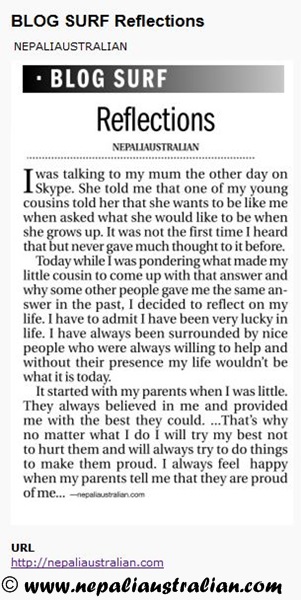
My post in The Himalayan Times

Recently, I was contacted by one of the leading daily papers in Nepal, The Himalayan Times to have one of my posts published in their paper. I am honoured and happy to be a part of the paper.  It was published in yesterday’s paper (20 February 2014). under Blog Surf section. If you are in Kathmandu, get the paper and find me on page 8 and for those who can’t, here is how it looked :).

himalayan times nepaliaustralian (1)himalayan times nepaliaustralian (2)

And here is the link to their epaper.

http://thehimalayantimes.com/fullNews.php?headline=BLOG+SURF%3A+Reflections&NewsID=406477

Its Friday today, so most of you must be already dreaming about your weekend. Wish you a happy Friday.

For me it is packing time and the start of my holiday soon.

Take care ,

M from nepaliaustralian

XOXO

Learn Nepal Bhasa / Newari – Chapter 22


Health

English

Nepal Basa

Body Mah
Ear Nhaay-paa
Elbow Chu-lyaa
Eye mi-khaa
Hai Saa
Hand Lhaah
Head Chhyaa
Mouth Mhu-tu
Nail Lu-si
Neck Ka-ku
Nose Njaay
Shoulder Bwa-hah
Stomach Pwaah
Thigh Kham-paa
Tounge Mea
Tooth Waa

Please click here for previous chapters.

Isle of Pines and Oro Bay : New Caledonia

After having a wonderful time in Noumea and Lifou, our last port was Isle of Pines. Everyone told me that it is the best place in New Caledonia and when we docked there, we could easily see why. It lived up to my expectations with beautiful white sand, stunningly clear blue water and impressive pine trees.

Isle of pines (1)

Isle of Pines was dramatically formed by a series of volcanic upheavals and is truly beautiful. After we docked, the tender boat took us to shore, Kuto Bay, and we were greeted by a French Polynesian song and dance by the locals. There is an fort like fence near this port, possibly built by the French to keep out the locals.

Isle of pines (5)

They also gave each of us a headband with flowers. I realised that they did their best to match the headband with our clothes, mine was pink as I was wearing pink top and AS had yellow as he had a yellow t-shirt on. After that we spotted the stand where you could get your passport stamped for $2 AUD or $200 French Pacific Franc. Unfortunately, we forget to carry our passport with us.

Isle of pines (7)Isle of pines (8)

That day we had booked a 2.5 hours day tour to snorkel at the Natural Aquarium. It is a traditional fish reserve and popular snorkeling site which can be found on the secluded lagoon edge of Oro Bay We waited for the bus and traveled to our destination.  As we traveled, we got to see the surprisingly diverse landscape of the small island. Most of the land was green and there was hardly any traffic on the road. Along the way we passed cows, local villages, lots of mango trees laden with fruit and plenty of jungle.  After about 20 minutes, we arrived at our destination, got out and walked to our destination.

Isle of pines (6)

After a short walk through knee high water we arrived at the natural aquarium. The place is just beautiful with blue water, green trees and lucky for us blue sky as well. We set eyes on this incredible pool of blue water surrounded by the pine trees; we knew it was well worth the journey. It is a protected area which many fish have decided to call home. Like other parts of New Caledonia, we saw lots of dead corals and I was glad that both of had reef shoe on.

Isle of pines (3)

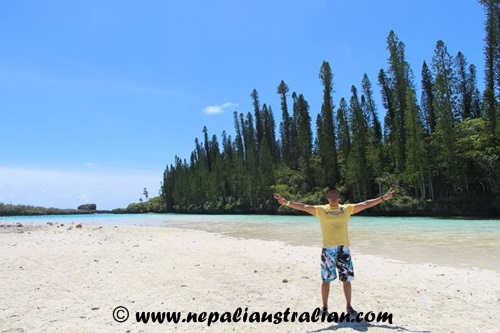
Oro Bay (Baie d’ Oro) is an absolute ‘must-see’ destination . It would have to be one of the most beautiful and stunning natural sites I have ever seen in my life.  It is surrounded by dense vegetation with much of it being the Island’s incredible pine trees; the sand is the whitest I have ever seen and the water the most serene shade of turquoise.

Isle of pines (2)

We dumped our stuffs at the end of the beach and just jumped into the water. There were already some tours there already but it was a good thing because one Japanese group had bread with them, which meant there were so many fishes closer to the shore.

The water at Oro Bay is the clearest I have ever snorkeled in.  It is like looking through the cleanest fish tank.  You can definitely see from the surface all the way to the white sandy bottom . However, if you have been snorkeling in the Great Barrier Reef, you will not find the coral to be as vibrant or as interesting. We saw plenty of ‘Nemo’ fish and zebra fish and other fish of many different kinds and in terms of coral we saw clams in a range of colours and many other beautiful types of coral.

OLYMPUS DIGITAL CAMERA

We both snorkeled and had so much fun chasing the fishes. The fish there were so confident that as I swam over them they didn’t flinch, just went about their business.

It was so much fun that I couldn’t believe that the tour was over so quick. We packed and headed to the bus to go back to Kuto bay. Before we boarded the bus we were served fresh fruits, watermelon and papaya and fresh coconut as well. They were very yummy.

Once back at Kuto Bay, we decided to walk around and find a good spot. Snorkeling was next on the plan in Kanumera Bay which is just opposite Kuto bay. There is a large rock in this area called La Rocher just off shore, which is completely off limits as it is sacred to the locals.. We took a few photos and went straight into the ocean to find more fishes. The photos taken in Isle of Pines are one of the best photos of the trip.

OLYMPUS DIGITAL CAMERA

The water took us by surprise being a little colder than we thought and was extremely salty. There is coral in the bay but pretty old and mostly dead. The fish life is lovely and it’s easy to snorkel and watch them, the water being quite refreshing. It was not as good as Oro bay but still really beautiful.

OLYMPUS DIGITAL CAMERAOLYMPUS DIGITAL CAMERA

We snorkeled around the “island rock” got some great photos while in the water and some beautiful underwater shots too. I really didn’t want to come out of the water but we had to.

OLYMPUS DIGITAL CAMERA

After snorkeling, we walked around a very small market area to get some last minute souvenirs.  I ended up buying a nice turtle made out of wood and shell.

Overall, we had a wonderful experience and loved Isle of Pines. We returned to the ship on a tender around 4pm and retreated to our cabin for some much needed rest.

Take care ,

M from nepaliaustralian

XOXO

Learn Nepal Bhasa / Newari – Chapter 21

Health

English

Nepal Basa

I feel unwell. Ji-tah mha-su-ku ma-du.
I have a cold. Ji-tah se-khaa chaah.
He has a fever. Wa-yaa jwar wah.
There is a boils on my face. Ji-gu khwaa-lay kai wa-la.
My friend’s leg is broken. Ji-mi paa-saa-yaa tu-ti twa-dhu-la.
It is difficult to breathe. Saa-sah ihaa-ye thaa-ku.
My finger is swollen. Ji-gu pa-tii ma-naa wa-la.
It burns Hi-yu
It itches Cha-su
It tickles Ku-vhu
My friend has been bitten by a dog. Ji-mi paa-saa-yaa-ta khi-chaan nyaa-ta.
I cut my hand. Ji-gu lhaa-tay ghaah ju-la.
I feel dizzy. Ji-tah i-ki-se chwa-na.
I feel nauseous. Ji-tah lhwa-ye wa-yi thee ju-la.
My knee hurts. Ji-gu pu-li syaah.
Can you give me something for the pain? Ma-syaai-gu waa-sah du laa?
Where does it hurt? Ga-na syaah?
Does it hurt here? Tha-na syaah laa?
Don’t move. Sa-ne ma-jiu.
Please take tis medicine. Thwa waa-sah na-yaa di-saa.
Two spoons thrice a day. Ni-guu cham-chaa nhinn swa-kah.
Before meals/after meals. Na-ye bhyah/na-ye dhunkaah.
Stay away from… ….na-yaa di-I ma-te.
I need to do a blood test. Hi jaan-che yaa-ye maa-ni.
Don’t worry. You will be OK. Dhandaa ka-yaa di-I mwah. Chhi-tah tik jui.

Please click here for previous chapters.