Tag Archives: Nepaliaustralian

My long weekend in picture

Last weekend, we had a long weekend as it was Labour Day on Monday. There is so much happening in Sydney right now that we had busy weekend. I am so tired now but glad I managed to do so much. Here are some of the photos from the weekend.

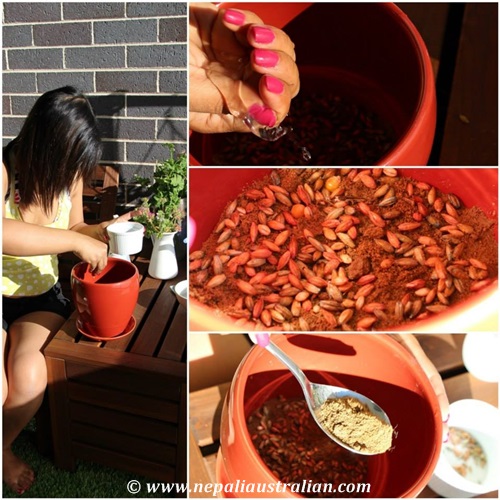
On Saturday, it was the start of Dashain, our biggest festival (for details click here). So in the morning I had to plant my Jamara to start the festival. To learn how to plant your own Jamara, please click here.

Jamara

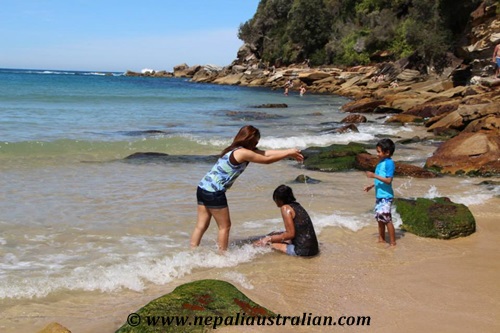
Around 10am, we headed to Wattamolla Beach to enjoy picnic with family and friends. Wattamolla Beach is located within the Royal National Park and have nice beach perfect to go with family. It was awesome sunny day and we had heaps of fun in water.

Wattamolla Beach  (4)Wattamolla Beach  (3)Wattamolla Beach  (1)Wattamolla Beach  (5)Wattamolla Beach  (7)Wattamolla Beach  (6)Wattamolla Beach  (8)

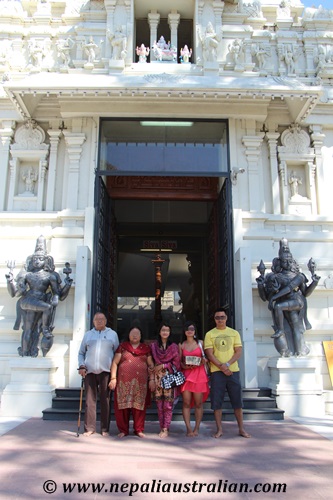
On Sunday, we went to Helensburgh temple (details here) as it is Dashain now and it seemed like a great idea.. We went there with some of our friends and his family. As always, we had breakfast there, yummy vegetarian South Indian dishes.

temple

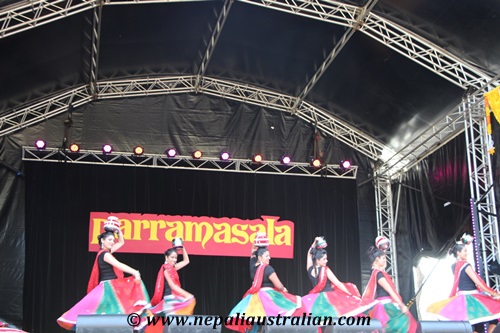
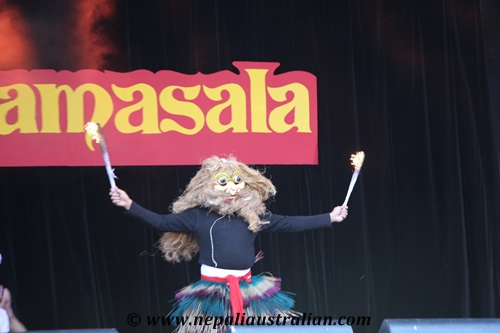
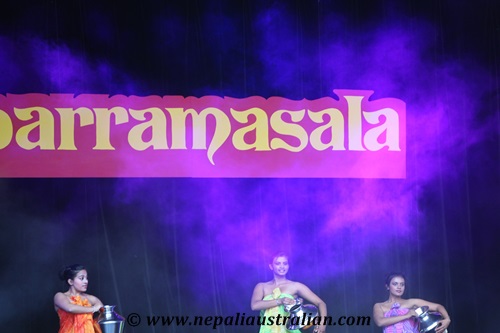
From there we drove for over an hour and was in Parramatta, enjoying Parramasala (details here). Like every year, it was fun with lots of food and music.

Parramasala (1)Parramasala (5)Parramasala (4)Parramasala (7) Parramasala (12) Parramasala (11) Parramasala (10) Parramasala (9) Parramasala (8)

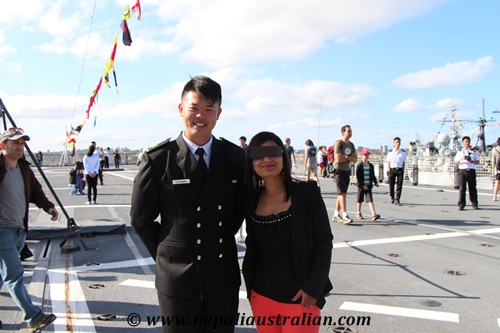
On Monday, we went and saw the war ship at International Fleet Review. The review is a celebration marking 100 years since the Royal Australian Navy fleet first entered Sydney Harbour. It was worth the visit as we got to see so many navy ship from many different countries.

International Fleet Review (1) International Fleet Review (20) International Fleet Review (18) International Fleet Review (17) International Fleet Review (16) International Fleet Review (14) International Fleet Review (13)

You may also like :

*Sculpture by the sea *Easter Long weekend trip *Snowy Mountains: Australia

Multi-talented

We were watching the show at the festival on the weekend.

Me: God that women is multi-talented, she can sing and dance. And look at the man, he can play guitar and harmonium.They are so cool.

AS: I am multi-talented too.

Me: Really?

AS :I can watch her sing and dance and enjoy him playing guitar and harmonium at the same time 🙂 🙂 🙂

P.S: Do not forget to nominate  your favorite blog .

Nominations open for NEPALIAUSTRALIAN’s Blog Award 2013

You may also like :

*How thoughtful!!! *He said *1,2,3

C Momo

If you have ever met someone from Nepal, you must already know by now that Nepali people are crazy about momo. There are many varieties of momo and a simple recipe for one of them is posted here.

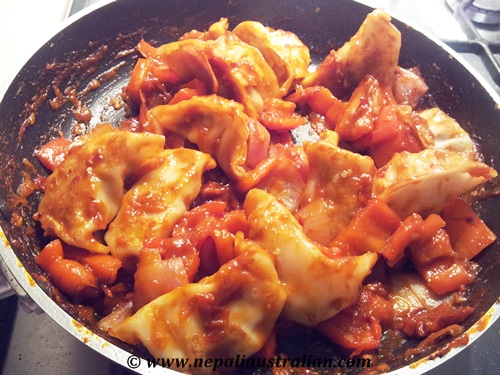
Today I am posting the recipe for C momo, C stands for chill so it is a hot and spicy momo recipe.

Ingredients

  • 20 pieces of steamed Momo (for recipe check here)
  • 2 tomatoes cut into quarters
  • 1 tablespoon of crushed garlic and ginger paste
  • 3 green chilies halved
  • 1 small red onion cut into quarters and with layers separated
  • 1 red capsicum cut into inch square shape
  • 3 tablespoons Oil
  • 5 tablespoons of ketchup
  • 2 tablespoons of chilli sauce/ hot and sweet sauce (more if you like hot)
  • 1 tablespoon  Chili paste/ half tablespoon chilli powder
  • Salt to taste
  • 5 tablespoons soy sauce
  • Coriander to garnish

C momo (2)

Steps

  • Preheat the oven to 200 0C and bake the tomatoes for 10 minutes or until tomatoes are cooked and skin starts peeling off.
  • In a pan, heat a spoon of oil and brown the momo. (optional)

C momo (3)

  • Take the momo out from the pan and put aside.
  • In the same pan, add remaining oil and fry crushed garlic and ginger paste.
  • Now add the baked tomatoes and cooked it until it is a smooth paste. If the sauce starts drying, add a small quantity of water.

C momo (4)

  • Now add green chill, onion, capsicum, and sauté for a couple of minutes.
  • Add ketchup, chill/hot and sour sauce, soya sauce and cook on low heat for few minutes. If the sauce starts to dry, add small quantity of water. Make sure the sauce is not very runny.

C momo (5)

  • Taste the sauce and add salt as requires. Soya sauce makes it pretty salty so watch the amount of salt you add.
  • Add momo to the sauce and stir and close the lid of the pan for 2 minutes allowing momo to heat.

C momo (6)

  • Transfer the momo to a plate and garnish with fresh coriander

C momo (1)

  • Tasty hot and spicy C momo is ready. Enjoy!

You may also like :

*Aloo chop *Chatamari *Gundruk Aloo Bhatmas Curry

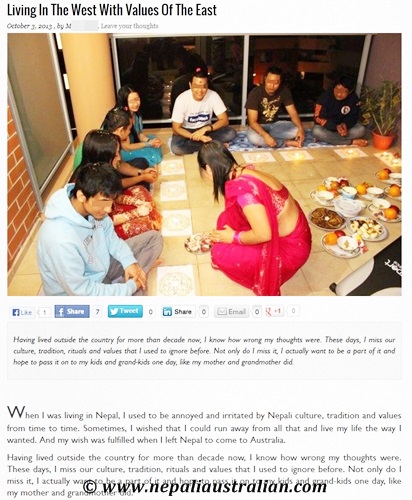
Living in the west with values of the east

This article was published in DREAMS online magazine on 3rd October 2013.

dreams

When I was living in Nepal, I used to be annoyed and irritated by Nepali culture, tradition and values from time to time. Sometimes, I wished that I could run away from all that and live my life the way I wanted. And my wish was fulfilled when I left Nepal to come to Australia.

Having lived outside the country for more than decade now, I know how wrong my thoughts were. These days, I miss our culture, tradition, rituals and values that I used to ignore before. Not only do I miss it, I actually want to be a part of it and hope to pass it on to my kids and grand-kids one day, like my mother and grandmother did.

The festive season of Dashain and Tihar is here, and it is one of my favourite times of the year. This festive time has helped me connect with Nepal, Nepali culture and tradition. Before, I used to wish things could be as good in Australia as in Nepal, but that was just wishful thinking. So instead of being sad and depressed, this time I decided that we would celebrate the festivals with whatever we could.

With the motto, “If the mountain will not come to M, then M must go to the mountain”, we bring Nepali style Dashain and Tihar to Sydney. For the last few years, I have been having a lot of fun in Nepali festivals here.

For Dashain, I plant Jamara during Ghatasthapana, and it is ready for Tika day. During Asthami, Nawami and Dashami, we plan a Newari bhoj to mark the days.

Last year we had Kuchi Bhwey, a Newari bhoj consisting of Baji/Chiura(beaten/flattened rice), Chicken curry, Spinach, Methi kerau (fenugreek and peas), Thulo kerau (big peas), Golbheda achar (tomato pickle), Butan(meat fry), Aloo tama(potatoes with bamboo shoots), and Methi(fenugreek) salad on Asthami.

On Nawami, we followed the tradition and performed a worship of our car. Later we had Samay Baji, a Newari dish consisting of Baji/Chiura(beaten/flattened rice) , Haku Mushya (black soyabean), Chhwela (smoked meat), Puka-la (spicy roasted meat), Aalu achar (cold potato salad ), Bhuti (boiled beans with spices), Khyen (boiled egg), Panchkwa (bamboo shoot, potato, beans mixed curry), Wo or Bara (shallow fried pancakes made of black lentil), Lava-palu (ginger and garlic), Achar (pickle), Wauncha (green vegetables) and Aayla (Newari liquor).

On Vijaya Dashmi, we normally take a day off from work so we can have fun with our loved ones. It is always fun to be blessed by elders with red Tika and Jamara. Following Tika, there are a few days where we get invited for tika, and this normally concludes the celebration of Dashain.

After a few weeks, we celebrate Tihar in full swing as well. I know people overseas normally celebrate only Bhai Tika but I didn’t want to miss out on the other days. So I perform Kag Tihar, Kukkur Tihar, Laxmi Puja and Mha Puja as well.

I haven’t seen many crows around in Sydney, so I decided to print a photo of a crow to perform my puja with. I know it sounds a bit silly, but it helps me to celebrate the festival. I did the same during Kukur Puja, printed the photo of a dog that my parents have in Nepal. If you ever feel like celebrating Tihar in full swing, you may want to follow my ideas.

I love Laxmi Puja as it make me feel happy and there is so much to do. We start the evening by lighting fairy lights and candles. Then I perform Laxmi Puja to the best to my knowledge. I normally print out the Mandap and Laxmi’s footsteps so I can perform the puja. Living overseas, we have to make do with whatever we can rather than missing out in the belief that we can’t do it.

Following Laxmi Puja, we performed Mha Puja with my brother, cousins, and friends. Mha Puja is such a great way to come together and have fun in our Newar culture. For this puja too we used printed mandaps, which made it easy for us to set up the puja. Like in Nepal, we have Shagun (a traditional plate typically consisting of a boiled egg, smoked fish, a “bara”, haku chhoila”  and “aila”, which ends with “dhau”) and bless our body for good health.

And finally, there is the Bhai Tika, which is always a big deal for me. I have two brothers on whom I perform the Puja, and I wanted to make sure it is a great celebration. I and my cousin even learned how to make Sel Roti, so our celebration is a lot like Nepal’s. I prepare for Bhai Tika weeks in advance, making masala (pack of dry fruits & nuts) and buying fruits, snacks and clothes. I prepare Shagun on the day and bake cakes for puja as well. I am always happy to see my brothers enjoying the day with me, and blessing me with happiness and gifts.

Not only celebrating Dashain and Tihar, but we try to do whatever we can to be in touch with Nepalese tradition and culture. Recently, my nephew had his 6th birthday, and it was celebrated with yomari (a newari delicacy made of external covering of rice-flour and an inner content of treacle) mala like in Nepal. One of my nephews was born here in Australia, so we did his chatti and nwaran (naming ceremony) according to Hindu rituals. We celebrate Teej every year wearing red and eating yummy Nepalese cuisine. And whenever possible, we go to Nepal to celebrate milestones like marriage and pasni. We had a traditional Newari wedding which went for over a week, and my nephew had his pasni in Nepal with our relatives and friends.

Even though I don’t have kids of my own right now, I know that they are affected by many thing in life, but their strongest main values are learned from their parents, society and surrounding environment. I know that even in Nepal, with globalisation we are losing some of our traditional values fast, while we adopt easily imitable aspects of western culture. Nepal has a unique blend of culture and customs, and people travel millions of miles to learn and observe these in Nepal. It will be a shame for our kids not to know their own customs, traditions, and rituals.

I hope my effort in bringing our eastern culture to the west will help my kids and their kids to learn more about Nepal, Nepali culture, traditions, rituals and values, so that they know their root and can be proud of it. I have been away from Nepal for a long time, but I still cherish the values that I have learned, and I hope one day, our next generation will do the same.

Happy Dashain and Tihar to all readers. No matter where you are, enjoy it in full swing!!!!

You may also like :
*Confessions of a Shoeholic *Recycling and reusing in Nepal *Slave of Smartphone and Instant messaging

Raw chocolate with 100% cacao – No thanks

Just a few weeks ago, I was telling you all the benefits of dark chocolate and trying to convert all of you to eating dark chocolate from now on. I must add a warning with that post because I had a taste of a 100% Cacao raw chocolate and it was not what I expected.

As you know I LOVE dark chocolate so one of my friends bought this chocolate for me from a health food store. You can see the packing looks great like any normal chocolate but this one is made from predominately Cacao not Cocoa.

chocolate

Did you know that Cacao is actually a super food? Not cocoa but Cacao; this tasty little bean is full of the good stuff. Cacao is derived from Theobroma Cacao beans, which literally means “Food of the Gods”. Cacao contains over 300 compounds including protein, fat, carbohydrates, fibre, iron, zinc, copper, calcium and magnesium. Magnesium helps to build strong bones and is a muscle relaxant associated with feelings of calmness. Cacao is also high in sulphur, which helps form strong nails and hair.

The difference between the two is something I never considered before. Cacao refers to the raw form of chocolate, including the tree and bean. Raw cacao powder is not roasted, relatively unprocessed, and contains no sugar or cocoa butter and so retains more of its natural nutrients. Cocoa is the Anglicized version of the word “cacao.” Cocoa powder has been roasted, ground, and sometimes mixed with a sweetener and cocoa butter. Most chocolate today is loaded with sugars, dairy products, sodium, stabilizers, emulsifiers, preservatives, and more.

Knowing all this fact, I thought I would love this chocolate. I had a piece and it is too bitter and too bland to my liking. It would be great if you were after a 100% no artificial ingredient chocolate bar but I have to tell you that it tastes nothing like the chocolate we know. For me it was one of the worst chocolates I have ever tasted.

As you can see in the packing, it says No sugar and 5.0 g fat per serve which means I know it will be great for my body but my mouth wouldn’t allowed me to have another piece.

Just to check how everyone would react, I gave the chocolates to my colleagues, AS and his cousin. All of them agreed with me that they would never eat this chocolate again. Anyway, if you can eat it I am sure it is great for you as raw Cacao bars are filled with nutrients and natural ingredients your body will benefit from.

We were joking that this is the chocolate we should introduce to our kids for the first time. Either they will love it and have all the health benefits or they will never eat chocolates again. 🙂

Just some quick steps on how cocoa bean becomes a chocolate bar

  • It takes six months for cocoa beans to ripen. Harvests take place twice a year
  • The beans, which are covered in a white pulp, are removed from the pods
  • Beans are put in large heaps and covered up to ferment. This takes about a week. and is when the cocoa flavour starts to develop
  • Beans are then dried for a week then taken to the chocolate factory
  • They are then roasted, and separated from their shells in hulling machines
  • The insides of the bean, called nibs, are turned into a liquid or chocolate liquor
  • The chocolate liquor is blended with cocoa butter, and other ingredients and stirred for several hours
  • The resulting thick mixture comes out and is poured into bar-shaped containers
  • The bars are now ready to be packaged and eaten, about four days after the cocoa beans reached the factory

You may also like:

*Dark chocolate health benefits *Benefits of wheat grass Juice *Eight foods you should never eat again