It is always great to report success of people from Nepal. Today I am introducing Varsha Thapa, a beauty with long cascading dark hair, enviable skin and exotic features who became the first ever Nepali to walk the New York Fashion Week in 2011.
She’s been recognized as one of Nepal’s first supermodels and she is represented by Wilhelmina Model Agency. She is the first and only Nepali model to be represented by a major agency in America. She made her runway debut in Spring/Summer 2012 during New York Fashion Week walking in 10 shows including Prabal Gurung, Phillip Lim and Many Coon.
Varsha’s dream is to walk for Roberto Cavalli, be the face of Calvin Klein and to become a Victoria’s Secret Angel.
Here are her details
Hair color: Dark brown
Eye color: Brown
Place of birth: Nepal
Date of Birth: Dec 16, 1990
Height: 5’10”; 178cm
Measurements: (US) 32-23.5-34; (EU) 82-62-86
Dress size: (US) 2-4; (EU) 32-34
Shoe size: (US) 8; (EU) 38.5; (UK) 5.5
Varsha is a graduate of Hospitality Management but decided to become a model because of her passion for modelling. Since having arrived in New York, Varsha has been mentored by her scout, Roman Young. “He has helped me with everything from my walk to advising me on what to wear when I go for casting calls,” Varsha said.
Varsha has been adjusting really well in New York as, on a single day, Varsha had casting calls scheduled with 19 designers. Impressively, she made it to 18 of them. The gruelling nature of the industry is the norm, especially for Fashion Week. But Varsha has also been sent to casting calls at some of the industry’s biggest names like Donna Karan, Calvin Klein, Tom Ford, Marc Jacobs, an indication of where her agency thinks her potential lies and looks fit.
She has done shows like – Spring/Summer 2012 {3.1 Phillip Lim, Creatures of the Wind, L’Wren Scott, Mandy Coon, Patrik Ervell, Prabal Gurung, St. John, Suno, Suzanne Rae}, Autumn/Winter 2012 {Bibhu Mohapatra, Dennis Basso, Libertine, Miguel Adrover, Tracy Reese}.
She was also featured in Navayaata magazine in Nepal as well as Rouge Magazine in China.
Here is her interview with Women’s Wear Daily (WWD)
WWD: It’s getting late in Paris — are you heading to bed soon?
Varsha Thapa: I just got to another job now, for Moda Operandi. We’re shooting Christopher Kane, I think. This is my first time working with them. I came from a fitting at Vivienne Westwood. I tried on like eight outfits. The shoes were crazy. Vivienne alwaysFXFLd7IfrZi45yu.ZOi3sc6D2CbHo_hmried were in a heart shape, with block heels. They were kind of hard to walk in, and I had to walk maybe twelve times.
WWD: Before we talk about Paris, how was New York Fashion Week?
V.T.: Great. I did Kimberly Ovitz, which was really fun. I like her clothes a lot. It was really artistic. Generally, she does like black stuff, but this time she included colour. She had these leather pants that were really cool. They were like painted gold or something. They were amazing.
WWD: Did any other shows stand out?
V.T.: I did Bibhu Mohapatra, and I really like his clothes a lot. That show had crazy hair. First there were braids, then they had to back-comb everything. There were a lot of things going on. It was painful, but it was only for a little bit, so I was fine. There was a bun and on top of that, there was a lot of crimping. There were a lot of clips in my hair. It took a while to take them out. I slept on the pins and the next day, I was like, “What is this in my hair?”
WWD: What are your thoughts on Paris so far?
V.T.: The amazing thing about Paris is there are so many patisseries here. You don’t really have to think about what to get — there are so many amazing choices. In New York, you don’t have that. Either you go to Starbucks or some other chain. There is this place near my hotel, and I know it’s not the healthiest, but it’s so good. Every morning, I’m so tempted to go there and get a croissant. They have different types of croissants, a healthy kind and a regular. I get the healthy kind, but sometimes I sneak and get the regular.
WWD: Have you gotten to do any tourist-y activities?
V.T.: No, and this is my first time ever going to Paris. Thankfully, I’m here until March 20th. I’m going to go to the Eiffel Tower and the Champs-Elysées. I want to explore Paris, which I haven’t been able to. Since the moment I got here, I started working.
WWD: Do you know what shows you’ll be doing?
V.T.: It’s all to be determined. You never know until you are confirmed. It’s very iffy. I’m not sure if I’m going to do anything, or if I’ll book a show after the fitting. But, the castings are still happening, the fittings are still happening and the options are still there.
WWD: Do you ever get disappointed when you don’t book a job?
V.T.: Yes. Just a few days ago, after a casting, I got sent directly to a fitting because the designers liked me a lot. I was there waiting for four hours, so I had to miss two really good castings. Then, after the fitting, I was cancelled from the show. That was a really big disappointment, but it’s all right. It happens every season to every girl.
Today is International Woman’s Day and it is a day to celebrate us, woman, and have respect, appreciation and love towards us. Because everything starts from you and if you don’t respect, appreciate and love yourself, you can’t share that with the world.
There are many reasons why this day is celebrated but I want to celebrate it by listing all the good reasons why I rejoice being a woman.
Woman is a daughter, sister, wife, mother and a friend. I can’t imagine this world without them. Yes, that is who we are.
Women have so many choices. They can work or stay home. Be a nurse or a soldier.
How can I forget to mention the choices women have in fashion. One can choose to wear jeans or skirts or dress or shorts or Kurta or Sari or Omani or Kimono or Shalwar Kameez. Anything your heart desires.
Talking about fashion, how about high heels, they are my favourite and give women an instant boost in height and confidence or they can choose to wear a ballet flat or thongs and still look beautiful.
Make-up is a part of our daily regime and we can experiment with different, glamorous looks.
Doors are held open for us, chairs are pulled out for us.
We could dye our hair and get rid of the gray without being ridiculed.
We have the gift of female intuition which usually steers us in the right direction.
Women are great listeners and don’t always feel they need to fix things.
We can wear coloured nail polish to match the season, mood or our clothing.
Women can multi-task with ease.
Women are intelligent enough to know there is no such thing as a “Happy Period.”
Chances are in front of every awesome man is an awesome woman who made him that way
I think the song by Helen Reddy sums of everything I want to express right now. This is for all the ladies out there. Here is the video and lyrics if you haven’t heard it before.
I am woman, hear me roar
In numbers too big to ignore
And I know too much to go back an’ pretend
’cause I’ve heard it all before
And I’ve been down there on the floor
No one’s ever gonna keep me down again
CHORUS
Oh yes I am wise
But it’s wisdom born of pain
Yes, I’ve paid the price
But look how much I gained
If I have to, I can do anything
I am strong (strong)
I am invincible (invincible)
I am woman
You can bend but never break me
’cause it only serves to make me
More determined to achieve my final goal
And I come back even stronger
Not a novice any longer
’cause you’ve deepened the conviction in my soul
CHORUS
I am woman watch me grow
See me standing toe to toe
As I spread my lovin’ arms across the land
But I’m still an embryo
With a long long way to go
Until I make my brother understand
Oh yes I am wise
But it’s wisdom born of pain
Yes, I’ve paid the price
But look how much I gained
If I have to I can face anything
I am strong (strong)
I am invincible (invincible)
I am woman
Oh, I am woman
I am invincible
I am strong
FADE
I am woman
I am invincible
I am strong
I am woman
Also there is the song “ I enjoy being a girl”, which I love .
Saying this I don’t hate men. I think we complement each other, like wheels of a bike. It is just that I am happy and content to be a woman and I won’t have it any other way.
To the all the ladies out there, Happy International Women’s Day. Enjoy and be proud of being a woman.
It is always great to see people from Nepal progressing so well. Binod Chaudhary, 57, owner and chairman of the Cinnovation/Chaudhary Group has made it to FORBES Billionaires List for this year with a net worth of $1 Billion as of March, 2013.
This world has lots of people with lots of money and he share his global billionaire ranking with 84 other individuals who have also been ranked 1,342nd richest on Earth.
He has interests in banking, foods (his company makes Nepalese favourite instant noddle and mine too, Wai Wai), cement, real estate, hotels, power, retail, electronics.
Mr. Chaudhary takes pride in his success in the noodles business, particularly with ‘WaiWai’. The brand has now spread wings to 35 countries with an annual production of a billion packets.
In a twitter update, Chaudhary said it was a “rare honour and recognition for a non-Indian South Asian”.
“We (are) humbled (and) take this as an honour for Nepal. Nepal will now be known in the global corporate sector,” twitted Chaudhary, who recently published his biography.
Here is some information about him I found in internet.
Mr. Chaudhary is Nepal´s first billionaire but built most of his fortunes are overseas, said Forbes, which in 2008 valuated his wealth at over $500 million. “His Cinnovation/Chaudhary Group, owns among much else, popular instant noodle brand Wai Wai, a controlling stake in Nepal´s Nabil Bank and a string of luxury hotels with India´s Taj hotel chain.”
Building this empire, however, was not an easy task, Chaudhary said. “This journey began with my grandfather´s decision to migrate to Nepal and 40 years of my persistent hard work,” he said.
His grandfather, a textile trader from Rajasthan, migrated to Nepal in the 19th century. He opened a small textile store that used to supply goods to the erstwhile rulers. Chaudhary’s father, converted that into Arun Emporium, Nepal’s first department store. The eldest of 3 siblings, Chaudhary joined the business at age 18, giving up his plan to study accounting in India when his father developed a heart ailment. The group had 400 people then versus 7,500 today.
A family division gave Chaudhary the freedom to pursue his own ambitions. Seeking expansion, he created Cinnovation through which he acquired overseas assets. Though scandals have dogged Chaudhary as he has flowered, he was also able to get a controlling interest in Nepal’s Nabil Bank .
A fitness fanatic, Chaudhary goes trekking in the Himalayas every year to clear his head. He and wife Sarika also regularly visit their health farm in the Philippines.
Currently, Nirvana, his eldest son, handles business operations in Nepal. Another son, Varun, oversees businesses in Dubai and India, while Rahul looks over businesses in Singapore and India.
“It is a proud moment not only for me, but for all my corporate friends and Nepali people. Nepal’s corporate sector has now come forward in the global arena. It has raised our self-esteem,” said Chaudhary.
“All this wouldn´t have been possible without the efforts of two of my sons, who are non-resident Nepalis,” Chaudhary told Republica, rebuking the government ban on overseas investment by Nepalis.
“The government should make changes to its policies if it wants to give birth to more Binod Chaudharys. I do not want potential and energetic entrepreneurs to struggle like I did.”
Here is an interview he gave to myrepublica in Jan 2013.
Not only am I doing well professionally, I’m also the world’s best husband. My wife will vouch for that,” says Binod Chaudhary, the man behind the successful Chaudhary Group, the biggest conglomerate in Nepal.
Born in April 1955, Binod started business from an early age. He expanded his family business and opened a disco before launching a music album and making movies. Then came Wai-Wai, and in the years that followed, one of Nepal’s largest companies was born. With that, Binod became a force to be reckoned with.
When the late King Birendra visited his home after a trip to the Wai-Wai factory, he had pulled Binod aside and said in a hushed whisper that Binod was on his way to becoming an icon everyone would soon be after.
Today, Binod is easily the most popular businessman in Nepal and has many, many accolades to his name. From President of the Confederation of Nepalese Industries to Member of the Constituent Assembly, the list of positions he has held is indeed long.
Photo: Chanda Shekhar Karki
But there is more of him than just titles. He is a charmer and a people’s person. His conduct and effervescent smile have won the confidence of his staffs and public alike. His easy way of instantly connecting with people has always made him an admired public figure.
As he continues to create ripples in the corporate world, there seems to be something else on his mind presently. Binod is excited about his soon-to-be-launched autobiography that has been published by Nepa-laya and penned by Sudip Shrestha.
The Week caught up with the business tycoon to talk about his upcoming book and everything else but business.
Why did you decide to tell your story?
Nepa-laya had been approaching me for quite a while but I kept putting it off. They said they would provide me with a journalist and everything would be taken care of. I had mixed feelings about it initially but I had a lot of respect for this publication house, looking at their past work, so I eventually gave in. I’ve always been a public figure and my life’s been an open book. There’s no dimension of my life that hasn’t been talked or written about. Coming up with a book was just taking it to the next level. I did think it was an unnecessary headache but I decided to go ahead with it.
How was the experience of having a writer as your shadow throughout your book writing journey?
Initially, I was skeptical when they assigned Sudip Shrestha. Generally, I have a very good relationship with the media but I didn’t know Sudip all that well. I didn’t know how my words would be interpreted. Also the fact that I didn’t have much control over what he would eventually write was worrisome. But we went on a ten-day trek to Annapurna and he gradually won my trust, and confiding in him then became easy. Our relationship evolved over the five years it took to write the book, and I think he got to know me inside out. I’m very happy with the way the book has turned out.
How did it feel telling your story?
Writing an autobiography is reliving your life to a certain extent. I had forgotten a lot of things that had happened in the past. During the process of writing, long forgotten situations and incidents resurfaced that compelled me to probe my memory further. I remembered friends and people I’ve lost touch with. To be living life once again after 57 years is nostalgic but immensely satisfying. The process of narrating my story was effortless for me because I had made up my mind that I was going to be ruthlessly candid. Also, when I developed confidence in Sudip and could trust him one hundred percent, it was all a breeze. I just had to be a storyteller and leave the narration bits to him.
Are you scared of the repercussions now that you’ve come out with a bare-it-all account of your life?
I have absolutely no regrets about anything that’s happened in my life. That’s why I decided to tell my story in the first place. But now, when I read bits and pieces of the book, I get goose bumps sometimes. While narrating my story, I did it without a thought. I’ve mentioned a lot of well-known names. It’s going to offend and annoy a lot of people. Many will be jealous. Many will interpret my words in their own ways and will try to read between the lines and scrutinize me. I wouldn’t say I’m nervous because I’m a fairly strong man; but yes, I’m a bit anxious and excited.
Is there any particular incident you wish you hadn’t mentioned?
My life’s been full of ups and downs and challenges, so there are many incidents that, now in hindsight, I wish I hadn’t disclosed. But if I had started filtering out incidents, then this book wouldn’t have been written. I also saw and felt no need to hide anything. All the experiences that I’ve had have shaped me into what I’m today, and I’m proud of who I’ve become, despite the odds being stacked against me. I’ve been one hundred percent honest and that was a conscious decision I made. So I don’t regret mentioning anything that’s in the book.
What are some of the instances you’ve shared in your book that aren’t public knowledge yet?
There are many instances that’ll take readers by surprise. When I was in Santiago, Chile, there was an earthquake of around 8 Richter scale. My wife and I woke up and saw the room spinning around us. Sarika was scared and started praying. She even suggested we make a run for it. But we were on the 12th floor of the hotel, so I convinced her to stay put and not get out of bed. After a while, the shaking stopped and we decided to head down. The funniest bit of this incident is that, as I was leaving the room, I saw a mineral water bottle sitting upright on the bathroom sink. Not a drop of water had been spilled. The earthquake experience changed my life. Had I died, there would be one news report and the world would move on and I would be forgotten. I learnt that if there’s anything one wants to do, there’s no better time than the present to do it.
In the course of your career, what’s the most difficult hardship you encountered, and how did you handle it?
I think turning CG (Chaudhary Group) into a multinational company was the biggest challenge in my life. For 20 years, I struggled to do so before finally being able to live my dream. The government didn’t support my initiative. For any Nepali to be an international entrepreneur, you had to be a non-resident Nepali. I wasn’t prepared to accept that. If Maggie can set up a factory in Nepal, then Wai-Wai should also be able to do so wherever it wants. The rules and policies were against it and I decided to fight it. At the cost of being crucified, I continued with that journey. Nepal’s fluid political environment and anti-business sentiments were the biggest hurdles I had to get over. I’ve talked all about it in my autobiography. I had to find innovative means to get where I wanted and I paved my own path.
What’s been your philosophy or mantra in life?
I’ve always been ambitions and have never given up on any goal I’ve set up for myself. I’ve always found a way to do things within the confines of my own limitations. Nothing has happened by fluke. I’ve been clear about what I want and everything’s been planned accordingly. The roadmap might’ve changed along the way but the destination has never fluctuated. I believe that there’s no monopoly on wisdom, so there’s no need for anyone to feel inferior and develop complexes. You might be geared up for a game of tennis but life throws you a cricket ball. You’ve to be prepared to face and stand up to those challenges. Basically, my mantra in life has been never to compromise. The most important mantra for success, I believe, is time management. Knowing and managing your priorities without mixing them up will get you places.
What’s your advice for people who want to be as successful as you?
What I’ve learnt from my life’s struggles is that even if your intentions are right, the process of achieving your goals can be tough. There’ll be people who’ll try to pull you down. But if you’re hell bent on achieving what you’ve set out to, you’ll find a way to do it. You shouldn’t make lame excuses and waste your time hounded by your own complaints. You’ve to devise your own solutions to problems. If there’s an artificial wall created to block you from reaching your goal, don’t be a fool to try and break the wall. Work your way around it and find a way to get there. Nothing’s impossible to attain as long as you’re clear and obsessed. You need to know your own strength and be clear about what you want from life. If you aren’t clear about what you want from life ten years down the line, chances are that it’ll never happen. Also, nothing’s going to be served on a silver platter; you shall have to work for it.
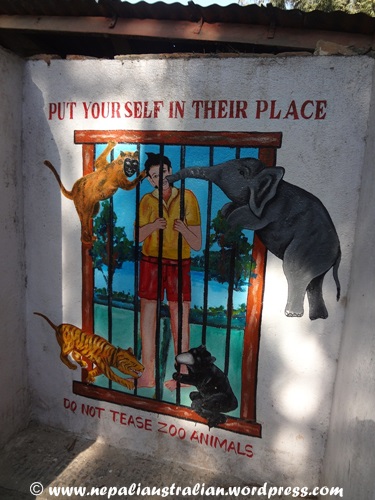
I hadn’t been to the zoo in Kathmandu for more than a decade but this time we were lucky that we had time enough to visit the zoo. The zoo is located a few kilometres away from the city centre, Kathmandu. It is the only zoo in Nepal, a country with a population of 30 million, and hence fulfils an important role.
We hadn’t planned to there. We were out for lunch with my parents, my brother, SIL and little nephew. As we were close to the zoo, my dad suggested that we should go and visit it so that my little nephew could have some fun and all of us agreed to it.
I remember around 3 years ago, me and AS wanted to go to the zoo. We were outside the gate and we saw so many people that it put us off from going inside. But I am glad we went this time.
As we walked inside, I realised nothing much had changed in the last decade, which is very sad.
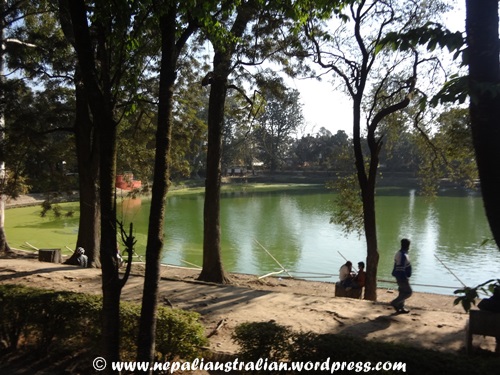
The animal enclosures are arranged around the perimeter of a large boating lake which takes up a large proportion of the zoo’s area.
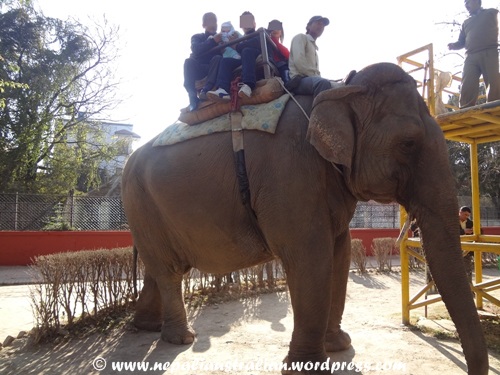
As we started of tour, we saw an elephant riding area. My dad wanted my nephew to have his first elephant ride so we went and asked the guys there for more information. They said there are a few groups already booked for the tour so asked us to buy the ticket and come back in an hour.
The elephant ride cost us RS 100 each for around 15 minutes ride. So after buying the tickets we continued our tour.
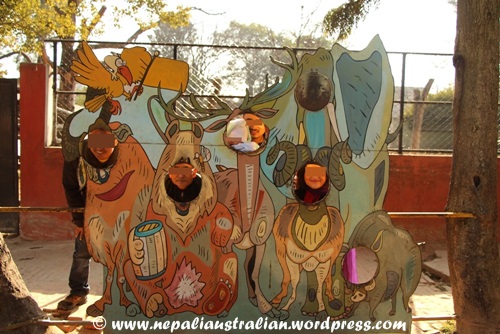
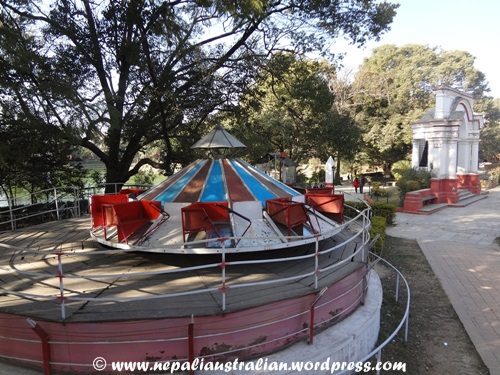
The zoo is arranged according to taxonomy, with mammals, birds, reptiles and fishes all occupying different parts of the zoo. There are also playground rides, picnic lawns and boat rides on the lake. As we started walking around the zoo, I realised that there were lots of families with small kids enjoying their picnic as well as many lovebirds in corner benches enjoying their time together away from prying eyes.
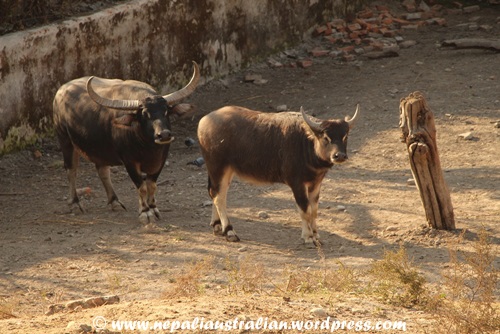
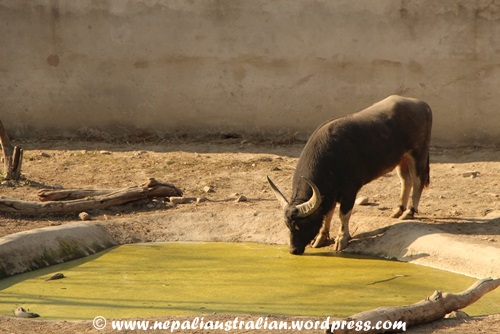
The zoo houses some 780 species including the critically endangers white-rumped vulture and Chinese alligator and six endangered species: Asian elephant, royal bengal tiger, one horned rhino, wild buffalo, gharial and yellow headed turtle.
Along with these animals, there were hippos that was lazily sunbathing, a hyena, a giant deer, peacocks, white-napped crane, two big rhinos, monkeys, water buffalo, chimpanzees, leopards, beer, tigers, lions as well as golden pheasant, silver pheasant, chukar, kalij, parrots, owls. They also have small reptile collection featured a common cobra, an Indian rock python, snakes and a turtle.
By the time we had a look around; it was almost our turn to ride the elephant so we went back to the riding area. We waited for 10 minutes and it was our turn.
The guy told us it is OK for all of us to ride at the same time (poor elephant) so me, AS, my dad, my brother, SIL and my nephew got on the top of this elephant. I was glad that my nephew enjoyed the ride.
Initially, the elephant was not listening to its handler and I was a bit scared as he was not moving according to the pre-planned route but after a while he relented and followed the route. While talking to the handler, he told us that the elephant is round 70 years old and does 8-10 trips every day. I felt sorry for the poor animal as he is so old and has to do this every day.
We were taken half way around the lake and then back to the same spot where we got on it. For some reason my nephew started to cry, poor baby. We were all glad when we get off as we were worried if something might have happened to him. But he was fine, just restless as he had to sit in one place too long. By this time it was getting cold and windy so we decided to go home.
I had a really nice time with my family and was happy to see my nephew have his first elephant ride.
Even though the zoo in Nepal is small but it is well maintained I am sure it is a great place for kids to visit to learn more about different animals. Construction was going on everywhere so it looks like it is in the process of a face lift with new paths and enclosures so I think in a few years it will be quite lovely.
In Nepal, a goat’s brain (gidi), feet (khutta), head (tauko), stomach skin (bhundi), tongue (jibro), liver (kalejo), kidney, lungs (phokso), fried intestines (aandra), fried solidified blood (rakati) are considered delicacies and are in very high demand in Dashain and during festivals.
I know some of you might feel squeamish even thinking about eating offal but believe me if you love your meat, you will love these dishes. Another is that eating offal uses the parts of the beast that might otherwise be wasted. As it takes 10 kilos of cereal to produce one kilo of meat, then we should not be wasting any part of the carcass. Unless you deliberately avoid meat, eating offal should be regarded as “green”.
As I am from Newar community so it is very common in our household to have these delicacies.
Most of you may not know it but fried lungs are one of the tastiest of delicacies. If done the right way, Phokso fried (fried lungs) are very tasty. AS was craving it when we were in Nepal. As we were a bit scared to eat out, my MIL decided to cook one at home and at the same time teach AS and me how to do it.
In order to have a perfect Phokso fried, you must make sure you buy fresh lungs without any punctures. In Nepal, they blow air into the lungs at the butcher’s to show that it is a good one.
Once lungs are ready, it must be cleaned properly to make sure there is no blood left in the vessels. To clean it, pour water in it through its trachea multiple times until all coagulated blood remaining in the lungs come out. At the end, pour a few tablespoonful of oil into each lung.
Ingredients:
1 khasi ko phokso (goat lungs)
2 cups all-purpose flour
2 eggs
1/4 teaspoons turmeric powder
1/2 teaspoons coriander and cumin powder
1/4 teaspoons chilli powder
1 1/2 teaspoons salt
1 teaspoon garlic ginger paste
4 cups water
kitchen strings
1 small potato to use as stopper
Process:
Put the flour in a dish and place all ingredients over it. Mix all ingredients together until all lumps are gone. The mix should be a bit watery.
To make sure there are no lumps in the mixture; strain the mixture through the strainer. Use whisker if required.
Fill a plastic bag (we used milk bag in Nepal but you can use zip lock bag) with the mixture. Place the end of the trachea into the opening of the bag and clamp your fingers over them to seal them. Pump the mixture in the bag into the trachea.
When the lungs become full you will notice that the outer skin will be smooth and shiny.
When the lungs are full, don’t just let the trachea go as the lungs will pump the mixture out quite rapidly. Keep holding the trachea!
To seal the trachea, peel and cut the potato and insert the cut potato into the opening of the trachea. Shove it inside then fold and seal trachea by tying with a kitchen string. This will make sure the batter doesn’t flow out while it is being boiled.
In a big pot, boil water and add turmeric powder.
Add the lungs and cook it. You may need to turn it over to make sure all sides get cooked.
Once the lungs are cooked, let it cool down before cutting it.
Slice the lungs into pieces a few centimetres thick pieces.
In a fry pan, heat oil and lay the sliced lungs in one layer.
Once one side is crispy and brown in colour, turn and fry the other side.
Take the fried lungs out on a plate.
Mix salt, chill power and cumin powder in the plate.
























 nepaliaustralian