Before I had visited Vatican I knew about Sistine Chapel but it had never interested me. But I was in awe of the whole place when I got there. I think the biggest credit goes to our guide who was so good at explaining all the details about the chapel that I wanted to share the information with all of you. I am sure many of you know a lot about this famous chapel already but I still am sharing what I learned.
As you know I am not a Christian but still the history behind the chapel is so interesting that anyone will fall in love with this architectural beauty and its frescos by Renaissance artists including Michelangelo, Sandro Botticelli, Pietro Perugino, Pinturicchio and others.
When we entered the Sistine Chapel, no photography was allowed but these are photos I took in the garden where the guide explained the detail about the chapel. Rest of the photos are from the internet.(I have no idea how they managed to take these photos.)
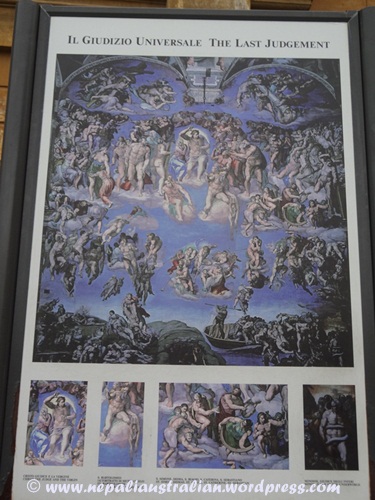
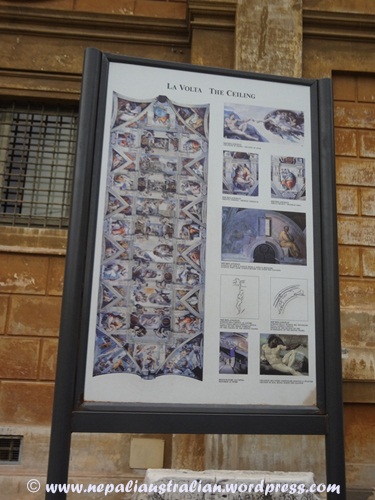

There are 1,100 sq. m of paintings in the chapel, and its beauty is astounding. Even though there were so many people inside the chapel, I was lost looking at the amazing pace while our guide was talking into our headphones.
From time to time I heard a guard in the Sistine Chapel enforcing the No Talking rule and hundreds of tourists instantly complied but just for a few seconds. Then the buzz began again but I was just lost in one of history’s monumental artistic achievements.
The Sistine Chapel ceiling, painted by Michelangelo, was exhibited to the public for the first time on November 1st 1512. It was quite shocking at the time as it appears to depict an image of God – forbidden by the Church.

Michelangelo considered himself more of a sculptor than a painter, which is one reason he was reluctant to accept the commission of Pope Julius II to come to Rome and paint the ceiling of this building. It had originally been built in the 1470s at the behest of Pope Sixtus IV.

The building had undergone some renovations due to structural flaws; Michelangelo started in on the new ceiling in 1508. There were problems: For one thing, he had relatively little experience with fresco. That technique involves applying paint to wet plaster, so the artist and his assistants had to estimate how much plaster they thought they could paint before the surface dried.

Another issue was even more basic: How do you work on a large horizontal surface that is 60 feet above the floor? The easiest approach would have been to build scaffolding towers, but the pope and cardinals wanted the floor to be clear so they could continue holding their meetings in the chapel.
Michelangelo figured out a way to bolt the scaffolding into the side walls; he and his assistants climbed up to their perch and did that marvelous work while leaning backward. The first half of the ceiling — the eastern side — was completed in 1510.

The scenes are all from the Old Testament and relate to rebirth and new beginnings (God creating the World, God creating Adam and Eve, Garden of Eden and Noah’s Ark) and therefore indirectly relate to how the della Rovere family helped achieve its own rebirth of the church.

Look at the interesting view of the ceiling below, the combination of large scenes combined with smaller scenes and the painted illusion of sculpture and a cornice is incredible. Everything you see below is painted and creates both a striking illusion and a powerful narrative.

The stories were painted in backwards chronological order. You can see how much his style was changed and simplified from the first scene showing Noah and the Flood. In that early painting the scene is crowded with figures. His work becomes much more effective when he simplifies his style.
He uses the human figure to represent the entire story, leaving out many of the symbols, landscape and backgrounds that other artists were using. His studies in human anatomy are evident and this key work shaped the direction of the Renaissance.

When that scaffolding was taken down, Michelangelo was dissatisfied with the result. There were too many figures in the panels, he felt; from the floor they appeared small. When you visit the Sistine Chapel, you’ll notice that the figures in the other end, starting with the iconic “Creation of Adam”, are larger.
There are also paintings on the walls, including some by eminent artists like Boticelli and Ghirlandaio, who was Michelangelo’s teacher. By far the most impressive wall painting, though, is the massive “Last Judgment” behind the altar on the west end, which took Michelangelo several more years to complete.

I found this amazing 360 degree view of the Sistine Chapel online. Check out this interactive video.
http://www.vatican.va/various/cappelle/sistina_vr/index.html
Here are some interesting facts about the Sistine chapel
Sistine Chapel Fact #1:
Did you know that the Sistine Chapel was built by a Pope named Pope Sixtus the Vl, hence the name Sistine Chapel?
Sistine Chapel Fact #2:
Did you know that Michelangelo was only 32 years old when he began painting the ceiling of the Sistine Chapel and completed it in only 4 years?
Sistine Chapel Fact #3:
Did you know that the Sistine Chapel was built to house the Cardinals while they deliberated on who should become the next Pope?
Sistine Chapel Fact #4:
Did you know that the famous chimney that releases black smoke telling us the Pope has died and white smoke telling us we have a new Pope is set up in the Sistine Chapel? You can see the marks where it sits towards the back right of the chapel?
Sistine Chapel Fact #5:
Did you know that no artist in history suffered as much as Michelangelo suffered in the 4 years it took him to complete the ceiling of the Sistine Chapel? He suffered with his knees, back and neck and he still managed to live to be 89 years old.
Sistine Chapel Fact #6:
Did you know that Michelangelo painted the Last Judgement (the front wall of the Sistine Chapel) 28 years after he finished the Sistine ceiling?
Sistine Chapel Fact #7:
Did you know that Michelangelo’s enemy, Rapheal, was originally asked to paint the Ceiling of the Sistine Chapel but refused. He suggested Michelangelo knowing he was a sculpture and not a painter.
Sistine Chapel Fact #8:
Did you know that the Sistine Chapel was completely cleaned between the years 1980 to 199. It was paid for by the camera company Fuji Film. Fuji Film now own all copyright to the paintings, and that is why there is no photography allowed in the Sistine Chapel.
Sistine Chapel Fact #9:
Did you know that Pope Julius ll (the Pope that commissioned Michelangelo to paint the ceiling of the Sistine Chapel) sold Indulgences in order to pay Michelangelo for his work? Selling Indulgences meant that people could pay money to get time off Purgatory.
Sistine Chapel Fact #10:
Did you know that there are 3 Botticelli paintings in the Sistine Chapel, painted 24 years before Michelangelo began the Ceiling?
Please click here more photos.
























 nepaliaustralian
How do you deal with negative/rude comments in your blog?
I am sure I am not the only one but everyone who has a blog gets negative or rude comments from some random people form time to time. Today I want to open a platform for everyone who have a blog and reads my blog to share their story.
I have read a few posts from time to time from other bloggers about people who are an individual or group of people constantly writing negative or rude comments on their blog to the point that it makes them upset and angry. I even read that they had a break down after reading the hurtful messages.
I have to admit I do have had a handful of these comments as well but I never published it, I just ignore them by deleting it. I don’t want to encourage them further by responding to their stupid and rude ideas.
The first time I got such comment, I was really hurt. It’s so hard not to have an emotional reaction when someone says something negative/rude about a post you’ve spent ages writing. I let that comment get me because it was directed to me in such a rude way. I really wanted to respond with an equally angry (but not rude) comment but after the initial anger, I realised that these people are not worth my time.
One of the reasons I decided not to publish those comments is because I don’t want them to have the satisfaction of those rude comments being read by many people who read my blog. Also they were made not only towards me alone but were towards Nepali people, women in general or to one of the comments on my post.
I believe these people are just loud mouthed and very negative, full of hot air. For whatever reason, they decided that they do not like something I’ve done, what I said or just take offense at me. They make it a personal mission to attack me in public throwing accusations at me via my blog.
If they have so much time to spread hatred, that is their choice in their life. I decided I should not help them in their mission so I am not wasting any of my time on them. If I have time to write, I better write another post so I can share more with my readers. I know I am better than these rude people so I decided to use my time and words in a positive way than becoming tangled in a stupid war of words.
I have come across blogs where I didn’t agree with the ideas expressed by the author or didn’t like the post. But I believe that if I can’t say something nice, I won’t say anything at all. From the next time, I made sure that I didn’t visit their blog and that is the end of it.
How often have you got rude comments on your blog? How do you deal with them?
Share this:
29 Comments
Posted in General
Tagged emotional reaction, full of hot air, negative comments, personal mission, rude comments