World’s largest Thangka painting on display in Kathmandu

A “Thangka,” also known as “Tangka”, “Thanka” or “Tanka” is a silk painting with embroidery, usually depicting a Buddhist deity, scene, or mandala of some sort. The thankga is not a flat creation like an oil painting or acrylic painting but consists of a picture panel which is painted or embroidered over which a textile is mounted and then over which is laid a cover, usually silk. Generally, thangkas last a very long time and retain much of their lustre, but because of their delicate nature, they have to be kept in dry places where moisture won’t affect the quality of the silk. It is sometimes called a scroll-painting.

These thangkas served as important teaching tools depicting the life of the Buddha, various influential lamas and other deities and bodhisattvas. One subject is The Wheel of Life, which is a visual representation of the Abhidharma teachings (Art of Enlightenment).

Recently in Kathmandu an exhibition of 70 m x 50 m thangka was organised by the Nepal Council for Preservation of Buddhist Religion (NCPBR) in association with Mandala 21st Century, Japan. It has been created by the joint effort of Surya Bahadur Thakali, Chairman of NCPBR and Yasutada Katagiri, President of Mandala 21st Century, a Japanese citizen.

 “The dream of creating the largest ever thangka was conceived in 1994 and with the effort of more than 10,000 volunteers from over 16 countries in a span of eight years, this masterpiece was put together. We feel proud of completing this big campaign and sharing the philosophies of the Buddha among all the people in the world.” Surya Bahadur Thakali explained about the Thangka.

The thangka depicts Buddha’s life story summarised in the 12 deeds that he performed from his birth to his life’s end. It weighs 1,900 kg and was completed by joining 81 pieces, each piece 20 feet in length and 18 feet in breadth with help of zippers.

At the exhibition, the thangka looked like a huge pool — you couldn’t really see clearly from one end of it to the other and only when you climbed to the top of the stadium that the thangka could be seen in its full form which was breathtaking in its exquisite detail, which is the main characteristic of a thangka.

Please look at the amazing creation

How do you deal with negative/rude comments in your blog?

I am sure I am not the only one but everyone who has a blog gets negative or rude comments from some random people form time to time. Today I want to open a platform for everyone who have a blog and reads my blog to share their story.

I have read a few posts from time to time from other bloggers about people who are an individual or group of people constantly writing negative or rude comments on their blog to the point that it makes them upset and angry. I even read that they had a break down after reading the hurtful messages.

I have to admit I do have had a handful of these comments as well but I never published it, I just ignore them by deleting it. I don’t want to encourage them further by responding to their stupid and rude ideas.

The first time I got such comment, I was really hurt. It’s so hard not to have an emotional reaction when someone says something negative/rude about a post you’ve spent ages writing. I let that comment get me because it was directed to me in such a rude way. I really wanted to respond with an equally angry (but not rude) comment but after the initial anger, I realised that these people are not worth my time.

One of the reasons I decided not to publish those comments is because I don’t want them to have the satisfaction of those rude comments being read by many people who read my blog. Also they were made not only towards me alone but were towards Nepali people, women in general or to one of the comments on my post.

I believe these people are just loud mouthed and very negative, full of hot air. For whatever reason, they decided that they do not like something I’ve done, what I said or just take offense at me. They make it a personal mission to attack me in public throwing accusations at me via my blog.

If they have so much time to spread hatred, that is their choice in their life. I decided I should not help them in their mission so I am not wasting any of my time on them. If I have time to write, I better write another post so I can share more with my readers. I know I am better than these rude people so I decided to use my time and words in a positive way than becoming tangled in a stupid war of words.

I have come across blogs where I didn’t agree with the ideas expressed by the author or didn’t like the post. But I believe that if I can’t say something nice, I won’t say anything at all. From the next time, I made sure that I didn’t visit their blog and that is the end of it.

How often have you got rude comments on your blog? How do you deal with them?

Chinese garden of Friendship

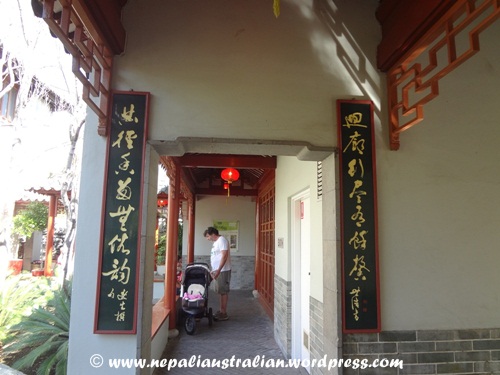
Last weekend, we went to visit a hidden treasure of Sydney, in the middle of the city in Darling Harbour.

Initiated by the local Chinese community to share their rich cultural heritage and celebrate Australia’s 1988 Bicentenary, the Chinese Garden is the result of a close bond of friendship and cooperation between the sister cities of Sydney and Guangzhou in Guangdong Province, China. The Chinese Garden of Friendship was designed by Sydney’s Chinese sister city, Guangzhou.

Even though I have been living in Australia for so long I have never been inside the Chinese garden. I have walked past the garden numerous times but for some reason never thought to go inside. Last weekend the weather was so good that I and my husband decided that we must go out and enjoy the sunny day. So we took a train to the city and walked to Darling Harbour from Town Hall train station.

We were in the garden by 11am and there were only 3 people on the queue to get tickets to go inside. We got the ticket and it cost us just $6.00. We started our tour from the right hand side door of the garden.

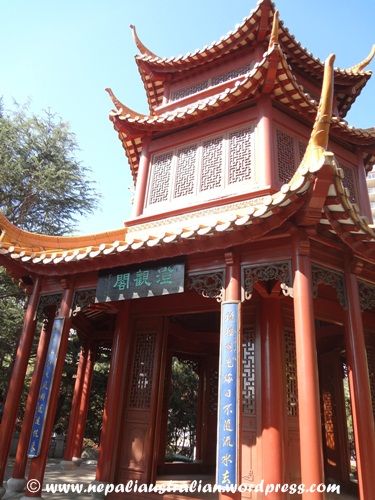
The whole garden cannot be seen from any one point within the garden. It has a number of features including the Dragon Wall symbolizing the bond between New South Wales and Guangzhou, the Water Pavilion of Lotus Fragrance, the Twin Pavilion and The Tea House that offers traditional Chinese tea and other refreshments. The garden is a popular venue for weddings, providing many beautiful backgrounds for photographs.

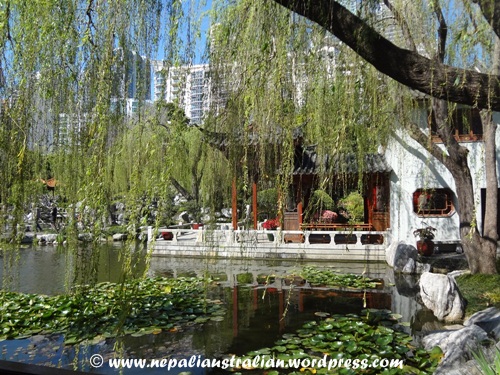
We were there to enjoy the day so we just walked around the garden and enjoyed the sun taking photos from time to time. There was a big pond in the middle of the garden and it had big colourful fishes. I actually forgot that we were in the middle of the city once we were inside. As spring has started here, there were so my beautiful flowers in the garden. I just loved everything in it: the trees, well-trimmed plants, beautiful spring flowers, calm lotus pond and the magnificent temple.

It was peaceful, serene, beautiful and calming. There is a waterfall which gives the feeling that you are in some national park. There are some alcoves to rest and overlook the whole garden to just soak in its natural beauty. We took so many photos as wherever I turned there was a beautiful view. The garden isn’t large but there are plenty of places to sit and take in the views. It took us about an hour to meander through the garden.

We saw a beautiful bridal carriage which is the imperial bridal carriage was used by Chinese Emperors in ancient times with extremely ornamental decorations. The jade carriage is typical of the historical carriages of past dynasties. It is believed 100 skilful artists were engaged in the laborious and intricate carving work. Over 300 tons of raw jade were used, the finished weight approx. 2 tons.

The carriage has a canopy decorated with entwining dragon motif with two lanterns in front. The main body of the carriage is carved into elaborate openwork of dragon, phoenix and fairies which are the symbol of Luck, Prestige and Authority. The two front shafts are cut as two lively charging dragons, guiding the carriage. Behind the carriage are two ornamental fans, which symbolise Royal Dignity.

The age and the cost of the carriage are unknown, however it is believed the carriage came from the Chinese Province of Guangdong and it is said to be the only carriage known to be outside China.

As we were walking around we saw a few people wearing traditional Chinese costumes and taking photos so we decided to find out more about it.

We found a place in one corner of garden where you can hire a costume for $10 and pretend to be a Princess/Queen/Emperor/Empress. They let you roam the garden with the costumes as long as you like and parade around the gardens and take as many photos as you like.

So me and AS decided to dress up as well and become Chinese for a while. I choose a red dress and the lady in the shop helped me to do my hair. AS choose a dark blue one and even got a long white beard to try with his costume. This was one of my favourite photos of the day.

Once we were dressed, the lady from the shop took a few of our photos. From there we walked the whole garden taking photos in different locations. We felt like we were in some movie walking around in the costumes and taking photos. Lots of people stopped to look at us and a few even asked us to pose so they could take a photo of us :). It was a really interesting experience to feel like we were in China.

I saw two girls wearing the costumes so we took photos with them as well. It was so much fun. I really loved it.

If you feel hungry there is a teahouse. You can also hire a 45-minute audio tour in English and Mandarin, if you like.

For the price, we had an amazing day, relaxing and wonderful.
Nepali Sel – roti (Crispy Rice Donut)

Dashain, the biggest festival of Hindu in Nepal, is just around the corner so I decided to learn how to make Sel roti, a speciality of the festival.  Dashain is celebrated for 15 days in Nepal. Sel can be eaten as a snack by itself or together with some side dishes if you like, such as aloo ko achar. Last Dashain I bought them $2 a piece so this time I wanted to make my own 🙂

Ingredients

  • 2 cups rice flour
  • 1 cup plain flour
  • 1 cup rice soaked overnight
  • 5 tablespoons sugar (add more if you like sweet)
  • 2 cups vegetable oil for deep frying
  • ½ cup ghee (clarified butter)

Steps

  • Wash and soak rice overnight, drain excess water and grind into a semi coarse paste.

  • In a bowl, add ghee and sugar.
  • Using electric mixer, mix it well and slowly add rice flour and plain flour.

  • Add all the rice paste to the mixture and mix it well using hand.

  • Leave the batter for few hours in the fridge.
  • Heat oil in a deep pan, making sure the oil is not too hot.

  • Clean an empty water bottle and cut into half so it will be like a funnel. (Use funnel if you have but I didn’t so I used empty water bottle.)

  • Put the mixture into the funnel and carefully, pour batter into oil into a doughnuts shape

  • Once it comes to the surface and is golden brown at the bottom, turn it over and cook for one minute on the other side.

  • Use wooden chopsticks to turn the Sel if you have one so that the Sel doesn’t break.

  • Once both sides are crispy and golden brown, remove from the oil and place on paper towel until ready to serve

  • Repeat with the rest of the mixture

You may also like :

*Yomari *Momo *Aloo chop

Guest Post : My Thai-Australian Relationship

I first came to South-East Asia in 2011, seeking an escape from the trappings of western life. Finding myself preoccupied with television, junk food and long hours at my dead-end job, I needed a new lease on life. Backpacking South-East Asia was always a dream of mine, so it seemed like the best exit strategy from a life of dis-contentedness.

In my first month in Asia, I met my fiancée in Chiang Mai, Northern Thailand. From what was a purely platonic friendship for 6 months, we eventually entered into a romantic relationship and have ended up in her hometown in Southern Thailand, on the Malay Peninsula.

We haven’t encountered too many hiccups in the first year of knowing each other, but there have been a few misunderstandings along the way.

I am a westerner. I enjoy my alone time, I appreciate my independence and my ability to choose things the way I want. This is not always compatible with Thai values, for instance, sometimes family members will drop by unexpectedly and it will turn into a whole day affair. Or I will go to visit my fiancé’s village for a ‘few hours’, which turns into all day, and then I feel cheated a bit, because I find my time precious and want control over how I spend it.

Communication too, can be a problem. My fiancée speaks English beautifully, but that doesn’t mean that she will always convey her thoughts to me clearly. Sometimes, if she wants to bring up a touchy subject, she will beat around the bush, by providing me with an example. Like, she will say “I wonder how much time couples should spend together, maybe you should read about what’s normal for couples in terms of time spent together’, when what she really means is “you are not spending enough time with me”. I think this is the conservative Thai values coming through, where she cannot always say something directly to my face, but it’s hard for me to understand what she wants me to do.

The dowry, or ‘sin sot’ as it is known in Thailand is also something foreign to me. Unlike in Nepal and the rest of South Asia, where the bride’s family gives money to the groom, in Thai culture it is the other way around. So, I have been feeling pressure to save money, in order to provide a dowry that is acceptable in the eyes of her family. Failure to present a large amount of money at the engagement party will bring shame upon the bride’s family. The concept is quite foreign to me, as there is usually no exchange of money between the bride and grooms families in your typical Australian marriage, but I do love Thai culture and I must respect its customs.

Things are not always easy for my fiancée either. Sometimes I crave western food, which does not taste great by her standards, but she does not complain about going to western restaurants when we have the opportunity.

I don’t have the capability to suppress my emotions the way the Thai’s do. When I am angry or upset, I tend to let it show, and this is something that Thai people really try to discourage, instead preferring to give off the image of a cool-mannered person. I think it makes her feel ashamed to see me carry on, but it is a part of the way we express our discontent in the west.

Even though we do have those negative aspects to our relationship, the majority of our time spent together is fun. We spend nearly 24 hours a day together, 7 days a week. We trade books with each other, we send cute photos to each other through Facebook and we make sure to spend time with each other to wind down at the end of a busy day.

At the end of the day, everyone is human and no matter what we are more alike than we are different, regardless of nationality. My dream is that our children will have the best of what both the East and West has to offer in terms of ideas, customs and culture.

This has been a guest post from Archie Ward, why not check out his blog dedicated to travelling Asia and digital marketing .

Please click here if you are interested to write a guest post for me.