Category Archives: Nepali Culture

My nephew’s Pasni Puja

As I told you before the main reason we went to Nepal this time was because my nephew was having his Pasni ceremony. My brother, SIL and the little one had gone to Nepal a week before us to prepare for the ceremony. Me and AS landed 10 days before the ceremony and all we did until the ceremony was to prepare for it.

AS I am married now we need to take gifts for everyone which included little nephew, my brother, my mum, my aunty and uncle (they being the head of our family) as well. So we were shopping for the first 7 days straight.

Also my mum and SIL had to give saris to all our relatives so I went with them to buy the saris. Saris seem to be so expensive so we had to increase our budget significantly to get the type of sari we wanted. After going to a few saris shops, finally we were happy with a sari and luckily they had 35 pieces of them so we just took them all. Also we needed to buy Pasni outfit for the little one which took another hour as there were so many choices.

sari

We went to many shops and after many days we managed to buy everything we needed for the ceremony. As I was living at my new home, I needed to go to my parent’s house whenever required to help my parents to organise the ceremony which kept me busy as well, traveling back and forth.

I also ordered a sari for myself in a boutique for the party. I went to many boutiques in Kathmandu and they were all pricy but they didn’t have what I was looking for. Luckly I found a small boutique in Kupondole who were happy to make what I designed. So I ordered my design and was pleased to get the sari that I wanted. The price was really high but as I got what I wanted, I was happy at the end. 🙂

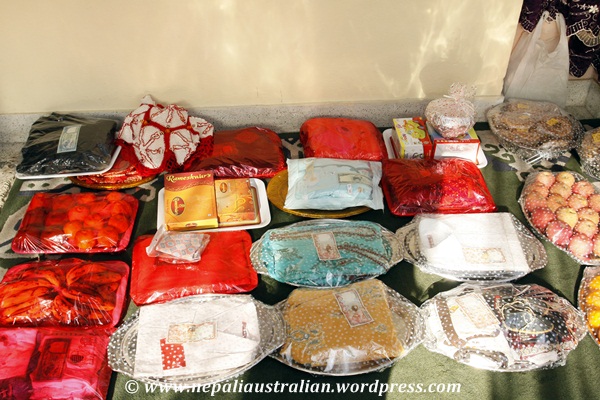
Once everything was set at my parents end, it was my time to help my MIL for the ceremony. We needed to take Sagun (eggs, bara, chicken, fish, yogurt) for the day along with gifts from my new home. So the day before the ceremony, the whole day I and my MIL were in kitchen making bara, chicken, fish and other items. We also went out and bought rotis and fruits.

My BIL and AS helped to wrap all the trays beautifully with wrapping paper and bows.

my nephews's pasni (1)

Finally, the morning of the Pasni ceremony, me and AS left for my parents’ house early in the morning to help around. My in-laws were coming in few hours later.

When I reached there, most of our relatives were already there. Everyone seemed to be busy doing one thing or other.  I help my mum and SIL to get ready.  The auspicious time (saayit) chosen by an astrologer for Pasni was 9.45 am so around 9.30, the priest started making preparation for the puja.

my nephews's pasni (10)

This puja is performed so that baby can taste all kinds of food. Although this is a centuries old tradition, modern science has also established the fact that child’s digestive system is capable of processing solid food when they are approximately 6 months old.
pasni puja

my nephews's pasni (19)

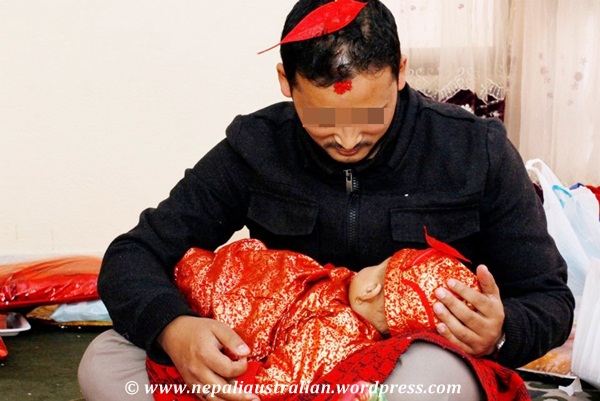
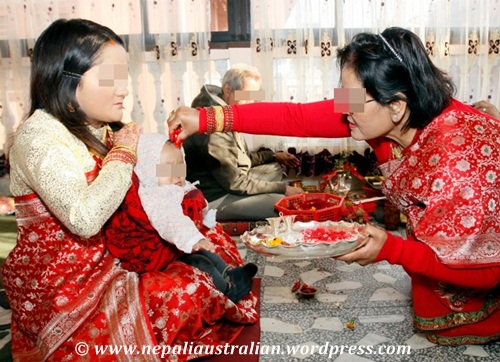
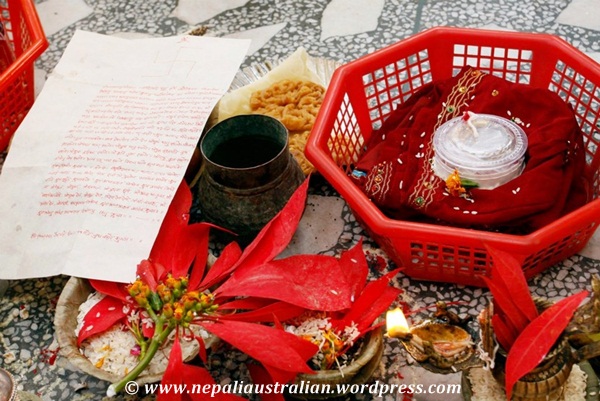
Normally, the baby needs to have a bath but as it was winter, we just cleaned the little man and he wore new cloths. He sat in his mum’s lap with his dad beside her and the ceremony began. My aunt started the puja with the help of the priest. The first step was to worship Lord Ganesh and sukunda and all the gods. Then she put tika on the forehead of the baby, and he was given a special outfit which was made of silk in red colour (Taas) embroidered with golden threads along with gold ornaments like chain, earrings, bangles and silver ornaments like anklets (kalli) carved with dragon at both the ends to keep the bad omens at bay.
my nephews's pasni (18)

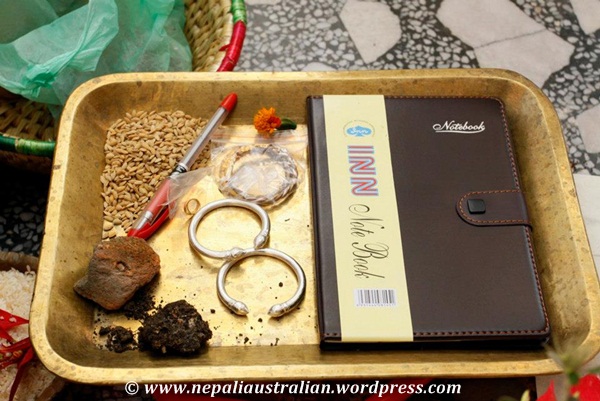
 He was also given a tray of stuffs like books symbolising learning, jewels symbolising wealth, a pen symbolising wisdom, clay symbolising property, food items symbolising a love for food. When the tray was given to him, the first thing he touched was a book so we are hoping he will be a big scholar one day.
my nephews's pasni (20) my nephews's pasni (16)

The priest asked the baby to be changed into the special outfit so I helped my SIL to change the baby into the red Taas outfit. He was really happy to play with us while we were changing him. We also put golden chain, bracelets and anklets on him but he cried a lot when we exchanged the earing he had on, on his recently pierced ears with the gold earring. I felt so bad that he was crying because it hurt but after a while he was ok.

my nephews's pasni (17)

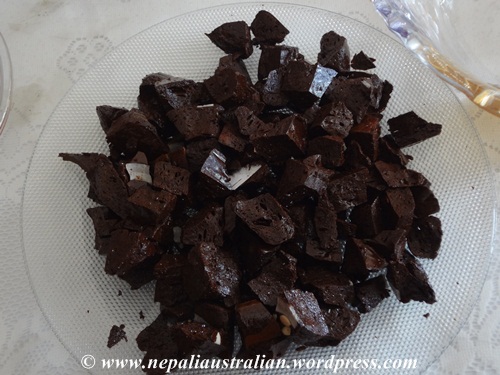
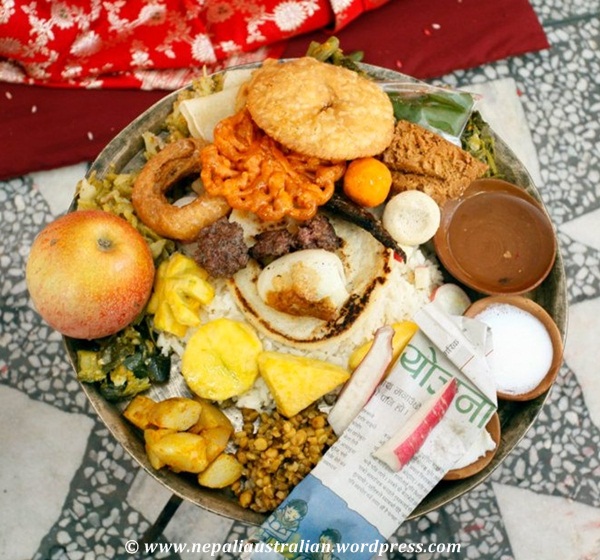
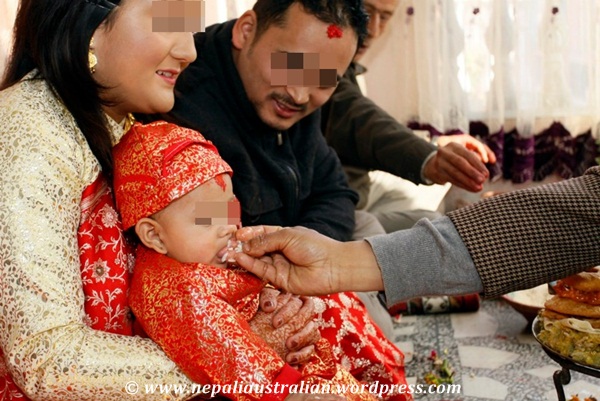
Again, my nephew, SIL and my brother sat down to continue the puja. The next step was to feed him his first solid food. As per our newari custom, it was Thaa Bu (Big plate with rice, eggs, yogurt, wine, fruits, Roti, meat, fish, vegetables and much more). Of course the little one is not going to eat everything but he got to taste salty food for the first time.
my nephews's pasni (14)

my nephews's pasni (12)

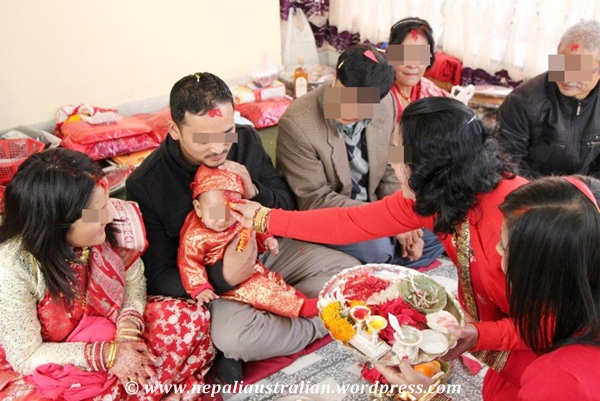
After that it was my parents turn to feed the baby. Then it was my turn to give sagun. By then my MIL had arrived with my FIL. So I helped my MIL to give sagun to everyone. All the work we had done was for that moment. We stared with my nephew followed my SIL, my brother, my aunt, my uncle, my dad and my mum. Then we gave sagun to all the family members. We also gave the clothes we had bought for everyone.
my nephews's pasni (9)

???????????????????????????????????

Then my SIL’s parents gave their sagun followed my aunties and other family members. Everyone gave my nephew clothes and jewelleries. Once everyone was done, my SIL’s maternal uncle put tika and garland on the baby and took the baby from my SIL.

my nephews's pasni (15)

my nephews's pasni (21)

Everyone took some sindoor, rice and flower and threw it towards my nephew so the maternal uncle could now take the baby outside for a temple visit. With the help of the priest, we took the baby to all the nearby temples and did some puja. It took almost an hour so when we came back home, the little one was so tired, he was fast asleep.

my nephews's pasni (23) my nephews's pasni (22) my nephews's pasni (11)

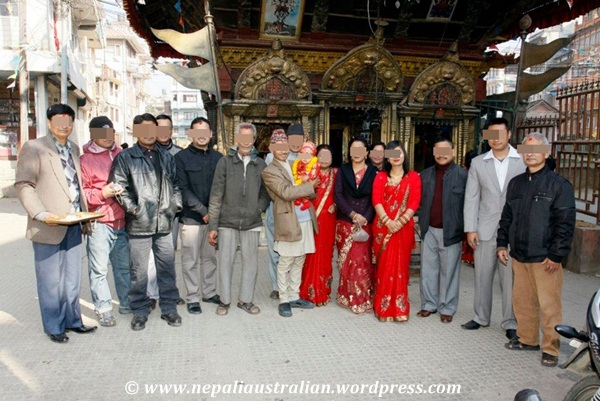
By the time we returned home, lunch was ready in the party place nearby so all of us went there for lunch. Before the lunch, we took family photos and lots of photos of the little man. He looked amazing in the red outfit and was smiling a lot enjoying his big day.

??????????????????????????????????? ??????????????????????????????????? ??????????????????????????????????? ???????????????????????????????????

My parents and my SIL’s parents were really pleased to witness their only grandson’s pasni in Nepal.

By the time we finished eating. We had less than four hours left for the guests to arrive for the Pasni party in the evening. I will write more about the Pasni party in my next post.


Update from Nepal Part 3

Skinny and photogenic

90% of the people I meet in Nepal told me that I am too skinny and I need to put on some weight. I am not underweight so I am happy with it and as you all know I try very hard with exercise and healthy food to maintain my figure but most people in Nepal have their own ideas about my weight.

IMG_2614

In the beginning I used to get annoyed about it but now I am so used to it that I ignored all these comments with a smile :). Also if you look around Kathmandu, most gals are either similar weight like mine or even skinnier than me so I have no idea why they think I need to put on weight. I have a feeling being married is one of the factor.

Anyway I am learning to just ignore and concentrate in good eating habit no matter what people say. Also AS is on my side telling me I am OK and we just need to concentrate on being healthy. I am very happy to have such a wonderful hubby who understands me so well. But I think he has an ulterior motive as well. He doesn’t want me gaining weight and buying more clothes as I won’t fit into my current ones then 🙂

Most of the people especially from AS’s side has seen me only during the wedding. That time I was a bride so I was fully made up in the traditional attire. After the wedding, lot of his relatives added me on their Facebook. So that is the only way they have seen me in causal dresses.

Anyway, I have heard from lot of his relatives that I am photogenic. I am not sure I should take that as a compliment or not. I am just wondering because, normally I think photogenic means I look good on photo but at the back of mind I was wondering, does that mean I don’t look good in person.

Anyway I got that comment from many people so just sharing what’s on my mind here 🙂

Maghe Sankranti

According to Nepali calendar, it was Maghe Sankranti (1st of Magh) a few days ago.  Please click here to read more about this festival.

As I am married now, I was invited to AS’s grandparents house to celebrate the festival with my in-laws. AS missed the occasion but I was glad I was there as I got to meet all his relatives again.

As I mentioned in my post, this day we eat laddoos (sesame seeds candy ball), chaku (molasses), ghee (clarified butter), sweet potatoes, yam, khichari (mixture of rice and lentils), ginger and salt  and green leaf spinach. So a big feast was ready in the house when we got there.DSC04802DSC04800DSC04799

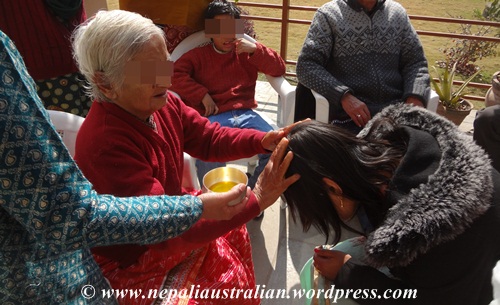
First his grandma put mustard oil on our head and blessed us then we all enjoyed the food. It was fun catching up with my new family.

DSC04779

After a few days of Magh 1, AS’s Mama (Mum’s brother) also invited us for Maghe Sankranti. In Newari culture normally, daughter’s family invites SIL, daughter and their kids after the festival as nakhatya (festival invitation in newari) to celebrate the festival.

DSC04803-tile

I got to meet more family members in this function as well. As you must have guessed,there was a feast prepared which included laddoos, chaku (molasses), ghee (clarified butter), sweet potatoes, yam, khichari, green leaf spinach and many more  dishes. .

Ma fussy chu ( I am fussy)

Sometime words have two different meaning in different languages and I got caught into that recently.

The other day I was in a departmental store trying on few make-up items. The sales gal was doing her job well convincing me to buy something so in reply I said, “ Ma fussy chu ( I am fussy), so let me think about it.” But she understood completely different thing.

Fussy (pronounced Fashi ) means con in a gentle way in Nepali language. So she thought I was telling her that she tried to con me into buying something else. For a minute I didn’t understand her reply as it was out of context when she said, “Don’t worry I am telling you the truth” but after a while I understood that she thought I thought she was conning me into buying something different.

Now I think before I say something as it might have a different meaning here.

Pasni Party

While AS was here we were invited to a Pasni of one of our friends’ kid along with my parents. They live in Sydney near us but they came here to host the function like my brother. It was nice to go to this function and enjoy Nepali way of socialising. I met a few friends and relatives in this function because in Nepal, somehow everyone seems to be related. 🙂

4994_10151470613096833_1587926127_n

Wedding party experience

I am writing this as my own experience and have no intention to disrespect any caste.

As I have told you in my post here, Nepal is a country of four castes and thirty six sub castes which means all of these castes have their own tradition and rituals.

I am from Newar caste and in our culture wedding parties goes till late at night. It is common to see Newari party starting around 6 pm and finish at 12 midnight but other castes like chhetri or bhaunu may have wedding parties that start in the afternoon and finish a bit early like 6-7pm.

One of my friends (a chherti by caste)  had invited me for his sister’s wedding. He asked me if I needed a physical invitation card but I said it’s OK as I didn’t want to bother him. So I went to the party hall where he had told me in that day with one of my cousins.

When we reach the hall, the hall was almost empty so I thought either I mix up the day or the venue. But as I entered, I saw my friend. It was 7 pm at most but there were only a few people left there. Even the bride and groom had left as they had to travel few hours to reach their home.

He informed us that the party was almost over. I was a bit embarrassed because I didn’t know what to say. I had tried to contact him earlier to find out the details but he was unavailable as he was flying in from the US the same day. Even my mum had reminded me to check the time but I just assumed that it would be same as ours but I was so mistaken.

I was happy to meet my friends after a while but it was a bit embarrassing situation and for the first time in my life I reached a party when it was almost over.

Latest update

I am having a great time with my parents. I am spending lots of time with them talking and having a great time. We have been to many temples around Kathmandu which I will post details of later. I am really glad that I extended my 2 weeks holiday to spend with them as they are very happy to have me here and I am very happy to be here.

I still miss AS a lot but I will be seeing him soon. We talk on the phone or Skype everyday so I am happy to be in Kathmandu in my birth home.

Take care everyone till my next post.
Makka Ku

We are still celebrating our wedding after more than 1 and half years. I am still a new bride wherever I go :). While I was living at my new home a few weeks ago, my mum following tradition and sent a Makka Ku (pronounced ‘mock-ka ku’).

Makka ku is a newar tradition in which during the first winter after the wedding, the bride’s family sends some items which are necessary for winter to the groom’s home. Makka means olden style charcoal heater but these days instead of makka, electric heater is sent to keep the newlywed couple warm during the winter, along with a full set of warm clothes for the bride as well as fruits, rotis, blanket, electric heater etc.

Makka ku (1)

As we were in Sydney during our first winter, this winter was perfect time for my parents to follow the rituals for the Makka Ku.

Makka ku (5)

My aunt, my cousin along with my brother came to my new home with sweets and roti like anarsa, fini, laakhamari, ladoo, saun papdi, fruits: like oranges, mandarin, bananas, sugarcane, apples, masala: like cashew, almond and chocolates along with snow peas, yogurt, peanuts, sari, pashmina shawl, shoes, bag, electric heater and a blanket.

Makka ku (4) Makka ku (3) Makka ku (2)

It was a great day for me as I was so happy to celebrate our wedding again as this was one of the best decisions of my life and I am very happy to see both the family very happy with our union.

Makka ku (6)

It was a good time for both families to meet and chat. My family came and sat down with my MIL, AS and BIL and had a good conversation. They also checked out our wedding album which my MIL had made for the house.

Makka ku (7)

I had baked blueberry muffin that morning for tea so we started with tea and muffins and it was followed by Nepali feast for my aunt, cousin and brother. My MIL cooked the feast and I was the helper all morning in the kitchen preparing for the day.

Makka ku (8) Makka ku (9)

After lunch my family left and Makku Ku was concluded. As I told you before, in Nepalese wedding the bride is always the winner and it was true for this function as well as I got a full set of new outfit :).

For details and photos on our wedding functions please click the following links.

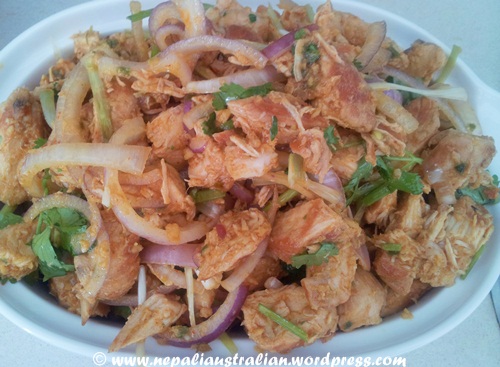
Chicken choila / chhoela / Choila

I learned this recipe from my BIL (K didi’s husband). He is one of the best cooks around us and he loves cooking. I am sure it is true when they say that when you cook with love, it tastes better. He does put lots of time and effort in his cooking as well.

Ingredients

  • 500gm boneless chicken
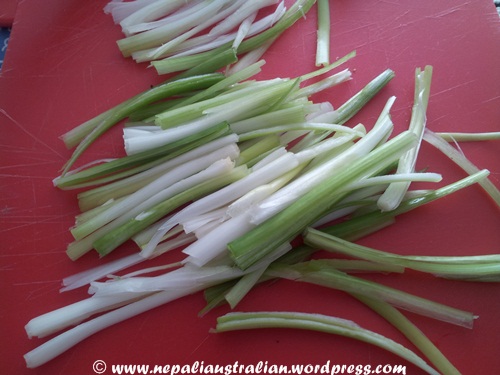
  • Few stems spring onion
  • 2 small green chilies
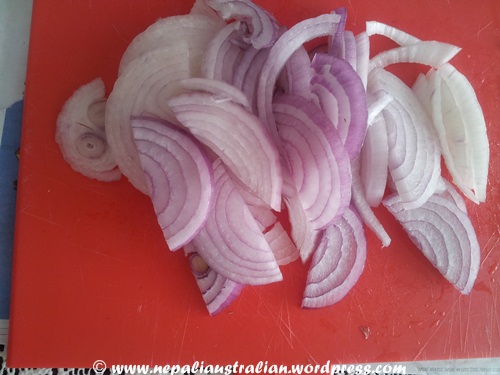
  • 1 red onion finely sliced
  • coriander leaves
  • 5 cloves of fresh garlic
  • 2 inch on fresh ginger
  • 1 teaspoon turmeric powder
  • 2 teaspoons chili flakes
  • 1 teaspoon chili powder
  • 5 tablespoons vegetable oil
  • 1 teaspoon fenugreek seeds (Methi )
  • salt to taste

Steps

  • Cut chicken breast into thin layers.
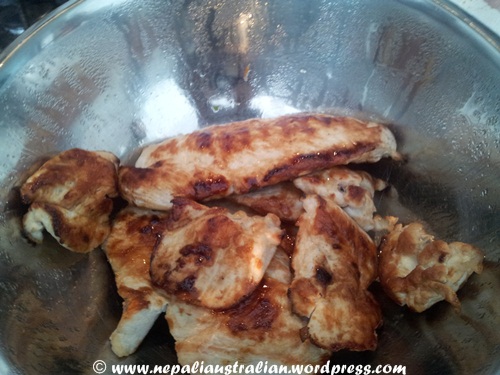
  • Heat the non-stick frying pan and sauté the chicken until cooked.

  • Cook on both side and make sure, the chicken doesn’t get burnt.
  • Once both sides are golden brown, repeat the process with all the chicken.

  • When you are doing this in batches, make sure you cover the cooked chicken in a container so it doesn’t become dry. This will also make the chhoela juicy and tender.
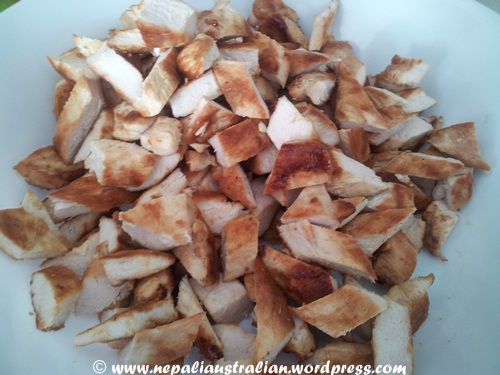
  • Once all the meat is cooked let it cool down for few minutes, slice the chicken into small diagonally into inch size pieces so it looks better for the presentation. Put all the meat in a big bowl.

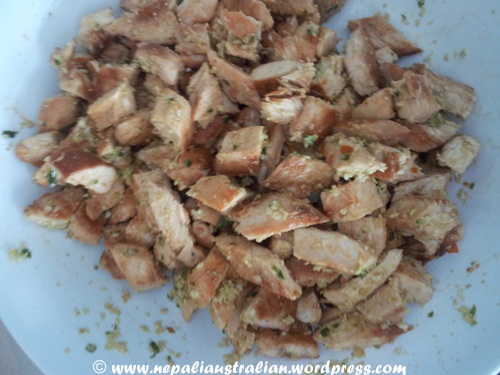
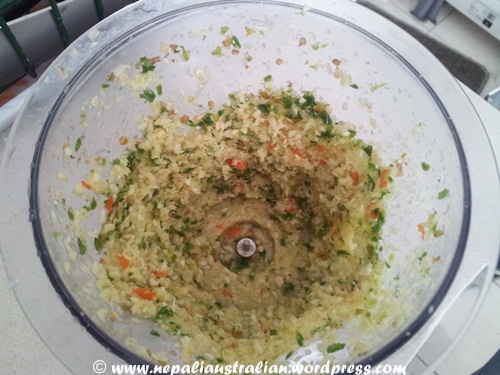
  • Make a paste in the blender using fresh garlic, fresh ginger, fresh chilli and fresh coriander. If you don’t have fresh ginger and garlic, you can used readymade paste but fresh always tastes better.

  • Then add this paste along with sliced onions, chili powder, cumin powder, coriander powder, chili flakes, turmeric powder and salt into a bowl with the chicken. Mix it well.

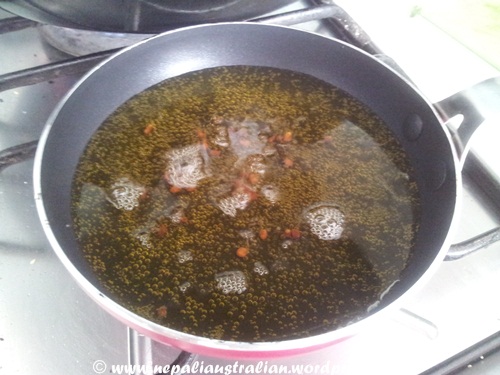
  • Now heat up the pan, add oil and fenugreek seeds and fry it till it turns dark brown. Make sure it doesn’t burn and turn black otherwise it will have a bitter taste.

  • Pour the oil over the chicken and mix it properly.
  • Cut the stem of the green onion into about 2 inch long sizes. Slice it into thin slices and add it to the chicken.

  • Add finely sliced red onion to the chicken

  • Garnish with fresh coriander and Chicken chhoela is ready to be served!

You may also like :

*Chicken chili *Goat curry *Momo

Dashain

Dashain is the 15 day Hindu festival celebrated in Nepal. It is the longest Hindu festival and it falls around September – October, starting from the bright lunar fortnight and ending on the day of full moon. Dashain is also popularly referred to as Bada Dasain, Dashera, Vijaya Dashami etc.

This year Dashain starts today, 16 October which is Ghatasthapana (Literally pot establishing). Ghatasthapana is the first day of Dashain and it is the day in which Jamara is planted on a pot or Kalash. The other important days for the festivals are Day 7 called Fulpati (21 October), Day 8 called Maha Asthami (22 October), Day 9 called Maha Nawami (23 October) and Day 10 called Dashami (24 October). The festival ends the 15th day with Purnima, full moon.

Every year Nepalis, remember the message “Good always wins over the evil”, with the celebration of the great festival of Bada Dashain.

Legend behind Dashain

King Ram Chandra, whose wife Sita was kidnapped by King Rawan, with the help of hanuman and its military, conquered Rawan on the tenth day, after regular worship of Durga Bhawani for 9 days. The 10th day is the victory day. We put tika on our forehead as prasad of the victory.

Another legend goes like this.

Demons, or Asuras, became very powerful and ambitious and continually tried to defeat the Devas, or Gods, and capture Heaven. One Asura, Mahishasur, in the form of a bull, grew very powerful and created havoc on the earth. Asuras started defeating the Devas and chasing them away from the heaven. The world was crushed under Mahishasura’s cruelty; the Devas put their energy together and form Shakti, a single mass of incandescent energy, to kill Mahishasur.

A very powerful band of lightning emerged from the mouths of Brahma, Vishnu and Shiva and a young, beautiful female virgin with ten hands appeared. All the Gods gave their powers and special weapons to her. This Shakti blended to form the goddess Durga. Riding on a lion, Durga Bhawanu fought Mahishasur. The battle raged for nine days and nights. Finally on the tenth day of Ashvin shukla paksha, Mahishasur was defeated and killed by Durga. This is the day of celebration.

Day 1: Ghatasthapana

Ghatasthapana marks the beginning of Dashain. It literally means installing a pot which symbolizes Goddess Shakti. In this day, Jamara is planted establishing the holy Kalash vessel, which represents the goddess Durga. Goddess Shakti is believed to reside in the Kalash vessel during the Dashain.

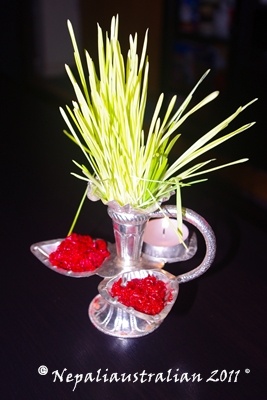
Today, everyone in Nepal will plant Jamara to mark the start of Dashain. Normally, Jamara is planted in Puja ghar (prayer room). Jamara pot is kept away from direct sunlight, and holy water is offered to it every day, so that by the tenth day of the festival the seed will have grown to five or six inches long yellow grass. This sacred grass is known as Jamara.

Today, before coming to work, I planted my Jamara as well :). It is the second time I have planted Jamara and I am hoping like last year, it will be a good one so I can use this for puja and tika .

How to plant Jamara

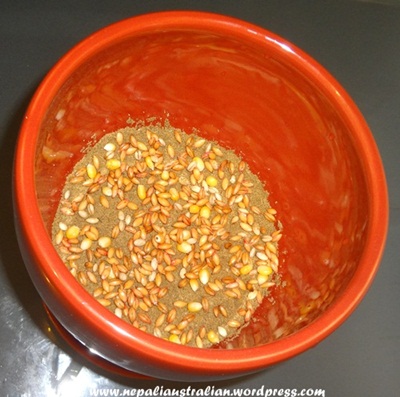
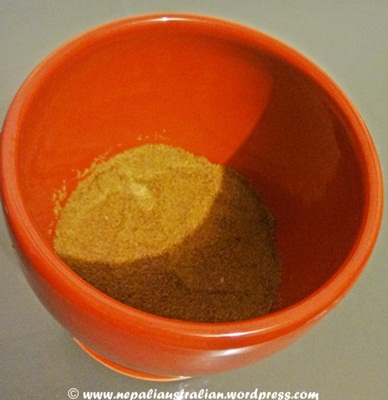
  • Soak barley seeds overnight. I used a Jamara mix (barley, corn, wheat) from Nepali grocery shop.

  • Get a deep bowl or container with a flat bottom. I am using a clay flower pot this year. Fill it with a layer of sand about 2 inches thick.

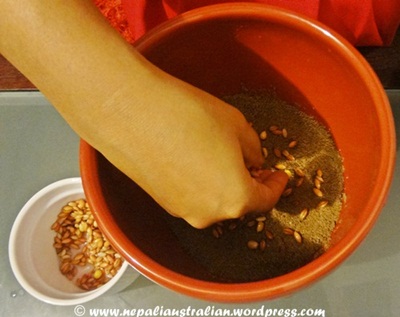
  • Sprinkle a layer of soaked Jamara mix into the container.

  • Make sure it is only one layer of the seeds so they have enough room to sprout.

  • Cover the seeds with a thin layer of sand.

  •  Sprinkle some water in the container. The sand should be moist, but not soggy.

  • Cover the container and put it in a dark corner, away from the sun.

  • Check the container daily to make sure that the sand is moist.

  • Your Jamara should be is ready for Tika.

Click here to see how Jamara looks like from my last year’s post.

If you are in Nepal, you will see lots of signs of Dashani which will remind you that the festival season is on.

Lots of kites in the sky

Flying kites has been a very important part of celebrating Dashain in the country as it is considered to be one way of reminding god not to send rain anymore. When I was a kid, we used to gather on the rooftop of the house and take turns flying kites. My brothers and his friends would be there and I would be there trying to learn how to fly kite. They used to teach me but most of the time I dropped the kite too low when I was taking control and one of them would jump in and take over  before someone could cut it in the sky, with so many kites fighting already.

When you cut someone else’s kite, you shout ‘Changa Chet‘ literally meaning Kite, cut! If we had a big group of friends we even used to take metal plates or metal buckets with metal spoons and bang them to make a loud noise to celebrate the Changa Chet. I know it might sound weird but it was lots of fun.
Ohoo, how I miss my childhood Dashain.

Kites are not only for kids but adults get into the spirit and have some fun too.

Everyone playing cards

Gambling is illegal in the Nepal but it is usually permitted in public places during this festival. While children are busy flying kites during Dashain, the older members of the family pass their time by getting together and playing cards with each other for money and fun all day long.

As a kid, I remember playing cards using 1 shuka (a quarter /25 paisa) and trying to win more money. It was so much fun to team up with the cousins and play it as a group. That is the only time we didn’t get scolding from our elder for playing cards.

 Everyone busy shopping for new clothes

I would never have thought as a kid I would ever own 100s of dresses or shoes in my lifetime. As a kid, Dashain was especially exciting as I got to buy new clothes along with a new pair of shoes which I could wear during the festivals. All of my friends used to gather during Dashain and show off our new dress and shoes 🙂

Buying and wearing new clothes is an important part of the festival. As many people are living in the villages below the poverty line and for them it is often the case that new clothes come only with Dashain. Almost all the shops in the country have festival offers and discounts. This makes shopping even more attractive to people. Clothes have the highest sales during the festival.

To get into the Spirit of Dashain, we went shopping last weekend and I bought two dresses and a pair of shoes. My husband bought a jacket and a few t-shirts :). I am wearing my new dress today so Dashain has already made an impact in our lives.

Swings everywhere

During Dashain, bamboo swings are constructed a week before Ghatasthapana in many parts of the country as a way of celebration. These bamboo swings are called ‘ping’ in Nepali. These kinds of swings present the best of local culture, tradition, community spirit and fun.

These swings are constructed with the help of community members using traditional methods which make the use of ropes made from tough grass, bamboo poles and wood etc. Theses swings are dismantled only after the festival of Tihar which is 2 weeks after Dashain.

The heights of some swings exceed twenty feet and one can swing really high. One can see people of all ages enjoying the swing. It is especially famous with the children.

I used to love these swings. It goes so high that the adrenaline kicks in. I used be a bit scared to get on at first but once you are on it, it is a great feeling. I am sure these kinds of swings won’t be allowed in western countries as it will be consider a health hazard as it doesn’t have any safety harness 🙂

Dashain Fairs everywhere

Different kinds of fairs are also organized during the festival. Usually small fairs are organized in the villages with the Ferris wheels for children and other items of entertainment for the adults. However, in the city it is the commercial fairs and celebration events that are usually organized.

My memories of Dashain fairs are of Bhrikuti Mandap Dashain Mela. My parents used to take my brother and me there and we were allowed to buy treats. They had concerts, dance shows, magic shows, family games, Band competitions, games, food, and a lot more. They also had stalls with goats, chickens, ducks etc. and great for people who want to buy animals to sacrifice for Nawami.

Also these days they organise lots of musical concerts during these festivities.

In Sydney, during Dashain there are lots of musical concerts with Nepali artists visiting down under to celebrate the festivals. Dashain festival and dance parties are also organised here to make merry and have a get together.

Animals slaughtered

This is probably the worst part of Dashain for me that thousands of animals such as buffaloes, ducks, goats, etc. are slaughtered during Dashain every year.

It is considered an important ritual since it is believed that the goddesses are appeased by such sacrifices. Almost all the temples, especially the temples of Goddess Durga and Kali  around the country are offered with thousands of sacrifices.

Asthami and Nawami are the days when the sacrifices reach their peak. While thousands of animals are sacrificed to appease the goddesses, people also slaughter animals for the purpose of feasts. Since a large number of feasts and gatherings are organized throughout the fifteen days of the festival, the demand for meat goes up considerably. Hence to meet the demands the slaughtering of animals becomes considerably high during the festival.

However, for the past few years the animal rights activists in the country have been continuously opposing these acts of slaughtering of animals in such a manner. They have been requesting people to stop such inhuman acts of killing the innocent animals and instead have suggested them to offer fruits and vegetables to the Goddesses since they believe that it is mentioned nowhere in the Hindu religious books that such sacrifices appease the gods and goddesses.

I do know that we need meat from animals but I still think it doesn’t need to be cruel killing of animals for the meat. I am sure there can be less violent way of killing animals for their meat.

As I am not into killing animals and also I can’t do that in Australia so I will be using coconut instead to mark Nawami. I will keep you posted about Dashain for the next 15 days.

A relaxed mind, a peaceful soul, a joyful spirit, a healthy body; be a heart full of love, may you have all these every day. Happy Dashain everyone!!!